A mental model to find systematically misvalued businesses
By Polymath Investor
Published: 2026-11-24
URL: https://www.polymathinvestor.com/p/i-like-when-companies-have-this
There’s a famous example of a man who cannot swim attempting to cross a river that is, on average, 3 feet deep. It seems perfectly reasonable. After all, the man is considerably taller than 3 feet. The problem, of course, is that in some parts the river is only 1 foot deep, while in others it is 15 feet deep. Based on the average depth alone, the man would have every reason to believe he could walk across.
In reality, he could not.
This is the essence of what Sam Savage calls The Flaw of Averages1, a concept rooted in a mathematical theorem formulated in 1906 by the Danish mathematician Johan Jensen).
Professor Savage has a wonderful catchphrase that captures the idea beautifully: “Plans based on average assumptions are wrong on average.”
I think this is a particularly useful mental model for fundamental investors because much of what we do when valuing businesses involves making assumptions about averages. We estimate normalized earnings, mid-cycle commodity prices, average utilization rates, and so on.
The problem is that businesses don’t always respond to changes in these variables in a linear fashion. I touched upon this idea last week, but today I wanted to get a little deeper into the weeds.

\Mean waters | Canva\
Curve Your Enthusiasm
Imagine you own a factory that can produce a maximum of 100,000 widgets per year. You make $10 per widget before fixed costs, and your annual fixed costs amount to $700,000. So at full capacity, you'd make $1,000,000 before fixed costs and $300,000 after.
Now, suppose there are two equally probable scenarios for next year: a pessimistic scenario in which demand is only 60,000 widgets, and an optimistic scenario in which demand reaches 140,000 widgets. What is the expected demand?
The arithmetic is simple. If you average 60,000 and 140,000, you get 100,000 widgets. Plug that number into your financial model, and you arrive at an expected annual profit of $300,000. All good, that’s the number we had from before, so it makes sense, right?
Some of my more astute readers may have already spotted the trap here, but let’s calculate what actually happens in each scenario.
In the bad year, you sell 60,000 widgets and lose $100,000 ($600,000 before fixed costs, less $700,000 of fixed costs). In the good year, demand reaches 140,000 widgets, but since you can only manufacture 100,000 (assuming no inventory), so you end up making a profit of $300,000.
If you average the outcomes of these two equally probable scenarios, your actual expected profit is $100,000, not $300,000 as in our first calculation! In our original model, we overestimated expected profits by a factor of three, even though our demand forecast was mathematically correct. I find that quite remarkable.
You can see this clearly in the figure below.
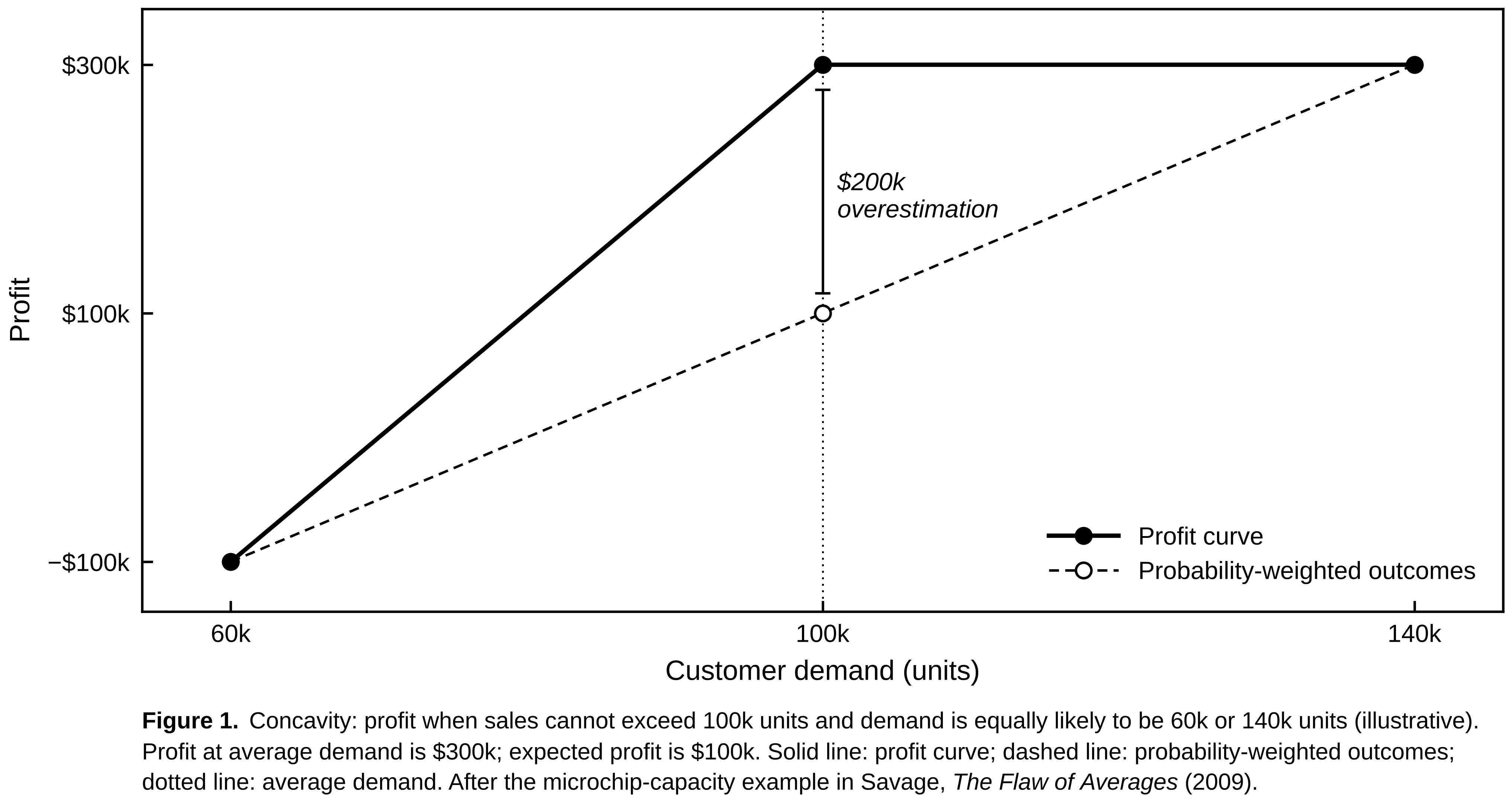
In mathematics, this is called concavity. In economic terms, what interests me about this phenomenon is that the business suffers the full consequences of unfavorable outcomes but cannot capture the full benefits of favorable ones.
You can find similar dynamics in hotels, airlines, semiconductor foundries, regulated utilities, and businesses selling perishable inventory. Once you start looking for this phenomenon, you begin to see it everywhere.
Financial leverage introduces another, potentially more destructive, version of the same problem. A company might comfortably service its debt under average economic conditions, but a sufficiently bad year could trigger bankruptcy.
I touched upon this idea in a previous article. After all, shareholders cannot compensate for bankruptcy by enjoying a particularly profitable year afterward.
Uncertainty Is Your Friend
Now, let’s reverse the situation. Imagine you own a copper mine capable of extracting 1 million units of copper annually at a cost of $10 per unit. There is an equal probability that copper will trade at $6 or $18 next year. The expected price is therefore $12, which, if you plug it into a standard financial model, translates into an expected annual profit of $2 million.
Now suppose management has the ability to suspend production at virtually no cost. Of course, this is somewhat unrealistic given the fixed costs, maintenance expenses, and other costs associated with shutting down a mine, but bear with me for the sake of the example.
When copper trades at $6, management can simply suspend production rather than extract copper at a loss. Profits in this scenario are zero. When copper trades at $18, management operates at full capacity and makes a profit of $8 million.
If we average the outcomes of these two equally probable scenarios, our actual expected profit is $4 million, twice what our original model suggested. This time, despite having a mathematically correct forecast for copper prices, we substantially underestimated the expected profitability of the business.
You can see this clearly in the figure below.
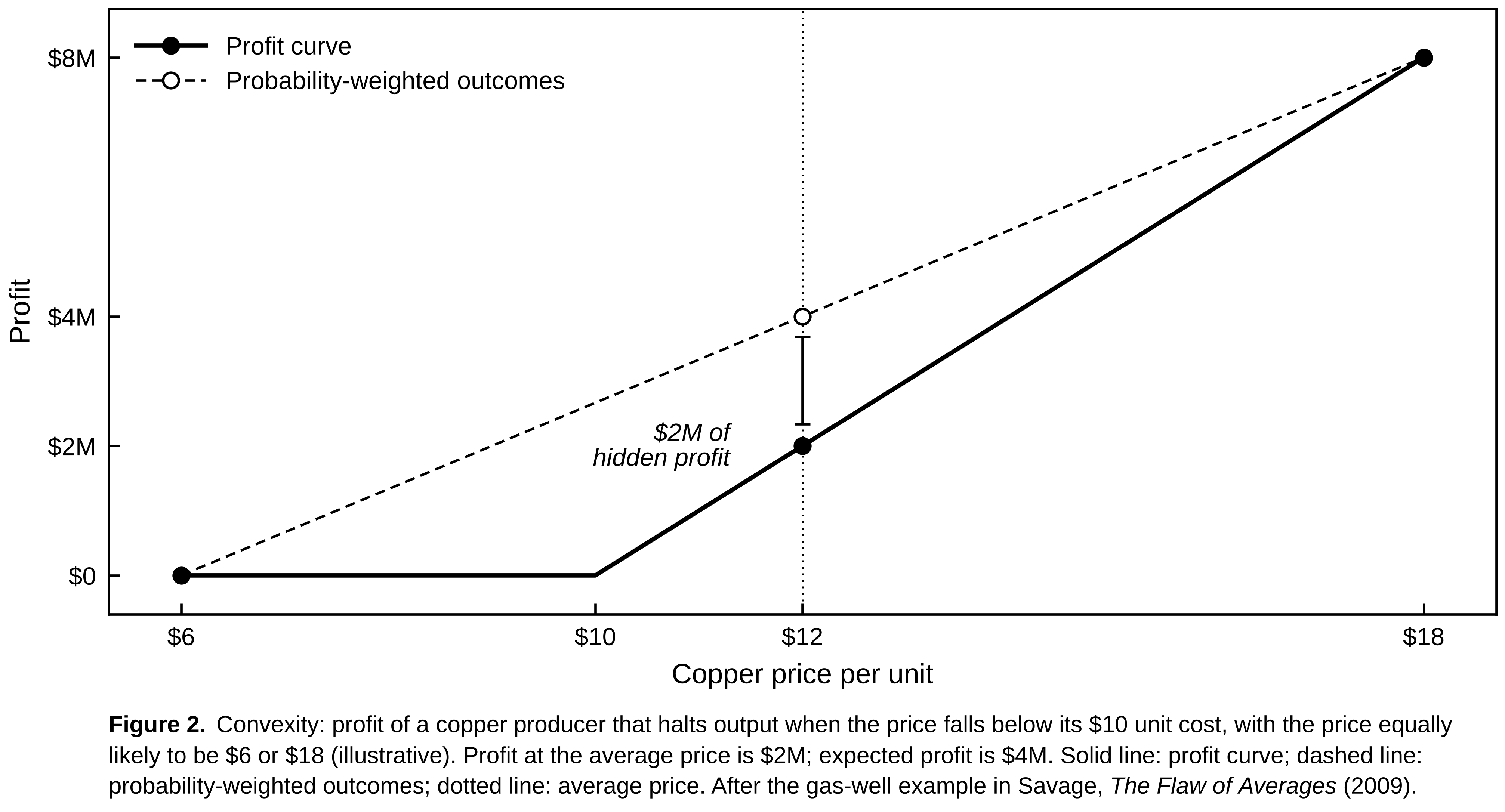
In mathematics, this is called convexity. In economic terms, what interests me about this phenomenon is that some businesses can protect themselves against unfavorable outcomes while retaining the ability to benefit from favorable ones.
That's the thing I like companies to have.
And this brings me to what I consider a particularly interesting mental model for fundamental investors: the ability to make a decision after uncertainty has been resolved has economic value in itself.
Think about:
- A pharmaceutical company that can abandon unsuccessful drug candidates before committing additional capital.
- A software company that can experiment extensively and inexpensively before committing substantial resources.
- A cash-rich holding company that can take advantage of attractive investment opportunities when markets collapse.
In all three cases, greater uncertainty can actually increase expected economic value.
Of course, we need to distinguish between real flexibility and theoretical flexibility. In practice, a copper mine will often incur substantial maintenance, severance, environmental, and restarting costs when suspending production. It may not, therefore, enjoy the attractive economics described in our hypothetical example.
Optionality is only valuable to the extent that it can be exercised economically.
The Shape of Things to Come
Regardless of how you go about valuing the companies you invest in, I think it’s worth spending some time understanding the shape of a company’s economic payoff under different scenarios.
Does the company benefit more from favorable surprises than it suffers from unfavorable ones, or is it the other way around? Where are the ceilings? Where are the floors? Where are the operational bottlenecks? Where are the financial cliffs?
You can see it more clearly in Figure 3 below.
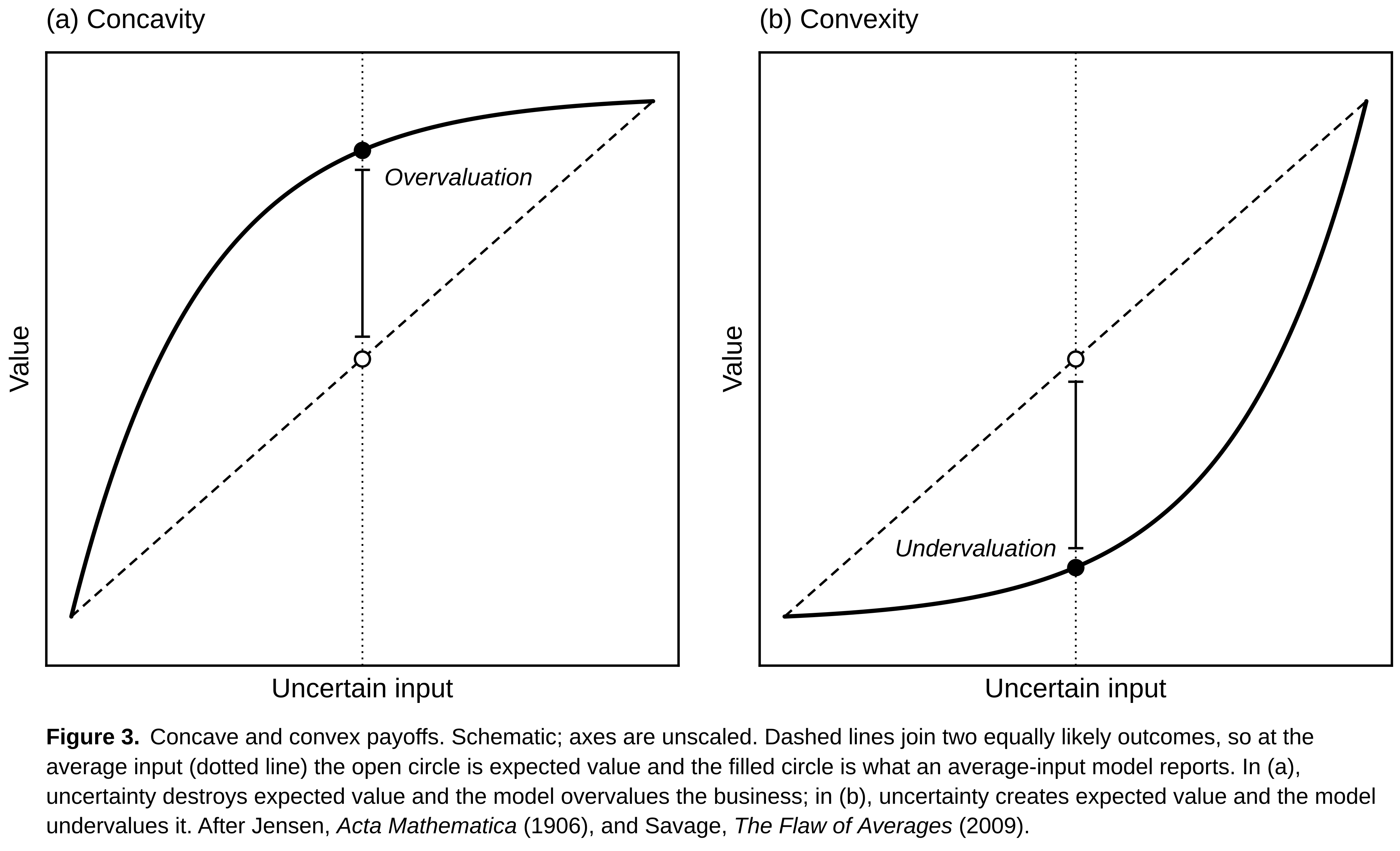
If you already have a financial model, a useful little heuristic is to look for anything in the company’s economics that would require a MAX, MIN, or IF function in an Excel spreadsheet. These functions often indicate that something changes once a particular threshold is reached. Think of a factory reaching its maximum production capacity, a company breaching a debt covenant, or a project becoming economically unviable. These are all points at which the economics of the business change, sometimes quite dramatically.
Whenever these thresholds fall within the range of plausible outcomes, we should resist the temptation to build a valuation around a single normalized scenario. As we saw in our factory example, averaging demand above and below production capacity can give us a misleading picture of the company’s expected profitability.
Instead, we should value the company under different economic scenarios, assign probabilities to each, and then calculate the probability-weighted average of those valuations.
The order of operations matters enormously. We are essentially doing the same arithmetic, but changing the order in which we do it can lead to dramatically different estimates of intrinsic value.
Conclusion
We tend to think of uncertainty as something that makes businesses less valuable. But uncertainty itself is neither inherently good nor bad. What matters is the shape of a company’s economic exposure to it.
Two companies facing identical average commodity prices, identical average demand, or even generating identical average revenues can have dramatically different intrinsic values simply because of how their economics respond to uncertainty.
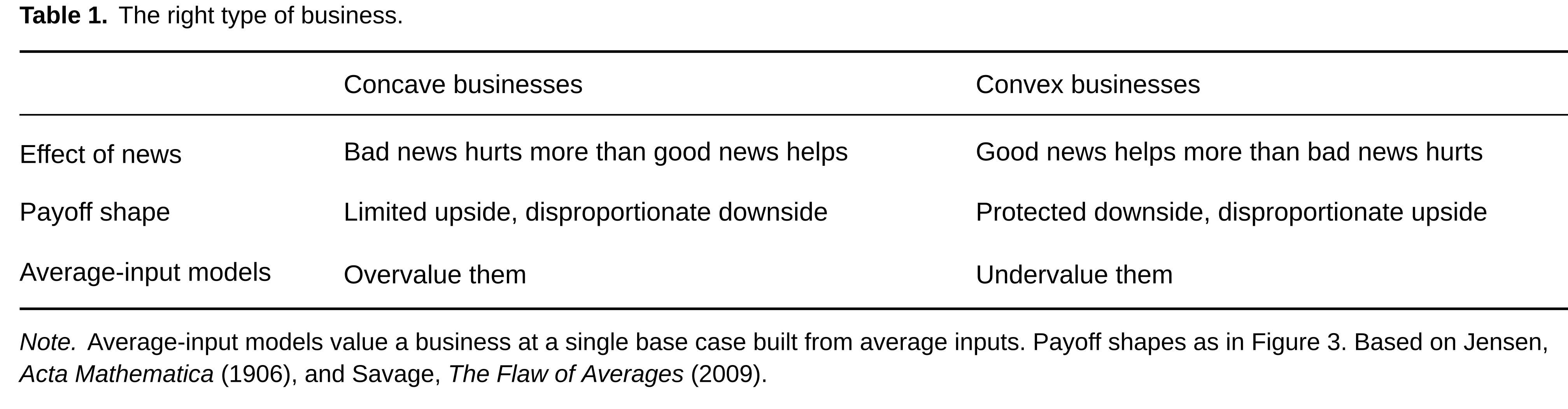
For a business with convex payoffs, greater uncertainty can create value. For one with concave payoffs, it can destroy it.
Perhaps the most counterintuitive implication of all this is that an investor can be right about virtually every input in a financial model and still arrive at a substantially wrong valuation.
After all, the average depth of a river is of little comfort to a drowning investor.
Disclaimer
This newsletter and its related articles, emails, and accompanying materials (collectively, the “Publication”) are provided for informational and educational purposes only. The Publication contains general commentary and analysis, not personalized investment advice or legal, tax, or accounting advice. It does not constitute an offer or solicitation to buy or sell any security or other financial instrument. Discussion of a particular company, security, or investment strategy should not be interpreted as a determination that it is suitable for you. The Publication is prepared without regard to any reader’s investment objectives, financial circumstances, risk tolerance, or particular needs. Reading or subscribing to the Publication does not, by itself, create an investment advisory relationship. You should conduct your own independent research and consult appropriately qualified financial, legal, tax, or other professional advisers before making investment decisions. You remain responsible for your own decisions and for assessing the suitability of any investment. Information is drawn from sources believed to be reliable, but its accuracy, completeness, and timeliness are not guaranteed. The Publication may contain errors, omissions, or outdated information. Unless otherwise stated, opinions and estimates reflect the author’s judgment as of the date of publication. Information and opinions may change without notice, and previously published material may not be updated. Investing involves risk, including the possible loss of some or all of your invested capital. Past performance is not a reliable indicator or guarantee of future results. Any forecasts, projections, valuations, scenarios, or other forward-looking statements reflect assumptions and judgments that may prove incorrect. They are not promises of future performance, and actual outcomes may differ materially. The views expressed are those of the author or contributing authors in their personal capacities and do not necessarily reflect the views of any employer, client, affiliate, or other organization. Authors and related parties may hold long or short positions in securities or other instruments discussed in the Publication and may acquire, increase, reduce, or dispose of those positions at any time, subject to applicable law and disclosure obligations. These interests may create conflicts of interest, and transactions may occur without further notice to readers. Any article-specific disclosures should be read alongside this general notice. The Publication is intended as general editorial content. Its availability does not imply that any security, product, or service discussed may lawfully be offered or purchased in every jurisdiction. The Publication is not intended for distribution or use where doing so would violate applicable law. Readers should inform themselves about any restrictions relevant to their circumstances. To the fullest extent permitted by applicable law, the authors, publisher, and their respective affiliates, directors, officers, employees, and agents disclaim liability for losses or damages arising from the use of, or reliance on, the Publication, including direct, indirect, incidental, or consequential losses. I use AI tools to assist with editing, proofreading, research, and developing and testing ideas. For longer articles, these tools may also help organize and synthesize findings from multiple sources, including scientific research. I retain editorial responsibility for what I publish. The use of these tools does not eliminate the possibility of factual errors, omissions, or misinterpretations, and AI-assisted material should be approached with the same critical judgment as any other source.
The Flaw of Averages is a concept popularized by Sam Savage in his 2009 book of the same name. It describes how relying on average inputs can produce misleading results when the relationship between inputs and outcomes is nonlinear.