"Proprietary Data" is not what it used to be
By Polymath Investor
Published: 2026-11-22
URL: https://www.polymathinvestor.com/p/data-moats-in-times-of-ai
"Talk is cheap. Show me the code." - Linus Torvalds, Linux kernel mailing list, 2000
For two decades, enterprise software investing followed one predictable, safe script: write code once, sell user seats at 75% to 80% gross margins, and let the switching costs compound free cash flow.
Well, not anymore.
As we know, AI is threatening that model. I’ve seen Excel clones, faithful down to the details, that took only $10 in tokens to build.

\Moat or less | Canva\
Margin of Terror
Ok, but what is AI doing to that model?
Two things.
The first one is about the product itself.
As AI gets dramatically smarter and cheaper, writing software gets easier, which means code and attractive interfaces are worth less and less as competitive advantages. What’s easy to write is easy to copy.
The second is about cost.
Traditional software costs relatively little to serve one more user, which is a big part of why those margins were so high. But now if your product uses AI to serve customers, then you will be using compute every time they perform a task, so more usage can mean significantly higher costs and lower profit margins.
So AI affects software from both sides: the moat and the margin.
Of course, as always, this is case by case, but you can see where I’m going.
“Proprietary Data”
So now companies are claiming that their proprietary data will protect them.
Will it? Their argument is simple: competitors can replicate our software, but they cannot replicate our unique data.
Are they right? Sometimes.
Not all proprietary data is valuable. Having millions of records or decades of historical information doesn’t necessarily create a competitive advantage, and I see three reasons why.
- It goes obsolete. If you own a database of restaurant prices from 2020, it might have been valuable then, but much of that information is useless today. The world simply changed.
- AI may already have it. A general-purpose AI model is trained on large amounts of information, so it may already know much of what a supposedly unique database contains. In other words, AI can increasingly replicate the value of historical datasets.
- You may not be allowed to use it. Holding data and having the right to use it are two different things. A software company might hold valuable customer information and still lack permission to train AI models on it, or to share insights across customers.
Obsolete, replicable, or off-limits. Those are the three things I’d check when a company is saying its data is the moat.
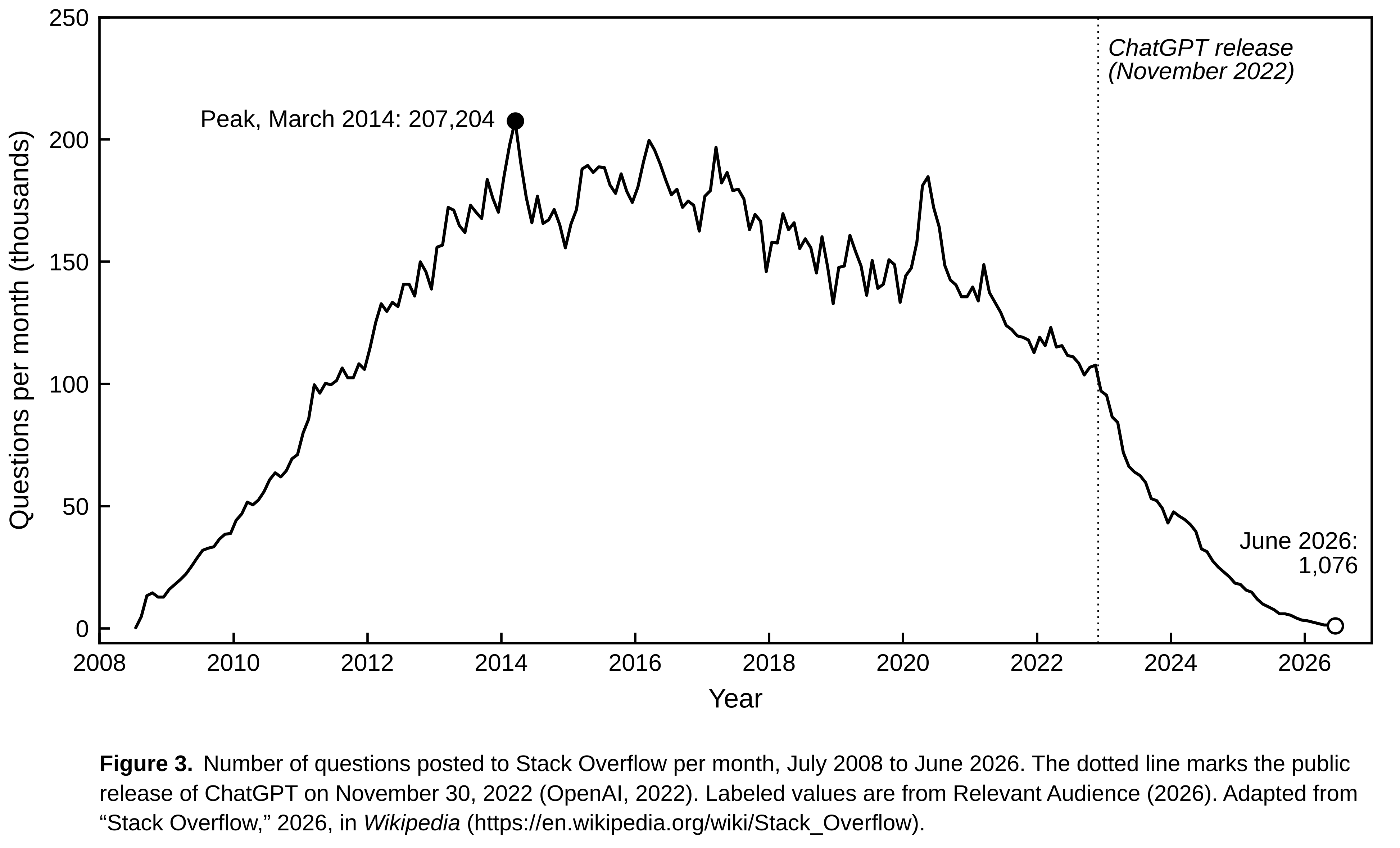
This isn’t theory. The first casualties are in. Just take a look at Stack Overflow1.
Survival of the Freshest
You may be thinking data is a lost cause.
Not really.
I think there are certain data moats that come from live business operations that have a good chance of survival.
A company that constantly collects fresh, exclusive information through its customers’ everyday activities has a more defensible advantage than one that only has an archive.
Fresh takes care of the first problem mentioned above, and exclusive goes a long way on the second, because a general-purpose model can’t already know the information only one company can collect. (The third, permission, is still a matter for the lawyers.)
Now, if you have live data, the best type would be the kind where you have verified business outcomes. Knowing what actually happened (whether a loan was repaid, a transaction succeeded, or a customer made a purchase) can be really valuable.
Input and output. Way more valuable to train models.
Data collection companies for big AI labs are paying white-collar workers more than minimum wage just to record their screens while they do their daily work.
But I digress. Companies with live, verifiable data keep improving their advantage, because each customer interaction generates fresh information, which improves the product, which attracts more usage, which generates even more valuable information.
Classic flywheel.
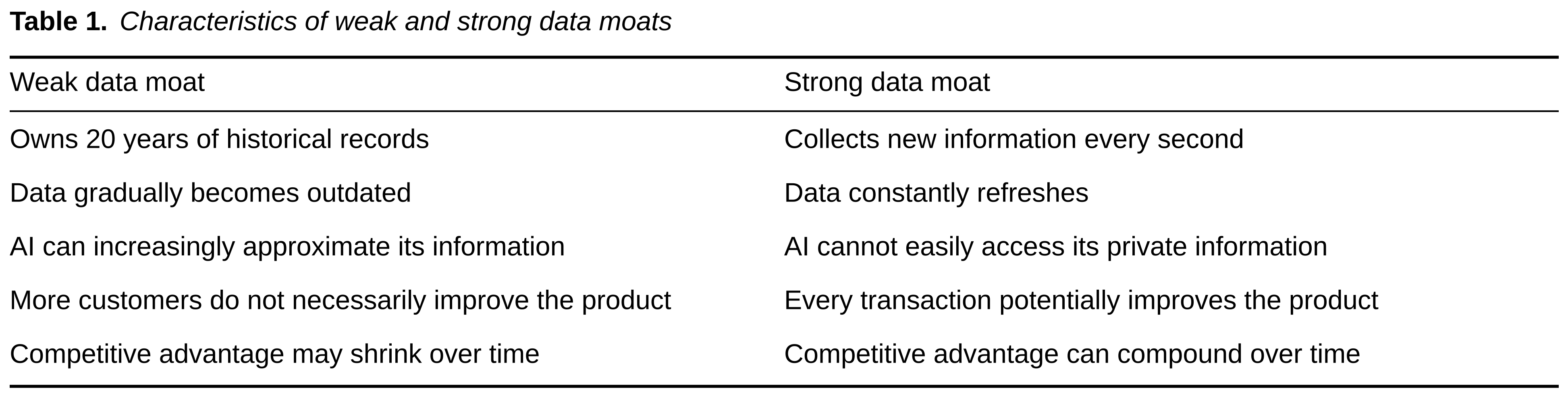
Table 1 shows the characteristics of these two types of data moats.
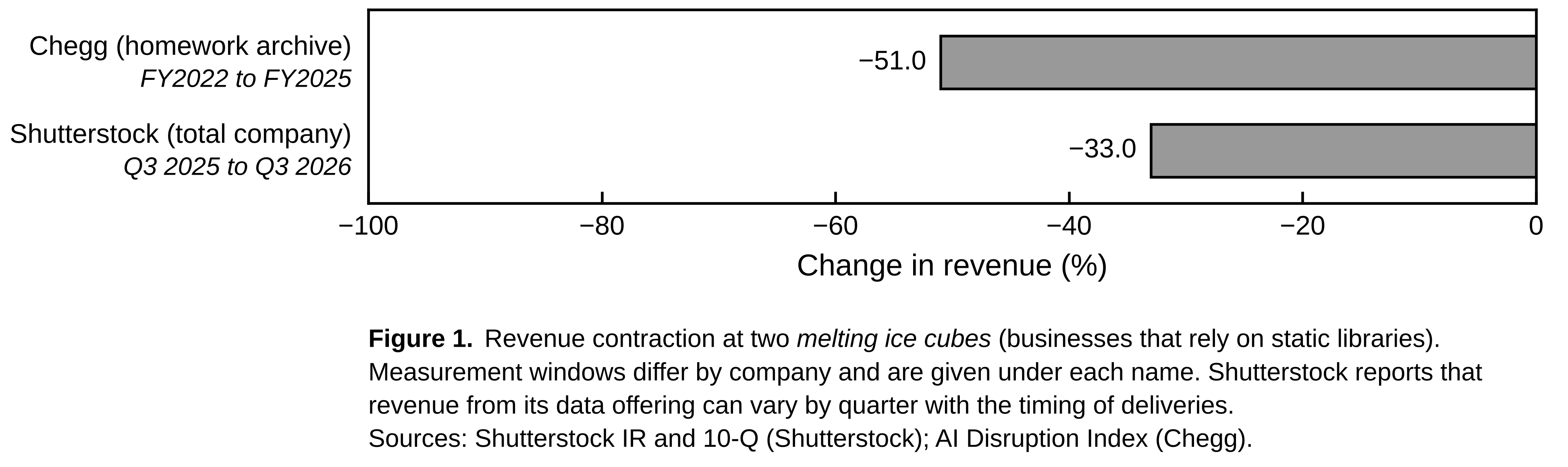
To put some numbers on it, some companies that depend on static information have suffered revenue declines of 33% to over 50% (Figure 1).
Meanwhile, some businesses with stronger operational data advantages maintain adjusted operating or EBITDA margins of 35% to 85% (Figure 2).
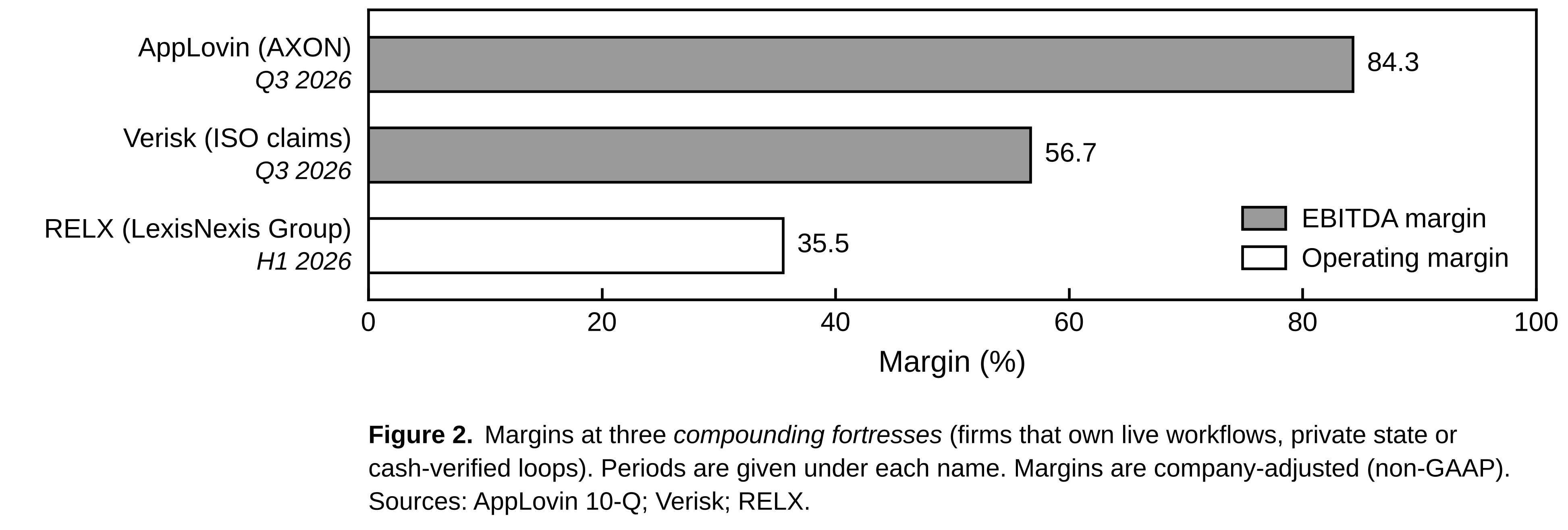
Of course, these are examples, not universal outcomes.
Moat to Self
When the interactions stop, when the model can replace your data, you get Figure 3. Stack Overflow’s information was fresh but never exclusive, because anyone could read it, and so could a model. Questions were slowly trending down but the launch of ChatGPT precipitated the fall.
If the code can be copied and the data goes obsolete, replaced or restricted, what is left to own?
In an AI-driven world, I’d argue the most valuable asset is a company’s privileged ability to observe what is happening in the real world, continuously learn from it, and turn that knowledge into measurable customer outcomes. The information it has already accumulated would be in second place.
The old moat was something you built once. The new one has to be earned again and again with every customer interaction.
Own the companies that generate irreplaceable new information.
Disclaimer
This newsletter and its related articles, emails, and accompanying materials (collectively, the “Publication”) are provided for informational and educational purposes only. The Publication contains general commentary and analysis, not personalized investment advice or legal, tax, or accounting advice. It does not constitute an offer or solicitation to buy or sell any security or other financial instrument. Discussion of a particular company, security, or investment strategy should not be interpreted as a determination that it is suitable for you. The Publication is prepared without regard to any reader’s investment objectives, financial circumstances, risk tolerance, or particular needs. Reading or subscribing to the Publication does not, by itself, create an investment advisory relationship. You should conduct your own independent research and consult appropriately qualified financial, legal, tax, or other professional advisers before making investment decisions. You remain responsible for your own decisions and for assessing the suitability of any investment. Information is drawn from sources believed to be reliable, but its accuracy, completeness, and timeliness are not guaranteed. The Publication may contain errors, omissions, or outdated information. Unless otherwise stated, opinions and estimates reflect the author’s judgment as of the date of publication. Information and opinions may change without notice, and previously published material may not be updated. Investing involves risk, including the possible loss of some or all of your invested capital. Past performance is not a reliable indicator or guarantee of future results. Any forecasts, projections, valuations, scenarios, or other forward-looking statements reflect assumptions and judgments that may prove incorrect. They are not promises of future performance, and actual outcomes may differ materially. The views expressed are those of the author or contributing authors in their personal capacities and do not necessarily reflect the views of any employer, client, affiliate, or other organization. Authors and related parties may hold long or short positions in securities or other instruments discussed in the Publication and may acquire, increase, reduce, or dispose of those positions at any time, subject to applicable law and disclosure obligations. These interests may create conflicts of interest, and transactions may occur without further notice to readers. Any article-specific disclosures should be read alongside this general notice. The Publication is intended as general editorial content. Its availability does not imply that any security, product, or service discussed may lawfully be offered or purchased in every jurisdiction. The Publication is not intended for distribution or use where doing so would violate applicable law. Readers should inform themselves about any restrictions relevant to their circumstances. To the fullest extent permitted by applicable law, the authors, publisher, and their respective affiliates, directors, officers, employees, and agents disclaim liability for losses or damages arising from the use of, or reliance on, the Publication, including direct, indirect, incidental, or consequential losses. I use AI tools to assist with editing, proofreading, research, and developing and testing ideas. For longer articles, these tools may also help organize and synthesize findings from multiple sources, including scientific research. I retain editorial responsibility for what I publish. The use of these tools does not eliminate the possibility of factual errors, omissions, or misinterpretations, and AI-assisted material should be approached with the same critical judgment as any other source.
Stack Overflow is a popular question-and-answer website where programmers ask technical questions and share solutions. For years, it was one of the internet’s go-to resources for coding help, before AI assistants began taking over much of that role.