Key takeaways from Latticework 2026
By Polymath Investor
Published: 2026-11-19
URL: https://www.polymathinvestor.com/p/a-latticework-of-mental-models
This piece will be a little different from our usual fare here at Polymath.
Today, I’d like to share some of my experiences from last week’s Latticework 2026 conference, where I had the pleasure of joining two fellow investors, Wyatt Sparks and Tim McElvaine, for a panel discussion at the University Club of Chicago. We talked about small-cap investing and, of course, AI.
For those unfamiliar with the event, Latticework is an annual summit organized by MOI Global, bringing together investors from around the world, mostly portfolio managers and chief investment officers, for two days of exchanging ideas, thoughtful discussions, camaraderie and keynotes (no slides allowed).
Beyond our panel, the conference featured some legendary investors I’ve long admired, including Chris Bloomstran, John Rogers, Bob Robotti, Pat Dorsey, and François Rochon. It was certainly a great honor to be part of an event alongside such an outstanding group of investors.
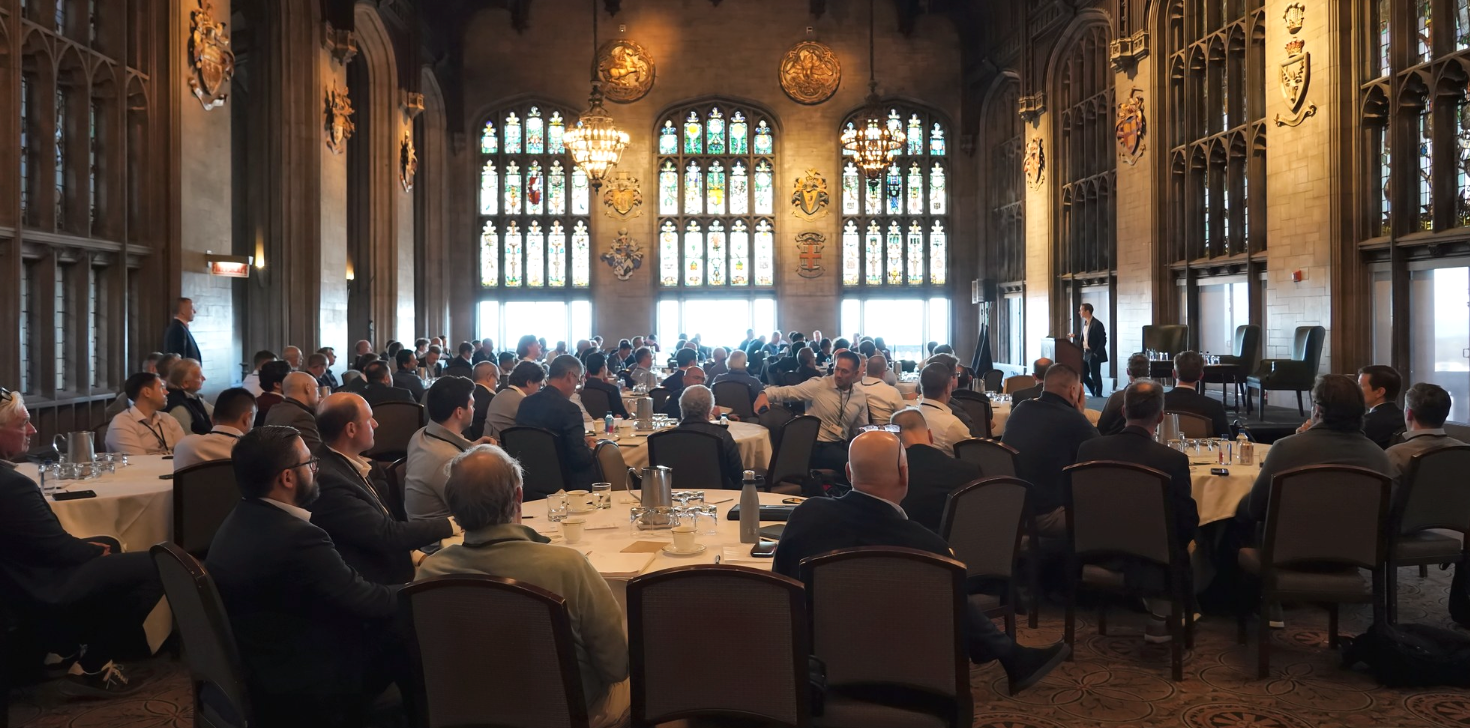
\Latticework 2026 at the University Club of Chicago, November 10–11, 2026.\
As for my fellow panelists, Tim has managed the McElvaine Value Fund since 1996, having learned the craft over twelve years working alongside the late Peter Cundill, one of Canada’s most respected value investors.
Wyatt, a former CFO, is the founder and Chief Investment Officer of Sea Meadow Capital, an investment partnership he launched in June 2021.
It was a pleasure exchanging ideas with both of them, and I’d like to share some of the more interesting insights that came out of our discussion.
So, with that, let’s get into the weeds.
A Few Names Right Off The Bat
John Mihaljevic, founder and Chairman of MOI Global, kicked things off by asking each of us to share an investment idea. Wyatt brought up Weyerhaeuser, the timber company, while Tim pitched “an ugly duckling called Diageo,” as he put it (more on that one later).
I mentioned two small Canadian-listed companies: BioSyent (RX), which sells an iron supplement called FeraMAX, and Metatek (MTEK), which conducts airborne surveys to map what lies beneath the ground. (You can find our full BioSyent write-up in the archive, while Forterra’s Q3 2026 commentary covers Metatek. For the record, I own both.)
But looking back, much of our discussion revolved around a single question John posed: “What does each of you look for, and where do you look in the small-cap space that others might be overlooking?”
That question led to some of the most interesting insights from the panel. And, perhaps unexpectedly, we’ll start with ABBA.
How Do You Find Bargains?
ABBA is the Swedish pop group formed in Stockholm in 1972. It’s also Tim’s acronym for how he finds companies.
Tim’s checklist goes like this:
- Accident. Why does he have an advantage on the purchase?
- Bird in hand. The stock has to be cheap.
- Brick house. He explained this one with the three little pigs, because “a wolf always comes to the door in our business.”
- Alignment of interest. Are you in the same boat as the people running the company?
An accident is someone selling for a reason other than price. Tim’s example was Diageo: after the company cut its dividend, he said, pretty much the entire shareholder register had to turn over. People wanted out, and what the business was worth had little to do with it.
Wyatt looks for the same thing across whole industries, and he goes where people say a space is “uninvestable”: starved for capital, and the last place a new graduate wants to work.
Different words, but probably the same underlying intuition. Find bargains in unloved segments, where people are forced to sell or where the crowd doesn’t want to look.
Why Root for the Ugly Duckling?
Tim grew up on a farm, and he told us he roots for the ugly duckling. What he avoids are swans, where you pay up for a beautiful-looking bird and hope it stays that way.
With a duckling, hope is optional. At the price he paid for Diageo, he said, he just needs it to “grow up and stay a duck.”
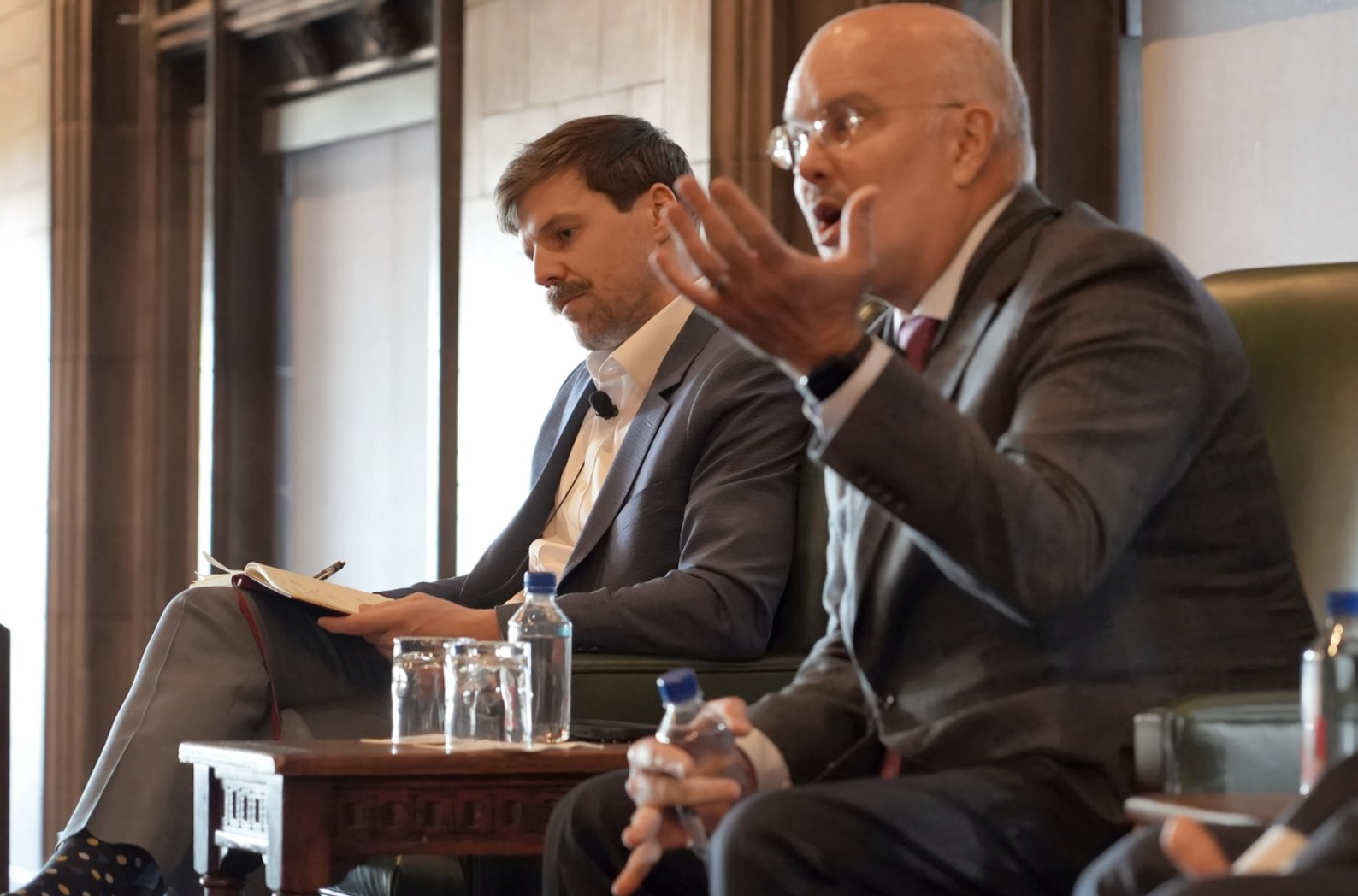
\Tim McElvaine, with Wyatt Sparks, on why he roots for the ugly duckling.\
Why is he so comfortable? Most investors value Diageo on its earnings, he said, and they miss that it’s really a collection of businesses, some good and some not so good, “jammed together in one structure.”
One example: the company’s stake in Moët Hennessy brings in about $100 million, he said, and could be worth somewhere between $5 billion and $10 billion.
If it becomes a swan, great, but he doesn’t need it to.
That’s the classic margin of safety: pay a price where an ordinary outcome is enough.
The Original Instagram Filter
Wyatt’s years as a CFO gave him a cool line: his financial statements and quarterly numbers, he said, were like “the original Instagram filter.” He could make them look as good as you wanted, so you have to get under the surface to understand what you own.
So what do you watch instead?
Wyatt watches what management does when the cycle turns against them. Some teams go on the offensive and do exactly what they said they would do, while others begin to falter. He described one of the first signs: the KPIs (key performance indicators) they once published start “disappearing from a deck.”
The tell he likes best is the opposite one: a manager who says “it’s actually my fault.”
Tim’s test is even shorter. If a CEO talks about strategy, “get the hell out of there.” If he talks about operations, “draw your chair a little bit closer.”
None of that is in a spreadsheet.
How Many Reasons Do You Need To Buy a Stock?
When the talk turned to AI, Tim had the line of the afternoon. His firm mostly uses Claude, and he described it as “four parts Mission: Impossible’s Ethan Hunt and one part Mr. Bean.” You never know which one will show up.
But maybe his bigger point was about volume: any analyst, and now any AI, can give you “50 reasons to buy a stock,” and as a portfolio manager he wants maybe three.
An analyst had just handed him a 40-page report, and his verdict was that “life’s too short to read that.” His final step before any investment decision is a single page, written by hand, that answers three things:
- why it’s cheap,
- what could go wrong, and
- how the insiders are aligned.
Fifty reasons but actually three that matter, on one page.
With AI, the data grows exponentially, and our job as investors is to subtract and find the signal in all the noise. Which is the perfect segue into the next section.
AI & Equity Research
This is probably the topic for a full future essay, but since John asked the question, I’ll share some of my views here.
As I said on the panel, AI has been “such a game changer” for my research. The biggest gain is what I called speed to insight: how fast we can decide whether to drop a company or keep digging into it.
In the last six or seven months, I’d say that process has sped up by an order of magnitude.
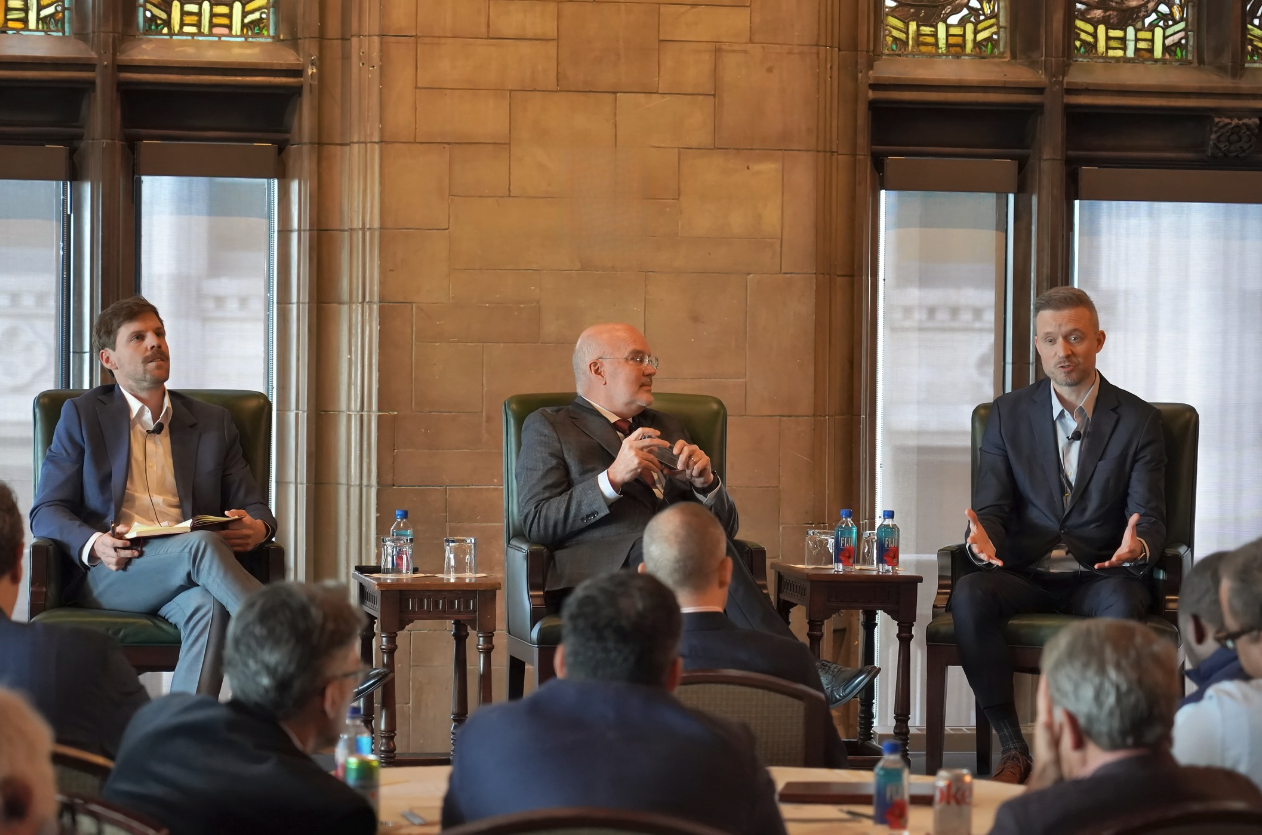
\From left to right: Wyatt Sparks, Tim McElvaine, and Mauricio Heck at the University Club of Chicago, November 10, 2026.\
The second gain is depth: I now build 100- to 200-page research files on a single small cap. You don’t need that much detail, and as Tim said, you probably only need three good reasons to invest in a company. But I’ve found that in small caps, that depth catches problems you’d otherwise miss.
And I don’t trust any single model. I’m running hundreds of agents across all of them: the Chinese models, the open-source ones, Claude. The idea is to get closer to the truth by making them disagree. As I put it on the panel, “we make the models fight each other.”
Of course, none of that makes the decision. All it does is point me toward useful research avenues.
So, where’s the catch?
The Human Bottleneck
Even after all of that, we go and talk to management, and there are things that just aren’t in the files.
In small caps especially, so much of what matters isn’t written down anywhere. It sits with managers, industry experts and clients, and you have to go and talk to them. On the panel, I called it “the human bottleneck.” But it’s really what it all comes down to in the end.
It’s the limiting factor in my research right now, more than anything else. And it’s the same thing I told John at the start of the panel: the main advantage is still boots on the ground, visiting companies and talking to management.
Ok, if you’ve followed along so far, you may have noticed something about the ideas above.
Most of those insights are about people.
AI is collapsing the cost of research and of putting information together for us to read. The scarce part, for now, is everything you can’t read on a screen.
Final Thoughts
Is AI making investing more competitive? For anything you can find online, I’d say yes. Pretty soon, everyone will have massive deep dives, the 200-page file.
What AI can’t shorten, at least so far, are the intangibles: the culture, the people. Companies are dynamic human organizations, after all.
Which brings me back to Latticework 2026.
Investors from all over the world traveled to Chicago to spend two days talking to each other, with no slides. They could have waited for the transcripts.
They came anyway.
P.S. The full list of insights and mental models from the panel, each one explained in plain English, is attached below.
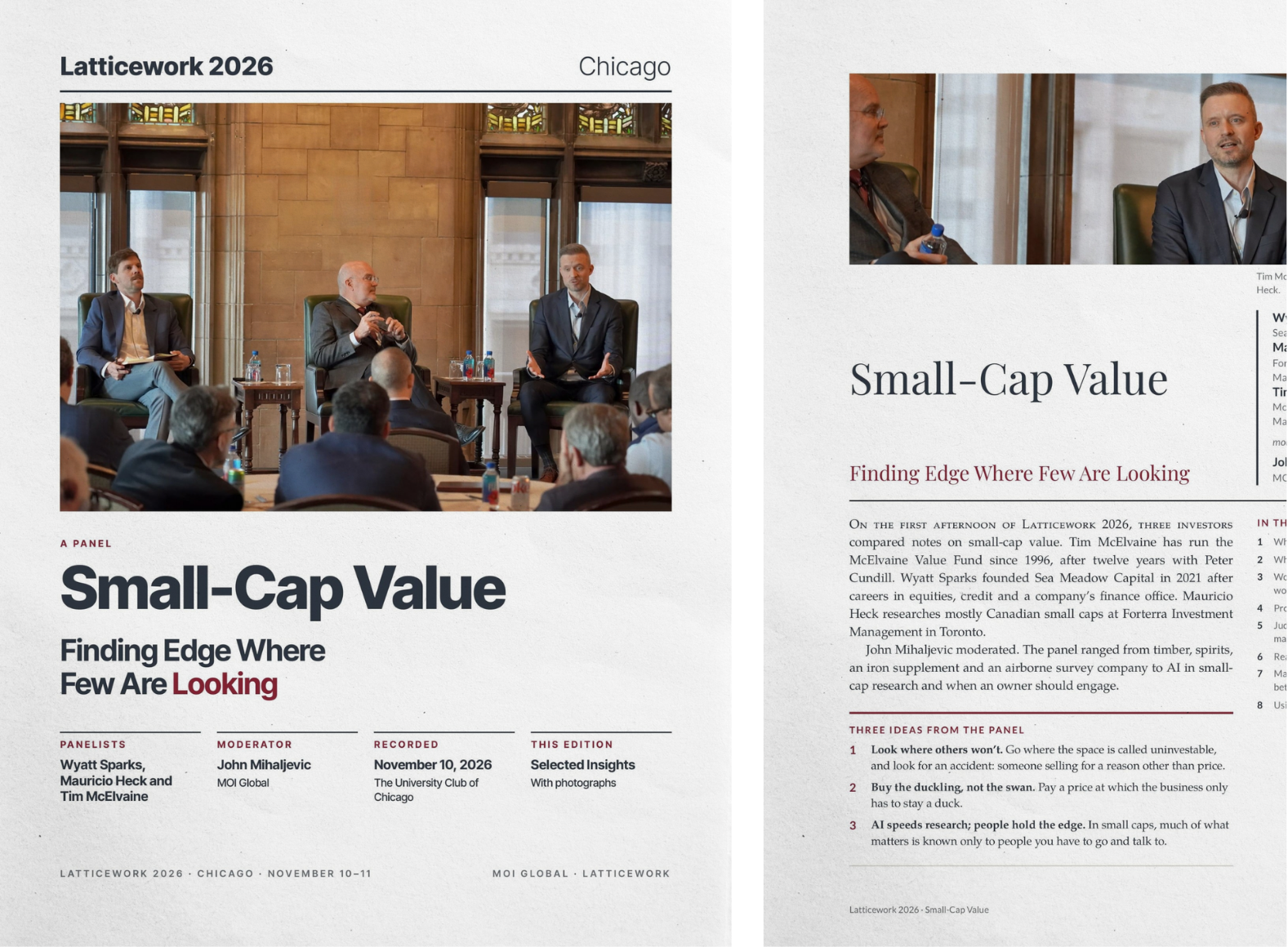
\[Download full printable PDF below.]\
Latticework 2026 Small Cap Value Panel Selected Insights
1.89MB ∙ PDF file