The principles behind Tom Brady’s decades of elite performance
By Polymath Investor
Published: 2026-11-26
URL: https://www.polymathinvestor.com/p/compounding-excellence-part-i
“We are what we repeatedly do. Excellence, then, is not an act but a habit.” - Will Durant
It’s interesting how much attention we devote to achieving excellence and understanding what it takes to get there. Yet we seem to devote considerably less time to understanding what it takes to sustain it.
Achieving excellence and sustaining it are two different challenges, and I would argue that, particularly in investing, the latter is the more important one.
Sports have always been fertile ground for uncovering insights, analogies, and lessons applicable to virtually every walk of life, and when it comes to achieving and sustaining elite-level performance, they are no exception.
In the 2000 NFL Draft, 198 players were selected before Tom Brady. Whether or not you follow American football, you probably know how the story goes (full disclosure here: I hold no position in any NFL team, long or short!).
Brady wasn’t especially fast, strong, or athletic by NFL standards. Yet he went on to win seven Super Bowls over 23 seasons, the last one at the age of 43.
Talk about sustaining elite-level performance well beyond your expected prime.
What I find particularly interesting about Brady is not necessarily how far he reached, but how long he managed to stay there.
And for us as investors, the staying there is arguably far more valuable.
Let’s dig in.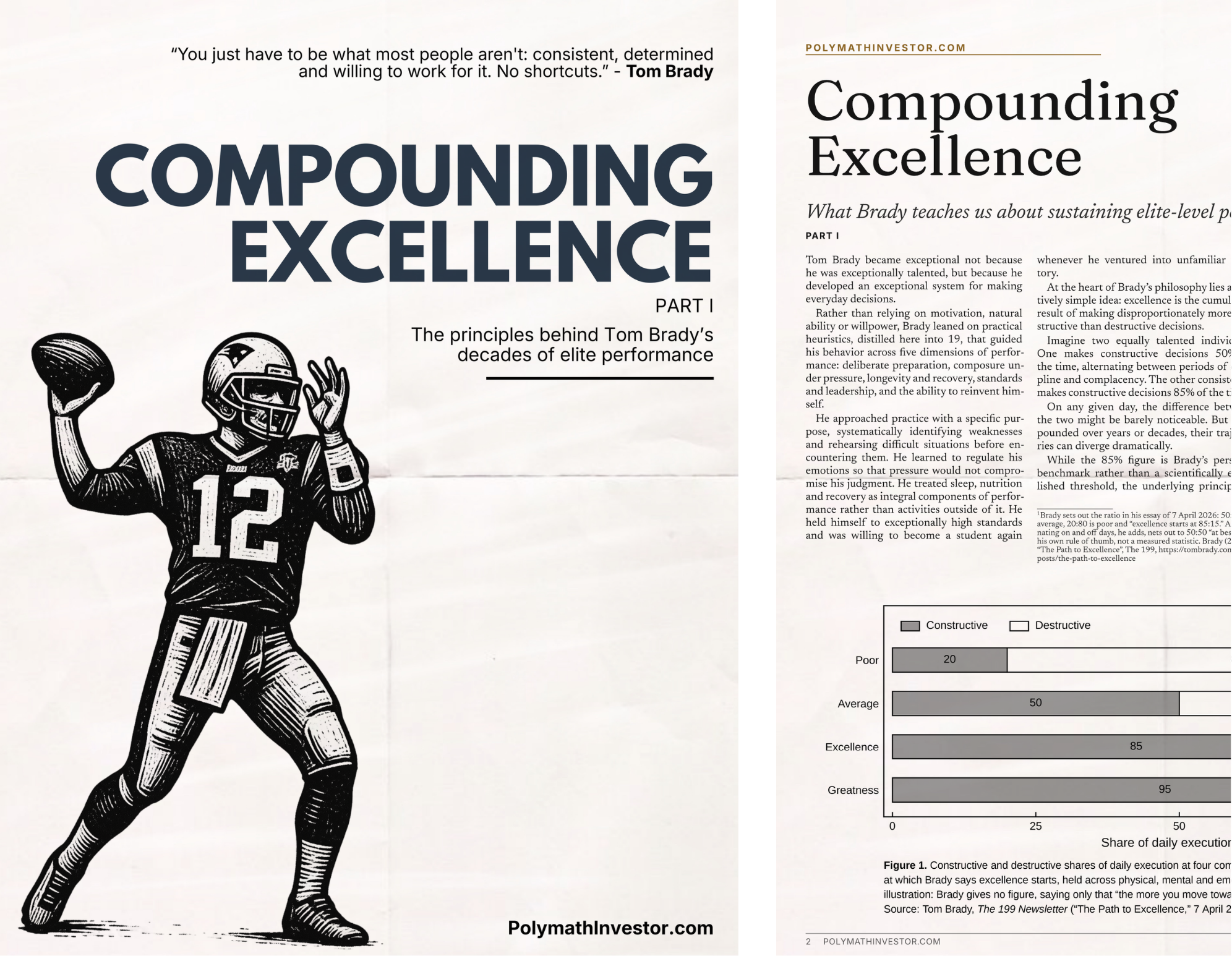 [Full Version printable PDF available at the end.]
The Little Things Are the Big Things
One idea I find particularly interesting is that Brady views performance as the cumulative result of thousands of seemingly insignificant daily decisions:
-
What you eat.
-
How you sleep.
-
How you prepare.
-
How you respond to criticism, etc.
I believe he mentioned a good benchmark is to get roughly 85% of those decisions right. Not 100%.
You can probably already see the parallels with investing.
Why do I find this useful?
Because it takes excellence out of the realm of extraordinary achievements and places it squarely in the realm of ordinary, repeatable behaviors.
Think about your own investment process. Every day presents dozens of small decisions:
-
Do you read the original filing or someone else’s interpretation of it?
-
Do you investigate an uncomfortable counterargument or seek additional evidence that confirms your thesis?
-
Do you spend a few uninterrupted hours studying a business, or do you drift into checking Twitter (or X, whatever we’re calling it these days), refreshing your inbox, and looking at stock quotes?
There are thousands of these little decisions that make up our working lives. Individually, none of them seems particularly consequential. Aggregate them over two or three decades, however, and the end result is Buffett vs your uncle talking about stocks at Christmas dinner.
Excellence, like capital, compounds. But so does mediocrity. A cut above | Photo: Brian Allen / Voice of America, via Wikimedia Commons.
Don’t Just Play the Game
One of the biggest traps in our (and every?) profession is that we can spend decades investing without necessarily spending much time practicing investing.
You see, there’s a fundamental difference between practicing (deliberate practice) and performing.
An amateur golfer can play golf every weekend for 20 years and still have the same lousy swing. Trust me, I know this one firsthand.
Why? Because repeating an activity is not the same as deliberately improving at it.
We’ve discussed deliberate practice in previous articles here at Polymath, but I think it’s always instructive to see how someone operating at an elite level actually applies it.
Brady’s approach to preparation involved identifying specific weaknesses, working on them in isolation, soliciting feedback, and repeating the process.
What would deliberate practice look like for a fundamental investor?
-
Perhaps you’re particularly bad at assessing management teams. You could study historical management interviews and compare what executives promised with what they subsequently delivered.
-
Perhaps your position sizing is suboptimal. You could reconstruct your last 50 investment decisions and examine whether your initial conviction was justified by subsequent outcomes.
-
Perhaps you consistently underestimate the capital intensity of a business. Well, there’s your next research project.
The idea is to periodically isolate a specific component of your craft and train it independently, rather than expecting it to improve simply as a byproduct of doing your job.
Experience doesn’t automatically translate into expertise. There needs to be a mechanism that converts one into the other.
Recovery, Recovery, Recovery
One of the most interesting findings from my research is something that professional athletes understand remarkably well but that knowledge workers frequently ignore: recovery is an integral part of the production process.
Imagine owning a manufacturing business and deciding that preventive maintenance is a waste of productive machine hours.
In the short term, you might even be rewarded for that decision. Production increases, utilization rates improve, and costs come down. Eventually, however, the machinery begins to deteriorate, defect rates rise, and unexpected downtime becomes increasingly frequent.
You’ve effectively borrowed productivity from the future.
I would argue that our brains are not that different. Sleep, exercise, nutrition, and periods of intellectual disengagement are investments in our productive capabilities. They are, if you will, the maintenance CapEx of our cognitive machinery.
As investors, our most valuable productive asset is our ability to think clearly. So why would we deliberately run that asset into the ground?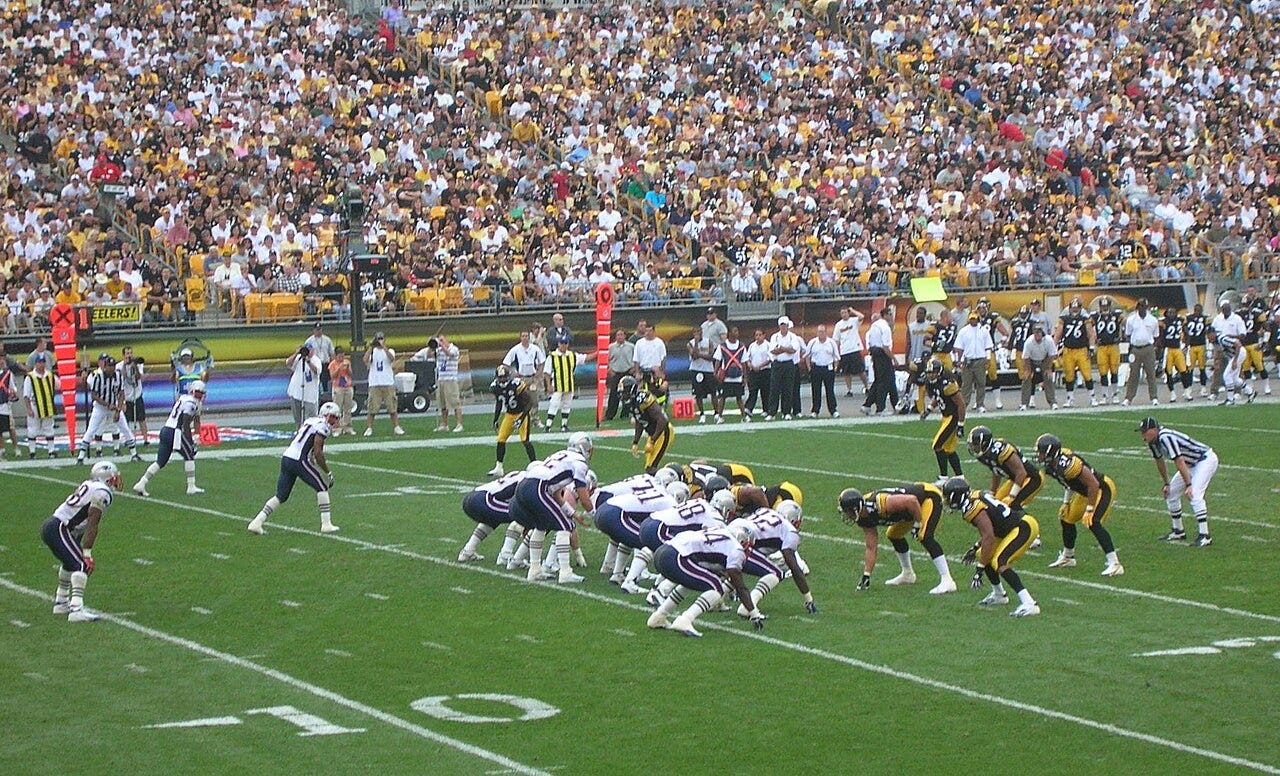 Offensive moats | Photo: Bernard Gagnon, via Wikimedia Commons, CC BY-SA 3.0

Playing for Decades, Not Quarters
There’s a tendency to think about elite performance in terms of intensity: more hours, more effort, more sacrifice.
But what emerges from studying Brady’s career is a considerably more interesting framework: designing a system that makes high-quality execution sustainable over extraordinarily long periods of time.
Tell me if that doesn’t apply to investing.
In a profession where the fruits of compounding are disproportionately concentrated in the later years, the ability to sustain excellence is of paramount importance.
Perhaps we should spend less time asking ourselves how to become exceptional investors this year and more time asking what kind of habits, routines, and practices would allow us to remain exceptional investors thirty years from now.
The challenge is not simply to become good at what we do, but to build a way of operating that allows us to keep getting better without exhausting the very resources that make that improvement possible.
After all, we spend a lot of time studying the durability of the competitive advantages of businesses. Perhaps we should devote some time to studying the durability of our own.
What follows is an attempt to reverse-engineer Brady’s performance system. Drawing on his books, interviews, documentaries, speeches, and personal writings spanning several decades, I have distilled his teachings and experiences into 19 actionable heuristics organized across five pillars of performance.
For each heuristic, I explore the underlying rationale, the historical context, the original sources, and practical examples of how we, as investors or knowledge workers, can apply it to our own professional lives.
The objective, of course, is not to learn how to become better quarterbacks, but to extract the transferable principles behind Brady’s remarkable ability to sustain excellence over decades.
And, of course, happy Thanksgiving to all our American readers! I hope you get to spend some quality time with family and friends and, in the spirit of today’s article, enjoy some well-deserved recovery.
[Download the printable PDF below for the first pillars of Brady’s performance system for sustaining excellence over decades.]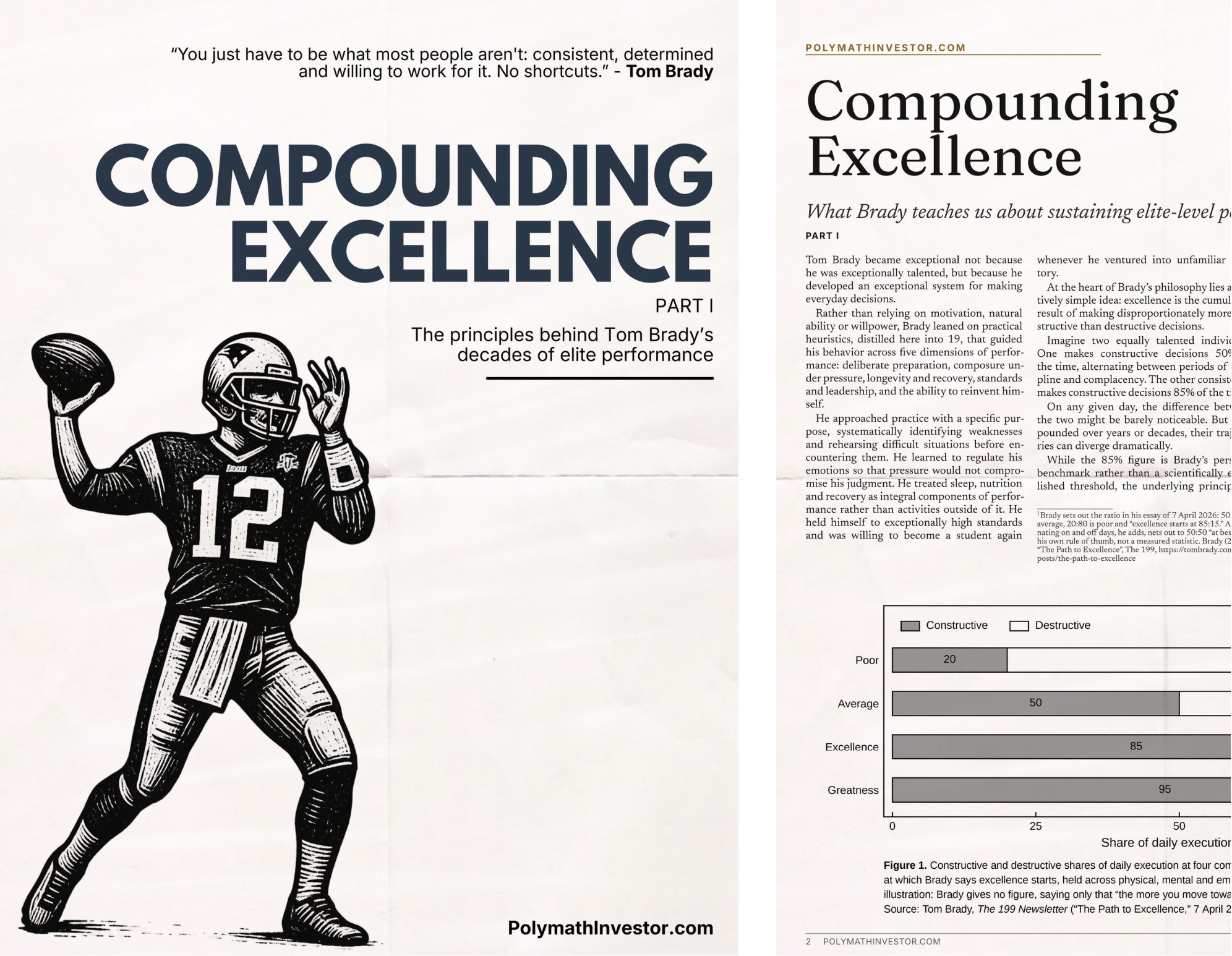 [Download full PDF below.]“This publication is not affiliated with, or endorsed by, Tom Brady, the NFL or the New England Patriots.”
Our Black Friday offer runs until Monday at 11:59 PM ET: an annual subscription for $192.50 instead of $550 (65% off), locked in for as long as you stay subscribed.