An idea tour on how great readers read
By Polymath Investor
Published: 2026-10-28
URL: https://www.polymathinvestor.com/p/reading-habits-of-yesteryears-luminaries
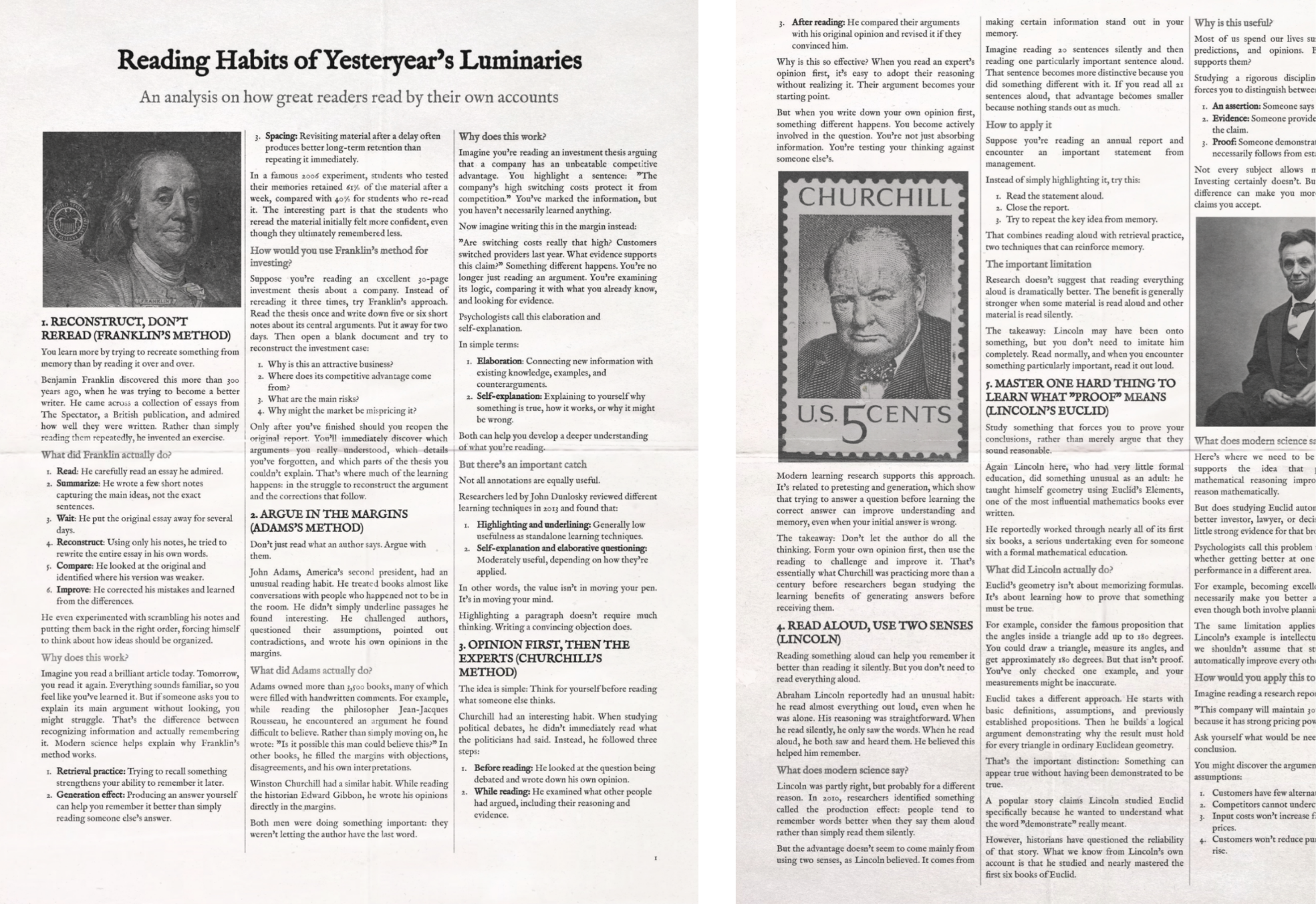 [Printable PDF available at the end of this essay.]
“One must be an inventor to read well.” - Ralph Waldo Emerson, The American Scholar
It’s the evening of December 10, 1513. An out-of-work civil servant just came home to his farmhouse outside Florence with all his clothes full of mud. After taking them off he slips into his courtly robes, and sits down for four hours to read history.
That civil servant is none other than Niccolò Machiavelli, describing his day in a letter to a friend. After being pushed out of politics, he liked to go into the “courts of the ancients” and ask the great men of the past why they did what they did. He would immerse himself deeply into his reading.
Oh, in that same letter, he mentions he has composed the little work on principalities1.
The luminaries of the past left plenty of evidence of how they read, what they read, and what they did with it. Some read everything they could get their hands on. Others returned to the same books over and over. A third group found a path between the two, and I’d argue their approach is the one worth copying.
Let’s go look.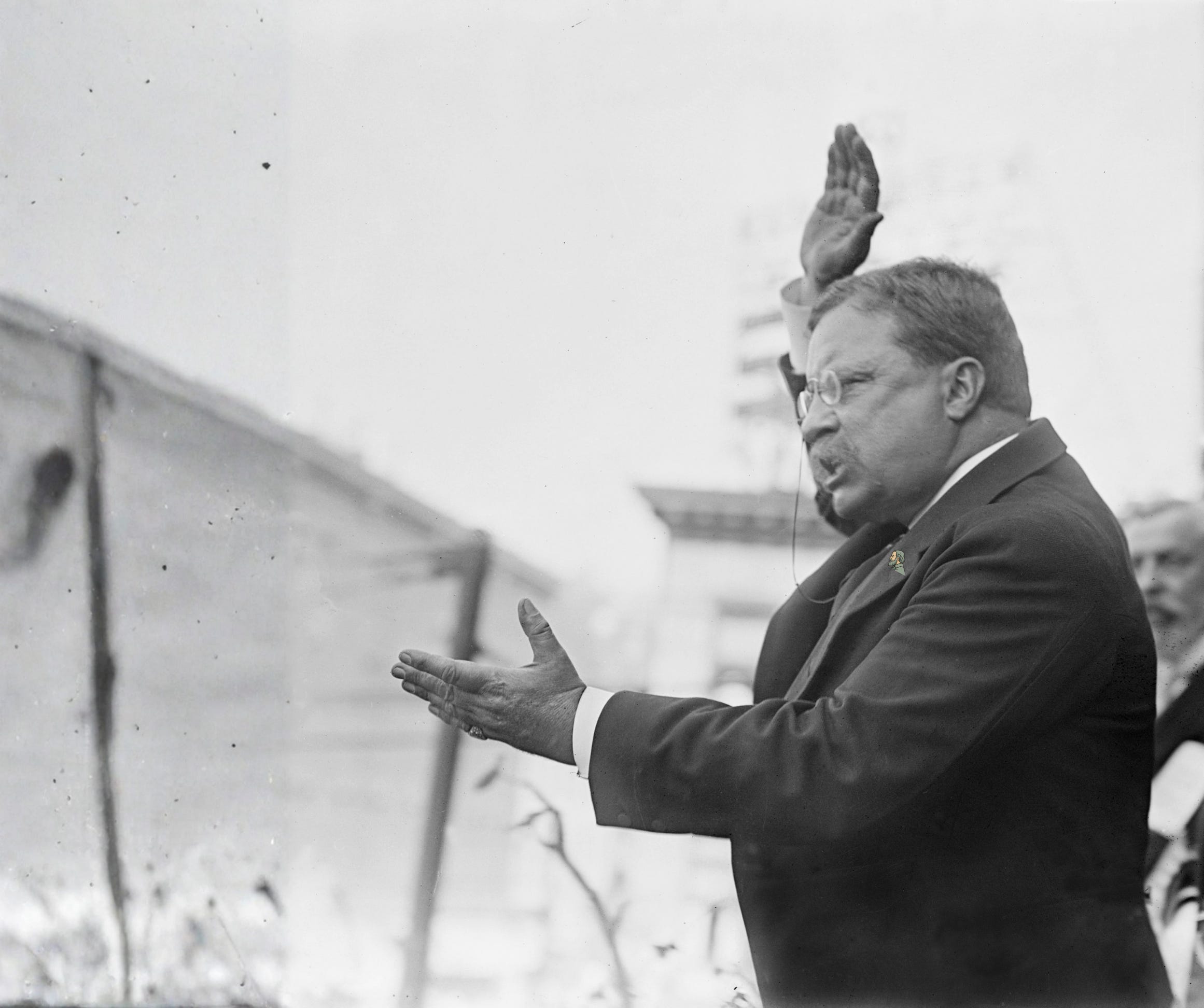 I read this much today | Theodore Roosevelt addressing a crowd in Yonkers, New York, October 17, 1910. Photo: The Everett Collection, via Canva.
Booked Solid
Theodore Roosevelt is the patron saint here. By his own account, he’s the biggest reader I came up in my research. He claimed to read a book a day (if busy) and two or three when time allowed. There could be a little self-promotion for sure, but also some truth. In those times there were fewer distractions. But we’ll come to that.
How much did he actually read? On one day of the 1900 campaign, his schedule mentions reading six separate times, four and a half hours in all2. He had a rule: “All kinds of odd moments turn up during even a busy day,” and he read in them.
Winston Churchill was another great reader. At 22, stuck in Bangalore as a young officer, he read Gibbon and Macaulay for hours every afternoon.
But since this is an investment newsletter, I can’t write an essay on reading habits without mentioning Buffett. According to Todd Combs, the Oracle recommended reading 500 pages a day3.
Then we have the other group.
Less Is Lore
Seneca would have hated all of this. His second letter to Lucilius tells him to stop wandering through books and stay with a small number of master thinkers until he has digested them. “Everywhere means nowhere.”
Take one idea a day and chew on it.
Abraham Lincoln is in this group too, partly because he had no choice. As a young man he owned very few books, so he read the same handful over and over: the Bible, Aesop, Pilgrim’s Progress, Weems’s Life of Washington and Shakespeare.
He read everything aloud, apparently because “When I read aloud two senses catch the idea.” After his years in Congress he worked through the first six books of Euclid.
I know many of my astute readers will already be questioning the premise of this whole exercise: why study these habits at all? Is it causation or mere correlation?
Maybe Buffett’s longtime partner can help us here:
“In my whole life, I have known no wise people (over a broad subject matter area) who didn’t read all the time - none, zero. You’d be amazed at how much Warren reads-and at how much I read. My children laugh at me. They think I’m a book with a couple of legs sticking out.” - Charlie Munger
Or we could let Schopenhauer make the contrarian case: “When we read, someone else thinks for us.”
A Margin Call
So who’s right? Both, I’d argue.
The readers I find most interesting read widely, like Roosevelt, and they also read with a pen in hand. I’ll call them the Annotators.
John Adams is the prime example.
His library of more than 3,000 volumes, now at the Boston Public Library, has margins full of his comments arguing with the authors. He would write next to a passage of Rousseau: “Is it possible this man could believe this?”
This was more of an active dialogue than passive reading. 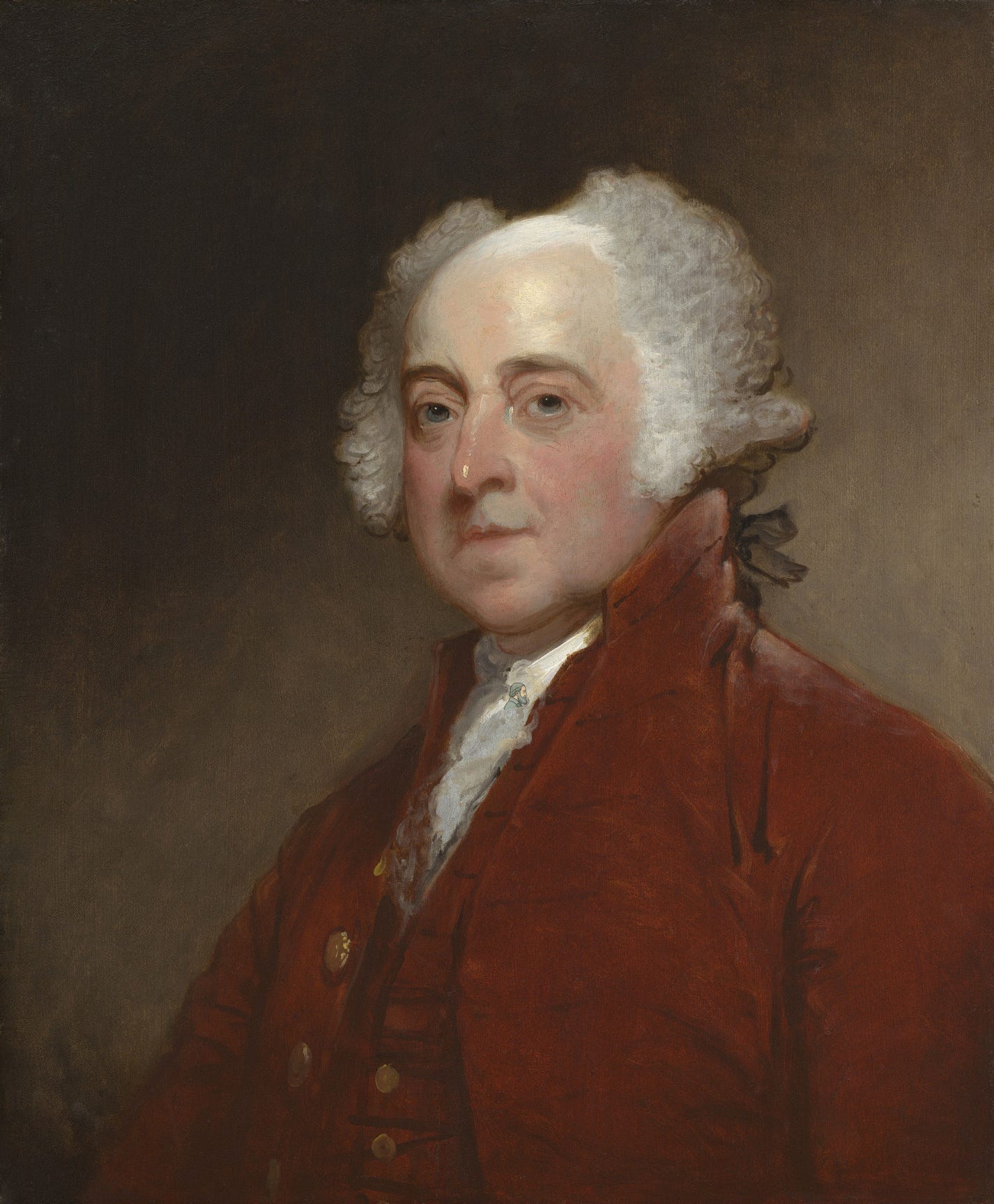 A firm believer in marginal returns. | John Adams, by Gilbert Stuart (c. 1800-1815), oil on canvas. Image: The Everett Collection, via Canva.
Benjamin Franklin did something stranger and, I think, better. As a young man he found a volume of the Spectator and wanted to write like that. So he took short notes on each sentence, put them away for a few days, rewrote the essay from the notes alone, then compared his version with the original and fixed his faults.
Brilliant idea (if you have the time).
Churchill did something similar. Before reading each debate in the Annual Register, he wrote down his own opinion on the question, then read, then revised. As for Gibbon: “I scribbled all my opinions on the margins of the pages.”
Why is this better than just reading for quantity or reading the same books again and again? I’ve discussed the testing effect before.
In a 2006 study by Roediger and Karpicke, students who werer tested themselves on a passage recalled 61% of it a week later, while the ones who just reread it recalled 40% and, surprisingly, felt more confident4.
Rereading is to learning what watching a workout video is to exercise. Franklin’s method is retrieval practice centuries before we found a name for it.
So far, these are all stories about great readers, including Munger’s. They don’t prove those habits made anyone great.
That’s where Roediger and Karpicke come to our rescue. They tested the method by assigning students different ways to study. A week later, those who practiced remembering recalled 61%, compared with 40% for re-readers. It’s one study of students and short passages, but it gives us a reason to close the book and see what we remember.
And Schopenhauer? Yes, reading gives us someone else’s thoughts. Arguing in the margins makes us work through our own.
Notification Nation
Now, to the distraction argument. Roosevelt didn’t have a phone to bother him in his odd moments. Machiavelli’s study had no notifications, only the dead, who don’t interrupt. Their world was quieter, and telling someone to read a book a day in 2026 is a stretch.
But let’s look at their methods for a moment. Machiavelli changed clothes to mark the beginning of his reading practice. Lincoln read aloud. Franklin put the notes away for days.
Each one of them made reading harder to interrupt but also harder to forget, and none of these methods needs more hours than you already spend reading.
They need a pen, a small ritual and a closed book.
The Write Way to Read
My argument is that writing is essential to reading well.
That’s the method I’d take from these luminaries. Read as widely as you like, and don’t leave a book without having argued with it on paper. How, exactly?
Let’s go into the detail.
Download 6 page full printable PDF featuring each luminary’s reading habits below: