How valuation, easy credit, speculation, and impossible growth expectations create financial manias
By Polymath Investor
Published: 2026-11-05
URL: https://www.polymathinvestor.com/p/how-to-spot-a-market-bubble
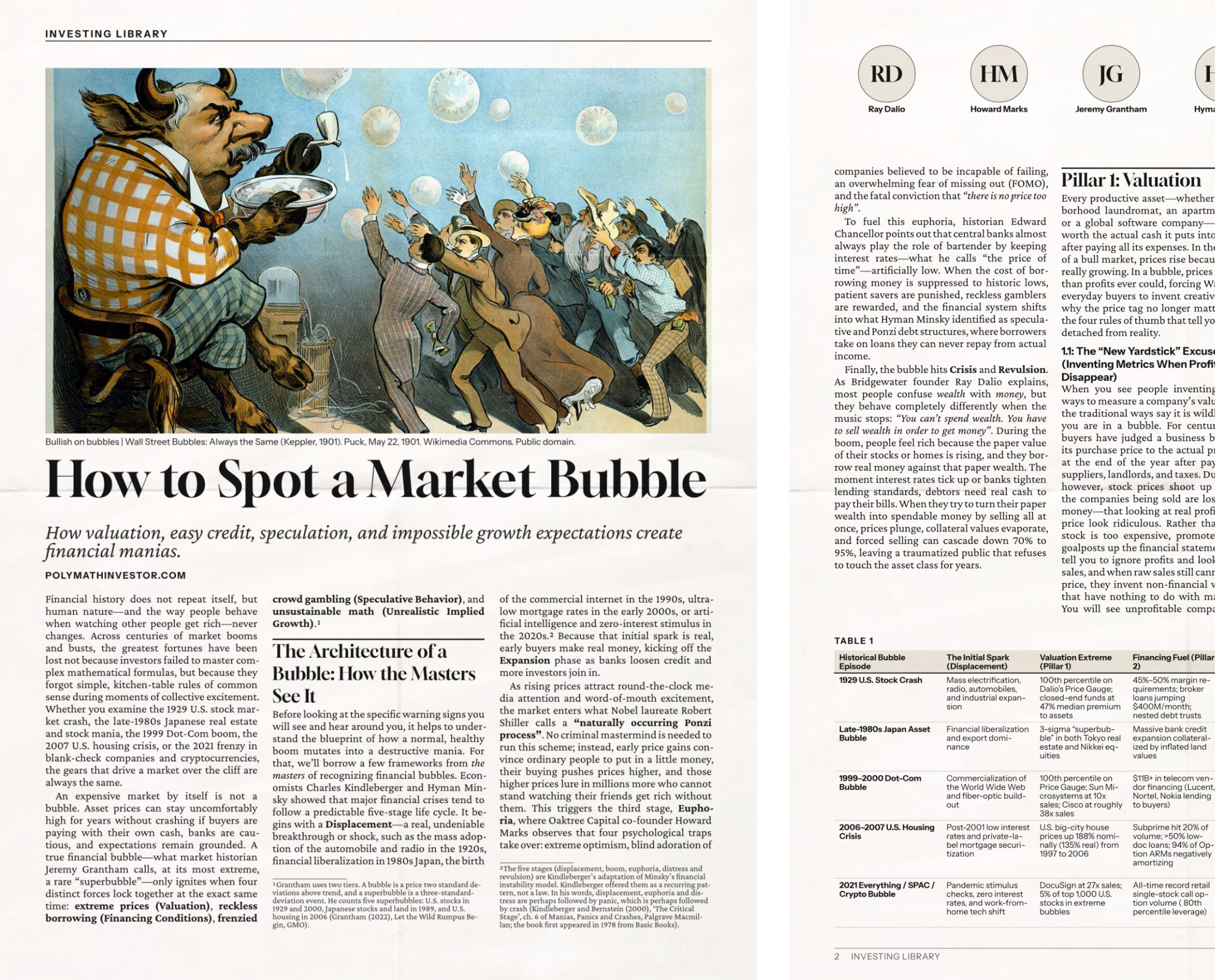 [Printable PDF available at the end of this essay.]
When I was looking at the research for this piece, I came across a story that I think illustrates the point rather well.
In 2002, Scott McNealy (the CEO of Sun Microsystems at the time) explained in a BusinessWeek interview why buying his stock at the top of the dotcom mania had been a mistake.
Two years earlier, Sun had peaked at $64 a share, ten times its annual sales. At that price, McNealy pointed out, the company would have had to give investors 100% of its revenue, every year for ten years, with zero costs, zero wages, zero research and zero taxes, just to pay them back.
Put that way, it sounds outrageous, right?
Sure enough, within two years the stock was trading below $5 a share.
“Do you realize how ridiculous those basic assumptions are?” McNealy asked. “What were you thinking?”
Obviously nobody was (thinking, that is).
That’s the thing about manias: the numbers are there the whole time, but it seems people are oblivious to them until it’s too late.
So, were those ridiculous assumptions the only problem with Sun Microsystems? Well, not really. Implied assumptions tell you what investors are betting on, but they tell you nothing about who’s doing the buying or how much borrowed money they’re using to do it. And that’s one of the most dangerous aspects of a bubble.
An expensive market by itself is not a bubble. Prices can be uncomfortably high for years without crashing, as long as buyers pay cash, banks stay rational, and expectations stay grounded.
What Jeremy Grantham calls a superbubble usually needs more than just ridiculous assumptions1.
P.S. We’re now a community of more than 88,000 readers! If you enjoyed this piece, please share it using the button above. Every share helps more people discover our content!
So what are all the factors that have to be present to form these irrational periods in markets?
Allow me to use the expression “ignite a bubble” here.
A bubble only ignites when four forces show up at the same time: extreme prices, reckless borrowing, frenzied crowd gambling, and impossible growth math.
I call it the Four-Cylinder Ignition Rule. Maybe McNealy was thinking of unreasonable growth expectations when he said that. But you also need the other three components to have a full-blown bubble:
Valuation
Every productive asset is worth the cash it puts in your pocket after expenses. In a bubble, prices outrun profits, so promoters have to move the goalposts.
In 1999 and 2000, startups with zero profits were valued in the billions on “price-per-eyeball” and “page views,” and even the profitable leaders went for 10 to 44 times sales.
A Treasury bond, meanwhile, paid 6% to 7%, risk-free. Investors who ignored that to buy the S&P 500 in 2000 got a full decade of negative returns2.
Financing
If elevated valuations are the spark, well, easy credit has to be the oxygen.
You will start seeing lending that only makes sense if the boom times never end.
Every bubble invents its own version: broker loans growing $400 million a month in the summer of 1929, or mortgages in 2006 that allowed borrowers to make payments while their debt kept growing.
Speculation
Bubbles are social epidemics. Robert Shiller calls it a “naturally occurring Ponzi process”: early gains pull in new buyers, their buying makes the next gains, and soon people who never cared about investing are making those gains their only topic of conversation.
Shiller documented exactly that across America in the late 1990s, and Ray Dalio’s gauge of new entrants hit the 95th to 100th percentile in 1929, 2000 and early 2021.
And the skeptics? When Shiller and Howard Marks warned of a historic mania at the dawn of 2000, they were dismissed as pessimists.
So what happens if a stock is overvalued and its performance disappoints? If the shareholders paid with cash and are not levered, then you probably don’t have a crash. You might just have a slow, boring stretch where the price goes nowhere for five or ten years until the business catches up.
On the other hand, if it’s borrowed money and amateur investors, then you can have an 80% market collapse. Dalio says it best: “You can’t spend wealth. You have to sell wealth in order to get money.”
When credit tightens, debtors sell, and their selling shrinks everyone else’s collateral.
Every superbubble on record popped that way.
The whole cycle has been well studied too, and I’m sure you are familiar with the graph below.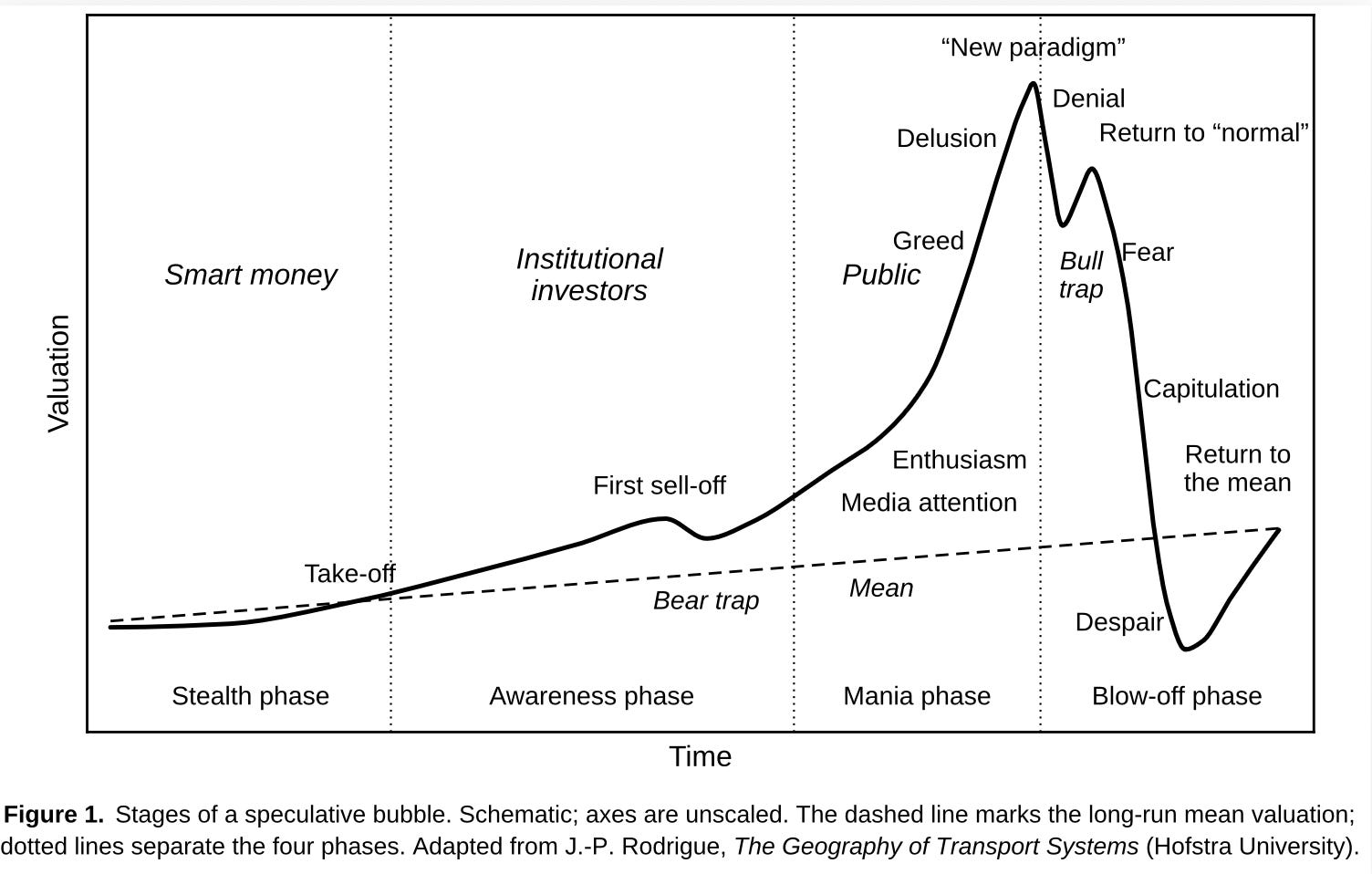
Which brings us back to McNealy.
Sun’s shareholders didn’t just have unreasonable growth expectations. They paid an impossible price, surrounded by speculative behavior, with the Fed tightening.
So, are we in an AI bubble right now?
Well, the guide below will help you answer that.
Just remember that in markets, there’s nothing new under the Sun.
Download the PDF: A complete guide to spotting market bubbles, recognizing the warning signs of financial mania, and protecting your wealth.How To Spot A Market Bubble724KB ∙ PDF fileDownloadDownload 1
Grantham uses two tiers for classifying bubbles. A bubble is a price two standard deviations above trend, and a superbubble is a three-standard-deviation event. He counts five superbubbles: U.S. stocks in 1929 and 2000, Japanese stocks and real estate in 1989, and U.S. housing in 2006 (Grantham (2022), Let the Wild Rumpus Begin, GMO).2
With dividends reinvested, $100 put into the S&P 500 at the start of 2000 was worth about $91 at the end of 2009, while ten-year Treasury bonds returned about 83% over the same years. On price alone, the index did not clear its March 2000 peak for good until March 2013 (Damodaran (2026), Historical Returns on Stocks, Bonds and Bills, NYU Stern).