NVIDIA is backing CoreWeave but the more interesting question is what it’s getting back.
By Polymath Investor
Published: 2026-10-18
URL: https://www.polymathinvestor.com/p/i-looked-at-whats-really-going-on
“Down, down, down. Would the fall never come to an end?” - Lewis Carroll
Ok, on Friday, I went deep down the rabbit hole of CoreWeave’s debt. Today, I’ll look at its relationship with NVIDIA and what the chipmaker’s support really means. That’s the thing with rabbit holes: once you start pulling the thread you keep going deeper and deeper, and every answer seems to lead to another question. Entrenched, Not Committed | Canva
So, what is it? Is NVIDIA a supplier, shareholder, customer or backstop for CoreWeave?
Let’s start with the easier part. The neocloud is expected to spend between $35 and $39 billion on equipment and data centers this year. Let’s recall that at $61.39, the Nasdaq close of October 16, the whole company is worth $33.9 billion.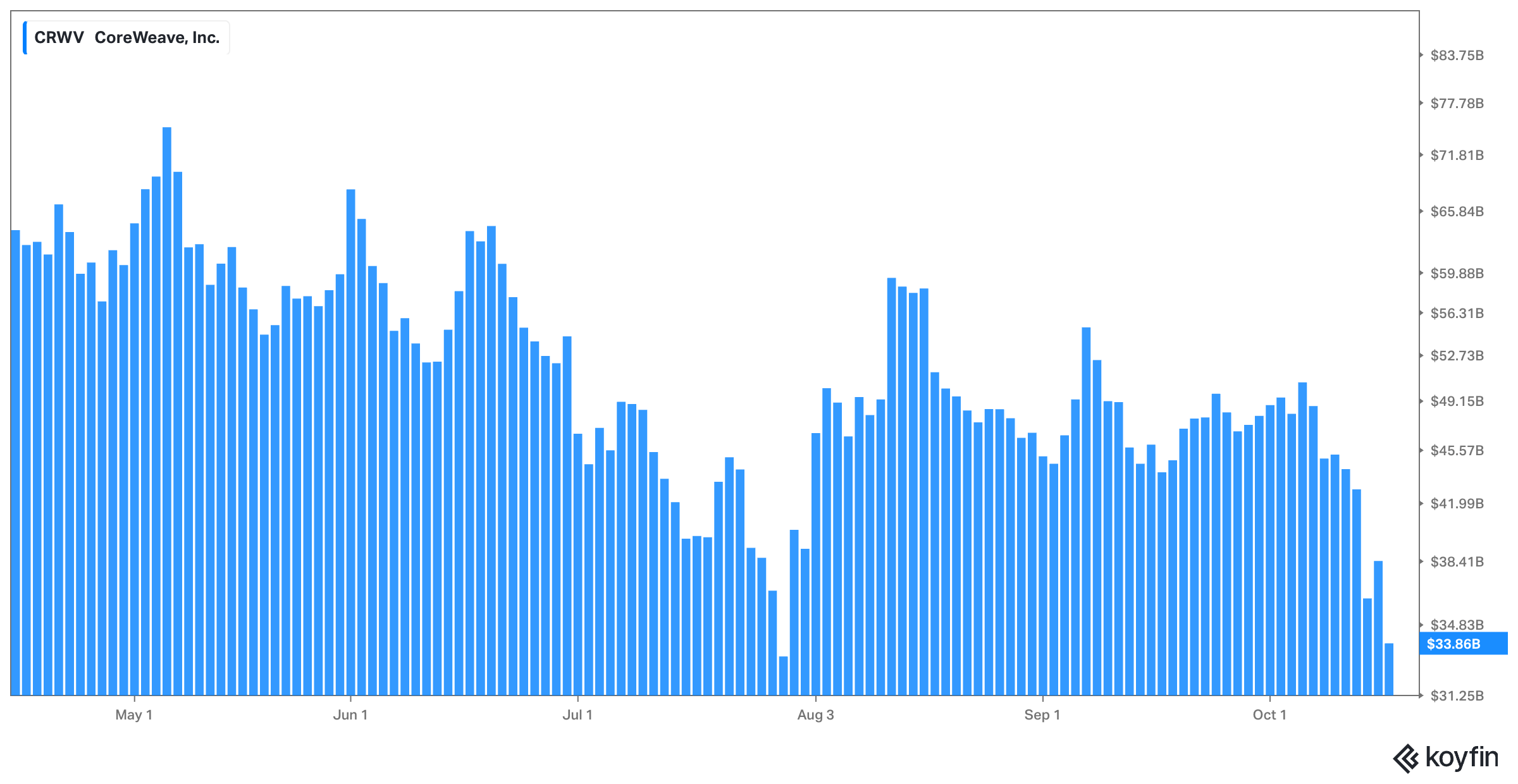 Bet the company | Koyfin
So they are investing a lot, and next year’s bill for new equipment will probably be higher. We don’t know exactly how much of that is NVIDIA chips, since CoreWeave buys some directly and some through server makers and other suppliers. What we do know is that every GPU CRWV runs today is NVIDIA’s, and that is written into its customer contracts.
So they are buying more, and so far only NVIDIA GPUs. That would make Huang’s company a very strategic supplier. Interesting position to be in.
Now, the relationship doesn’t stop there. NVIDIA owns about 8.6% of CoreWeave, buys some computing from it and also acts as a backstop. There’s a history to that, but more on that below.
So who is entrenched in whom?
My answer: both, deeply, but the door only swings one way. The word “circular” comes up in many media outlets, but this looks like a pretty lopsided relationship. Let’s put some numbers to each one1.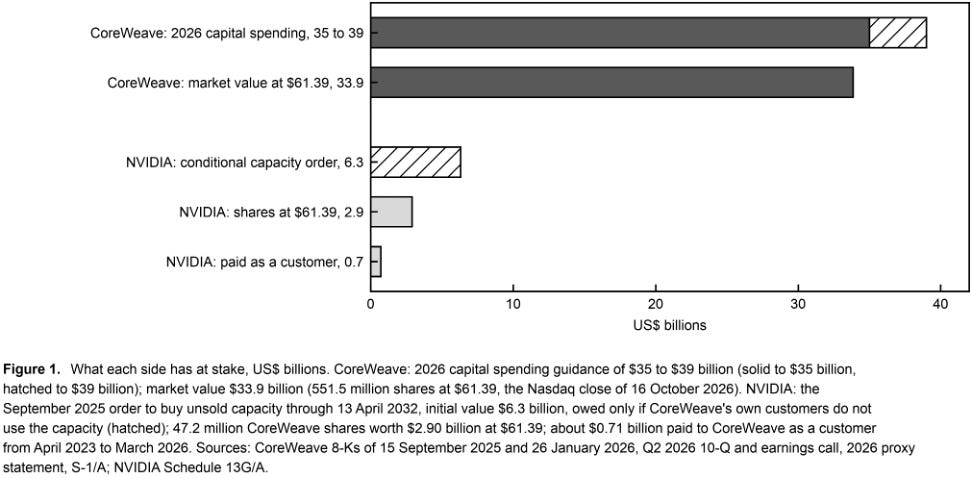
When you look not only at the numbers but also at the strategic angle, you realize that CoreWeave is in a very fragile position. A quote from their proxy makes it even clearer: “As a result of our obligations in our current customer contracts, all of the Graphics Processing Units used in our infrastructure today are NVIDIA GPUs.”
Customers are choosing the chips. At this point CoreWeave could not switch without breaking its current contracts, even if it wanted to.
Last year NVIDIA accounted for 17% of CoreWeave’s purchases directly, and much of the other 83%, I’d infer, went on servers with NVIDIA chips inside. The CEO said as much in August: the product is “NVIDIA infrastructure delivered through our cloud.” Cloud computing. Concrete obligations | Photo: Theodore Christopher / Wikimedia Commons (CC0 1.0).
A $35 to $39 billion build against a market cap of now $33.9 billion means CoreWeave is spending roughly its own worth this year, or a bit more, most of it on NVIDIA systems2. That’s the biggest number one could use to describe the relationship, and most of it flows in NVIDIA’s direction.
So what flows the other way? What could possibly go in CRWV’s favor?
NVIDIA as a shareholder first. NVIDIA held 24.2 million shares after the IPO and now has 47.2 million, after buying 22,935,780 more shares at $87.20 on January 23.
So, 47.2 million shares. What percentage of the total does that represent? CoreWeave’s share count is 551,536,602 shares: 458,871,690 Class A plus 92,664,912 Class B3. So the math is pretty straightforward: 47,213,353 ÷ 551,536,602 = 8.56%, which rounds to 8.6%.
Not so fast: the answer really depends on what you divide by.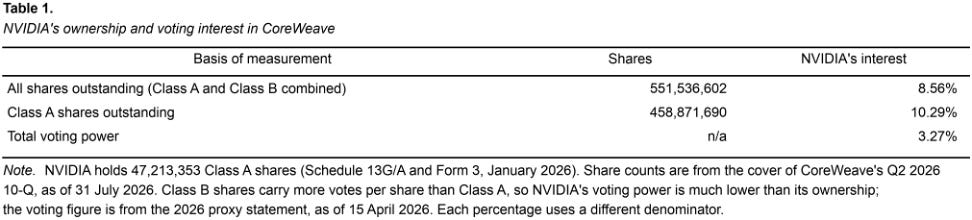
The 10.3% figure is why NVIDIA filed as a “10% Owner” even though it owns 8.6% of the company: the 10% test counts only Class A shares.
Was that, so far, a good investment for NVIDIA? At Friday’s close of $61.39, the stake is worth $2.90 billion4, though the January shares on their own are worth $1.41 billion, down $592 million, or 30%. 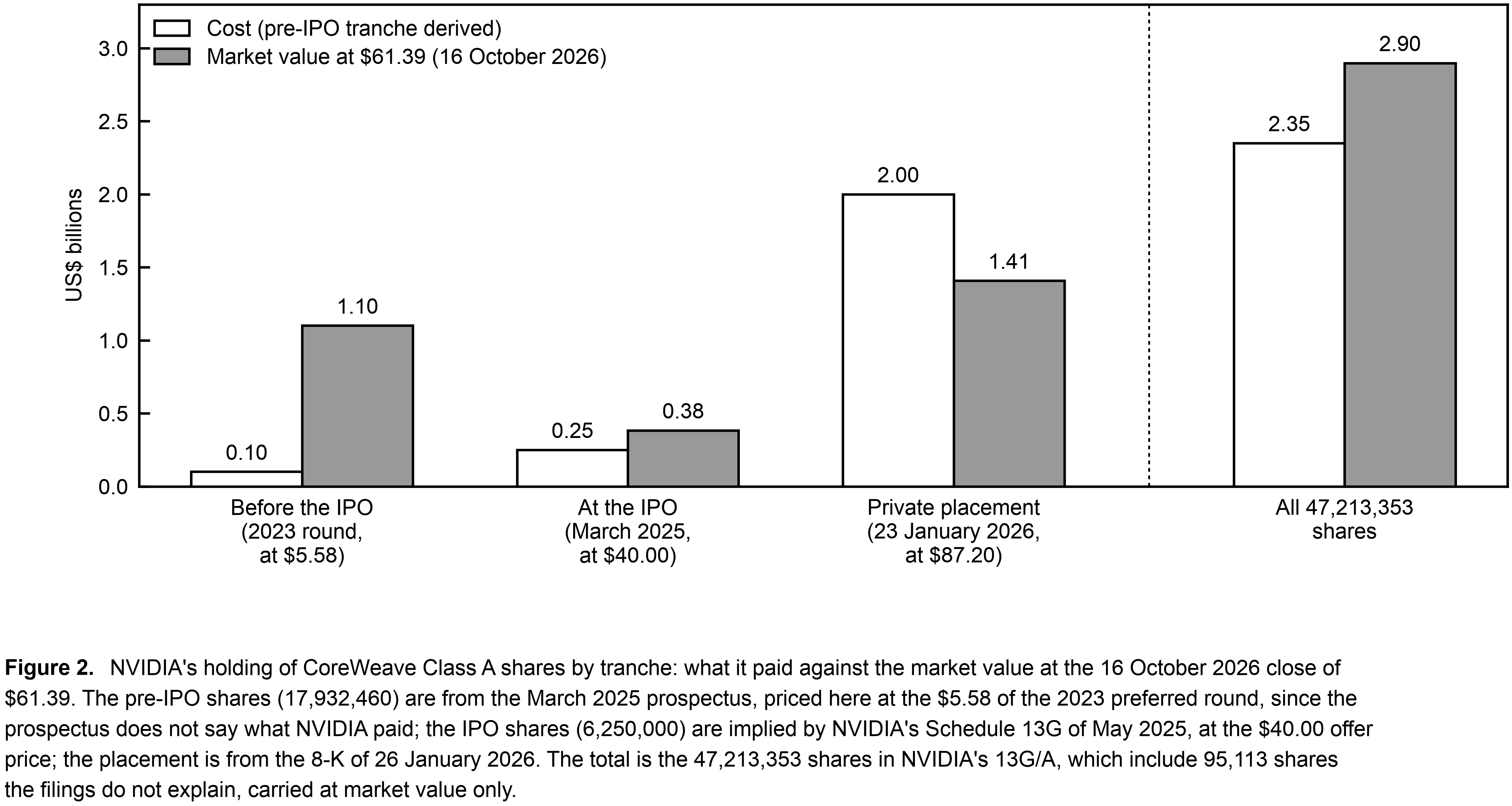
Can NVIDIA easily sell its stock? Presumably.
It has registration rights, so nothing stops it from doing it. This doesn’t help the “who can leave” argument on CRWV’s side. What keeps NVIDIA in place is visibility, but more on that later.
NVIDIA as a customer next. This is, I’d say, the lightest part of the relationship. NVIDIA paid CoreWeave about $320 million from April 2023 through 2024, $326.3 million in 2025 and $59.6 million in the March quarter: about $706 million in three years, 6.4% of 2025 revenue and 2.9% of revenue in the March quarter. Not that significant and not that sticky: 30 days’ written notice of a breach ends the master agreement, and NVIDIA can simply stop placing orders.
NVIDIA as the backstop, finally. NVIDIA promised to buy any computing capacity CoreWeave can’t sell to anyone else, up to $6.3 billion through April 2032. That works out to about $956 million a year5:meaningful, but not life-saving. As far as we know, this promise guarantees capacity, not price.
How do we track how much of this has been used already? CoreWeave reports two numbers, RPO and revenue backlog, and can tells us something.
RPO, or remaining performance obligations, is the contracted revenue they still have to deliver, reported in its financial statements under accounting rules.
Revenue backlog is a much looser measure that CoreWeave defines itself.
What CRWV did was exclude NVIDIA’s backstop from RPO but keep it in revenue backlog. So the gap between the two numbers should roughly be the part of NVIDIA’s promise CoreWeave expects to resell to other clients.
And something interesting happened to that gap over the past two quarters…