An examination of debt, lease commitments, and the cash available to cover them
By Polymath Investor
Published: 2026-10-16
URL: https://www.polymathinvestor.com/p/can-coreweave-crwv-service-its-debt
“If something cannot go on forever, it will stop.” -Herbert Stein
You can’t make this stuff up.
On the October 13 episode of Mad Money, Jim Cramer declared that CoreWeave was the “real deal” and the only neocloud provider he trusted. Naturally, the very next day, the stock plunged 15%.
You’ve probably heard quite a bit about CoreWeave over the past few days, with many news outlets attributing the selloff to the company’s debt. I’ve seen plenty of reporting on the numbers, but little analysis of what’s actually going on beneath the surface of its financial statements (and believe me, there’s a lot going on beneath the surface).
Of course, yesterday the stock was already bouncing back. Apparently, all it took was a little reassurance from the Silicon Sorcerer himself, Jensen Huang, who declared that he was “optimistic” and that “CoreWeave’s strength is improving every day.”
But around here, we don’t take headlines at face value, whether they come from Jim Cramer, Jensen Huang, or anyone else.
So let’s open the books and look at the numbers.
What’s Really Going On With CoreWeave (CRWV)? Outstanding technology, even more outstanding debt | Canva
Mind The GAAP
It starts a few months back, on August 11, 2026, when CoreWeave’s CFO mentioned two relevant pieces of information. Interest expense for Q2 “was $640 million compared to $267 million in Q2 of 2025.” And for the following quarter he said this: “Q3 interest expense is expected to be in the range of $860 million to $940 million.”
Q2 revenue came in at $2.575 billion, meaning interest expense alone consumed roughly 24.9% of revenue. We expect a similar figure in Q3, around 25%.
A quarter of revenue, again, and growing faster than revenue. 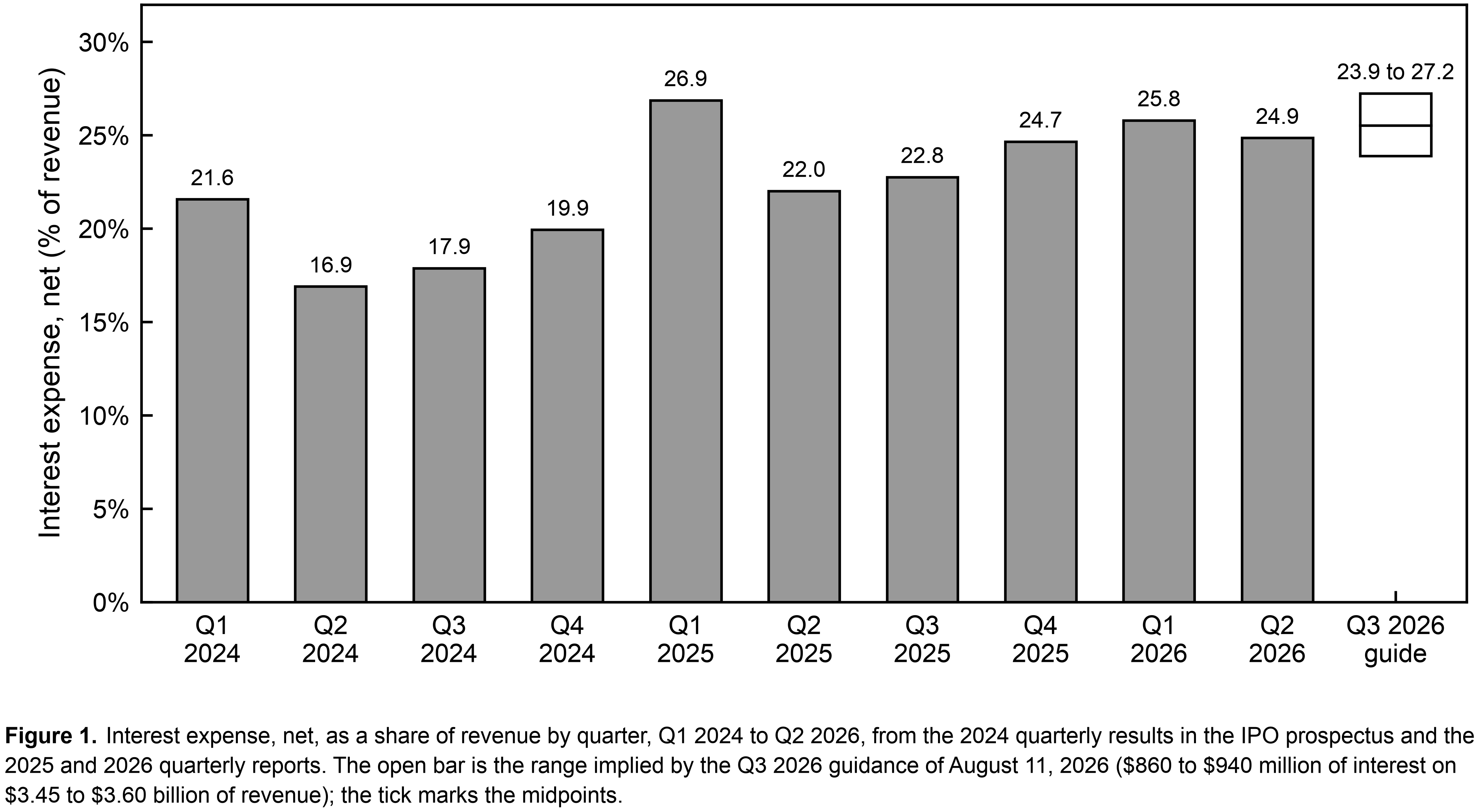
So, can CoreWeave actually service its debt? These days, it seems we have to be precise with our vocabulary. By “service its debt,” I mean something fairly straightforward: pay the interest and repay the principal as it comes due, using the cash the business generates.
Asked that question, and you will probably get an answer mentioning adjusted EBITDA1. For Q2 it was $1.51 billion, an outstanding 59% margin, and with that it covers $640 million of interest 2.4 times. Within that definition, the debt looks fine.
Now let’s look one step down. EBITDA is earnings before depreciation, and CoreWeave’s depreciation in that same quarter was $1.393 billion, more than two times the interest. Factor that into the calculation, and you reach the adjusted operating income: $128 million2. That covers interest 0.2 times.
So, one fifth. That starts to look not so great. And the Q3 guide looks barely better.
But let’s do one more step. Adjusted operating income leaves out share-based pay, $165 million in the quarter. Charge that too, and GAAP operating income is a loss of $49 million.
After the interest, net loss was $626 million.
With all that we can build a little coverage ladder if you will, that can help us assess the trend. 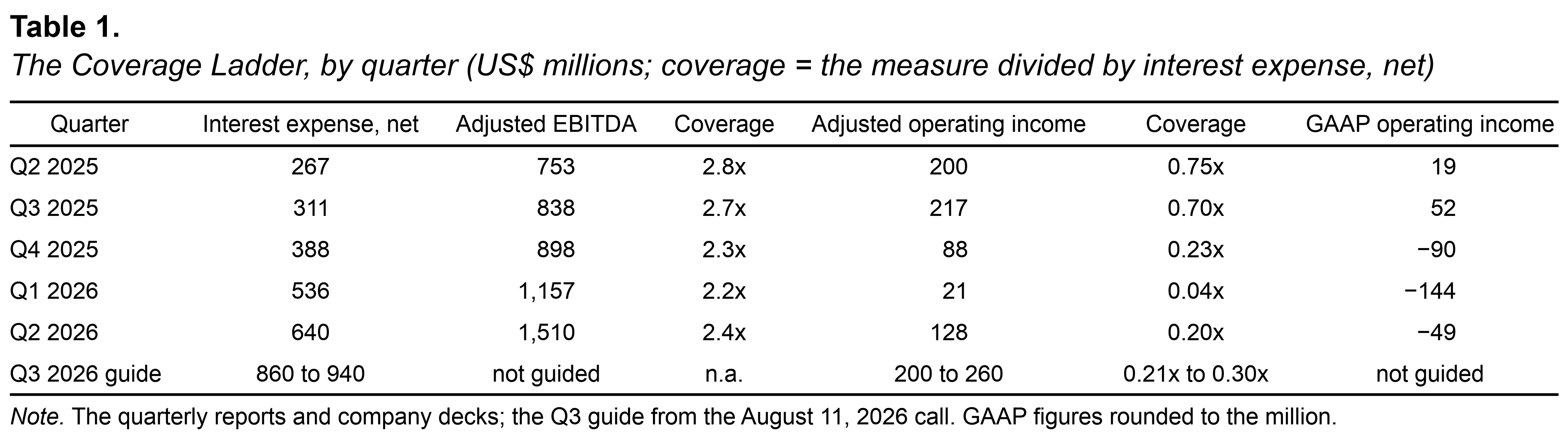
Obviously, depreciation is a real economic cost here. If we were talking about buildings, we could have a different conversation. But when a company’s main assets are servers3 built around NVIDIA’s chips, depreciated over six years, and its loans are repaid from renting those same servers, I’d argue that depreciation is a very real cost indeed.
Now, I know there’s a legitimate debate about the actual economic life of these chips versus their accounting depreciation schedules. I don’t pretend to know the answer. But surely we can agree on one thing: those chips aren’t going to last forever.
Judging CoreWeave’s ability to service its debt based on EBITDA alone is like assessing if a taxi company can afford its car loans by subtracting fuel costs from fares while pretending the cars never wear out.
The Principal Problem
And the loans are coming due. The 10-Q puts first-half debt service at “approximately $6.2 billion, consisting of $5.2 billion of principal payments and $982 million of interest payments.” Operating cash flow in the same six months was $3.7 billion. Scheduled principal is $4.4 billion for the rest of 2026 and $6.2 billion for 2027, before any loan drawn after June.
Ok, so we know there are some obligations coming. So let's try to see what else the company needs to pay. CoreWeave doesn’t own its data centers; it rents all of them, and rent is an operating cost, so it’s already counted in. That’s the good news.
The bad news is the size of these commitments. Operating lease cost was $500 million in Q2, up from $180 million a year earlier, and the leases on the balance sheet carry $29.1 billion of rent still to pay over a weighted twelve years, worth $16.3 billion today at the company’s 10% discount rate4.
Those $16.3 billion are outside the $35.6 billion of principal the company reports under debt (see the Appendix for more on how that debt is structured), and it’s also the smaller part of all the leases: leases signed but not yet started carry a further $35.5 billion of undiscounted rent, plus up to $14.7 billion for one 393-megawatt site whose rent is set as a share of the landlord’s construction cost, so the exact figure isn’t known yet5.
Rent is paid before any lender, and worth saying, long before any shareholder.6
So what does the $1.51 billion of adjusted EBITDA from Q2 really cover, once the rent is paid? Let’s do the arithmetic (mine, and rough). Take out $640 million of interest and you have $870 million left. The servers wore out by $1.393 billion in the same quarter7, and scheduled principal for the second half of the year is about $2.2 billion a quarter.
One quarter’s EBITDA covers the interest, about 60% of the wear on the fleet, and none of the principal.
Let’s now take a look at the cash flow statement.
Advance Warning
Over the twelve months to June, operating cash flow before interest was $8.2 billion, against $7.0 billion of principal repaid and $1.3 billion of cash interest. Not too bad.
But $4.8 billion of that operating cash flow was customers paying in advance for service not yet delivered. Take that out and the business covered 0.41 times its debt service. Prepayments aren’t earnings. Yet.
For 2027, the claims already fixed are $6.2 billion of scheduled principal and roughly $3.2 to $3.5 billion of cash interest at the Q3 run rate: $9.4 to $9.7 billion of debt service, against $8.2 billion of trailing operating cash flow before interest, prepayments included. Rent on leases already running adds $2.1 billion on top.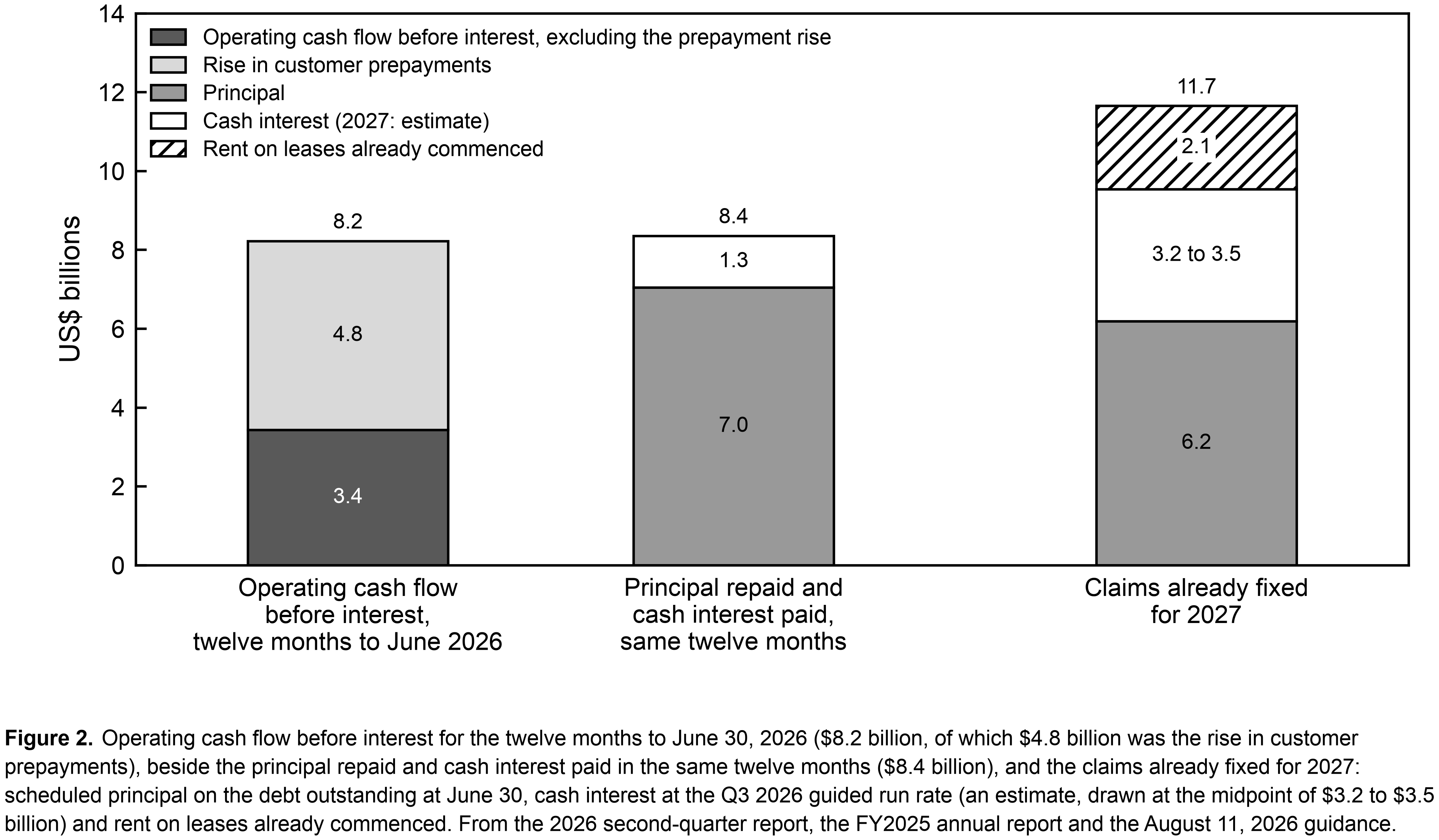
So the claims already fixed for next year come to $9.4 to $9.7 billion, against $8.2 billion of trailing operating cash flow before interest (and that includes the $4.8 billion of prepayments!).
You may say, but growth could make the debt and cash requirements more manageable, right?
Can Growth Outrun the Bills?
That’s the optimistic argument, so let’s look at the numbers.
CoreWeave expects to finish 2026 bringing in revenue at a pace equivalent to $18.5 to $19.5 billion a year. Apply Q2’s 59% adjusted EBITDA margin, and you get roughly $11 billion in annual earnings before interest, taxes and equipment depreciation.
Of course, that’s my rough calculation, not company guidance. As we discussed above, existing debt requires $9.4 to $9.7 billion in interest and principal repayments in 2027. That means you’d have just $1.13 to $1.17 of adjusted EBITDA for every $1 due in interest and principal.
And that’s before accounting for equipment wearing out, new equipment, or principal repayments on loans taken out after June. Still seems a pretty precarious situation.
Even in that scenario there are three catches.
First, customers have already paid $9.7 billion for services CoreWeave still has to deliver8. That money will count as revenue when the services are provided, but you won’t have the cash inflows.
Second, the servers must be bought before they can earn anything. CoreWeave expects to spend $35 to $39 billion on infrastructure in 2026 alone. Over the past twelve months, the business brought in $6.9 billion in operating cash but spent $20.6 billion on equipment, so you have a $13.7 billion gap. Will this repeat in 2027?
Third, each equipment loan is sized so the customer contract behind it is expected to produce $1.15 to $1.40 in cash for every $1 of loan payments. Most of that cash is therefore already spoken for. The parent company must use whatever remains to pay its own share of each new server installation, cover interest on at least another $16.6 billion (see Appendix) of debt, and pay rent on buildings that aren’t earning revenue yet.
Based on the past twelve months, the business isn’t yet generating enough cash to cover all of that.
The Next Lender, Please
So, at the end of the day, who has been servicing the debt? New lenders and new shareholders.
Since June 30 the company has drawn $1.2 billion on a new equipment loan at SOFR plus 5.50%, drawn $1.2 billion on its revolver and sold $4.2 billion of convertibles: $6.6 billion of new money in a quarter in which interest is guided to about $900 million.
So the bond market started to react to all this.