A look at what we know of the company so far
By Polymath Investor
Published: 2026-10-08
URL: https://www.polymathinvestor.com/p/is-anthropic-a-good-business
For all the doom and gloom about how AI might destroy civilization, there’s surprisingly little discussion of how Anthropic looks as a business, on its own business merits.
Who knows? We may learn a thing or two by looking past the headlines and digging into what is actually happening inside the company as it gears up for its IPO.
You may have seen recent headlines suggesting that Anthropic has released its pre-IPO documents, giving investors a detailed look at the business. Well, not quite so.
Anthropic has filed what is called an S-11, but the filing is still confidential and isn’t publicly available. What we do have are some headline numbers reported by Reuters and other media outlets that did have access to the filing, whose main body alone runs 261 pages.
So we still don’t have the full picture.
But between what has emerged from that filing and the stream of announcements and disclosures over the past several months, I think we do have enough to start asking more interesting questions.
So, what can we say about the quality of Anthropic’s business?2
Let’s dig in. Where do you want to go today? | Canva
Last year, 47% of all Anthropic sales were routed through cloud partners Amazon and Alphabet.
Those same two firms own, according to some estimates, somewhere between a quarter and a third of the company.
Those same two firms sell it much of its computing power.
And hey, those same two firms? They also sell rival models of their own.3
So the same companies that own a big part of the firm also help with distribution and supply, and compete with it to some degree.
And this is only scratching the surface of what’s really going on. To give you a sense of the stakes: during the IPO, you will be offered shares in this company at an (estimated) valuation of more than $2 trillion (see below).4 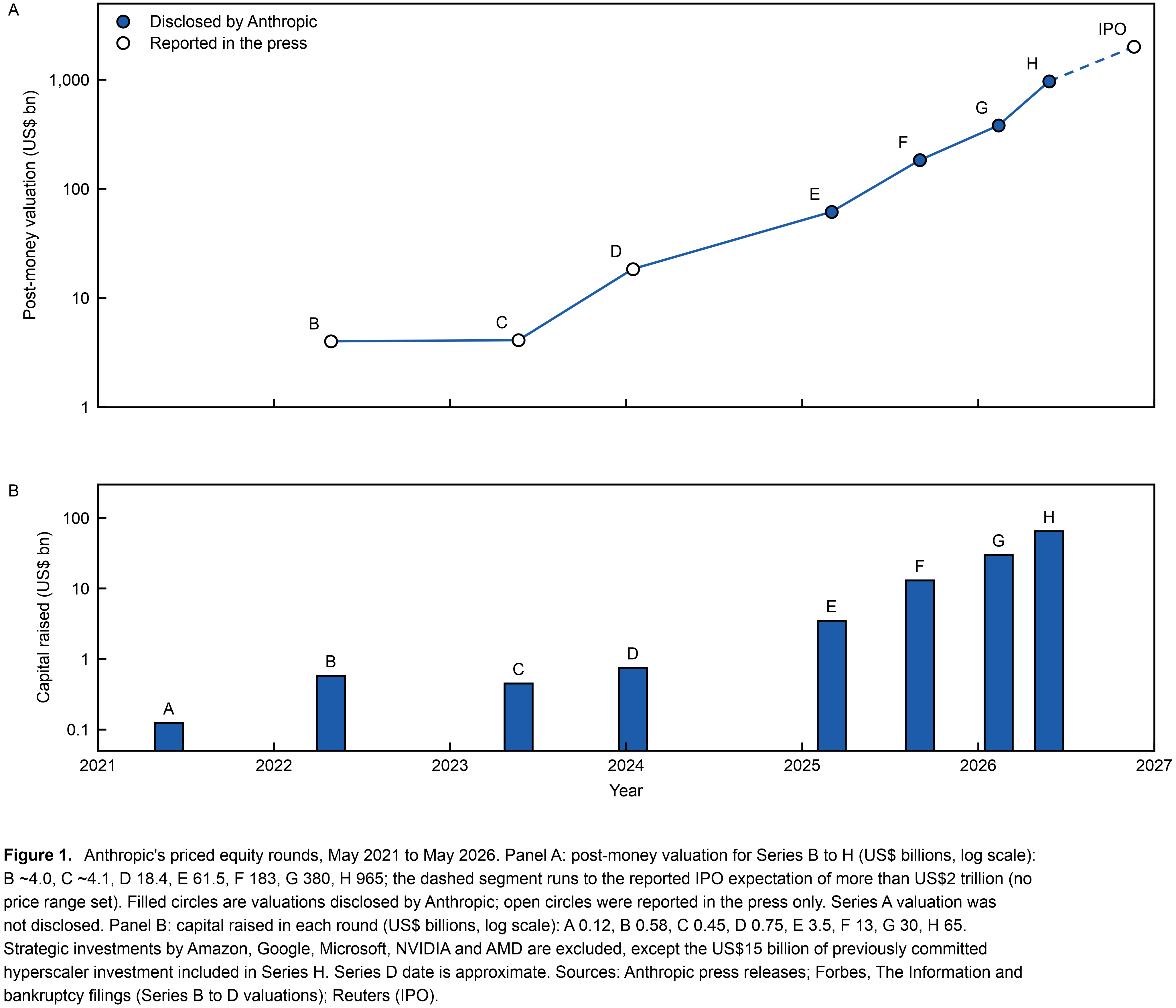
How do you decide if it’s a good investment? Probably the media is going to focus on the insane rate of growth (revenue in 2025: nearly $4.6 billion, twelve times the year before!).
Growth is, indeed, impressive.
But we, astute value investors (?), like to ask other questions.
What’s the real nature of the relationship with Amazon, Alphabet and the other hyperscalers?
The table below shows who led each round. It leaves out the strategic investments by Amazon and the others.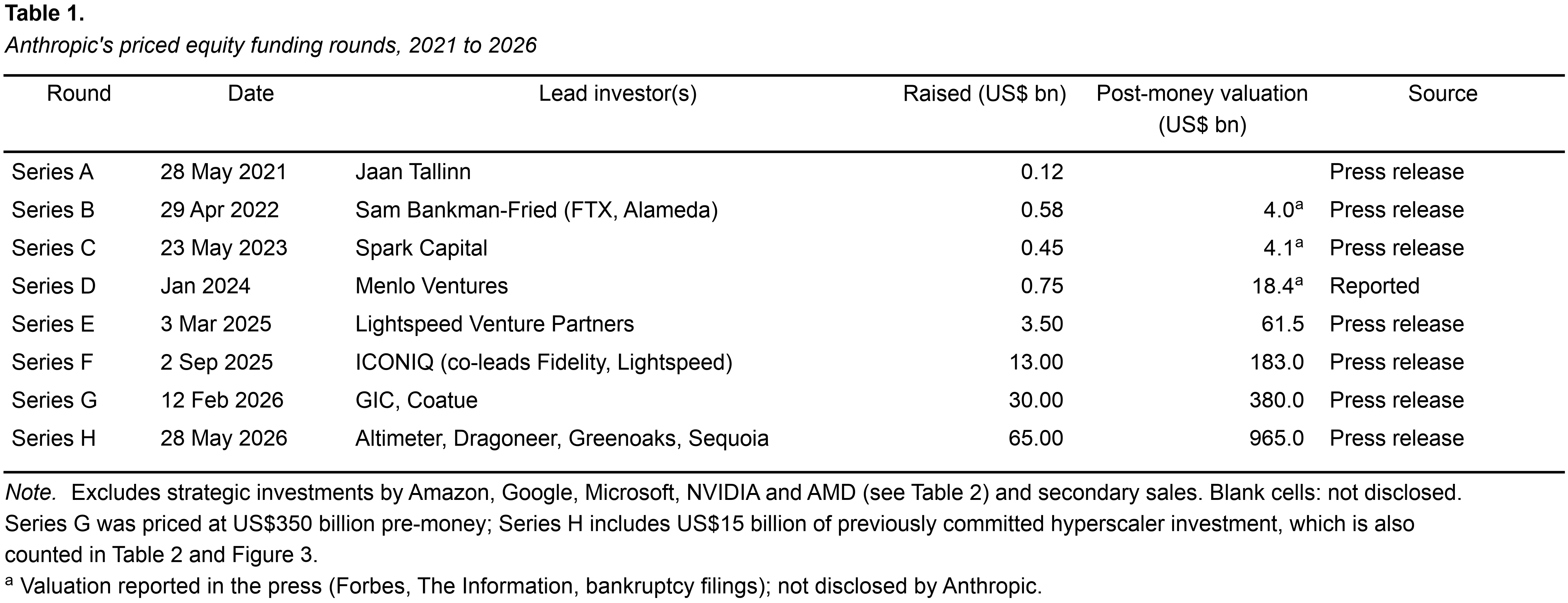
Analyst estimates put Amazon ownership somewhere between 15% and 21%, and Alphabet at roughly 10% to 15%. Call it a quarter to a third of Anthropic owned by these two hyperscalers.
Ok, that’s simple enough. But, as we know, it doesn’t stop there. So, let’s peel the onion, layer by layer.
Five Layers of Entanglement
Anthropic’s relationship with Amazon, Google, Microsoft and now Broadcom is much deeper than simply “they invested in the company.”
There are, at least, five layers to it.
1) Amazon and Google are financing Anthropic.
Amazon has committed as much as $33 billion in total, while Google pledged as much as $40 billion in April alone, on top of what it had already put in. That looks really great for Anthropic because it gives the company massive capital to fund growth.
The table below lists the main strategic investment, compute and financing agreements announced or reported so far.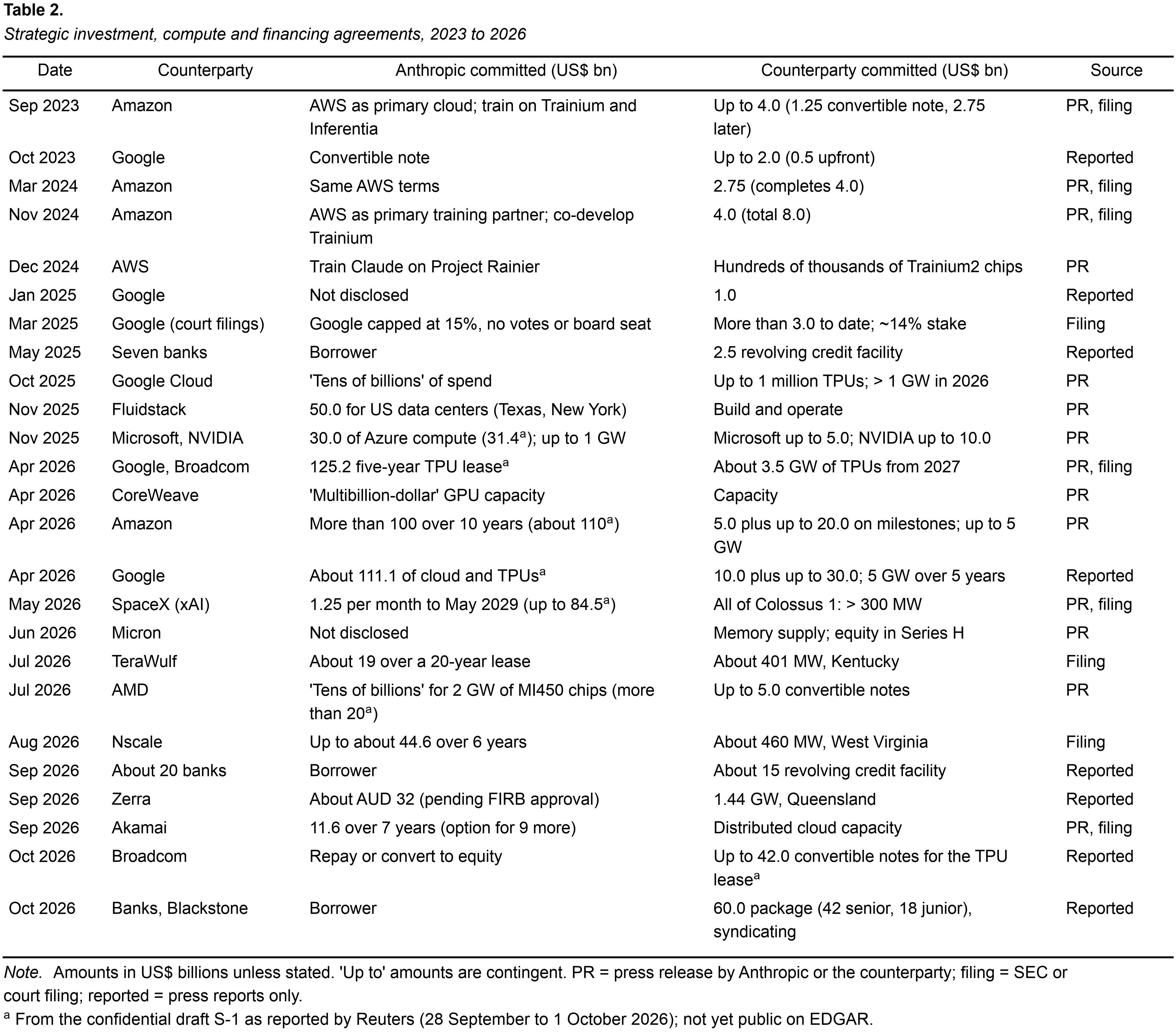
2) But wait. Anthropic is simultaneously committing large amounts of money back to them.
Anthropic has agreed to spend more than $100 billion with AWS over the next decade.
On the Google side, it has committed at least $111.1 billion to cloud and TPU computing capacity. And apparently, the IPO draft lists about $161.2 billion more in equipment leases linked to Broadcom, which helps Google design those chips.
So Amazon and Google are not merely investors. They are also among Anthropic’s biggest suppliers.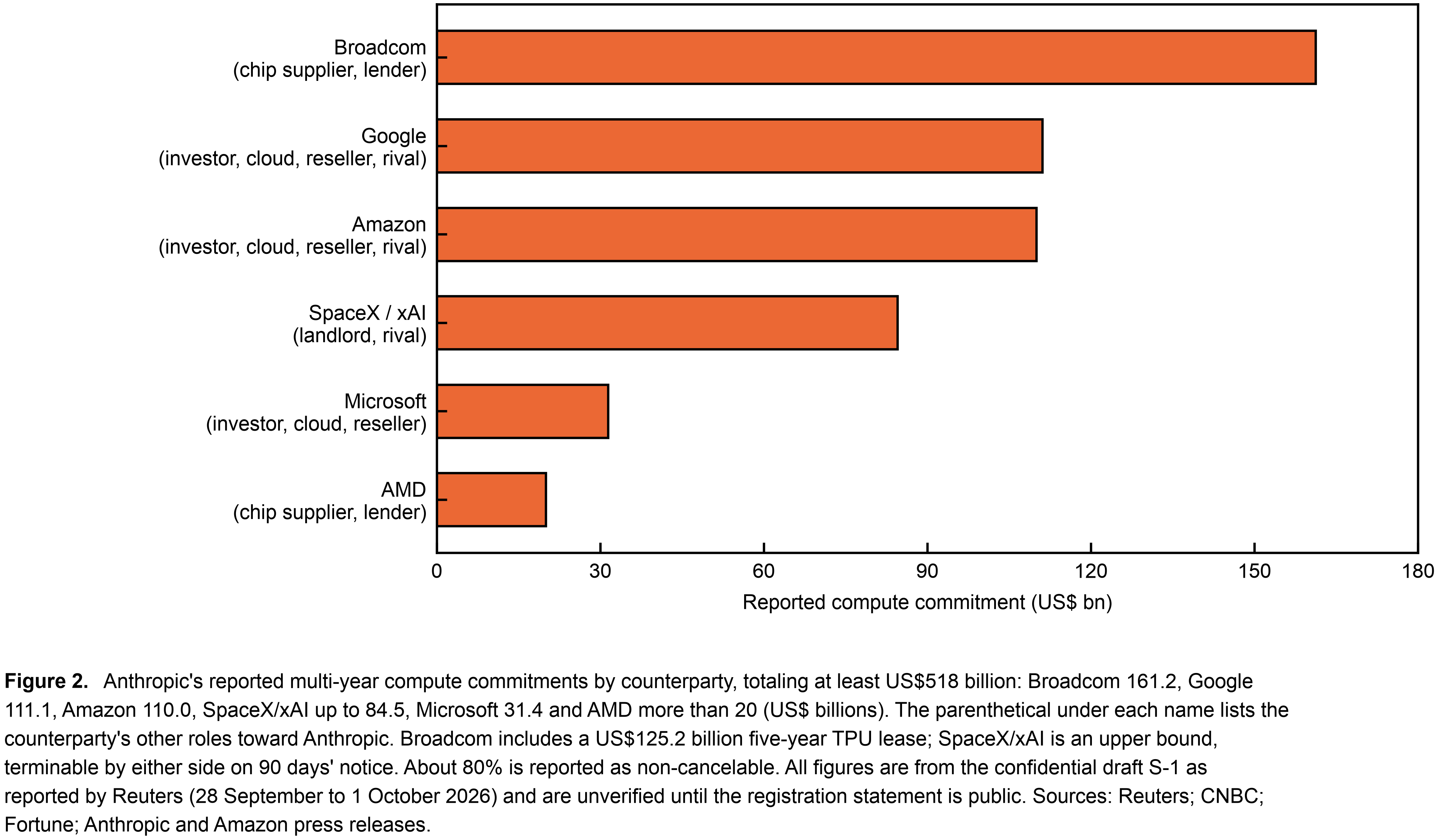
In very simple terms:
Amazon gives Anthropic billions of dollars, but Anthropic then promises to spend vastly more than that buying computing power from Amazon. Same with Google.
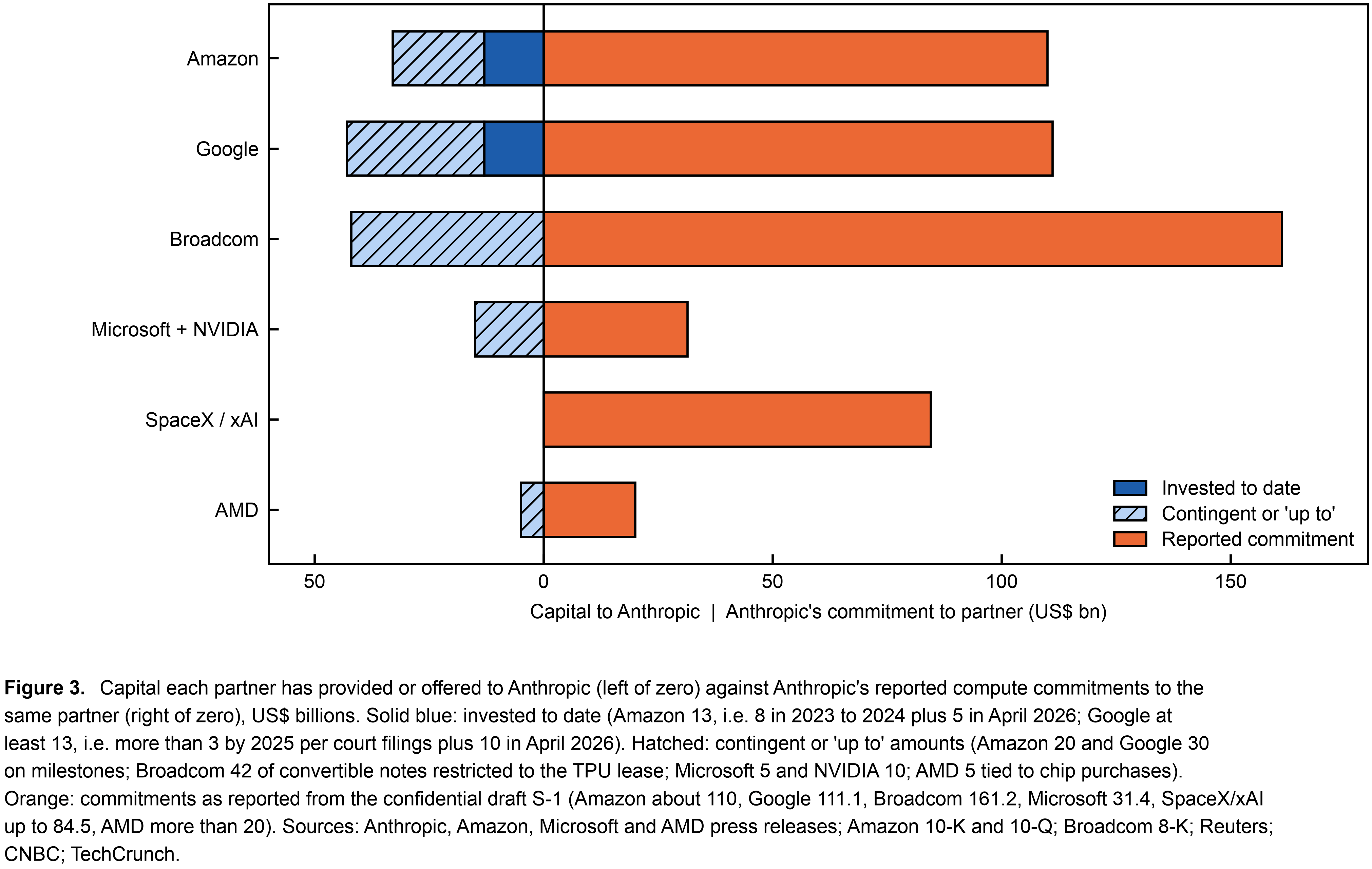
I added a few extra Spidermen so we are covered for future announcements.
3) But, as always, there’s more. Anthropic also relies on these companies to reach customers.
Businesses can buy Claude through Amazon Bedrock, Google Cloud, and Microsoft Foundry instead of buying directly from Anthropic. That channel has become very important from the numbers we can see. Amazon and Google accounted for 11% of Anthropic’s sales in 2023, 32% in 2024, and 47% in 2025, as I mentioned at the beginning.
And on top of the strategic risk, those platforms take a cut. Anthropic paid about $351 million in distribution fees on $2.16 billion of sales flowing through Amazon and Google, roughly 16% (!).
It doesn’t stop there. They also handle much of the billing. At the end of 2025, 60% of the money customers owed Anthropic was actually sitting as receivables with those platforms (!!).
If this were a small-cap, I would probably just keep reading out of curiosity at this point. The business risks of this company are very high (imo).
So Amazon and Google are simultaneously:
investors + suppliers + distributors + payment intermediaries.
4) And they are also competitors.
Amazon and Google have their own AI models and AI businesses. So Anthropic depends heavily on companies that have an economic interest in competing with it. (It even rents capacity from SpaceX’s xAI, another rival, in a deal worth up to $84.5 billion.) Anthropic itself apparently warns in the filing that these relationships could create conflicts of interest and potentially affect its access to computing power.
Even if all of the above hasn’t dissuaded you from buying in the IPO, you would want to understand exactly who has leverage over whom.
5) Despite all that economic dependence, Amazon and Google do not formally control Anthropic.
Anthropic’s seven founders5 will apparently retain 50.1% of the voting power through a special Class F share, while strategic investors get very little voting power.
So that’s interesting: Amazon and Google have enormous economic exposure to Anthropic, but Anthropic’s founders retain control of the company.
At least in theory.
And, in theory, there is no difference between theory and practice. But in practice, there is.
A Matter of Magnitudes
Ok, those are the five layers. But I want to stop for a minute to consider the magnitude of these financial commitments and their trajectory.
At the end of 2025, Anthropic reportedly had about $20.3 billion of cash, versus $54.6 billion of non-cancelable compute commitments. By early 2026, that figure had passed $417 billion, with plans to spend at least $518 billion on cloud and infrastructure over roughly the next decade.
To put that in context, combined capital expenditure (capex) for all major global hyperscalers in 2026 was projected to range roughly between $700 billion and $800 billion. That’s one year of spending, and those are the most profitable companies on earth. Anthropic’s $518 billion is spread over roughly a decade, but it comes from a company with only $4.6 billion of revenue last year.
The issue is not simply whether Anthropic can grow. It clearly can grow extraordinarily fast.
So the most interesting question here is: if Anthropic generates $100 of revenue, how much of that $100 ultimately belongs economically to Anthropic, and how much gets captured by Amazon, Google, Microsoft, Broadcom and other infrastructure providers before Anthropic shareholders see a profit?
To answer that question, we’d have to look at who captures the margin, who has the bargaining power, and how much of its own economics Anthropic controls.
And for that let’s follow the money.
Your Investor, Your Vendor, Your Lender
The most important idea here is the circular flow of money.
Anthropic raises money from companies like Amazon and Google. Then Anthropic turns around and spends enormous amounts of money buying computing power from those same companies.
From the numbers we have, in 2025 alone, Anthropic spent about $7.33 billion on compute and infrastructure, inside nearly $13 billion of operating expenses, while generating only $4.6 billion of revenue.
So let’s take Amazon as an example. Amazon invests in Anthropic. Anthropic then uses some of that money to buy AWS computing capacity. And when customers buy Claude through Amazon Bedrock, Amazon also takes a distribution fee.
That means Amazon can potentially make money from Anthropic in three different ways:
-
It sells Anthropic computing infrastructure.
-
It takes a fee when Claude is sold through its platform.
-
It owns equity in Anthropic, so it benefits if Anthropic’s valuation rises.
Google has a similar setup.
That third part has already become enormous. Alphabet’s stakes in private companies, which its filing says consist primarily of one investment (Anthropic, according to Bloomberg), were carried at about $124.3 billion as of June 30, against a total cost of $47.6 billion.
Then there’s Broadcom, which took this one step further.
Anthropic has reportedly committed to lease $125.2 billion worth of TPU capacity over five years, the biggest piece of the roughly $161.2 billion in Broadcom-linked leases. Reuters reported that Broadcom has also agreed to lend Anthropic up to $42 billion to help pay for that same lease.
In plain English:
Broadcom may lend Anthropic money specifically so Anthropic can use that money to pay for Broadcom-related computing capacity.
But apparently, that loan is convertible.
That means Broadcom could eventually turn some of the debt into shares of Anthropic.
So Broadcom gets two potential benefits:
interest or repayment on the loan + revenue from selling the infrastructure.
And if the loan converts, Broadcom could also become an owner.
Of course, I don’t know the specifics. But apparently Amazon has something similar going on. A significant part of Amazon’s Anthropic investment is apparently held through convertible notes, meaning Amazon is also not simply a passive shareholder. It has financial claims that can become equity.
So, to our initial question, who has the bargaining power?
Anthropic needs staggering quantities of computing capacity to operate and grow. It has already committed to spending more than $100 billion with AWS and huge additional sums across Google, Broadcom, and Microsoft.
Those suppliers largely determine the price of the most important input in Anthropic’s business: compute.
And Anthropic has made many of those commitments (as far as we know) before even proving that the business can generate sustained operating profits.6
These are unusual economics, no doubt about it. But, is there any saving grace?
The Demand Side of the Story
Anthropic may depend heavily on Amazon, Google, Microsoft, and other infrastructure providers, but it still has two very valuable things going for it.
First, customers specifically want Claude.
Amazon, Google, and Microsoft are not distributing Claude out of the kindness of their hearts.
They make competing AI products themselves and if they are willing to offer Claude on their own cloud platforms, it is because their customers are asking for it.
Anthropic has real product differentiation and real customer demand (for now).
That demand is also narrower than it looks. Per Reuters, two unnamed customers each brought in 12% of 2025 revenue, and the filing warns that many of the biggest ones aren’t on long-term contracts.
Second, the growth is extraordinary.
Mind you, the run-rate chart below is on a log scale.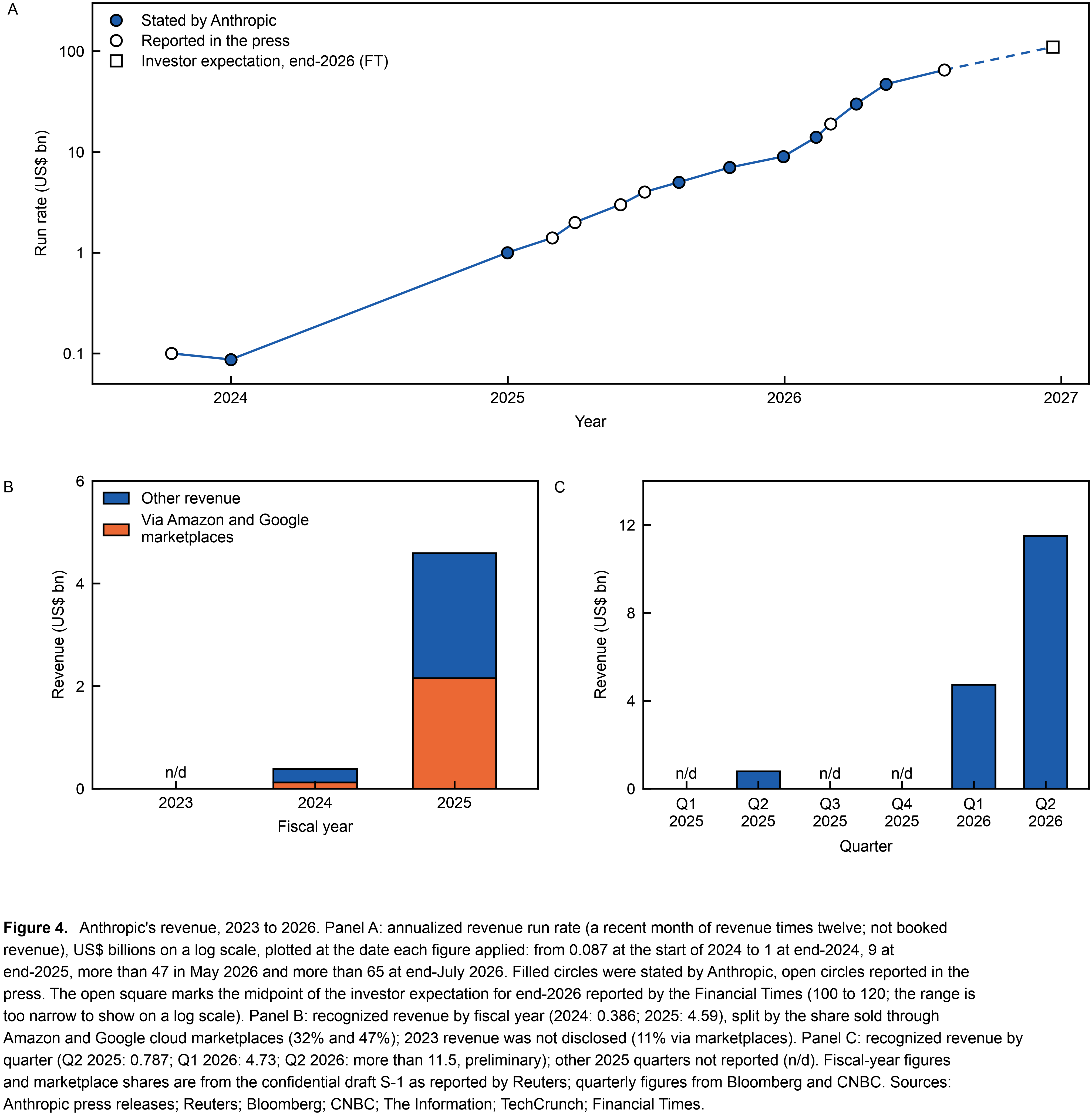
Anthropic reportedly generated more than $11.5 billion of revenue in the second quarter of 2026 alone. Its annualized revenue run rate had already moved above $65 billion by the end of July, versus roughly $9 billion at the end of 2025. It was also reportedly heading toward a second consecutive quarter of adjusted operating profit.
So whatever concerns there are about suppliers, distribution, and bargaining power, this is not a weak company being kept alive by investors.
Customers are adopting the product at a massive rate.
The important question is whether Claude remains meaningfully better or different from competing models.
Right now, that differentiation gives Anthropic leverage.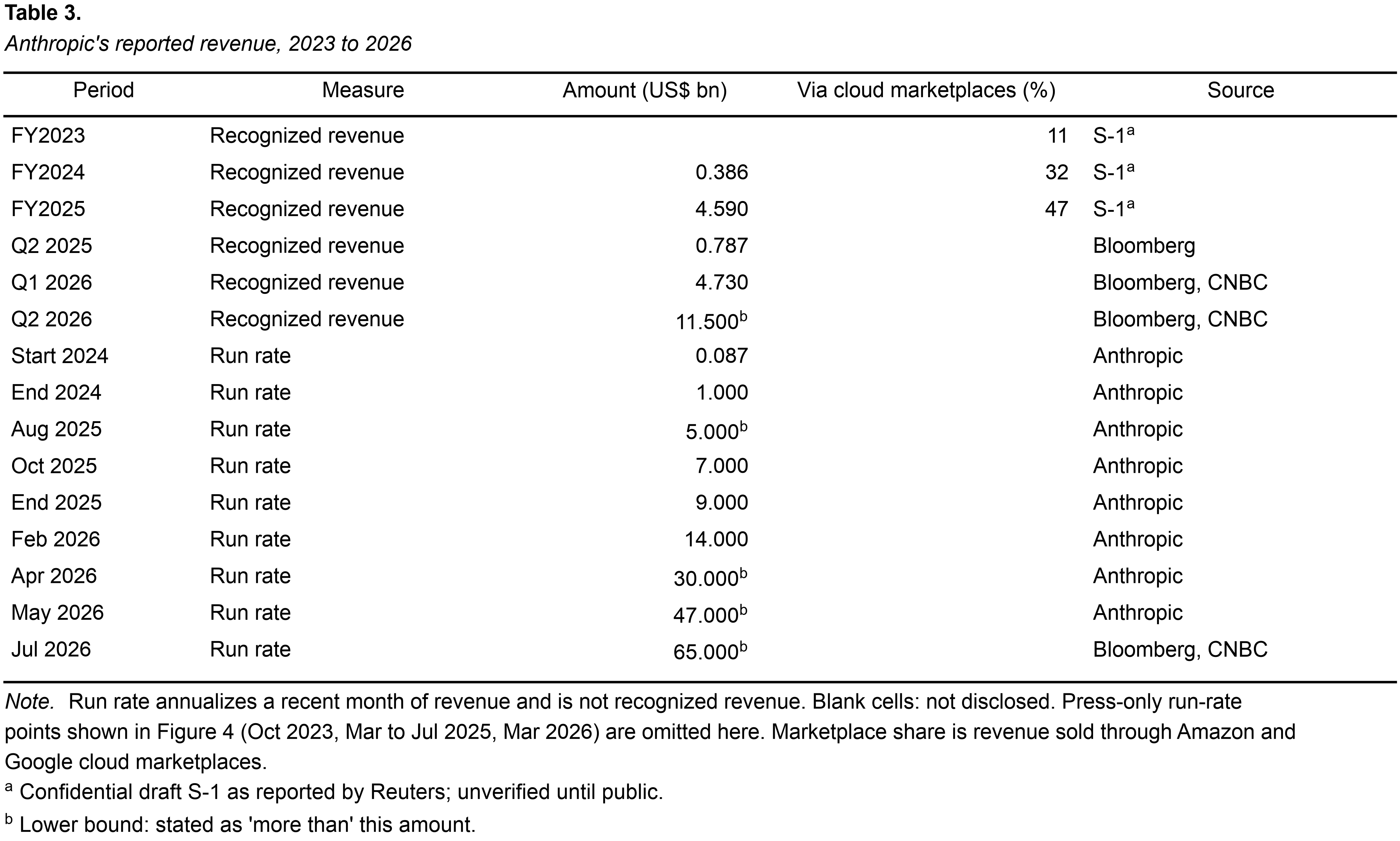
But that advantage could weaken if frontier AI models become increasingly interchangeable. Which… has been known to happen. And what about the open-source models that are good enough?
If customers eventually see Claude, Gemini, GPT, and other leading models as broadly equivalent, then Anthropic loses some of its negotiating power. Customers may simply use whichever model is cheapest or most conveniently bundled with their existing cloud provider.
And that would be particularly important for Anthropic because many of the companies controlling the infrastructure and distribution already have competing models of their own.
So the basic idea is:
Anthropic’s strongest asset today is that customers specifically want Claude. As long as that remains true, Anthropic has leverage despite its dependence on Big Tech. If AI models eventually become commodities, that leverage could disappear very quickly.
My Problem Is Your Problem (If Big Enough)
This wouldn’t be a proper essay if I didn’t make the case against the idea that Anthropic is powerless in these relationships.
Amazon, Google, and Broadcom now depend on Anthropic too.
So Anthropic is not simply dependent on its suppliers. The dependence goes both ways.
The important question, then, is what kind of bargaining power Anthropic actually has.
Most of its leverage comes from being an enormously important customer of Amazon, Google, Broadcom, and Microsoft. Anthropic buys huge amounts of compute, so these companies want to keep its business.
But that kind of bargaining power can be temporary.
Every time Anthropic needs more computing capacity, new chips, new cloud contracts, or distribution agreements, the terms have to be negotiated again. The infrastructure providers still control the underlying assets Anthropic needs to operate.
What’s more: Amazon, Google, and Microsoft have alternatives.
They all have their own AI products or models. So even though they want Anthropic to succeed, they are not completely dependent on Claude. If Claude became less differentiated or Anthropic became less important, they could push their own products harder instead.
Anthropic, by contrast, cannot easily operate without enormous amounts of outside computing infrastructure.
And there, in my view, lies the asymmetry.
But hey, there is one final irony.
Amazon and Google could be the biggest financial winners from the IPO. If Anthropic’s valuation ends up settling above $2 trillion, these two companies will have massive gains on their investments, which could be way higher than any competitive win they could get from pushing their models.
Anthropic needs Big Tech, but Big Tech now needs Anthropic too. The question is which side needs the other more, and whether that balance changes once Anthropic is public.
So, Would I Buy This at the IPO?
A great business owns its margin.
Anthropic doesn’t fully control the economics of its own business.
Its single most important input, computing power, comes largely from Amazon, Google, Microsoft, Broadcom and others. Those companies have a lot of say over what it costs Anthropic to operate.
What matters to us, mere would-be shareholders, is what’s left after the compute bill, the distribution fees paid to the clouds, the cost of financing and everything else. The more of that list is in other companies’ hands, the less of its margin Anthropic owns.
That’s why, when the S-1 is finally available on EDGAR (the SEC’s public filing database), I suspect some of the most important pages in it will be the ones on related parties, where a company has to lay out its dealings with its own big shareholders.
So we have a company entangled with its suppliers, its investors and its distributors, and still carrying some customer concentration. Its product lead gets challenged every other week, as more and more companies around the world release new models.
It’s growing fast, yes, and the technology it’s developing may change the course of human civilization, for better or for worse. But it’s still a gamble.
So, would I buy this at the IPO? Not until I’ve read the related-party pages and seen the price. And it probably won’t be a cheap one.
Anthropic may be an extraordinary company.
But before we decide whether it’s an extraordinary investment, we need to understand how much of the value it creates Anthropic actually keeps.
And that’s not a question we can ask Claude. Not yet.
Disclaimer**This newsletter and any related emails (the “Publication”) are provided for informational and educational purposes only. They do not constitute an offer, solicitation, or recommendation to buy, sell, or hold any security or other financial instrument, nor should they be interpreted as legal, tax, accounting, or investment advice. The Publication is general in nature and has been prepared without regard to the investment objectives, financial situation, or particular needs of any specific person. You should conduct your own independent research and consult with a qualified financial adviser and other professional advisers before making any investment decision. The information contained in the Publication is based on sources believed to be reliable, but its accuracy, completeness, or timeliness cannot be guaranteed. All information and opinions are subject to change without notice. Any forward looking statements or projections are inherently uncertain and actual results may differ materially due to various risks and uncertainties.
Investing involves significant risks, including the possible loss of principal. Past performance is not indicative of, and does not guarantee, future results. The views expressed in the Publication are those of the author(s) in a personal capacity and do not necessarily reflect the views of any employer, affiliate, or other entity. The author(s) and related parties may hold or acquire positions in securities, instruments, or issuers discussed and may buy or sell such positions at any time without notice. Neither the author(s) nor any publisher, affiliate, director, officer, employee, or agent accepts any liability for any direct, indirect, incidental, consequential, or punitive damages arising out of the use of, or reliance on, the Publication.
Jurisdictional and regulatory notices
United Kingdom: This Publication is general editorial content. It is not an invitation or inducement to engage in investment activity for the purposes of section 21 of the UK Financial Services and Markets Act 2000. If you choose to engage in any investment activity, you should rely only on the terms of the relevant offer as set out in the issuer’s prospectus and applicable regulatory filings.
European Economic Area, North America, Australia, and Asia: Distribution of this Publication may be restricted by local law or regulation. It is not intended for any person in any jurisdiction where such distribution would be contrary to local law or regulation. Recipients are responsible for informing themselves about, and observing, any such restrictions that apply in their jurisdiction.
By reading the Publication, you agree that you use it at your own risk and that you are solely responsible for any investment decisions you make. **I use AI for inline editing, proofreading, and as a thinking partner. For longer pieces, I also use it to research and pull together findings from multiple sources, especially science-based research.1
Quick context: since 2017 any company can submit its S-1 (the registration statement that becomes the IPO prospectus) to the SEC privately, fix things with the regulators out of view, and only make it public at least 15 days before the roadshow. Anthropic announced it had done exactly this on June 1, 2026. 2
And this analysis will only take us so far! To determine whether Anthropic is a good investment, we ultimately have to consider price and valuation, which, by the looks of it, won’t be for the faint of heart.3
Amazon changed its strategy on Amazon Nova, but you get the point. 4
The timetable for the IPO has moved twice now. In early September, Reuters reported that Anthropic would start marketing the shares in mid-October at the earliest and list days before the November 3 midterms. By September 28, Reuters was describing the IPO as expected after the midterms, and on October 1 Bloomberg reported the roadshow could start as soon as the week of November 9. Given the 15-day rule, that would put the S-1 on EDGAR in late October. Politics may add a wrinkle of its own: on October 5, Senator Bernie Moreno of Ohio wrote to Dario Amodei, in a letter first reported by Axios, about ordinary American investors: “I do not understand how you can ask them to invest their hard-earned savings in Anthropic’s continued development while warning those same Americans that your product could ultimately lead to their extinction.” I have to say, the senator has a point.5
As Reuters describes the draft, the Class F share sits with a “Founder LLC” controlled by majority vote of the seven co-founders, and Anthropic stays a Public Benefit Corporation, a legal form that lets directors weigh a stated public mission alongside shareholder returns. Ordinary Class A shares get one vote each.6
In 2025, Anthropic reportedly lost more than $8 billion from operations.