The art of asking “why?”
By Polymath Investor
Published: 2026-10-10
URL: https://www.polymathinvestor.com/p/how-id-learn-investing-using-ai
“The mind is not a vessel which calls for filling. It is a pile, which simply requires kindling-wood to start the flame of eagerness for original thought and ardour for truth.” - Plutarch, On Listening to Lectures
I see so many articles about how to use AI for investing, how to use AI for trading (!). You name it. But what I don’t see nearly as often is probably one of the highest-return uses of AI: your own education.
I’d say Socrates was the most consequential teacher in Western civilization.
He taught Plato. Plato founded the Academy and taught Aristotle, and Aristotle went on to tutor a teenager named Alexander, you know, “the Great.”
Teacher, student, student’s student. You can probably trace most of Western philosophy back through that one line.
So, let’s say you and your friends want to learn how to invest in stocks and you hire Socrates. How would that go?
He’d walk into the classroom, put a stock certificate on a table in the middle of the room, and then, silence. It would be up to you to start asking questions: What is it? Who printed it? Why would anyone pay for it?
I made that scene up, of course, but the real Socrates did something pretty close.
In Plato’s Meno, he draws a square in front of a boy who was never taught geometry and asks him how to double its area. The boy gets it wrong twice. Socrates just keeps asking, until the boy finds the answer in a line drawn from corner to corner1.
Allegedly, he claimed: “I am not teaching the boy anything, but only asking him questions.”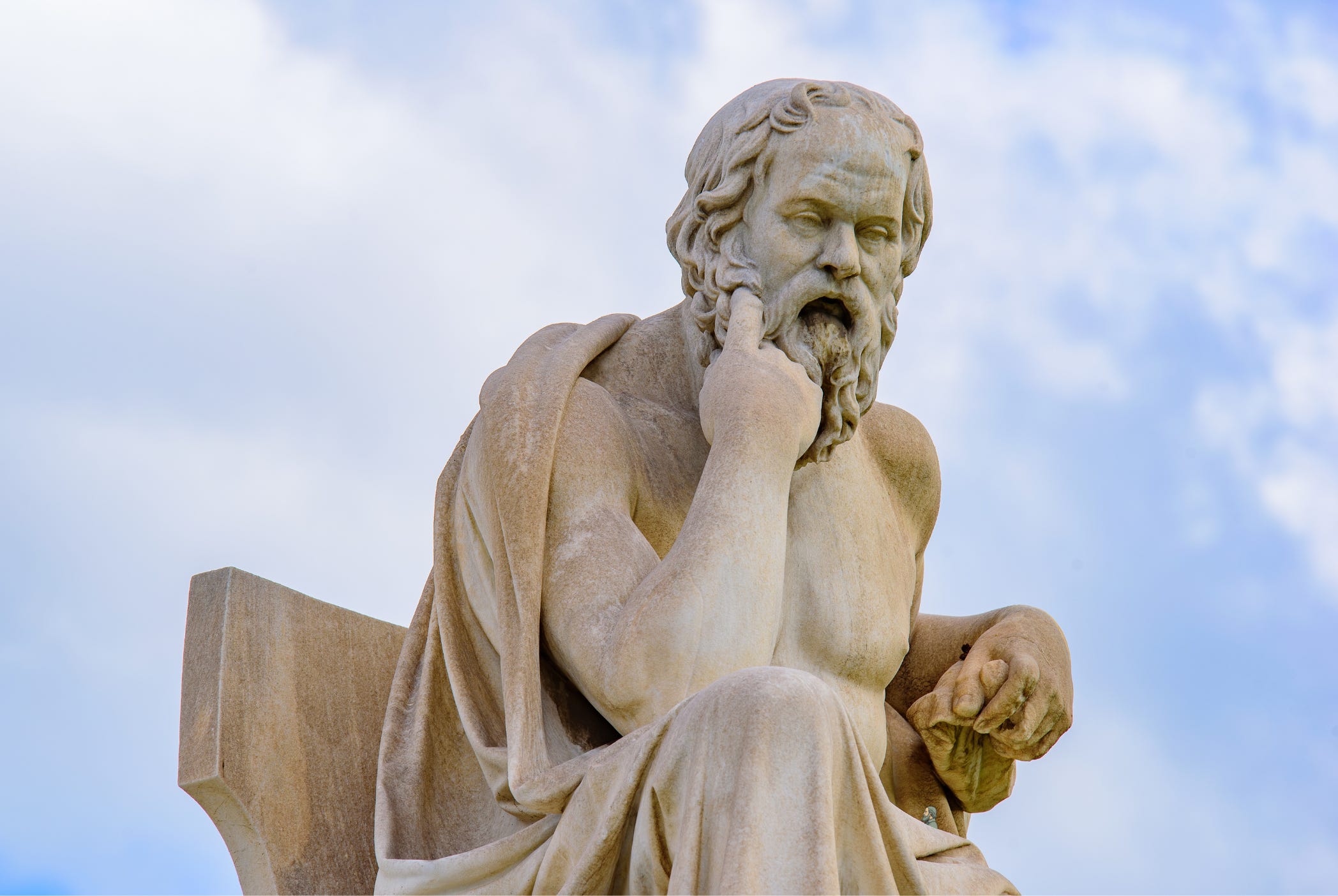 Prompt engineer OG | Canva
Pour In, or Draw Out?
The word education carries a similar idea. It goes back to the Latin educare, to rear, a close cousin of educere: to lead out, to draw forth2.
To draw forth. On that view, a teacher’s job is to pull understanding out of the student, one question at a time.
Now, those of us who went through university usually got the answers first: here’s the formula for what a business is worth, here are the rules, now memorize them.
The conclusions came long before we ever felt the need to ask the questions.
If I had to learn how to invest from zero in 2026, I’d flip the order. I’d reason from first principles, which of course just means asking “why” until you reach some irreducible principle, and then building back up from there.
So which questions? I’d start the same way as that imaginary classroom, with the object on the table and the two questions a child would ask.
What is a stock? And why would anyone buy one?
So, What’s New?
Two things.
1) A Socrates on demand.
In 400 BC, you would have had to travel all the way to Athens to find him. Today, you can just ask your friendly AI model, which has two advantages:
-
You have unlimited credit to keep asking why.
-
You can ask the most ridiculous questions, and nobody is going to judge you.
After you have some basic understanding or you’ve reached a milestone, you can even flip the roles and tell it: just ask me questions until I can explain it back to you.
2) Unlimited artifacts (small interactive apps).
Socrates needed a square, or some physical object, to make his lesson work. Until recently, you needed a developer to code something that had any semblance of helping with learning. Now you have unlimited artifacts.
I’d argue the second one is the bigger deal, so I built one to show you. It’s called The Price-Value Gap3. There’s even a made-up company at the beginning! It’s called Millbrook Pumps, and each of the four chapters helps clarify some investment concept with interactive dials.
Let’s walk through them.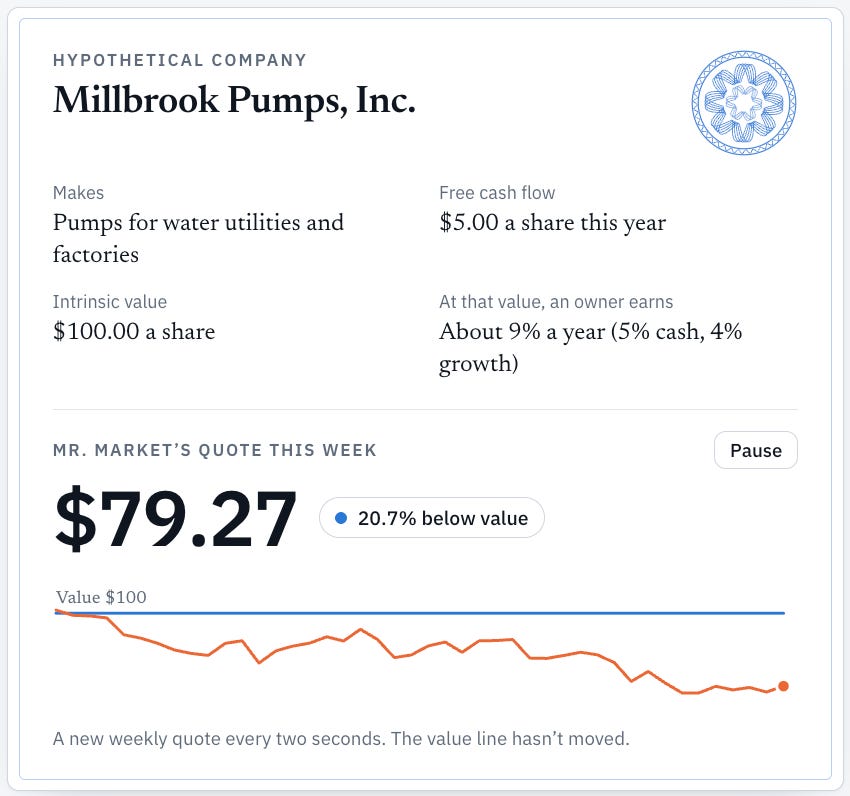
1) What’s a Stock, Again?
As we know, a stock is a piece of a business.
Think of the bakery on your corner. If the owner sold you a slice of it, you’d be entitled to a share of whatever the bakery earns, for as long as it stays open.
Millbrook makes pumps for water utilities and factories, and not much about that business changes from one week to the next. The next question writes itself: why does the stock price change every few seconds if the business changes much more slowly?
Ben Graham gave us the classic metaphor of Mr. Market. He asked us to imagine a business partner called Mr. Market who offers to buy your piece of the business or sell you his, every single day. Some days he’s euphoric and wants to buy your part of the business at exorbitant prices, and other days he’s gloomy and he would only pay so much.
Chapter 1, “Meet Mr. Market,” tries to represent that lesson with twenty years of weekly prices. In a typical year the price moves 22%, and the business itself moves 4%, but you can change that using dials and see the effect.
Same company, two very different lines.
Now turn down the dial called “How far price strays” and Mr. Market calms down, the two lines hug each other, and there’s almost nothing left to buy cheap.
So price volatility is the friend of the value investor.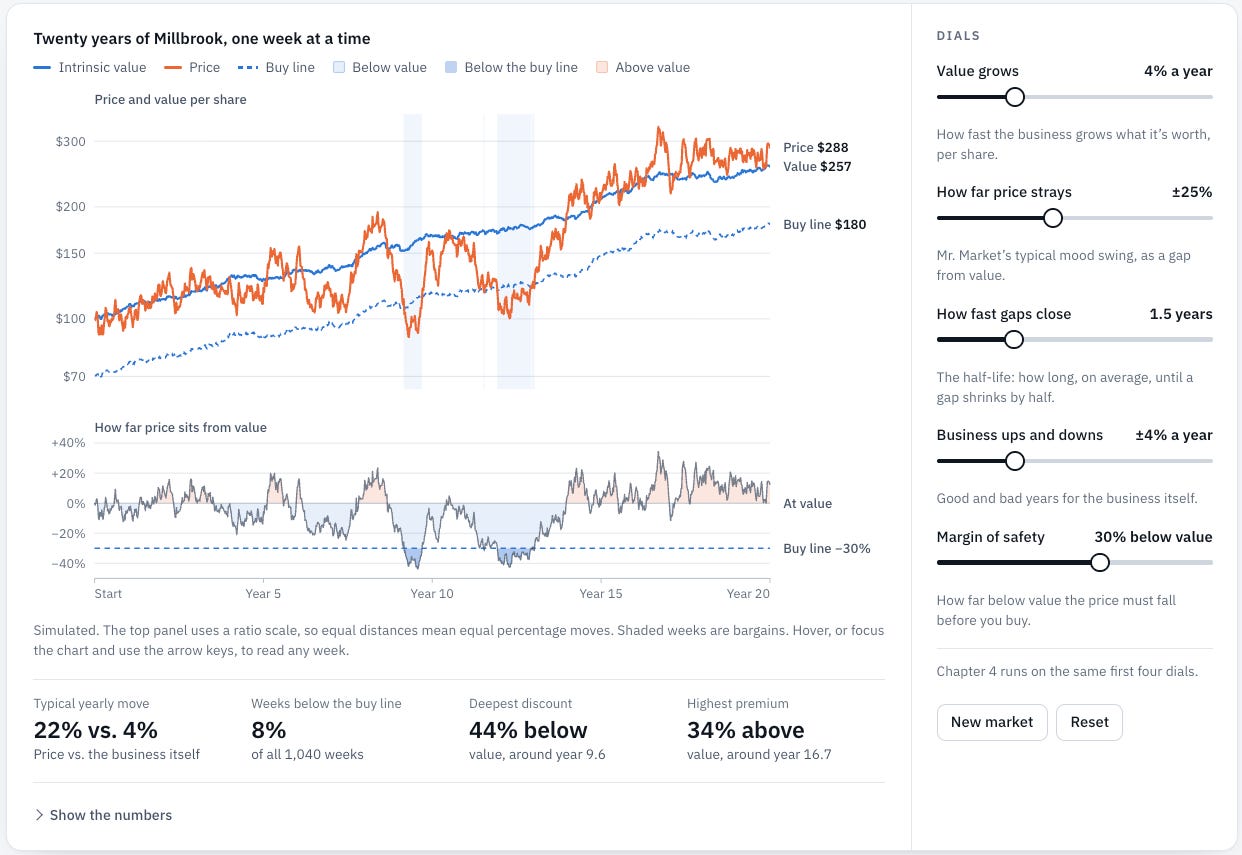 Chapter 1: Meet Mr. Market
2) Why Would You Buy a Stock, Then?
For the cash.
Theory tells us that a business is worth the cash it will produce for its owners, with each future dollar discounted to the present.
Millbrook produces $5.00 of free cash flow per share this year, meaning the cash left over after running the business and paying for its own growth4.
How fast will that grow? Nobody knows for sure, so in Chapter 2, you have to imagine three stories about the next ten years5: 1) a pessimistic one where let’s say cash flow grows 1% a year, 2) a base case at let’s say 5%, and 3) an optimistic one at 9%.
They work out to $63, $100 and $136 of value per share.
Value is a range, never a single number.
You can also look at the classic reverse DCF. What is the growth assumption if the current price is $80? 2.6%. What is the growth assumed if the price is $150? 10.3%.
Are those growth rates realistic? Only a deep knowledge of the business would tell.
At that point, “is this cheap” has become something you can go and check.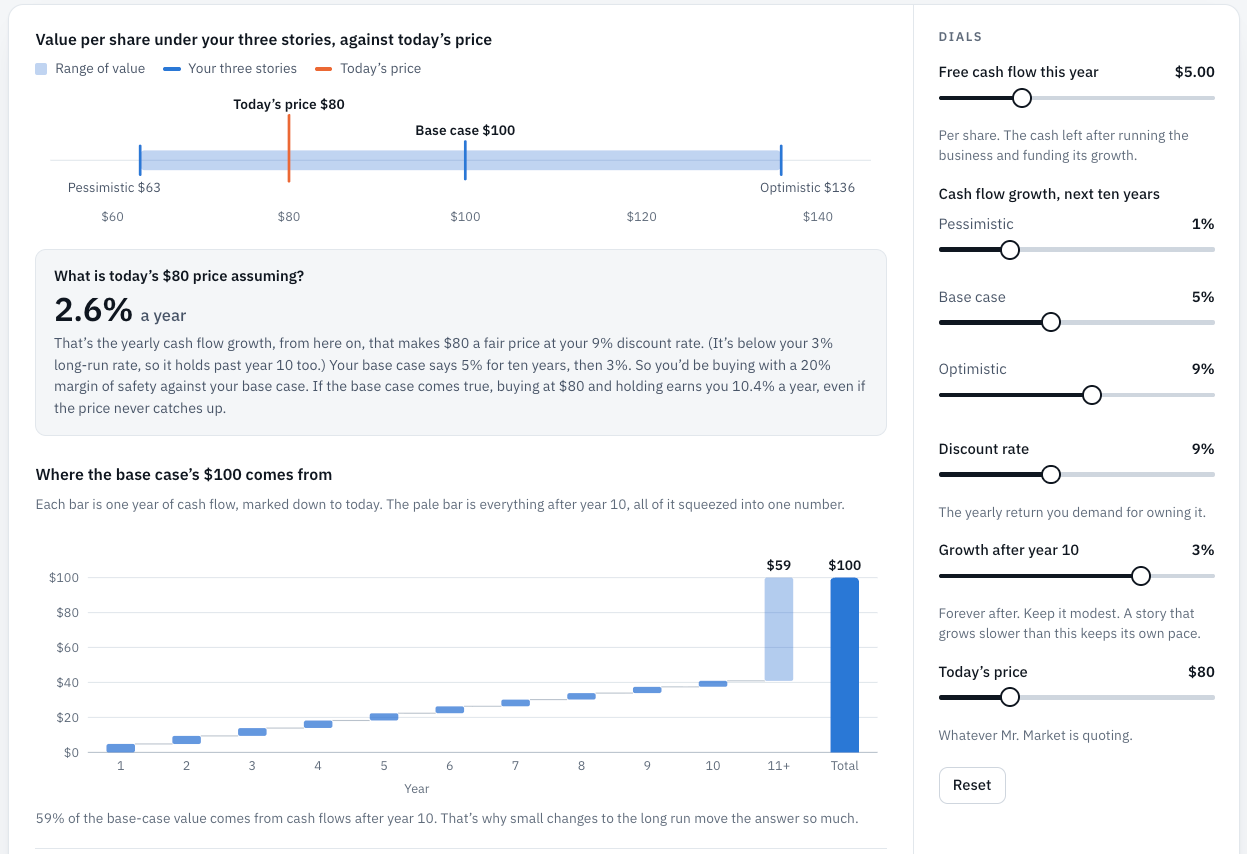 Chapter 2: Where Does Value Come From?
3) Why Is It Rational to Buy at a Discount?
If you’ve followed along so far, you may be thinking: my estimate is a range and I could be wrong, so why not insist on paying less than I think it’s worth?
That’s Graham’s margin of safety, and Chapter 3 shows that it is a rational thing to do for two reasons.
Let’s put some numbers to it. You pay $70 for a share worth $100, and that value grows 4% a year and pays 5% in cash. If the price catches up in three years, you earn 23.5% a year, and if it takes ten, you earn 14.0%. And if it never catches up, you still earn 11.1% a year, against 9% at a fair price, as long as the gap doesn’t get wider.
So the discount adds return when you’re right and cushions you when you’re wrong.
On the other hand, if you overpay, you get the same math but running against you: pay $150 for that same share, let the price drift back to value over ten years, and you’ve earned 3.8% a year from a business that compounded at 9%.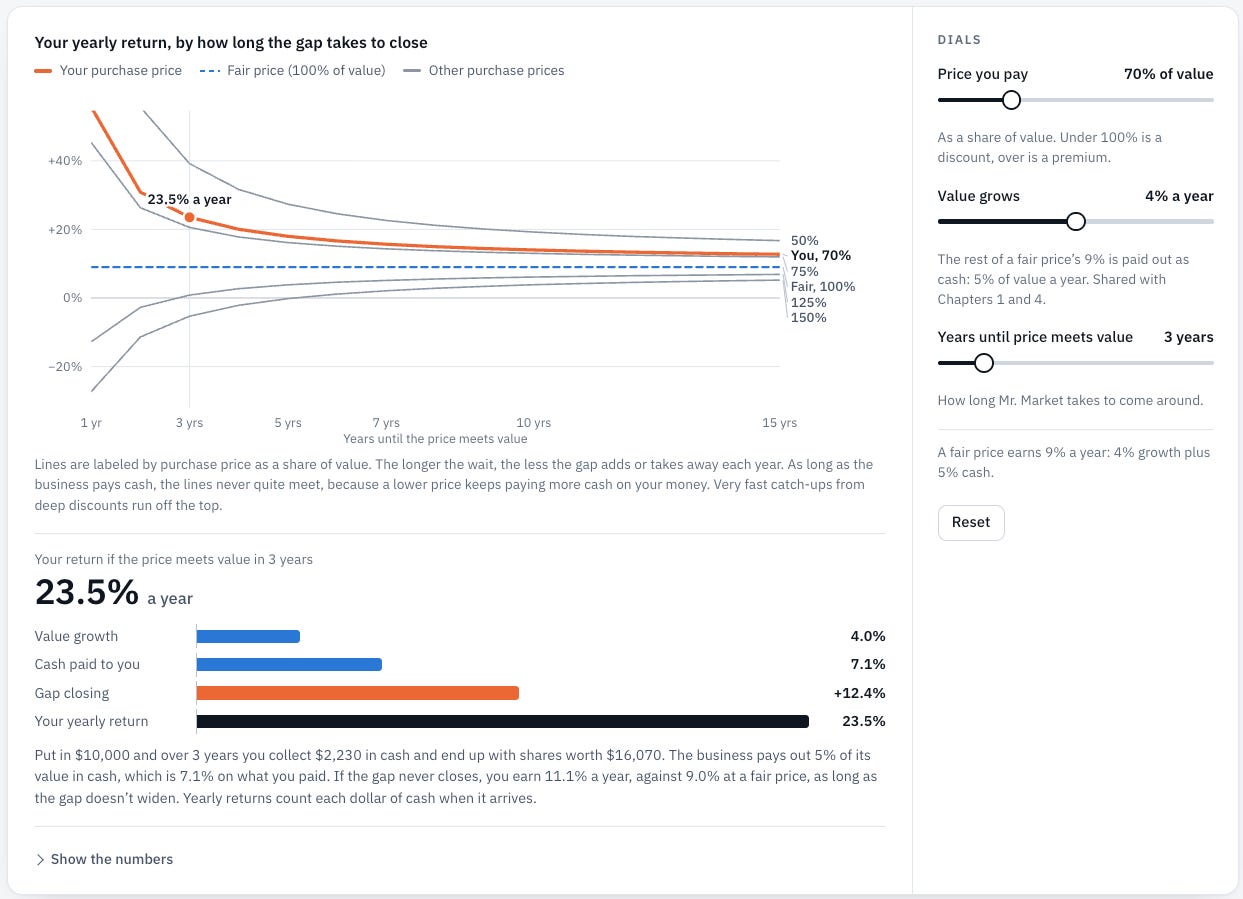 Chapter 3: What Does a Discount Buy You?
4) And When Do I Get Paid, You Say?
Graham had a line for this too, passed along by Buffett: in the short run the market is a voting machine, and in the long run it’s a weighing machine.
Chapter 4, “Votes Today, Weight Later,” tests it with 1,000 simulated investors who each buy Millbrook on a random day and then hold. After one year, the middle 90% of them earned anywhere from negative 24% to 57%, and one in three lost money. After twenty years, the range shrank to between 5% and 13% a year, and nobody lost money.
Same business, same 9%, and the only thing that changed was how long they waited.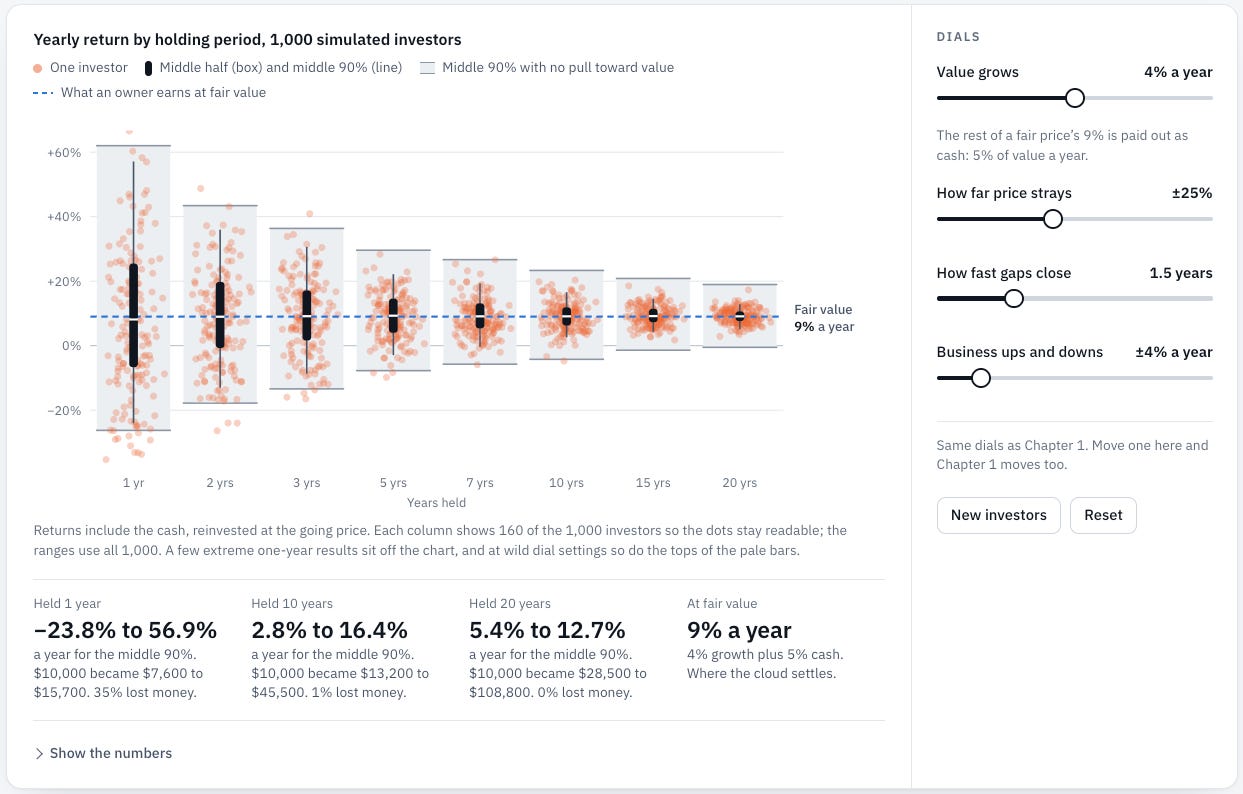 Chapter 4: Votes Today, Weight Later
Final Thoughts
Back to our certificate on the table.
We asked four questions, building our understanding step by step, chapter by chapter.
With the help of the dials we were able to internalize the questions better and play unlimited what-ifs.
That’s what to draw forth looks like.
Socrates made do with a rudimentary square and a boy willing to be wrong twice. You have infinite charts and a tutor that never gets tired of “why.”
So ask the next question.
Uninspired? 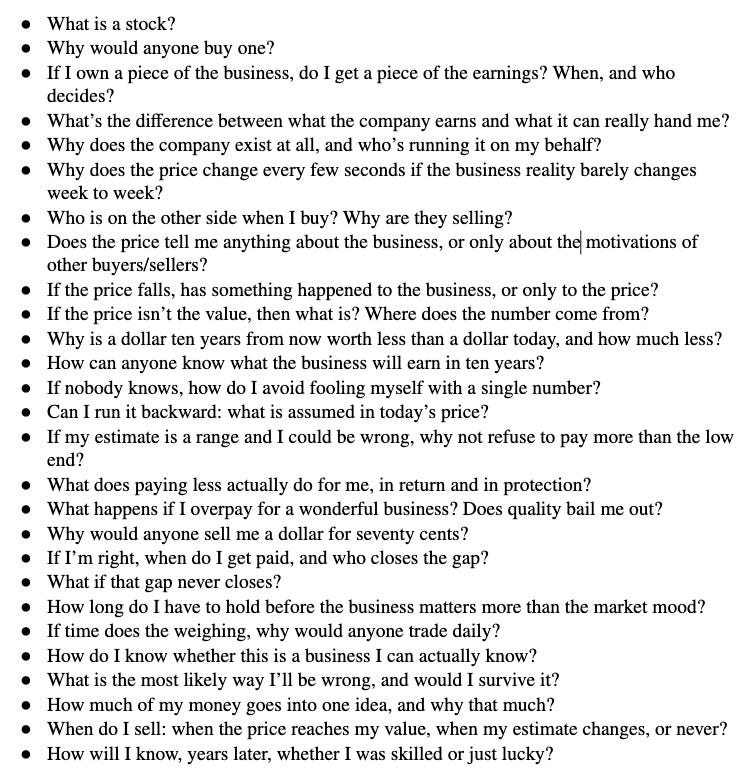
Disclaimer**This newsletter and any related emails (the “Publication”) are provided for informational and educational purposes only. They do not constitute an offer, solicitation, or recommendation to buy, sell, or hold any security or other financial instrument, nor should they be interpreted as legal, tax, accounting, or investment advice. The Publication is general in nature and has been prepared without regard to the investment objectives, financial situation, or particular needs of any specific person. You should conduct your own independent research and consult with a qualified financial adviser and other professional advisers before making any investment decision. The information contained in the Publication is based on sources believed to be reliable, but its accuracy, completeness, or timeliness cannot be guaranteed. All information and opinions are subject to change without notice. Any forward looking statements or projections are inherently uncertain and actual results may differ materially due to various risks and uncertainties.
Investing involves significant risks, including the possible loss of principal. Past performance is not indicative of, and does not guarantee, future results. The views expressed in the Publication are those of the author(s) in a personal capacity and do not necessarily reflect the views of any employer, affiliate, or other entity. The author(s) and related parties may hold or acquire positions in securities, instruments, or issuers discussed and may buy or sell such positions at any time without notice. Neither the author(s) nor any publisher, affiliate, director, officer, employee, or agent accepts any liability for any direct, indirect, incidental, consequential, or punitive damages arising out of the use of, or reliance on, the Publication.
Jurisdictional and regulatory notices
United Kingdom: This Publication is general editorial content. It is not an invitation or inducement to engage in investment activity for the purposes of section 21 of the UK Financial Services and Markets Act 2000. If you choose to engage in any investment activity, you should rely only on the terms of the relevant offer as set out in the issuer’s prospectus and applicable regulatory filings.
European Economic Area, North America, Australia, and Asia: Distribution of this Publication may be restricted by local law or regulation. It is not intended for any person in any jurisdiction where such distribution would be contrary to local law or regulation. Recipients are responsible for informing themselves about, and observing, any such restrictions that apply in their jurisdiction.
By reading the Publication, you agree that you use it at your own risk and that you are solely responsible for any investment decisions you make.**I use AI for inline editing, proofreading, and as a thinking partner. For longer pieces, I also use it to research and pull together findings from multiple sources, especially science-based research.Artifact disclaimer: The interactive artifact linked in this Publication (“The Price-Value Gap”) is provided solely as an illustration for educational purposes. It is based on a hypothetical company and a simplified model, may contain errors or omissions, and should not be relied upon for any investment decision.1
The Meno is one of Plato’s dialogues, the boy is one of Meno’s slaves, and the quote comes from Benjamin Jowett’s translation. Astute readers may argue that Socrates is leading the witness. Fair. But a lead is all a good question is, and the boy still does the walking.2
For the Latin sticklers out there. The English word comes through educare, to rear or bring up. “Drawing out” belongs to its cousin educere. I’m keeping the image anyway, because it describes the method.3
A note on the artifact: The Price-Value Gap is an illustration I built for educational purposes only. Millbrook Pumps is a made-up company, the numbers come from a simplified model, and the artifact may contain errors. Nothing in it is investment advice.4
I’ll stay with general definitions here, but you can create your own using owner earnings or any other variant you like. 5
I used the classic discounted cash flow approach here (9% discount rate, 3% growth after year ten), which of course has its drawbacks, but you can create artifacts to represent and play with whatever valuation method you choose.