Rules for putting the odds in your favor
By Polymath Investor
Published: 2026-09-23
URL: https://www.polymathinvestor.com/p/how-to-find-mispriced-bets-on-prediction
“The race is not always to the swift, nor the battle to the strong; but that is the way to bet.” —Hugh E. Keough
It’s October 15, 2024. Three weeks before the U.S. presidential election.
Ashley Grosse, who ran scientific research at YouGov at the time, receives a curious request. A Frenchman wants to commission a study across three swing states, Pennsylvania, Michigan, and Wisconsin, and he wants it done within seven days.
But this is not a typical request: he wants to look for shy voters.
How do you find them? You look for respondents who won’t tell you how they plan to vote, but will happily tell you how they think their neighbors will.
Grosse takes the job. What she doesn’t know: her new client already has a $30 million bet on Donald Trump winning the election on Polymarket.
The public polls are a coin flip. But this mysterious French trader has a variant perception. He thinks the polls are wrong.
At the end of October the study with the neighbor question comes back and tells him he’s right. So he sells nearly all his liquid assets, spreads the money across 11 accounts, and increases the bet to roughly $80 million.1
Election night.
He’s right about the presidency, the popular vote and all three states. Profit: about $85 million, or so the story goes.
Ok, so what happened here? Skill or luck?
Shake That Hand
In 1994, at USC, Charlie Munger told students that the stock market can be like a racetrack. A pari-mutuel system. Given that the crowd sets the odds, usually the favorite is no bargain, but neither is the long shot. But in investing, “you’re looking for a mispriced gamble,” he said. “That’s what investing is.”2
After discounting track fees, almost everybody loses, but the few who win do so betting seldom and betting heavily when the odds are in their favor.
For many years, that was true: you only had a handful of gambling venues and betting markets. But since 2020, there’s been an explosion of activity on platforms like Polymarket or Kalshi.
Enter prediction markets. 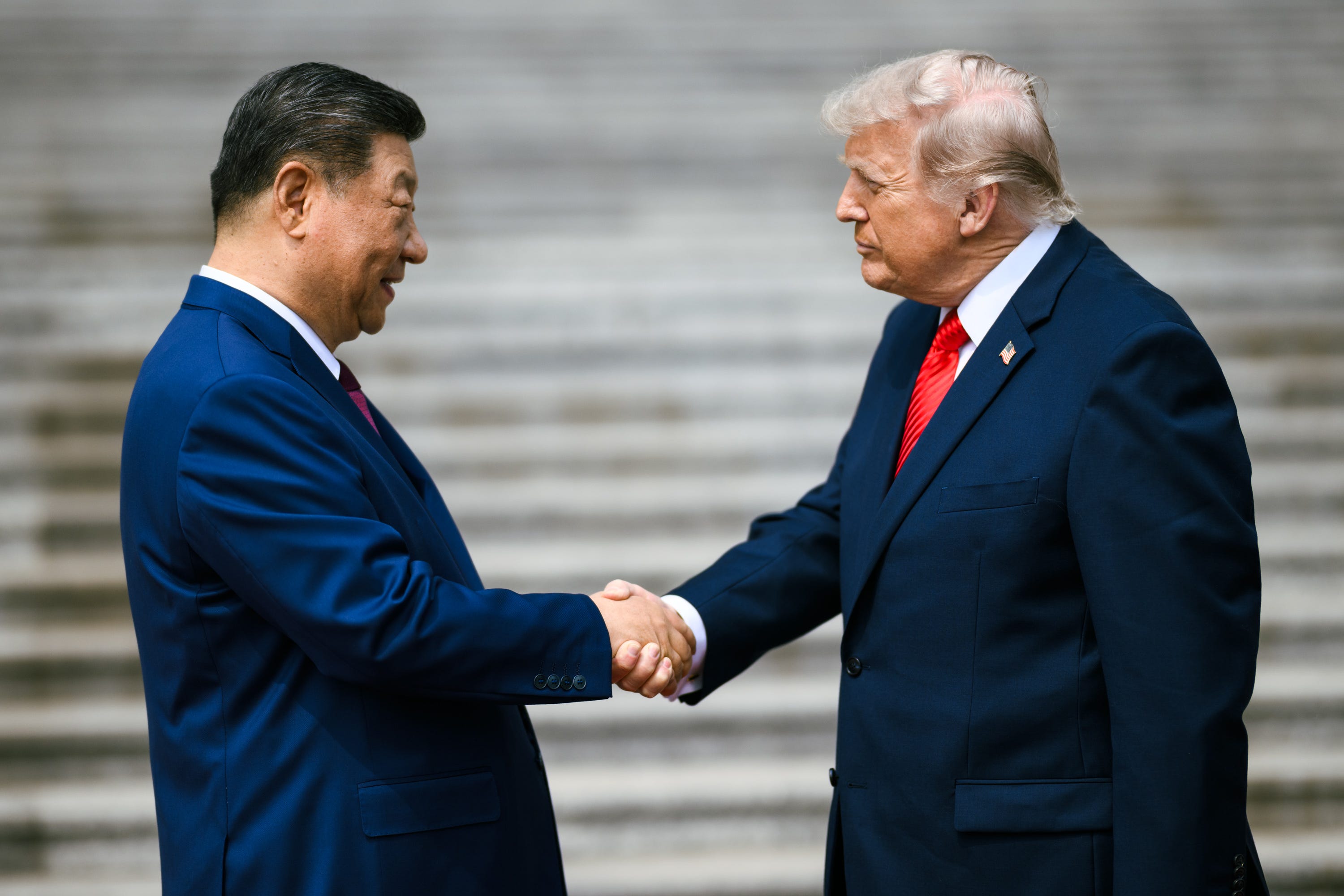 A firm grip on the odds | Photo: Daniel Torok / The White House, public domain.
And what an explosion it has been. We can bet on almost anything.
As I write this, on the eve of Xi Jinping’s state visit to Washington, you can bet on how long he and Trump will shake hands (the favorite: 10 to 15 seconds). On whether they’ll hug or on whether they’ll kiss (only 1% so far).3
Silly? Sure. But let’s use this as an example.
So, how can we, mere mortals, find mispriced bets in a place like this?
Well, according to a recent research report, only 2% of 2.5 million wallets analyzed have ever made over $1,000.
The base rate is not encouraging. Now, what can we do to put the odds in our favor?
Let’s find out.
Hedge Your Enthusiasm
1. Ask who is selling to you, and what they could already know.
First things first. Why does the mispricing even exist? Are passionate fans betting on the other side? Is there any bias? The worst reason is, of course, that someone knows more than you know.
There’s an ongoing case where prosecutors say a Special Forces master sergeant who helped plan the Maduro raid made nearly $410,000 on about $33,000 of bets (he has pleaded not guilty).4 Whoever sold him those contracts probably had really good base rates, but the counterparty here knew more.
To put the odds in your favor, avoid betting on a person’s decision or outcome. Military operations, corporate announcements, and award juries are examples where it’s difficult to have an edge. It is better to look for markets where the outcome depends on millions of people or nature, etc.
2. Bring information.
Théo (the French trader who bet Trump would win) paid for a data point that he thought the market was missing.
Trump and Xi’s previous handshakes are on video. If you watch them all (stopwatch in hand), you can get a base rate that most people won’t ever bother to look for.
A good way of externalizing this process is to write it down: “The market is wrong because , and I know that because .”
3. Check sister bets.
Let’s do one together.
Our handshake market has an outcome called “No Handshake.” It pays you if they never shake hands, or if Xi hasn’t set foot in the U.S. by October 7. Right now it costs 1 cent.
Now, there’s a sister bet that can tell you something about our handshake situation: “Will Xi visit the U.S. by October 31?”
At the time of writing, “Yes” costs 98 cents, so a deeper market is telling you that there’s a 2% chance he hasn’t arrived even by Halloween. If he hasn’t arrived by October 31, he hasn’t arrived by October 7 either, which is the last day the rules of the original bet allow for resolution.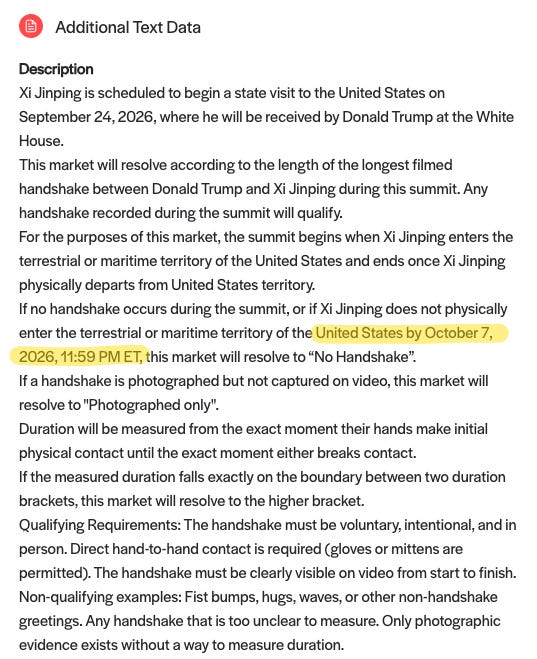
You don’t need to know which price is actually wrong here. Buy “No Handshake” at 1 cent and “visits by October 31” at 98.
For 99 cents, you buy a pair of contracts that together pay at least $1. If Xi visits by October 31 but either arrives after October 7 or skips the handshake, both pay out, giving you $2.5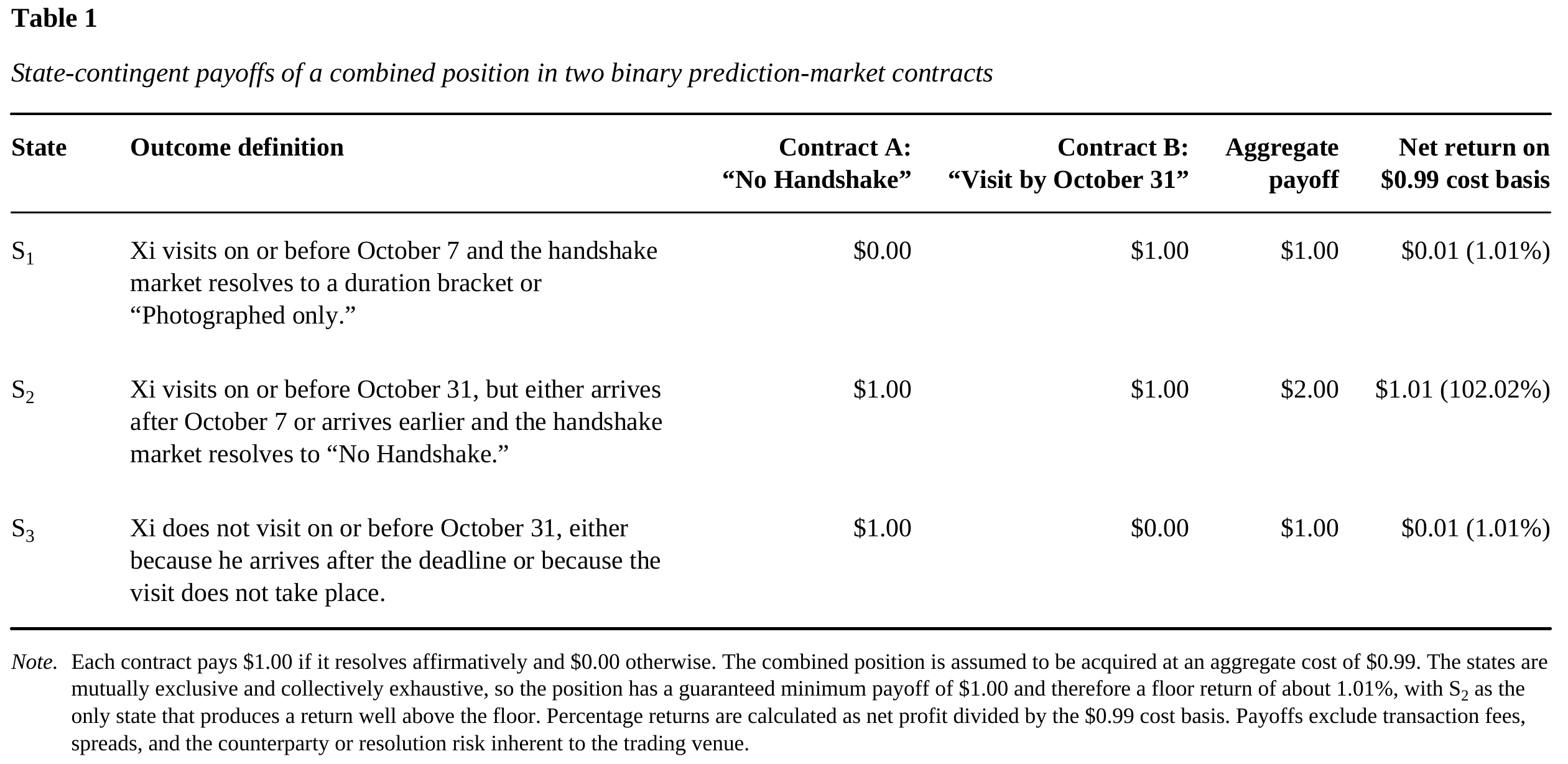
Before you get excited: in this specific case the size on offer is tiny, you would have the money locked up for weeks, and you still carry resolution risk.6 But the example is, I think, instructive.
Hey there!
Enjoy content like this? Take advantage of our FLASH OFFER and get 60% off an annual membership. Just click the button below!