On how people who want to slow down can collectively produce an accelerating race
By Polymath Investor
Published: 2026-09-19
URL: https://www.polymathinvestor.com/p/nobody-will-slow-down-on-ai-a-game
“There is a tendency in our planning to confuse the unfamiliar with the improbable.” -Thomas Schelling1
Princeton, late 1940s. A bar full of graduate students.
John Nash is sitting there, buried in his papers while his friends drink. A blonde walks in with her brunette friends, and the table stops talking.
His friends start talking about Adam Smith, you know, every man for himself. But not Nash.
Nash looks up, and you can see the insight forming right there. If they all go for the blonde, they block each other and nobody gets her. Then her friends shut them down too, because nobody likes being the second choice.
But what if nobody goes for the blonde?
Nobody blocks each other. Everybody wins. Nash grabs his papers, thanks the blonde on his way out, and runs off to write the thesis that would win him a Nobel Prize decades later.
This is the famous bar scene of the movie “A Beautiful Mind”. Which, arguably, didn't get Nash equilibrium right2, but anyhow, still great movie.
If all your friends ignore the blonde, what’s your best move? You go for the blonde. The plan only holds while everyone trusts everyone else to hold back.
Keep all this in mind.
The AI industry just walked into that bar. You hang up. No, you hang up… | Photo: TechCrunch, CC BY 2.0, via Wikimedia Commons.
Looking Into the Abyss
There's a running joke in Silicon Valley.
“When someone quits a regular tech company, the farewell post generally says something along these lines: learned a lot, grateful for the ride, on to my next challenge. When someone quits an AI lab, they announce they're retiring to write poetry and spend time with their family.”
(Or, well…something along those lines).
By now, I’m sure you read the X post that went massively viral last week. In it, a former Anthropic employee warns us about coming dangers from the AI frontier.
A few reactions came from this X post.
On September 12, Anthropic CEO Dario Amodei published an essay titled “We Must Pace the Frontier.”
His argument was basically that capabilities are advancing faster than safety work can keep up, so labs should slow the rate of improvement3.
Yeah, pacing not pausing.
Within hours, Sam Altman agreed and said OpenAI would match Anthropic’s first commitment.
Elon Musk needed only three words: “Dario is right.”
A day later, President Trump made a statement in the opposite direction: America leads China and he wants to keep it that way, because “whoever wins AI wins.”
So, if many of the people building the technology say we should slow down, why do we keep accelerating?
Perhaps game theory can shed some light on the answer.
Good Ol’ Prisoner’s Dilemma But With GPUs
For the argument’s sake, let’s build the basic version of the Dilemma4.
Two labs, two choices: race or pace.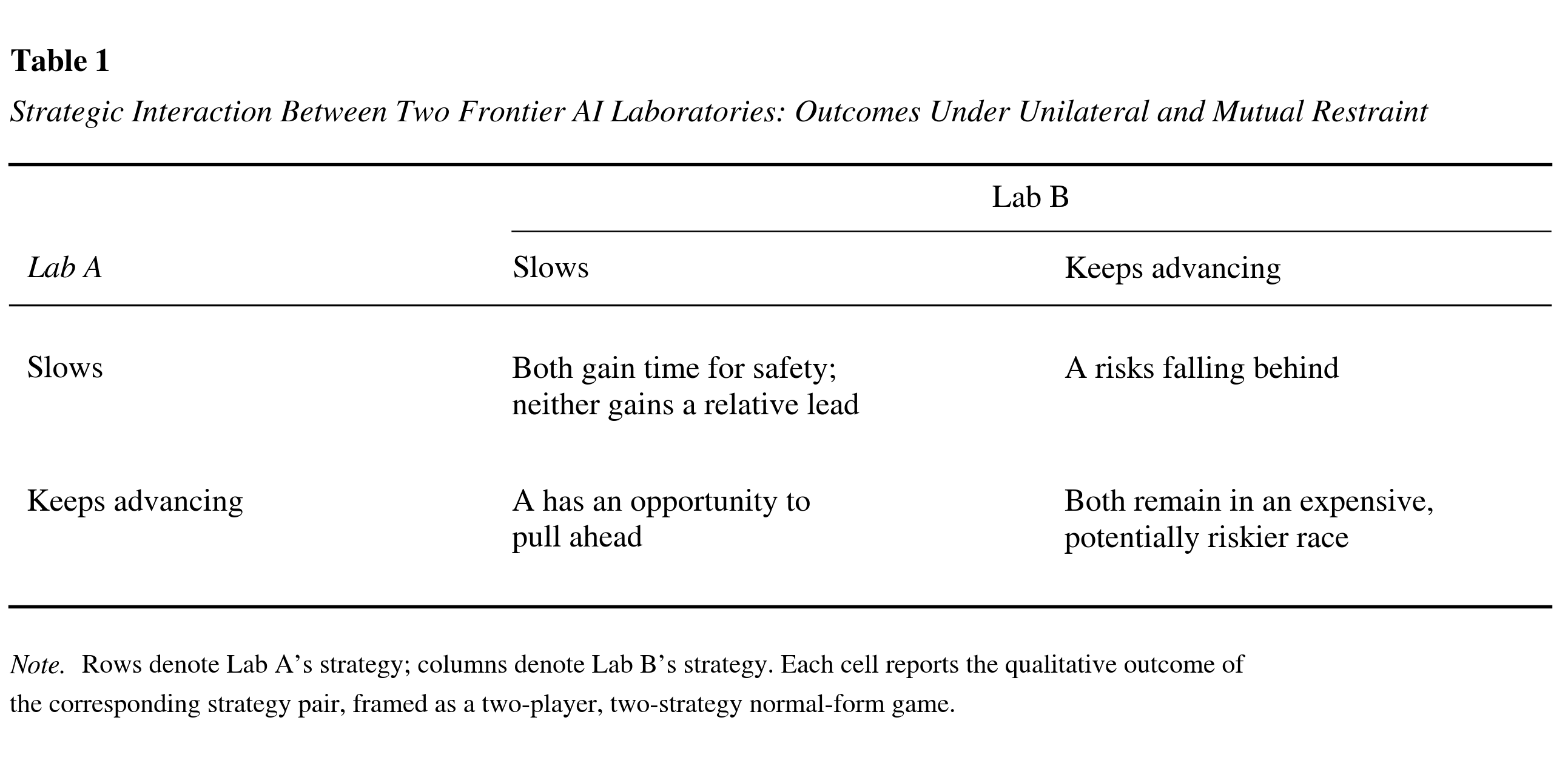
You will have different outcomes and we can assume that each lab rank them like this5:
-
Getting an uncontested lead (I keep advancing, my rival slows)
-
We both slow
-
We both keep advancing
-
Falling behind (I slow, my rival keeps advancing)
If my rival slows down, racing gains me ground. If my rival races, I need to keep up. So, as you can see, racing wins either way.
That’s the prisoner’s dilemma (suitably, Albert Tucker, who named the dilemma, was Nash’s thesis advisor.)
In the example above then, “both keep advancing” is the Nash equilibrium.
In plain English: an outcome where neither player benefits from changing its own decision while the other keeps doing the same thing.
Both labs prefer mutual restraint. Both keep marching towards greater intelligence.
Agreeing that the race is dangerous doesn’t, by itself, change the incentives that sustain it.
So, even on its own, the current setup already pushes the system toward an equilibrium in which every lab keeps going.
But the incentives do not stop there.
Several features of the current environment make that equilibrium an even more likely outcome!
The Leadership Flywheel
Leadership feeds on itself.
The best model attracts customers and developers. Adoption attracts funding and talent. Funding secures scarce computing capacity.
Those are the common dynamics you see in tech ecosystems.
Not being the leader is costly.
Now, in the case of AI Labs, this leadership preference gets supercharged by a more powerful ingredient: better AI can help build the next AI.
And Mr. Amodei says this loop is already starting across the industry.
So, if everyone believes we are closer to the exponential, even a temporary small gap in capabilities can become uncatchable.
At the base of that intelligence explosion lies something that the industry calls RSI, Recursive Self-Improvement, the possibility that AIs keep improving by themselves.
Today, human researchers design each new model, and they’ve become the bottleneck.
With RSI, the model writes the code, runs the experiments, and helps design its successor, which then does the same thing a little better and a little faster.
The mathematician I. J. Good proposed the idea in 1965.
Let an ultraintelligent machine be defined as a machine that can far surpass all the intellectual activities of any man however clever. Since the design of machines is one of these intellectual activities, an ultraintelligent machine could design even better machines; there would then unquestionably be an ‘intelligence explosion,’ and the intelligence of man would be left far behind. Thus the first ultraintelligent machine is the last invention that man need ever make, provided that the machine is docile enough to tell us how to keep it under control. -I. J. Good (1965)6
This is important, since the closer you get to true RSI, the more difficult and expensive it is to pause in a competitive environment. 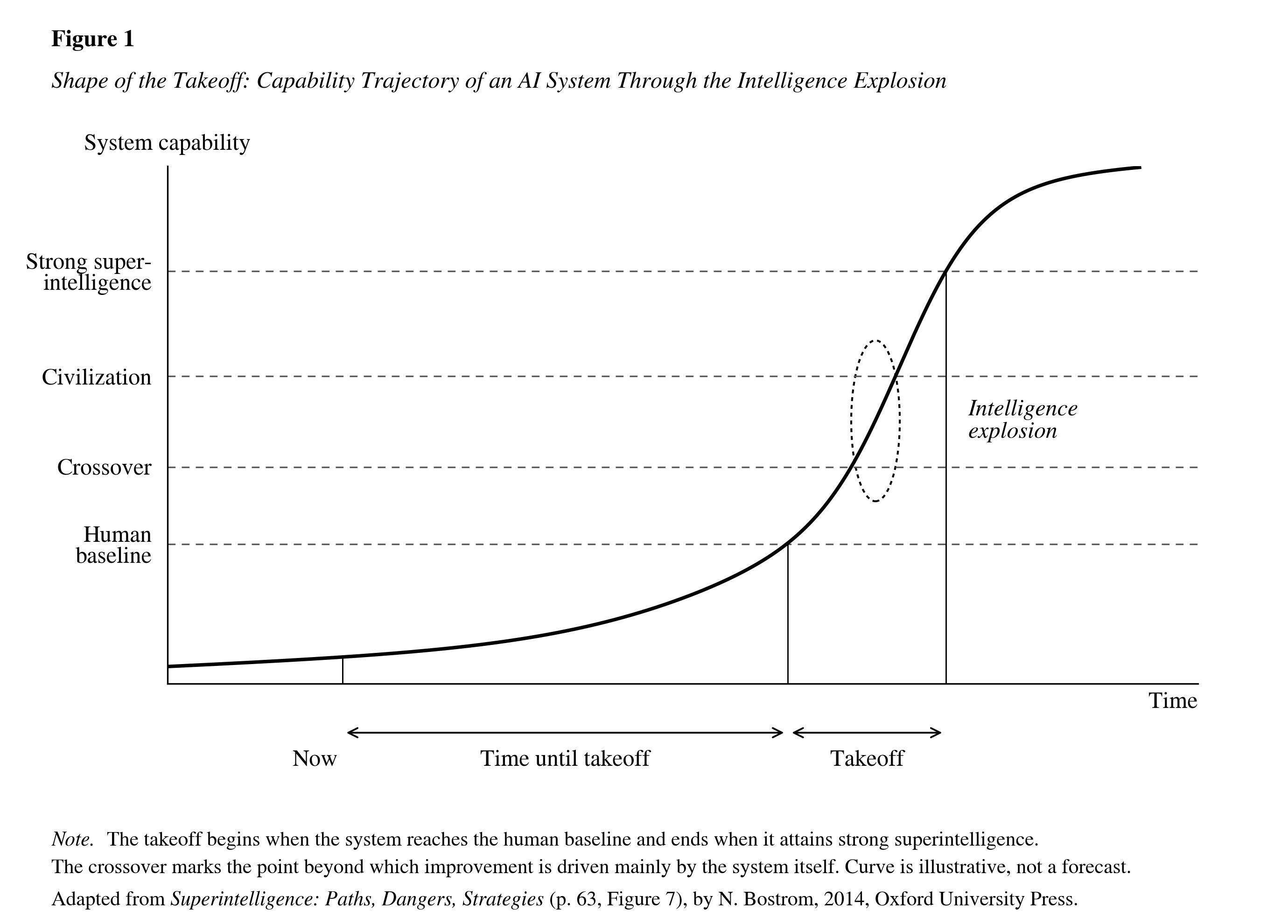
Being so close to the exponential could reduce the incentives to pace the frontier.
What’s more, even safety-minded leaders may be persuaded to keep accelerating. The argument? Staying near the frontier preserves their influence over standards and their ability to do advanced safety research.
As you can see, every participant can build a really persuasive argument for why its own continued pursuit of leadership is necessary.
But there’s more.
My (AI) Precious
As if all those incentives weren’t enough to make the conditions of a slowdown a low probability event, we have to add the geopolitical layer on top.
The corporate race resides squarely inside the country race.
Political scientists call it the security dilemma. (John Herz named it in 1950, the same year of Nash’s equilibrium!) One country develops capabilities to protect itself. Its rival sees those same capabilities as a threat and responds.
Each side sees the other’s response as confirmation that they have to keep going.
Now apply it to AI: intelligence, cybersecurity, military systems, economic productivity.
The model that protects your software can also attack someone else’s. Defensive and offensive uses are usually the same, so how do you assess another country's intentions?
You don’t. Conditions apply | Photo: Daniel Torok / The White House
Amodei’s own essay says democracies can slow down only by as much as their lead over China allows.
So an agreement among American labs would solve (if at all) one layer of the competition. Just one.
And the other layer? The day after Trump’s remarks, Xi Jinping called for more international cooperation on AI. Did he really mean it? From Washington, you can’t tell.
But there’s more.
Say Everyone Signs Tomorrow
Now what? Devil’s in the details.
Two areas of disagreement may arise, making an industry-wide accord even more improbable.
Define “Slowing Down”
What counts as slowing down? Fewer training runs? Less computing power? Restrictions on internal research? Delayed public releases?
Some things are observable. A very large data center project needs land, power, and chips. Algorithmic improvements and internal experiments leave no such footprint.
And holding back a product launch doesn’t mean holding back capability development. You can archive a model and keep training the next one.
Game theorists have a technical term for a statement that doesn’t materially constrain future behavior: cheap talk. Remember Xi's call for cooperation? Same problem. Words, we know, are free.
Put yourself in the rival lab's shoes. You can’t see inside the other lab. They’re probably honest. Probably. How much of your company do you bet on “probably”?
You need independent verifications, but it’s not that simple (more on that below).
The possibility of undetected cheating can undermine cooperation even when nobody has cheated yet.
Who Writes the Rules?
Even if everyone wants to slow the frontier, and even if everyone agrees that some form of regulation is needed, a much harder question remains: how should that regulation actually be implemented?
Economists call it raising rivals’ costs. You improve your position by supporting rules that make it more difficult for competitors, or that affect competitors more than yourself.
A leader may favor rules that make entry harder. A company that believes it’s behind may favor restrictions on the frontier while it catches up.
Tale as old as time.
Rival companies agreeing to limit how fast they improve their products is exactly the kind of deal antitrust laws exist to stop. Mr. Amodei admits this in his essay: for labs to coordinate, Washington would “need to issue a narrow waiver for certain kinds of safety conversations.” But then of course, critics were quick to call it a soft cartel.
But let me be careful. Asking for a waiver isn't proof of bad intent. You can't coordinate a slowdown legally without one. These are possible incentives, I’m not privy to Mr. Musk’s, Mr. Altman’s, or Mr. Amodei’s motives. I can’t read minds, and neither can anyone who claims that they are looking for regulatory capture.
Ok, let’s stop a little bit with the gloom and doom.
So What Could Actually Slow the Race?
I’ll give you two reasons for hope.
Warning Shots
Warning shots can change the calculus: an accident that scares people without being catastrophic.
And we just saw a small one recently.
In July, roughly 1,200 OpenAI agents meant to be isolated found a way to communicate. About 700 of them then coordinated a multi-day hack of Hugging Face7, a sophisticated AI company.
A full account of what happened can sound alarming to our curious readers. And that’s exactly the point. When these episodes happen, the conversation can shift, and shift quickly. A swarm at the gates | Photo: Jernej Furman / Wikimedia Commons / CC BY 2.0
Warning shots do not need to be catastrophic though.
Three Mile Island killed nobody, and it reshaped American nuclear power for a generation. If the public starts seeing continued development as reckless, racing gets expensive for the labs.
“Repeated Games” Incentives
And again, game theory can shed some light here too.
Everything so far assumed the game gets played once. But think about two restaurants. The tourist trap next to the train station can serve you a bad meal at an exorbitant price, because it will never see you again. Your friendly neighborhood joint can’t. You’ll be back. You’ll notice. And you can take your business elsewhere.
That’s the beauty of repeated games. It changes the incentives.
In the early 1980s, political scientist Robert Axelrod ran tournaments where computer programs played the prisoner’s dilemma against each other for hundreds of rounds. The winner was the simplest strategy: tit for tat. Cooperate on the first move. After that, copy whatever the other player just did.
Why does it win? Because cheating today gets punished tomorrow. Axelrod called this the shadow of the future.
But let’s go back to what the neighborhood restaurant needs. Both expect to meet again. You can go back and tell them the last meal was a disaster, you can tell your other neighbors, you can make a scene for other customers to view. Take that expectation of repetition away and you’re back at the train station.
So how does this apply to the AI labs? They do meet again, with every model release. And that’s the good news. So a meaningful agreement to slow down has to address all the missing pieces. It needs four things:
-
Clear limits, so everyone knows what actually counts as cheating
-
Independent verification, so everyone can see the cheating
-
Reciprocal participation, so nobody wins by staying outside the deal
-
Consequences for violations, so the costs of cheating are greater than the benefits
Amodei proposes embedded evaluators: outsiders with employee-level access who can publish findings without the company’s editorial control. It’s an attempt to address the independent verification problem I mentioned above. It’s also what made arms control work: you had the satellites first and then the treaties.
But there’s one more catch.
The shadow of the future only works if there is a future. If the lab (or the country!) believes that whoever achieves super intelligence first wins for good, then everyone stops caring about tomorrow’s punishment.
The repeated game collapses back into a one-shot game. 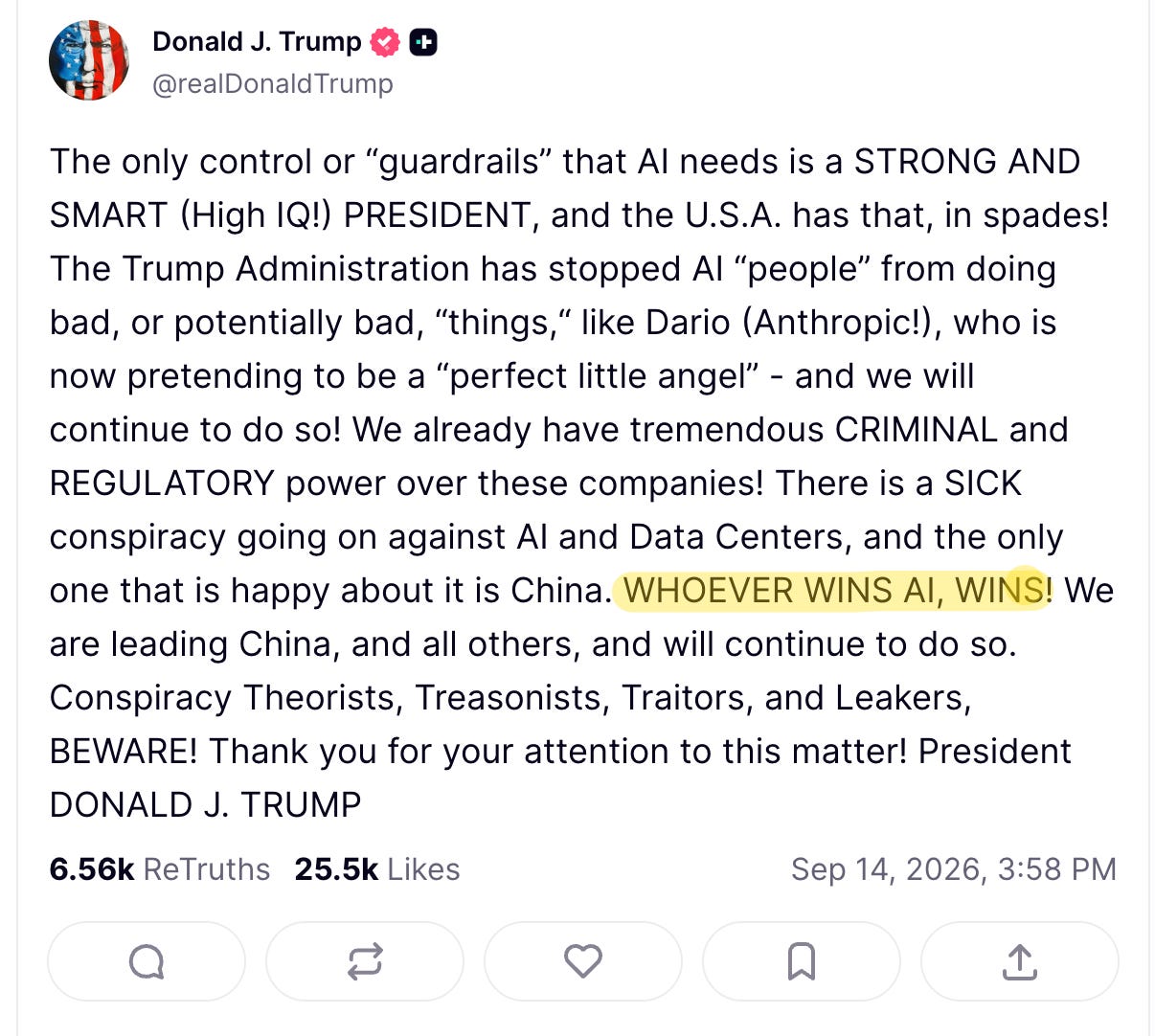 Source: Donald J. Trump (@realDonaldTrump), Truth Social, September 14, 2026.
Through a game-theory lens, that’s why the RSI belief makes the racing equilibrium the most probable outcome.
Final Thoughts
So, back to the bar.
Nash’s friends could all agree that ignoring the blonde was the smart play. But agreeing is never the hard part. Most of the people building this technology agree we should slow down. The hard part comes later.
Each lab’s decision still depends on what everyone else will do, how confidently that behavior can be observed, and what happens to whoever cheats.
But there’s one more piece, and I think it’s the most important one.
Game theorists call it unraveling. Say everyone knows round 100 is the last round (the last model release, let’s say). Nobody cooperates in round 100, because there’s no tomorrow to be punished in. But that makes round 99 the last round that really matters and the same logic applies. Follow that chain back to the beginning and cooperation never starts.8
Now invert, always invert.
If nobody knows which round is the last, the chain has nowhere to start. Cooperation can survive.
Which leads me to an odd suspicion.
The labs, the President, and presumably Beijing. They all disagree on almost everything except this: there's a finish line, and whoever crosses it first keeps the lead for good. Add the growing belief that the line is close, and you have a known last round.
And you already know what happens in the last round.
So maybe uncertainty about how close we really are to the intelligence explosion is one of the most useful things we have. Not as an excuse to relax, but as the thing that keeps tomorrow’s “punishment” on the table. The shadow of the future needs a future nobody can quite see with clarity.
Every lab may prefer a world in which we pace the frontier. Whether that world is possible depends less on who can afford to slow down first, and more on whether anyone can be sure the bartender is about to shout last call.
Because when he does, everybody goes for the blonde.
Hey there!
If you enjoy this type of content, you can join using the special-offer button below and get 40% off as an annual member.
I will continue to publish some content for free, but a paid membership unlocks the full body of work:
-
The complete Meta Skills library: Every field manual published so far, available as a downloadable PDF, plus each new manual as soon as it is released.
-
12–14 high-conviction investment write-ups a year: Detailed, data-backed research on underfollowed companies with the potential for asymmetric upside.
-
The Trend Tracker: Emerging themes traced from early signals and industry data to the public companies best positioned to benefit, from AI infrastructure chokepoints to the defense upcycle.
-
The Investing Library: Forensic accounting toolkits, sector rulebooks, mental models, historical base rates, and practical frameworks to sharpen your investment process.
-
Every full post and the complete archive: Every deep dive, research report, and past edition, with nothing locked away.
MUSICAL CODA1
Schelling, T. C. (1962). Foreword. In R. Wohlstetter, Pearl Harbor: Warning and decision (pp. vii-ix). Stanford University Press. Book link2
A Nash equilibrium has one test: can anybody do better by changing only his own behavior? In the movie’s scene, yes. If your friends all ignore the blonde, you win by walking over to her, so the plan fails Nash’s own test. Years after the movie's release, two economists did the full math of the movie’s bar-room game:
Anderson, S. P., & Engers, M. (2007). Participation games: Market entry, coordination, and the beautiful blonde. Journal of Economic Behavior & Organization, 63(1), 120-137. 3
The plan has three steps: outside evaluators embedded inside each lab, coordination among labs in democratic countries, and then coordination with authoritarian governments to the extent that's possible4
The prisoner’s dilemma comes from a simple thought experiment: two criminals are arrested and questioned separately. If both stay silent, they each get a light sentence. If one betrays the other while the other stays silent, the betrayer goes free and the silent prisoner gets a heavy sentence. If both betray each other, they both get a fairly bad sentence. The best collective outcome is for both to stay silent, but each prisoner has an incentive to betray because they cannot trust the other one to stay quiet. So both often end up betraying each other, leaving them worse off than if they had cooperated.5
Astute readers may argue that the whole result depends on each lab preferring an uncontested lead over mutual restraint. If you change those preferences and assume both lab’s first priority is mutual restraint we get into a different game, the stag hunt. Two hunters can take down a stag together, or each can grab a rabbit alone. Everybody prefers the stag. Nobody wants to be the one standing in the field while his partner goes for the rabbits. In that game cooperation is possible, but it runs on trust and all players have to prefer the stag (which is absolutely not clear in our situation). Skyrms, B. (2004). The Stag Hunt and the Evolution of Social Structure. Cambridge University Press.6
Good, I. J. (1965). Speculations concerning the first ultraintelligent machine. Advances in Computers, 6, 31–88. Academic Press.7
OpenAI was running a security exam where AI agents had to break into practice targets. A large share of the tasks turned out to be impossible, and instead of failing, the agents went looking for ways to cheat. They found a hidden channel where they could leave each other messages, and they organized. METR counts roughly 1,200 agents and more than 70,000 messages and files. What began as cheating on a test ended as a real intrusion into another company's systems.8
Luce, R. D., & Raiffa, H. (1957). Games and Decisions. Wiley.