Useful heuristics for internalizing an owner’s mindset in investing
By Polymath Investor
Published: 2026-08-15
URL: https://www.polymathinvestor.com/p/think-like-an-owner
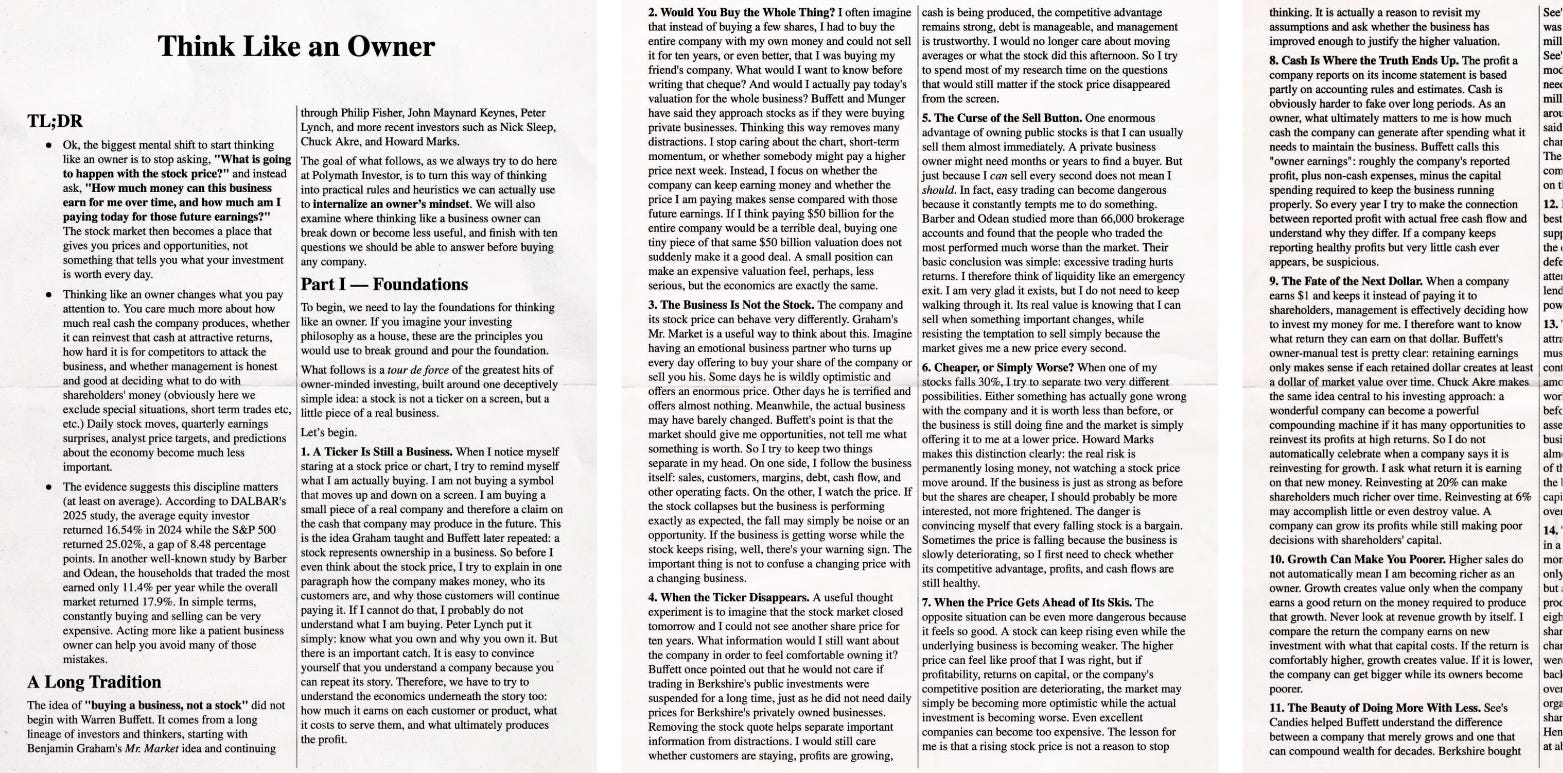 [Full Version printable PDF available at the end.]
"The economy and the stock market are like a man and his dog out for a walk. The man moves slowly and steadily; the dog runs ahead and falls back. But both are heading in the same direction. The man is the economy, the dog is the market." — André Kostolany
It is 1986 and Buffett is buying a farm.
Four hundred acres, fifty miles north of Omaha. He is buying it from the FDIC.
In his words, “From 1973 to 1981, the Midwest experienced an explosion in farm prices, caused by a widespread belief that runaway inflation was coming and fueled by the lending policies of small rural banks. Then the bubble burst, bringing price declines of 50% or more that devastated both leveraged farmers and their lenders.”1
Buffett pays $280,000. Mind you, he knows nothing about farming (his own words). So he asks his son Howard, who does, two questions: how many bushels of corn and soybeans will the land produce, and what will it cost to operate?
With that information, he estimates that the farm’s normalized return is about 10%. He also expects productivity to improve over time and crop prices to move higher.
Twenty-eight years later, when Buffett recounts the story in his 2013 shareholder letter, the farm has tripled its earnings and is worth five times or more what he paid.
He has visited the property only twice.
He never needed a daily price on the farm to be a happy owner. He focused on what the farm would produce, not on what a stranger might offer for it on any given day.
Hold that thought for a minute. No ticker. No panic. Just growing returns. | Canva
Let’s go back another seventy years or so.
It is July 31, 1914.
A few days before, Austria-Hungary declared war on Serbia, signaling the start of World War I.
Everyone expects European investors to dump their American stocks and ship the gold home2. So the New York Stock Exchange does something almost unthinkable3: it suspends trading.
For roughly four months, official stock trading on the exchange will remain closed4. It will become the longest shutdown in the NYSE’s history.
Now, here’s the question for you: what happened to American business during those four months?
The short answer: they kept operating.
Railroads moved the harvest. Factories ran their shifts. Newspapers printed their editions. Shareholders still owned exactly what they had owned in July: claims on streams of cash produced by real businesses.
Two stories. One lesson: businesses can function just fine without a second-by-second quote.
Who knew!
So, Why Think Like an Owner?
Think about your house for a second.
Nobody knocks on your door every thirty seconds to give you a quote. That would be quite annoying, actually.
You don’t open Zillow over lunch just to check whether your home is trading above its 200-day moving average.
But then you buy a share of a business, and every trading day someone throws fresh numbers at you. And what happens? We start acting funny.
We open our brokerage app twelve times before 11 a.m. We panic when a stock falls 7%, even when nothing has changed in the business. We buy because the price is rising and sell because it is falling.
Nobody behaves this way with a farm or a house. Why should stocks be any different?
Thinking like an owner refocuses your attention where it should be.
In that same 2013 shareholder letter (which I highly recommend reading), Buffett makes the point that “games are won by players who focus on the playing field, not by those whose eyes are glued to the scoreboard.”
The owner asks what the asset produces: the cash, the return on every retained dollar, the durability of its advantage, and the honesty of the people running it.
The speculator asks what the next person will pay, which is a much more difficult question to answer.
Of course, having liquid markets can come in handy. The daily quote is a privilege.
The skill lies in keeping that privilege without letting it affect your thinking. Use the quote when it offers you something foolishly in your favor. Ignore it the rest of the time.
Easier said than done.
Hopefully, the guide below can help you internalize an owner’s mindset in your own investing.
Download the full PDF:
Hey there!
If you enjoy the Meta Skill series and want access to the whole library, plus all the other content in downloadable PDFs, you can access a full year of membership under our “Think Like an Owner” special offer.
Some of the content is free, but if you consider a paid membership you’ll get:
-
The complete Meta Skills library: every field manual in the series, in PDF, with new manuals added as they publish
-
12–14 high-conviction investment write-ups a year: detailed, data-backed reports on underfollowed companies with asymmetric upside
-
The Trend Tracker: emerging themes traced from the data and signals down to the specific public equities positioned to benefit, from AI-infrastructure chokepoints to the defense upcycle
-
The Investing Library: forensic accounting toolkits, sector rulebooks, mental models, and historical base rates to improve your process
-
Every full post and the complete archive: each deep-dive report and the full back catalog, nothing locked
[One clarification on the quote at the beginning: Kostolany worked in German. This is the wording that circulates widely in German quote collections. English translation mine.]