Claude Fable 5.2 cuts its token price 20%, Railway's breach ends in about $740,000 of stolen AI spend, and GitHub retires six Copilot models on December 14.
By Angel Llosa
Published: 2026-11-15
URL: https://vibecodingweekly.substack.com/p/vibe-coding-weekly-55
Everything that mattered this week in AI-assisted development, distilled into three headlines, one must-read, and the takeaways behind them.
This week, compiled:
- The Big Story: Anthropic cut the price of Claude Fable 5.2 to $8 / $40 per million tokens, 20% below Fable 5.1, but at Max effort it writes about 3.5 times the median output of comparable models
- The Deadline: GitHub retires six Copilot models on December 14, among them Claude Fable 5 and Gemini 4 Argon, in the same week it added Fable 5.2 and two Gemini 4 models
- The Trend: Antigravity CLI previews
/swarm, where one agent coordinates worker agents that all spend your quota, in a week when Cursor and OpenCode also shipped multi-agent features
If you only read one thing this week: read two incident reports side by side, because both attackers went after the credentials around AI coding tools. On November 13 Cursor published its full postmortem: an exposed key issued to its vendor Fireworks exposed coding-agent traces, some with plaintext credentials, and malicious copies of Anthropic’s Claude Code extension sat in its marketplace cache for about 11 hours, reaching up to 5,000 users. On November 10 Railway published its final report: the attacker searched customer variables for AI provider keys, and unauthorized spend reached about $740,000. Every figure is the company’s own. Two checks for a team: find out where your agent traces are stored and who else holds a key to that storage, and put a provider-side spend limit on every AI key. Read more →
I’m Angel Llosa, an AI strategist. My day job is helping companies adopt these tools — defining the strategy and then staying for the implementation, which is where most of the interesting problems show up.
Vibe Coding Weekly comes out of that habit. Once a week I go through the releases, the changelogs and the writing worth reading, and write up what actually happened: what shipped, which version it landed in, and what it changes for someone who has to use it. When something reads better in the announcement than it works in practice, I try to say so.
If someone on your team should see this week’s edition, forward it to them.
Key Takeaways
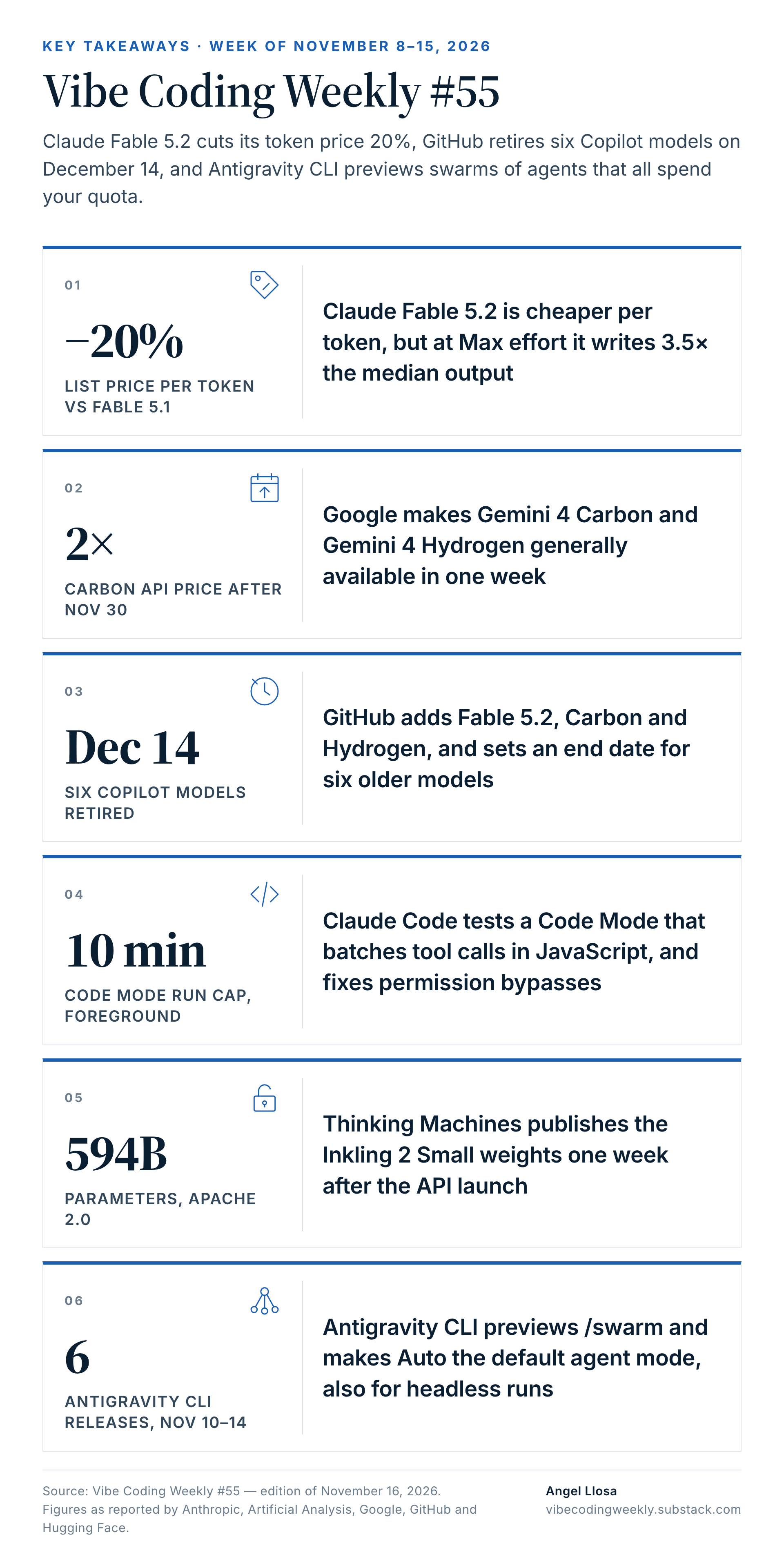
- Claude Fable 5.2 costs 20% less per token, but effort level decides the cost per task: on November 9 Anthropic released Claude Fable 5.2 at $8 / $40 per million input / output tokens, down from $10 / $50 for Fable 5.1. Anthropic says High effort roughly matches Opus 5.5’s best score at about half the cost per task. Artificial Analysis found the other side: at Max effort it used 275M output tokens on its index, against a median of 77.3M, so a cheaper token does not guarantee a cheaper task. Fable use needs 30-day data retention and is capped at 50% of weekly limits on Pro and standard Team plans. Edition 47 covered Fable 5.1. Read more →
- Gemini 4 Carbon and Hydrogen are generally available, and Carbon’s price doubles after November 30: Gemini 4 Carbon reached paying API developers on November 10 at $2 / $10 per million tokens until November 30, then $4 / $20. Google says it ranks first on CursorBench 4.0 at more than 2 times lower cost per task than the next-best external model, but it gives no raw scores and still recommends Gemini 4 Argon for most software engineering. The cheaper Gemini 4 Hydrogen followed on November 12, with a free tier and a paid price of $1.50 / $7.50. Edition 53 covered Argon. Read more →
- GitHub retires six Copilot models on December 14, in the week three new ones arrived: Fable 5.2, Gemini 4 Carbon and Gemini 4 Hydrogen reached Copilot between November 9 and 13, all billed at provider list pricing. Fable 5.2 is off by default for Business and Enterprise until an admin turns it on. The deprecation notice lists Claude Fable 5, Claude Haiku 4.5, Gemini 3.8 Flash, Gemini 4 Argon, Grok 4.6 and Kimi K3. GitHub names replacements for most, and Kimi’s is still to come, so a team that chose Argon on purpose should test its replacement before the date. Read more →
- Claude Code adds an experimental Code Mode and closes several permission bypasses: four releases between November 9 and 13 (2.1.321 to 2.1.325) fix, among other things, read-only commands that ran outside the sandbox without a prompt and deny rules that did not apply to some file commands. That is a reason to update today. Version 2.1.323 also adds Code Mode, opt-in, where Claude writes a short script that makes several tool calls in one step. It is terminal-only, works only with the Anthropic API or a subscription, and a run stops after 10 minutes. Read more →
- Thinking Machines published the Inkling 2 Small weights under Apache 2.0, one week after the API launch: in Edition 54 I wrote that Latent Space expected the weights “next week”, and that I would check. They arrived on November 12 in a public, ungated Hugging Face repository, a 594-billion-parameter model that reads images and text. By November 15 it had 7,329 downloads. Apache 2.0 has none of the revenue thresholds in the Kimi K3.1 Pro license that Edition 54 covered, so any team can now fine-tune it and host it itself. Read more →
- Antigravity CLI previews swarms of agents and makes Auto the default mode: six releases from November 10 to 14 (1.5.4 to 1.5.9). The new
/swarmcommand turns the agent into a coordinator that adds worker agents, and Google labels it “Preview & Quota Heavy” because every worker spends your quota. The default mode also changes to Auto, including scripted runs, so a team that runsagy -pin scripts should check its permission setting now. Edition 54 covered 1.5.0 to 1.5.3. Read more →
You already have Change Management in Agentic AI Adoption — the framework for moving an organization that didn’t ask to be moved. Anyone you forward this edition to gets the same thing the moment they subscribe.
📦 Releases & News
Cursor Projects goes multiplayer in beta
Cursor — November 10, 2026
A whole team can now work in one Cursor project. Each person keeps a private chat with their own agents, while a shared task board and shared docs show who works on what. The beta is open to all users. Edition 54 covered Cursor’s Build Live Apps.
Codex CLI 0.168.0 and 0.169.0 keep project tools off in untrusted folders
OpenAI — November 11 to 13, 2026
The security change comes first: codex exec now keeps project config and MCP servers disabled in untrusted folders unless you pass --trust. The releases also make custom model providers easier to set up. There is no model or pricing news. Version 0.167.2 also shipped on November 11, and I could not verify its contents. Edition 54 covered 0.167.0.
OpenCode v2.2.7 and v2.3.0 let Copilot’s router choose the model
Anomaly — November 10 and 13, 2026
If your Copilot account has an Auto pool, you can pick Auto in OpenCode and Copilot’s router chooses the model for each session at a discount. That is per-task model routing inside a third-party client. Version 2.3.0 also makes subagents always run in the background. Edition 54 covered v2.2.6.
Kiro adds an “Approve for me” mode and enterprise policy management
Kiro — November 10 to 12, 2026
Approve for me approves safe routine actions, blocks risky ones and asks when it is unsure. A preview of Enterprise Management lets an admin set one policy for the whole Kiro product line. The experimental Grok 4.7 model uses 2.7x credits up to 200K tokens and 5.4x above. Credit pooling, which Edition 54 covered, now works with Okta and Microsoft Entra ID.
Anthropic lets companies run Claude Managed Agents on their own infrastructure
Anthropic — November 12, 2026
The whole Managed Agents service can now run on your own infrastructure, and it stores agents, sessions and history there. Access goes through the Anthropic account team.
Lovable stops a publish when critical security findings are open
Lovable — November 8 to 12, 2026
Since November 12, publishing a backend project with unresolved critical security findings triggers a review first. Admins and owners on paid plans also get alerts when daily usage rises sharply against the previous 7 days, and the alert does not block usage. Edition 54 covered AGENTS.md in subfolders and Dreaming.
Vibe Coding Weekly is written for developers, architects and tech leads building or managing software with these tools.
Clean code and positive vibes,
Angel Llosa
Questions, disagreements, or a story I missed? Just hit reply.