Revolut says self-hosted GLM cut its coding-agent bill about 90%, Claude Code and Kiro ship pooled team budgets, and Meta buys Conductor and shuts its cloud on November 20.
By Angel Llosa
Published: 2026-11-09
URL: https://vibecodingweekly.substack.com/p/vibe-coding-weekly-54
Everything that mattered this week in AI-assisted development, distilled into three headlines, one must-read, and the takeaways behind them.
This week, compiled:
- The Big Story: Meta bought Conductor, the app that runs coding agents in parallel, and Conductor Cloud shuts down on November 20
- The Money: Claude Code and Kiro both shipped pooled team budgets in the same week, so a group can now share one monthly spend limit
- The Trend: Moonshot put the Kimi K3.1 Pro weights on Hugging Face: 2.8 trillion parameters, a custom license and 65.7 on Terminal-Bench 4.0 by its own count
If you only read one thing this week: Revolut moved about 2,000 engineers from Claude Code and Codex to an open-weight model that it hosts itself, and it says its AI coding cost fell by about 90%. According to The Register (November 3), Revolut serves Z.ai’s GLM-5.3 (about 754B parameters, 40B active) on 56 Nvidia B200 GPUs at about $0.30 per million tokens. Before the switch, some engineers spent $1,000 to $10,000 a month with little return, and Revolut had to set strict budget limits. Revolut also reports 60% better coding time and 70% better lead time. All of these figures are the company’s own, from a talk that The Register reported, and I could not find the talk itself. The same article lists the limits: GLM reads text only, so image questions still go to Gemini or GPT, and most of the gain came from debugging and ticket work. The part I would take to a team is the order of events. The budget problem came first, and the open-weight model was the answer to it. Read it next to the Claude Code and Kiro budget features below. Read more →
I’m Angel Llosa, an AI strategist. My day job is helping companies adopt these tools — defining the strategy and then staying for the implementation, which is where most of the interesting problems show up.
Vibe Coding Weekly comes out of that habit. Once a week I go through the releases, the changelogs and the writing worth reading, and write up what actually happened: what shipped, which version it landed in, and what it changes for someone who has to use it. When something reads better in the announcement than it works in practice, I try to say so.
If someone on your team should see this week’s edition, forward it to them.
Key Takeaways
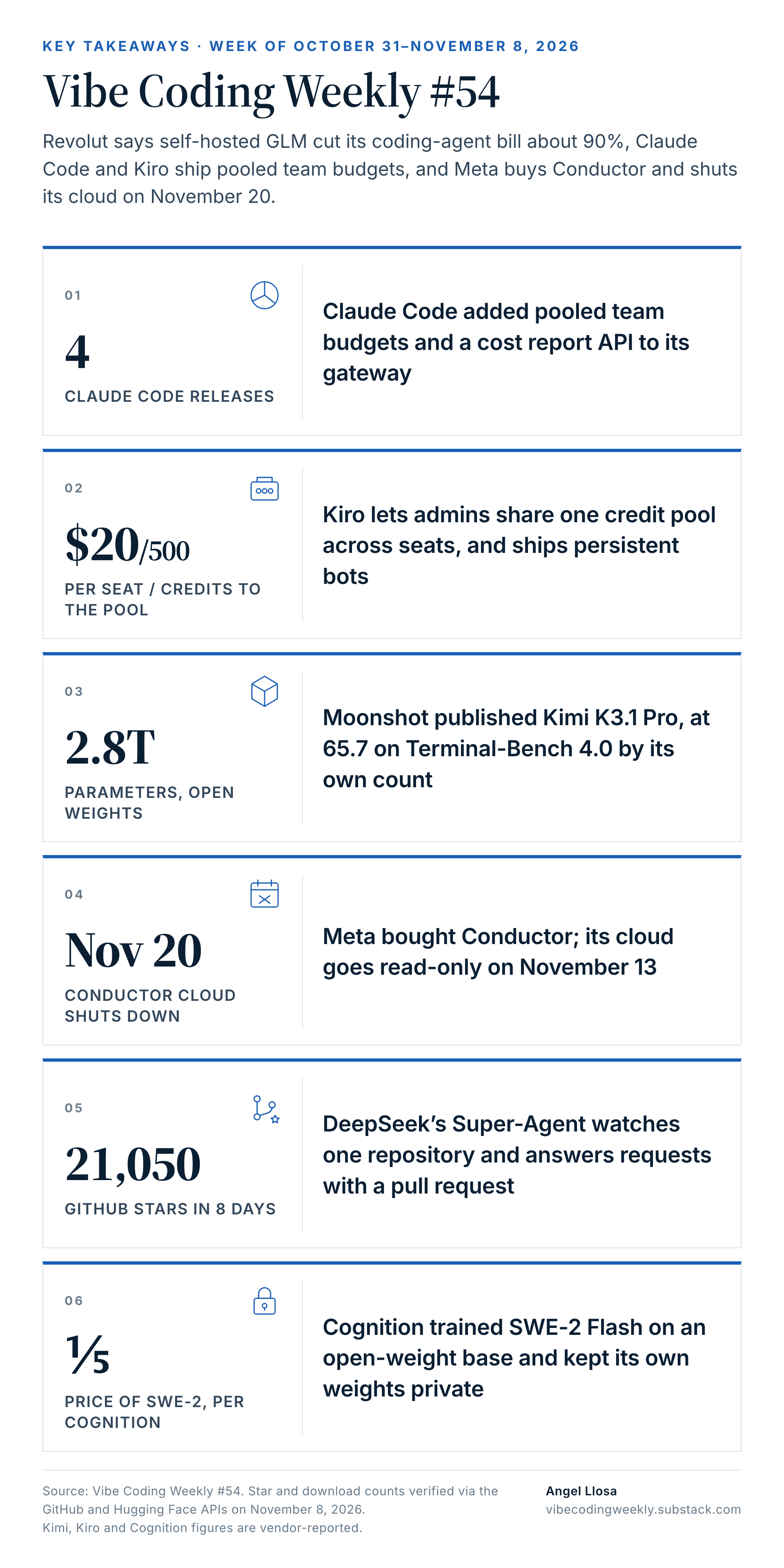
- Kiro lets enterprise admins pool credits across seats, and ships persistent bots: on November 4 Kiro added credit pooling. Each seat costs $20 a month and adds 500 credits to one shared pool, and extra credits stay valid for a year. On November 5 Kiro bots became generally available. A bot is a persistent agent that coordinates worker sessions, keeps its own memory and runs recurring jobs, and the coordinator and the workers can use different models. VentureBeat notes that a credit is not a fixed unit of work, so the plan price does not tell you what a bot costs. CLI 3.0.0 (November 3) makes V3 the default and retires the Classic interface, the desktop app and inline autocomplete. CLI 3.1.0 (November 5) shows the session’s credit use in
/usageand in the status line. Edition 53 covered Kiro’s local sandbox. Read more →
- Moonshot published the Kimi K3.1 Pro weights, 2.8 trillion parameters under a custom license: the repository on Hugging Face was created on November 2, and by November 8 it had 25,569 downloads. The model is an MoE (mixture of experts) with 104B active parameters and a context of about 1M tokens. Moonshot’s model card gives 65.7 on Terminal-Bench 4.0, measured with the Claude Code harness, against 66.4 for Claude Opus 5.5 in Moonshot’s own chart. According to a write-up of the license by Pasquale Pillitteri, it allows use, modification and sale. A model-as-a-service business with more than $20M in yearly revenue needs a separate agreement, and products above 100M monthly users or $20M monthly revenue must show the model’s name. Few teams can self-host a 2.8T model. For most readers it matters as a cheaper hosted option and as pressure on frontier API prices. Read more →
- Meta bought Conductor, and Conductor Cloud shuts down on November 20: Conductor’s app runs several Claude Code and Codex agents in parallel, each in its own copy of the project. The Next Web reports (November 6) that the team joins Meta Superintelligence Labs, and the price was not disclosed. Sign-ups closed on November 4. Conductor Cloud becomes read-only on November 13 and shuts down on November 20, and its cloud data is then deleted. The desktop app keeps getting new models and critical fixes until early 2027. A team on the cloud version has until November 20 to take its data out. In the same week, HumanLayer said it is joining Factory (November 4). Secondary sites such as Runtimewire say Factory plans to open-source the HumanLayer platform, and I could not confirm that on a primary page. Read more →
- DeepSeek released Super-Agent, a coding agent that stays on and watches one repository: the repository was created on October 31 under the MIT license, and on November 8 the GitHub API showed 21,050 stars. Super-Agent is a bundle for DeepSeek Harness. It listens to GitHub, and optionally to Feishu. When an allowed person asks for work, it opens a work item, runs it in its own agent session and answers in the same conversation, usually with a PR (pull request). A web panel shows what needs a human. The README calls it a research prototype, not an official DeepSeek product, and says that coding agents wrote much of it. DeepSeek Harness itself is at 276,161 stars, with release candidate
dsh-v0.2.2-rc.1on November 4. Read more →
- Cognition built SWE-2 Flash on an open-weight base model and kept the weights private: SWE-2 Flash (November 4) runs in Devin Desktop and Devin CLI, and it is free for paid Devin users until November 30. Cognition says it costs about one-fifth of SWE-2 and generates about 200 tokens per second against 60, but it gives no per-token price. The base model is Thinking Machines’ Inkling-Small (276B total, 12B active), and Cognition added its own training on top. Cognition cites the risk of cyber misuse as the reason for keeping the weights private, and it promises a sharing program for trusted partners. All the numbers are Cognition’s own. On November 5 Thinking Machines launched Inkling 2 Small (594B total, 17B active, $0.30 / $1.00 per million input / output tokens). According to Latent Space, its Apache 2.0 weights are due next week, and I will check that in the next edition. Read more →
You already have Change Management in Agentic AI Adoption — the framework for moving an organization that didn’t ask to be moved. Anyone you forward this edition to gets the same thing the moment they subscribe.
📦 Releases & News
Anthropic’s Message Threads beta makes long agent sessions faster, but not cheaper
Anthropic — November 2, 2026
With Message Threads, an agent sends the full conversation once, and after that it sends only the new messages and the ID of Claude’s last reply. A thread expires 5 minutes after its last request. Anthropic says requests of 500K to 1M tokens get about 35% lower median time to first token. Prices and rate limits do not change, and Claude still reads the whole conversation every turn, so the tokens you pay for do not go down. You still keep your own transcript, and TNW reports that threads do not work with zero-data-retention or HIPAA setups.
GitHub Copilot arrives in JetBrains Air and Xcode, and the usage API starts counting your own keys
GitHub — November 3 to 6, 2026
The FinOps item is the usage API. From November 3 it reports BYOK (bring your own key) usage and enterprise custom models separately, including Copilot CLI sessions that point at Ollama or LM Studio. Local BYOK figures come from client telemetry, so they undercount, and older data is not backfilled. The same day, Copilot became an agent in JetBrains Air through ACP (Agent Client Protocol). Its cloud tasks use the Copilot plan, and Air admins cannot set Copilot spend limits. Copilot is in public preview in Xcode (November 4), and @GitHub in Slack and Teams is generally available (November 6). Copilot CLI 1.0.106 and 1.0.107 add GPT-6.1 Terra and a /code command.
Antigravity CLI 1.5.0 to 1.5.3 can run as a backend for other editors
Google — November 4 to 7, 2026
In 1.5.0, agy acp runs the CLI as an ACP (Agent Client Protocol) server, so another editor can use Antigravity as its agent. 1.5.1 offers every model on your account to every ACP client. 1.5.0 also adds --remote-agent, which runs the session’s work on remote agents. In 1.5.2, --dangerously-skip-permissions now blocks commands on the system denylist instead of approving them automatically. 1.5.3 shows each subagent’s model next to its name. Copilot arrived in JetBrains Air over the same protocol this week, so ACP is becoming the common way to plug an agent into an editor. Edition 53 covered 1.3.4 to 1.4.2.
Cursor’s cloud agents can now build and host a live app
Cursor — November 5 and 6, 2026
With Build Live Apps (November 5), a cloud agent builds a web app, sets up a Postgres database if the app needs one, puts it behind Cursor SSO (single sign-on) and hosts it. Security checks, for example for exposed secrets, must pass before you publish, and publishing is a manual step. You can share the app with people, groups or the whole team, and individual plans can also publish it publicly. This moves Cursor into the space of Lovable and Replit. On November 6 Cursor added voice chat with agents, which runs on Grok Voice. Edition 53 covered cloud-agent canvases.
Codex CLI 0.167.0 adds an agent command center
OpenAI — November 6, 2026
codex agents --no-daemon opens a command center that marks agents with unread results. You can switch between connected backends from the session picker without losing drafts, and a new gcp\setup\wizard sets up Google Cloud Vertex AI. The release also fixes resuming a chat after a provider switch and fixes context compaction. There is no model or pricing news in it. Edition 53 covered 0.163.0.
OpenCode v2.2.6 shares MCP connections across projects
Anomaly — November 6, 2026
With pool: true, projects that use the same MCP (Model Context Protocol) setup share one connection. opencode run -w starts a scripted run in a new git worktree, and --archived keeps CI (continuous integration) sessions out of the session list. It is a routine point release after the 2.0 launch that Edition 53 covered.
Lovable now reads AGENTS.md files in subfolders
Lovable — November 3 and 4, 2026
Lovable now reads the instruction file in the folder of each file it edits, and in every folder above it (November 3). On paid plans, a background feature called Dreaming tidies project memory and AGENTS.md rules by checking them against the code and the chat (November 4). It does not touch app code and uses no credits.
📚 Tutorials and Resources
The Pragmatic Engineer: Scaling Slack and GitHub with Maude Lemaire
Gergely Orosz, The Pragmatic Engineer — November 5, 2026
Maude Lemaire worked on scaling at Slack and GitHub, and on performance at Cursor, including time to first token. In this interview she explains how she uses AI. She checks LLM output herself for foundational platform work and checks it less elsewhere. A team can copy that rule by deciding where review is strict before the code arrives. The episode has no productivity numbers.
💡 Others
The Register: Anthropic reportedly won’t fix a Claude Dispatch flaw that lets a browser extension run code
Jessica Lyons, The Register — November 5, 2026
Researcher Gal Weizman says that any browser extension that can control claude.ai can make Claude Desktop run code on the user’s machine, or on another machine signed in to the same account. According to the report, Anthropic closed it in May as a duplicate of a known issue, with no bounty and no CVE, and Anthropic did not answer The Register. Weizman says Claude Code Remote Control sessions are exposed in a similar way. He also found that in six organizations, personal Claude accounts were 18% to 71% of the known Claude accounts. A security team can check that last number in its own organization.
Vibe Coding Weekly is written for developers, architects and tech leads building or managing software with these tools.
Clean code and positive vibes,
Angel Llosa
Questions, disagreements, or a story I missed? Just hit reply.