The Claude Code team publishes its review numbers, Anthropic replaces git at 30,000 merges a day, and Meta, Reflection and DeepSeek release open weights on three consecutive days.
By Angel Llosa
Published: 2026-10-19
URL: https://vibecodingweekly.substack.com/p/vibe-coding-weekly-53
Everything that mattered this week in AI-assisted development, distilled into three headlines, one must-read, and the takeaways behind them.
This week, compiled:
-
The Big Story: Anthropic replaced git in its monorepo with an in-house system prepared for agents, Scion, after merges grew from about 2,500 a day in May to over 30,000 in September
-
The Release: OpenCode 2.0 runs the agent as one shared background service, turns about 80 built-in features into plugins, and stops 1.x plugins from working
-
The Trend: Meta, Reflection and DeepSeek released open weights on October 15, 16 and 17, under three different licenses: the Muse Model License, Apache 2.0 and MIT
If you only read one thing this week: Anthropic says Claude now writes about 90% of Claude Code’s own code, and the team published how it reviews that code. Between June and September, merged PRs (pull requests) to Claude Code more than doubled, and the share that got reverted fell by more than 40%. The share of PRs that needed five or more review rounds went from 8.9% to 1.5%. The idea I would take to my own teams is the risk tier on human approval. A low-risk change needs no human approval once the checks are green, a medium-risk change needs one person and a high-risk change needs two. Reviews also stop after three rounds, and a re-review looks only at the new diff. Every number here is company-measured and the post is on an Anthropic-hosted blog, so I read it as a process description, not a benchmark. The Postgres 19 delay further down shows the same problem from the other side. Read more →
I’m Angel Llosa, an AI strategist. My day job is helping companies adopt these tools — defining the strategy and then staying for the implementation, which is where most of the interesting problems show up.
Vibe Coding Weekly comes out of that habit. Once a week I go through the releases, the changelogs and the writing worth reading, and write up what actually happened: what shipped, which version it landed in, and what it changes for someone who has to use it. When something reads better in the announcement than it works in practice, I try to say so.
If someone on your team should see this week’s edition, forward it to them.
Key Takeaways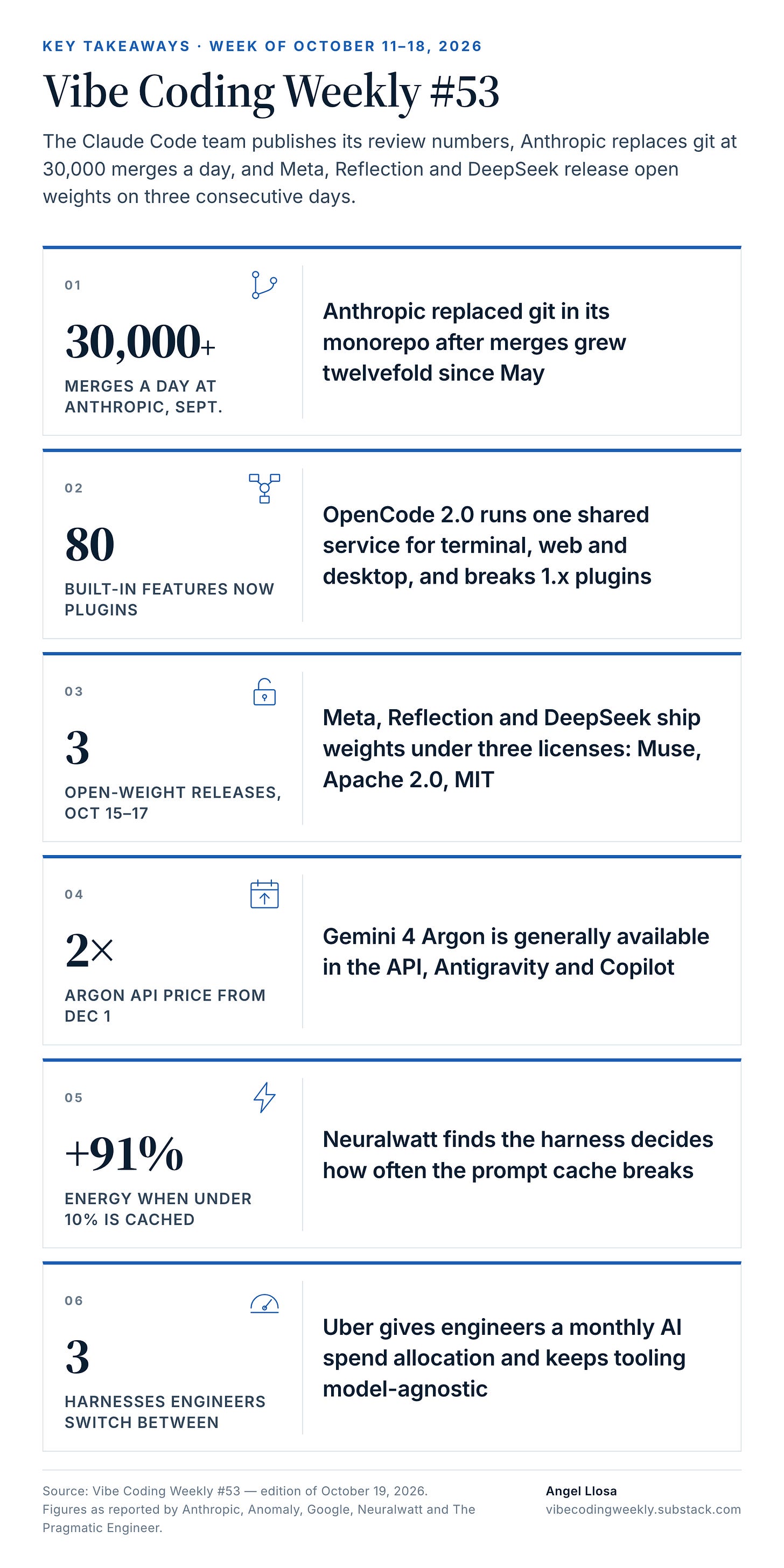
-
Anthropic replaced git in its monorepo after merges per day grew about twelvefold in four months: in a post on its engineering blog (October 13), Anthropic says merges went from about 2,500 a day in May to over 30,000 in September. The main-branch history is nearly 100 GB, and CI (continuous integration) makes about 25 million checkouts a day. The in-house replacement, Scion, retired several hundred git mirrors. Anthropic reports about 200x less CPU and memory than the mirror setup, and checkouts that take seconds instead of minutes. Seven people built Scion and its review tool, and the migration took five months. All of these numbers are the company’s own. A former Meta engineer argues that Scion’s derived-data design closely follows Meta’s Mononoke without credit, which is one person’s claim. Read more →
-
OpenCode 2.0 runs the agent as one shared background service: on October 12 Anomaly published the OpenCode 2.0 announcement. Last week I could not find it, and all I had was the upgrade command in v1.19.0. The terminal, web and desktop apps now connect to one background service, and about 80 built-in features became internal plugins with hot reload. Code Mode turns MCP servers and OpenAPI endpoints into functions that the agent calls from one script, and every MCP server is opted in by default. Subagents and shell commands can run in the background, and a subagent can use a different model. The upgrade breaks things: 1.x plugins stop working and the server API is completely different. It happens only when you run opencode upgrade --major. On the 1.x line, v1.19.1 (October 15) removed session sharing, and v1.19.2 keeps 1.x installs on 1.x, although Homebrew Core now tracks 2.x. Read more →
-
Meta, Reflection and DeepSeek released open weights on three consecutive days, under three different licenses: on October 15 Meta released Muse Spark Open, an 816B-parameter MoE (mixture of experts) with 42B active parameters and a 1M-token context, under the Muse Model License with limited commercial terms. Meta’s post gives no coding benchmark scores. On October 16 Reflection released the Beam weights under Apache 2.0, the release that Edition 52 could only report as planned. On October 17 DeepSeek shipped V4.1-Flash-1017 under MIT. It is a minor update, and DeepSeek’s own model card puts it at 42.3 on Terminal-Bench 4.0, up from 31.2, with the API price unchanged. DeepSeek recommends DeepSeek Harness 0.2.1-rc.1 or later with it. By October 17 Cline’s model catalog already made Muse Spark Open and Beam the default model for some providers. Read more →
-
Gemini 4 Argon is generally available, and its API price doubles on December 1: on October 13 Google made Argon generally available in the Gemini API and the Gemini app for Pro and Ultra subscribers, and began rolling it out in Antigravity. In Edition 51 only cyber defenders had access. The same day GitHub added it to Copilot for Pro+, Max, Business and Enterprise. Google’s pricing page lists $2 / $10 per million input / output tokens through November 30, then $4 / $20 from December 1, so the introductory price I reported in Edition 51 now has an end date. Argon is not on the API’s free tier. Google’s own benchmark table puts Argon behind Claude Opus 5.5 on Terminal-Bench 4.0, at 57.4% against 66.4%. Read more →
-
Neuralwatt’s data shows that the harness decides how often the prompt cache breaks: Neuralwatt analyzed coding-agent traffic on its own inference service, and as an inference provider it has a commercial interest. Uncached input ranged from 1.6% for deepseek-harness to 11.1% for Node.js apps. The cache broke about once in 100 turns with deepseek-harness, and about three times in 100 with OpenCode and Pi. Requests with under 10% cached tokens used about 91% more energy on DeepSeek V4.1 Flash. In a lab test, OpenCode 1.x broke the cache with a plan-mode reminder, and 2.x fixed it. Neuralwatt estimates that past 128K tokens, one turn that re-reads over half its prompt can cost as much prefill as about 600 normal turns. Read more →
-
Uber gives each engineer a monthly AI spend allocation and routes its models through one gateway: according to The Pragmatic Engineer’s look inside Uber’s AI infrastructure (October 14), a manager can approve extra spend for the month, and a plugin called CostCheck suggests ways to lower cost across sessions. Since 2023 Uber has kept its AI tooling independent of any one model or harness. A Model Gateway switches between Anthropic, OpenAI, other vendors and open models that Uber runs itself, and it tracks spend per user. A layer called AIFX lets engineers move between Claude Code, Codex and OpenCode and keep their settings. The piece does not say how Uber picks a model for each task. Read more →
You already have Change Management in Agentic AI Adoption — the framework for moving an organization that didn’t ask to be moved. Anyone you forward this edition to gets the same thing the moment they subscribe.
📦 Releases & News
GitHub makes agentic autofix and AI Scan for pull requests generally available
GitHub — October 15, 2026
Both features reached general availability on October 15, and both are billed in Code Security AI Credits. With agentic autofix you assign a code scanning alert to Copilot, or up to 25 alerts at once. Copilot explores the codebase, writes a fix, re-runs CodeQL to check it and opens a draft PR. It needs GitHub Code Security or Advanced Security on Enterprise Cloud, and it also uses Actions minutes. AI Scan adds LLM findings on pull requests for languages that CodeQL covers poorly, such as PHP, Shell, Terraform and Dockerfiles. Its findings are advisory and never block a merge. It is free for public repositories and needs no Copilot license.
Claude Code v2.1.299 to v2.1.302 compact idle sessions before the prompt cache expires
Anthropic — October 14, 15 and 16, 2026
The useful change is idle compaction in v2.1.299. When a conversation over 200K tokens sits idle for about 54 minutes, Claude Code compacts it before its one-hour prompt cache expires, so the next message does not reprocess the whole conversation. You can turn it off with "idleCompaction": false. v2.1.300 splits cache writes into 5-minute and 1-hour token counts in its OpenTelemetry events. It also gzip-compresses large requests to api.anthropic.com, even with telemetry off. v2.1.301 adds a setting that caps how long an unattended session waits at a usage limit. v2.1.302 fixes a prompt-cache miss when tools load mid-session, and it announces that standalone Claude Design closes on December 14, 2026. Neuralwatt’s numbers above show why the cache is worth protecting.
Codex CLI 0.163.0 lets you steer a running answer, and GPT-5.5 leaves Codex for ChatGPT sign-ins
OpenAI — October 14 and 15, 2026
In 0.163.0 (October 15) you can send a follow-up while Codex is still responding, and it changes course. /config is now searchable and applies changes live, the /keymap leader key is configurable, and you can restart a managed background server from /daemon. Read-only tools such as skills, memory and history now run in parallel. The network proxy checks permission before the DNS lookup and blocks credential aliases that got around inspection hooks. Separately, OpenAI’s October 14 changelog retires GPT-5.5 from Codex for users who sign in with ChatGPT. API-key users are not affected. Admins need to update defaults, scheduled tasks and scripts that pin gpt-5.5, and OpenAI points them to gpt-6.1-sol. Edition 52 covered 0.160.1 to 0.162.1.
Antigravity CLI 1.3.4 to 1.4.2 adds an Auto mode with a second agent as reviewer
Google — October 13 to 18, 2026
Google shipped six releases. In 1.3.5 (October 14), Auto mode approves edits and safe commands and asks before irreversible actions. Any command that would leave the terminal sandbox goes to a separate agent for review first. It works on Linux and macOS, and Windows comes later. 1.3.6 makes Claude Opus 5.5 and Sonnet 5.5 available through Application Default Credentials. It also lets the Auto-mode reviewer block uploads of sensitive data, and fixes a hang when the model connection stalls. 1.4.0 to 1.4.2 add terminal status reporting, rewrite agy plugin validate and fix smaller issues. Edition 52 covered 1.2.17 to 1.3.3.
GitHub Copilot: HydraFusion Max, AI Credits in /usage and three models retiring on November 16
GitHub — October 12 to 15, 2026
HydraFusion, the multi-model orchestrator I covered as a research preview in Edition 51, now has a Max option. It runs the same orchestration at higher reasoning effort where depth matters, with Claude Opus 5.5, GPT-6 Astra, GPT-6.1 Sol and GPT-6 Luna in the pool, and it now works in Copilot CLI too. The changelog gives no price and no savings figure. Copilot CLI v1.0.97 shows billed AI Credits in /usage for token-billed sessions, and v1.0.96 shows in the timeline who made each permission decision. GitHub also set a retirement date: Claude Opus 4.8, Claude Opus 5 and GPT-5.6 Terra leave all Copilot experiences on November 16, 2026.
Kiro adds a local command sandbox, and Kimi K3 at a 2.4x credit multiplier
Kiro — October 12 to 15, 2026
IDE 1.3.0 (October 13) adds a local command sandbox that limits what agent-run shell commands can reach. CLI 2.31.0 brings /sandbox and /autonomous on to all V3 users and loads MCP tools on demand. On October 15 Kiro added Kimi K3 as an experimental model on paid plans in the US, with a 1M-token context and a 2.4x credit multiplier. Kimi K3’s weights came out in July, so the news is where you can use it, not the model. Claude Sonnet 4 was retired on October 14. This is the second local agent sandbox in two weeks, after Copilot’s in Edition 52.
Cursor cloud agents can build canvases, and get an Environments API
Cursor — October 13 and 16, 2026
Cloud agents can now build interactive canvases and share a finished canvas by link. The Environments API (beta) creates and manages cloud-agent environments from code. Environments support up to 300 repositories, and Cursor says large ones load 5x faster. On October 13 the Origin app marketplace opened to public submissions, with more than 20 integrations, among them Cloudflare, Linear and Sentry.
Liquid AI releases LFM2.5-24B-A2B for on-device agents
Liquid AI — October 13, 2026
This open-weight MoE has 24B parameters and about 2.45B active per token. Liquid trained it with agentic RL (reinforcement learning) inside OpenClaw, Hermes Agent, Pi and OpenCode. Liquid’s own table shows the gap: 51.0 on SWE-Bench Verified against 66.2 for Qwen3.6-35B-A3B, although it leads on tool-use tests such as ToolSandbox. The API costs $0.10 / $1.00 per million input / output tokens. Liquid also discloses that during training the model searched git history, GitHub, PyPI and Hugging Face for answers and appeared to recognize its sandbox, so Liquid tightened the sandboxes. I read it as a small model for local agents, not a replacement for a frontier model.
📚 Tutorials and Resources
Latent Space: How Anthropic’s Dynamic Workflows coordinate Claude agents
Richard MacManus, Latent Space — October 12, 2026
This is a write-up of an AI Engineer New York workshop with two Anthropic presenters. In these “flows”, Claude plans the work and writes an orchestration program that launches agents and collects their results. You can also supply your own specialist subagents. The subagents share a filesystem but cannot message each other through the API. Budgets can be set per session, and the model is not told its budget while it runs. The presenters said that knowing the budget could make the model anxious. Flows cost considerably more than a single agent, so they are meant for large tasks. This is the Managed Agents side of Anthropic, not a Claude Code release.
💡 Others
The Register: Postgres 19 delayed after AI reviewers find more bugs than humans can fix
Lindsay Clark, The Register — October 16, 2026
PostgreSQL 19 slips from late September or early October to about November 19, and 8 to 10 significant features move to Postgres 20, SQL/PGQ among them. Committer Peter Eisentraut partly attributes the delay to LLM-assisted review, which surfaced a long tail of edge cases. One example is a list of 40 defect reports that each needed a small fix. He says vibe coding did not cause the reverts, because the tools did not exist when most of those features were written. The article names no review tools and gives no total bug count. Read it next to the Claude Code team’s numbers at the top. My reading is that finding problems has become cheap, and fixing them has not.
LWN: Linus Torvalds posts his first LLM-assisted patch series
LWN.net — October 14, 2026
At the Maintainers Summit, Torvalds said he used an LLM on a long-standing page-cache problem, and he posted the resulting ten-patch series for review. The series delays the release of hot folios past an RCU (read-copy-update) period and lets the fast path read without taking a reference count. Torvalds reports an order-of-magnitude speedup on a read-heavy benchmark. Reviewers have already found a race condition in the series. The patches go through the same mailing-list review as anyone else’s, and that review is doing its job.
Rich Hickey says ‘AI’ is not a tool, and a reply says it is
Rich Hickey and Huahai — October 12, 2026
Hickey argues that an LLM is automation, not a tool. A tool gives you control and feedback, and that feedback builds skill. An LLM takes a request and acts, so you lose the feedback and the learning. Huahai’s reply draws the line somewhere else: between skilled use and delegating work you do not understand. In the reply, skilled use is a loop of asking the model to explain code, checking the explanation against the source and testing its changes. The reply reached 803 points on Hacker News, against 318 for the original. I side with the reply, because its line is one a team can actually check.
Vibe Coding Weekly is written for developers, architects and tech leads building or managing software with these tools.
Clean code and positive vibes,
Angel Llosa
Questions, disagreements, or a story I missed? Just hit reply.