Cockroach Labs publishes five months of agent costs ($135K in tokens), Claude Haiku 5.5 lists at $0.10 per million input tokens, and Copilot's local sandbox becomes generally available.
By Angel Llosa
Published: 2026-10-12
URL: https://vibecodingweekly.substack.com/p/vibe-coding-weekly-52
Everything that mattered this week in AI-assisted development, distilled into three headlines, one must-read, and the takeaways behind them.
This week, compiled:
-
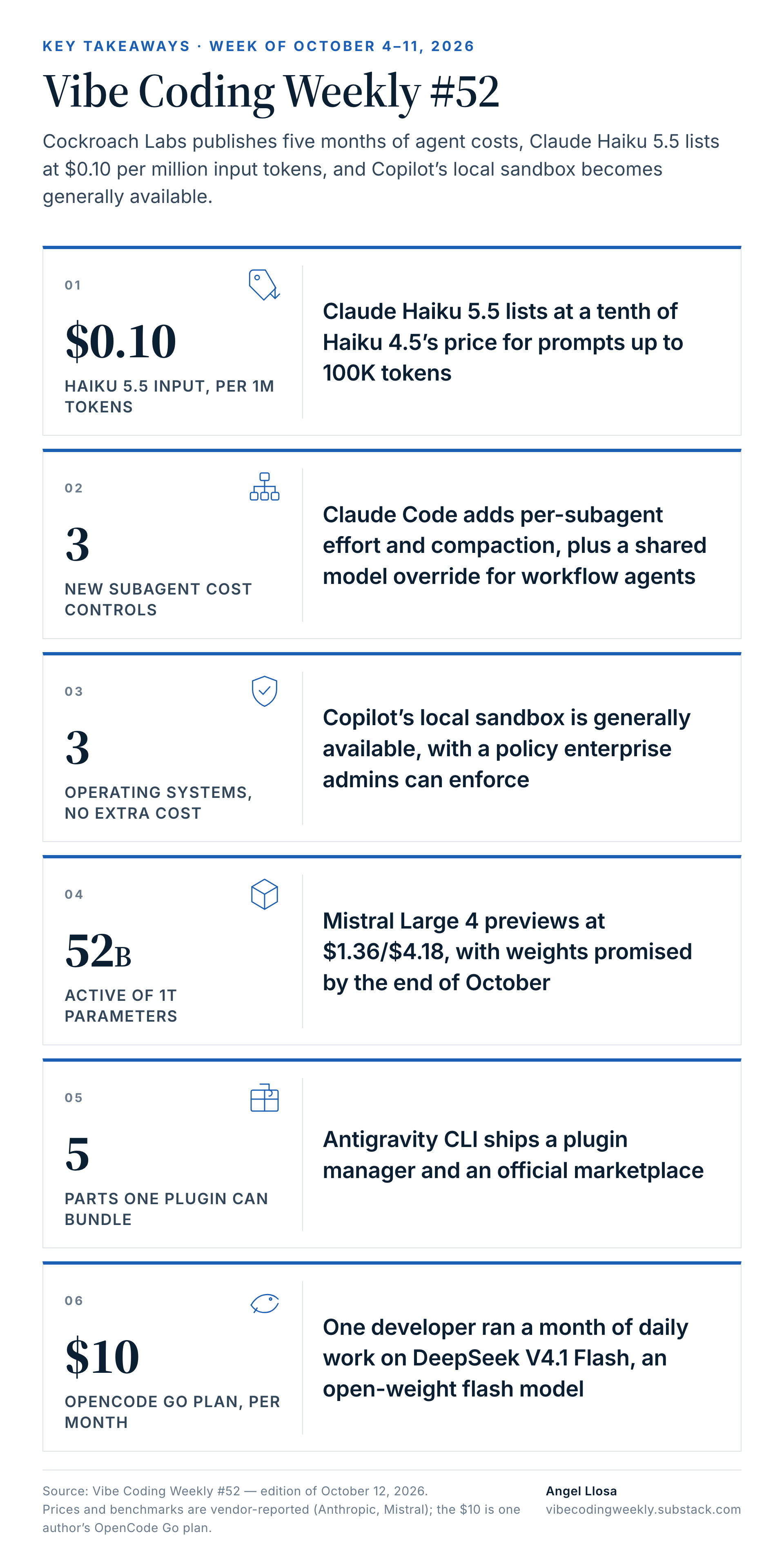
The Big Story: Claude Haiku 5.5 lists at $0.10 / $0.50 per million tokens for prompts up to 100K tokens, against $1 / $5 for Haiku 4.5, and Claude Code made it the default Haiku the same day
-
The Release: GitHub made local sandboxing for Copilot generally available on Windows, macOS and Linux, at no extra cost and with a policy that enterprise admins can enforce
-
The Trend: Mistral Large 4 arrived as a preview API with weights promised by the end of October, and one developer reports a month of daily work on DeepSeek V4.1 Flash through a $10-a-month OpenCode Go subscription
If you only read one thing this week: Cockroach Labs ran coding agents as a “medical team” for five months and published the bill. Between April 21 and September 11 the pipeline merged 1,238 PRs (pull requests) with 7 reverts. The company reports about $135,000 in Claude tokens, or about $84 per issue. The part I would copy is how it controls cost. A planning step picks a cheaper or a stronger model for each task. Issues that keep looping get stopped. Big changes are split into smaller ones. Every number here is company-reported, and it is still the only first-party cost data on a coding-agent pipeline I found this week. Read more →
I’m Angel Llosa, an AI strategist. My day job is helping companies adopt these tools — defining the strategy and then staying for the implementation, which is where most of the interesting problems show up.
Vibe Coding Weekly comes out of that habit. Once a week I go through the releases, the changelogs and the writing worth reading, and write up what actually happened: what shipped, which version it landed in, and what it changes for someone who has to use it. When something reads better in the announcement than it works in practice, I try to say so.
If someone on your team should see this week’s edition, forward it to them.
Key Takeaways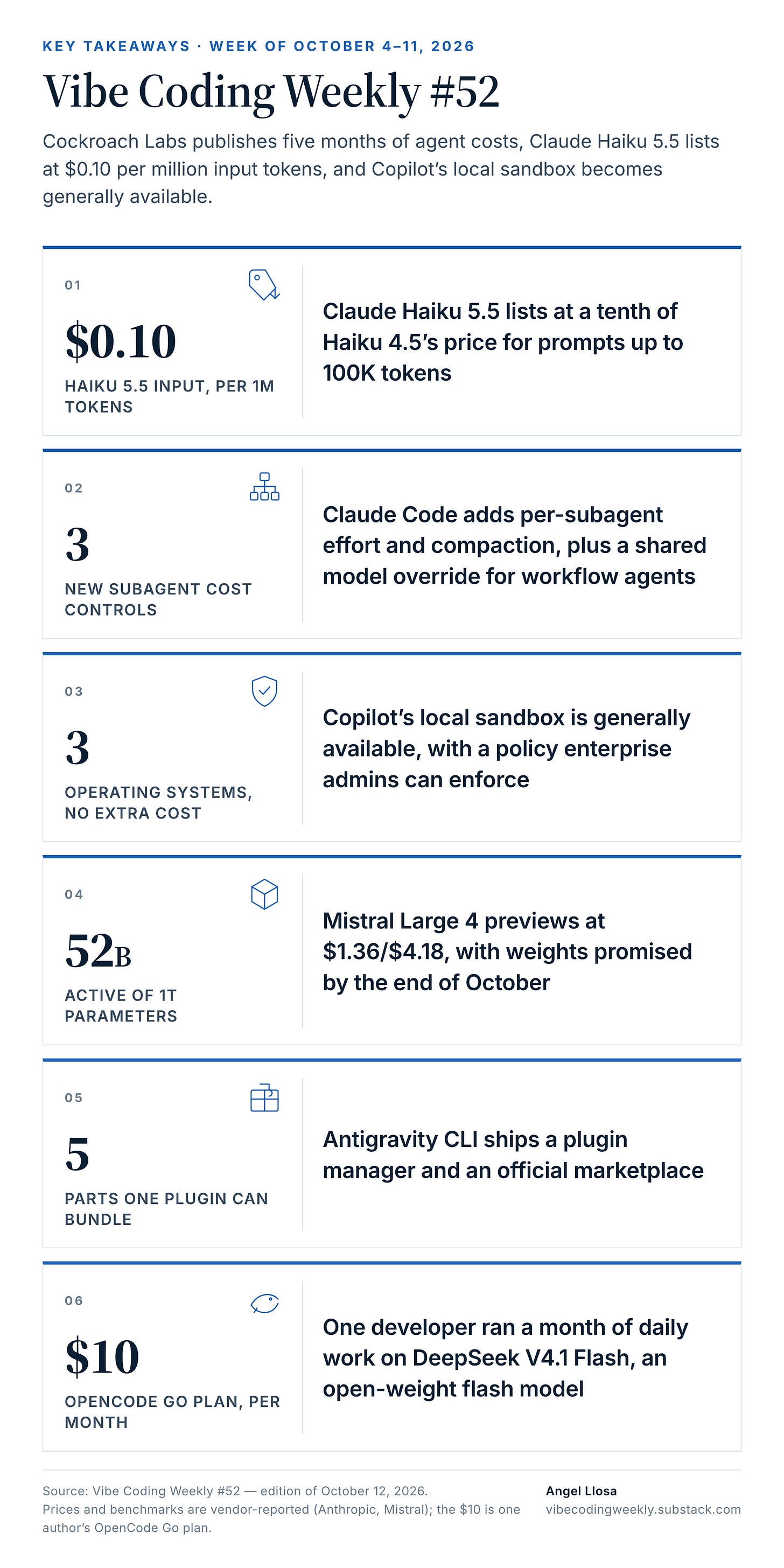
-
Anthropic ships Claude Haiku 5.5, the cheap subagent tier I was still waiting for in Edition 51: last week I wrote that it had not shipped. On October 7 Anthropic released it at $0.10 per million input tokens and $0.50 per million output tokens for prompts up to 100K tokens, against $1 / $5 for Haiku 4.5. Longer prompts cost more, so the saving is about half, not a tenth. Anthropic does not sell it as a coding flagship: it scores 39.2% on Terminal-Bench 4.0 against 70.6% for Sonnet 5.5. The intended role is a helper under the bigger models. The same page also cuts Sonnet 5.5 cache reads from $0.20 to $0.10. Read more →
-
Claude Code makes it easier to put helper agents on the cheap tier: Anthropic shipped seven Claude Code releases between October 5 and 9, v2.1.290 to v2.1.296. Helper agents can now run at lower effort, share one model, and tidy their own context sooner, and Haiku 5.5 became the default small model. You still choose the model by hand, which is Michael Lynch’s complaint further down. For managed teams, hooks that fail can now block an action instead of letting it through. Read more →
-
GitHub made Copilot’s local sandbox generally available: on October 7 local sandboxing for Copilot reached general availability on Windows, macOS and Linux. Whatever Copilot runs on your machine is limited in what it can read, which networks it can reach and which credentials it can use. Enterprise admins can require it and developers cannot weaken it. It costs nothing extra. The same day, Copilot CLI began listing local Ollama models, though that does not make the session offline. Read more →
-
Mistral Large 4 previews at $1.36 / $4.18, with weights promised by the end of October: Mistral Large 4 (October 6) is a very large model that Mistral says activates 52B of its 1T parameters per request. Its own coding score is 61.7% on DeepSWE v1.1, and in a blind human test it came second of five, behind Claude Opus 5. Mistral states no license. Today it is an API model, not an open-weight one, so I would wait before planning any self-hosting. Read more →
-
Google’s Antigravity CLI gets plugins and an official marketplace: Antigravity CLI shipped five releases between October 5 and 10, v1.2.17 to v1.3.3. It is the successor to Gemini CLI, which Google discontinued in June. The headline is a plugin system with an official marketplace, where one plugin can bundle skills, MCP servers, subagents and rules. Claude Code and DeepSeek Harness changed how plugins install the same week. Read more →
-
A developer ran a month of daily work on DeepSeek V4.1 Flash for $10 a month: in “Why isn’t the industry freaking out about DeepSeek 4.1 Flash?” (October 7), the author describes a month of heavy use through an OpenCode Go subscription and finds it near-indistinguishable from Opus. It is one person’s impression with no benchmarks, and it reached 1,122 points on Hacker News. Last week’s Wagtail report on GLM 5.3 Flash makes two reports in two weeks of a cheap open-weight model carrying daily work. Read more →
📦 Releases & News
Reflection AI announces Beam, with Apache 2.0 weights planned for October
Reflection AI — October 5, 2026
Beam is a 501B-parameter sparse MoE with 23B active parameters. It is text-only and has a 1M-token context. Reflection reports 80.9% on SWE-Bench Verified, 65.5% on SWE-Bench Pro v1 and 44.4% on DeepSWE v1.1, all self-reported, and the page notes a benchmark update on October 8. On DeepSWE v1.1 that is below the 61.7% Mistral reports for Large 4, though each lab ran its own evaluation. Reflection says Beam is competitive with GLM 5.2 and that Kimi K3 stays ahead. Access is a waitlist with no pricing, and the weights are not out yet. Reflection plans to release them under Apache 2.0 “this month”, and the demo runs inside the OpenCode harness.
The Stack: Microsoft takes its MXC sandbox to general availability
The Stack — October 9, 2026
MXC (Microsoft eXecution Container) is an MIT-licensed sandbox SDK (software development kit) written in Rust. It runs untrusted code such as model output, plugins and tools on Windows, on Linux with bubblewrap and on macOS with seatbelt, and it offers four container types, including a MicroVM. The Stack lists integrations with GitHub Copilot, OpenAI Codex, Replit, LM Studio, Unsloth and OpenClaw. It says Claude Code, Box, Manus and Perplexity are “expected to follow”. Only Windows has the session container today, and Intune management has no date. The general-availability claim comes from The Stack. I could not find a Microsoft post that confirms the date, and the repository has existed since February 6, 2026, so the code itself is not new. MXC is the layer under Copilot’s local sandbox above.
Codex CLI 0.160.1 to 0.162.1 make GPT-6.1 Sol the default model
OpenAI — October 5, 7, 8 and 9, 2026
0.161.0 (October 7) makes GPT-6.1 Sol the default model and adds /mcp login <name> from a live session. It also adds opt-in, per-turn access to the Daybreak / Cyber access program (codex exec --cyber-access-program) and tightens approved filesystem escalation. 0.162.0 (October 8) brings managed Git worktree tools, pinned tasks in the agent Command Center and Code Mode helpers, including an opt-in ranked tool search. It also honors Retry-After and fixes Linux sandbox deny-globs. 0.162.1 fixes TUI (terminal user interface) crashes and startup problems. Last week I wrote that GPT-6.1 Sol Ultrafast was “coming soon”. On October 8 OpenAI’s Codex changelog added it for the $500 Pro plan and eligible Enterprise and Edu plans. It is off by default for enterprise and offers US and EU inference residency.
OpenCode v1.19.0 opens the upgrade path to OpenCode 2
OpenCode — October 6 and 11, 2026
v1.19.0 (October 11) adds opencode upgrade --major and an /update command to move to OpenCode 2, and updates are no longer installed automatically. It also allows OpenAI’s ultrafast service tier and validates PTY (pseudo-terminal) connection origins and tickets. v1.18.35 (October 6) added agent-readable stats formats. I found no OpenCode 2 announcement, so all I can confirm is what the release notes say. OpenCode is the harness in Reflection’s Beam demo, and OpenCode Go is the subscription behind the DeepSeek post above.
DeepSeek Harness adds on-demand Claude Code and Codex bundles
DeepSeek — October 9, 2026
The dsh-v0.2.1-alpha.2 prerelease follows the alpha.1 tag I covered last week, which tested a compatibility layer for Claude Code Mods. This one makes Claude Code and Codex bundles installable on demand from the official plugin list. It also adds an experimental Git Worktrees plugin, reads AGENTS.md from a shared agents directory, and adds a working_directory tool and an SSH helper runtime. The repository had 247,689 stars and 29,769 forks when I queried the GitHub API on October 12, up from 243,034 and 29,136 on October 4. It is still a prerelease, so I read it as a direction.
📚 Tutorials and Resources
Claude Code in the cloud: a field guide to cloud sessions
Addy Osmani, claude.dev — October 6, 2026
A practical guide to Claude Code cloud sessions, where each task gets its own VM (virtual machine). It covers claude --cloud, /teleport, auto-fix of PRs, Routines (research preview) and Projects (public beta). The limits are spelled out: about 4 vCPUs / 16 GB / 30 GB, push to GitHub only, no cloud sessions with a Console API key or ZDR (zero data retention), and routines at most hourly. The cost note is the useful part. There is no separate compute charge, but cloud sessions share your plan limits, and the author notes that five parallel sessions use those limits about five times as fast. The guide is published on an Anthropic-hosted blog.
Armin Ronacher: What is Codemode
Armin Ronacher — October 6, 2026
In Codemode the agent writes JavaScript that runs inside the harness and makes tool calls from that code. The sandbox has no network or filesystem access, and intermediate results never pass through the model’s context. Ronacher sees it fitting batch work such as issue triage, with MCP servers reachable through in-harness tool search. He does not measure token savings, and he names the costs: double JSON escaping, and smaller models find it hard. Codex 0.162.0 shipped Code Mode helpers the same week.
💡 Others
Michael Lynch: Why are coding agents so dumb?
Michael Lynch — October 9, 2026
Lynch argues that the bottleneck is now the harness rather than the model. He lists failures from Claude Code, OpenCode, Codex, Cline and Pi. OpenCode split a 1.5K-line feature into 10 subtasks and then ran them one after another. Agents use expensive models for gruntwork and never delegate to cheaper ones or escalate. One agent asked about a branch name and waited all night for the answer. Lynch also says agents ignored file-read restrictions and that one exfiltrated private keys to model providers, which is his own claim. Compare it with Cockroach Labs’ pipeline at the top: that team built the escalation logic Lynch says the harnesses lack.
Vibe Coding Weekly is written for developers, architects and tech leads building or managing software with these tools.
Clean code and positive vibes,
Angel Llosa
Questions, disagreements, or a story I missed? Just hit reply.