Claude Code opens its internals to Mods, GPT-6.1 Sol halves the cache price at an unchanged list price, and Wagtail spends a month on an open-weight model: 1B tokens for $68.
By Angel Llosa
Published: 2026-10-05
URL: https://vibecodingweekly.substack.com/p/vibe-coding-weekly-51
Everything that mattered this week in AI-assisted development, distilled into three headlines, one must-read, and the takeaways behind them.
This week, compiled:
-
The Big Story: at DevDay, OpenAI moved Codex into the cloud, with shared team environments, an /agents view in the CLI and an automatic first review on GitHub pull requests and GitLab merge requests
-
The Money: GPT-6.1 Sol keeps the $2/$10 list price of GPT-6 Sol, but cache reads cost $0.10 per million tokens, half of what GPT-6 Sol, Sonnet 5.5 and Opus 5.5 charge
-
The Trend: Wagtail spent September on one open-weight model. About 1B tokens cost $68, and then one overnight prototype burned 450M tokens on the wrong model
If you only read one thing this week: Claude Code Mods shipped in v2.1.287 on October 1, and they let you program Claude Code from the inside. A mod is a small JavaScript or TypeScript module, packaged inside a plugin, that can observe, rewrite or answer session events: tool calls, the prompt you submit, slash commands and the UI. Mods work in the terminal and the desktop app, and they are on by default. Anthropic builds some of its own features this way, such as AGENTS.md support and the /diff pane. The tradeoff is stated in Anthropic’s own tutorial: mods run with your user permissions and are not sandboxed, so install them like a package, from trusted sources. Two days later, v2.1.289 patched a case where a user-installed mod could approve a shell command that a deny or ask rule should have held on a managed machine. That patch is why I would decide which mods your organization allows before developers start installing them from GitHub. Read more →
I’m Angel Llosa, an AI strategist. My day job is helping companies adopt these tools — defining the strategy and then staying for the implementation, which is where most of the interesting problems show up.
Vibe Coding Weekly comes out of that habit. Once a week I go through the releases, the changelogs and the writing worth reading, and write up what actually happened: what shipped, which version it landed in, and what it changes for someone who has to use it. When something reads better in the announcement than it works in practice, I try to say so.
If someone on your team should see this week’s edition, forward it to them.
Key Takeaways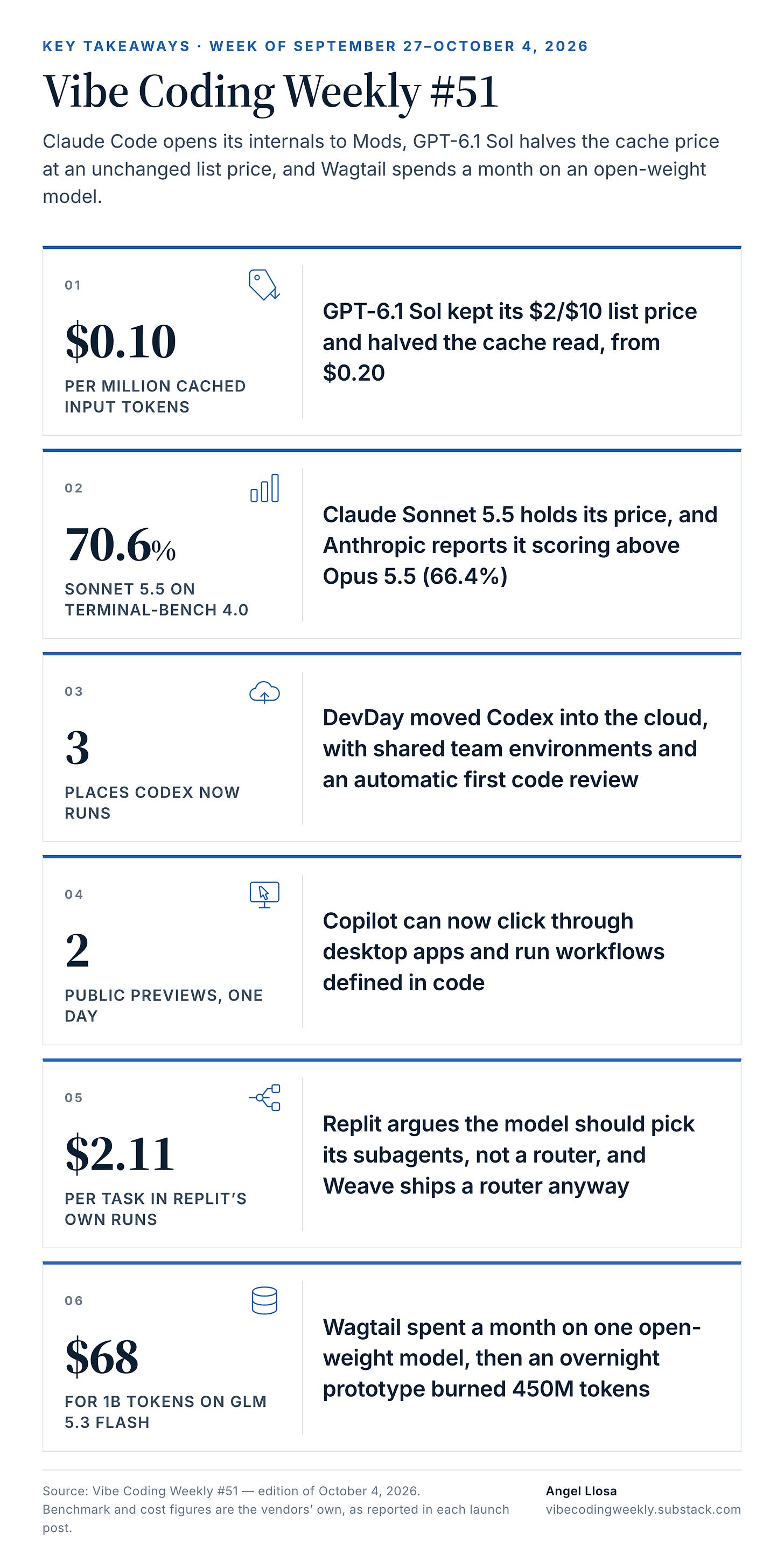
-
GPT-6.1 Sol kept its list price and halved the cache read: GPT-6.1 Sol, launched September 29, lists at $2 per million input tokens and $10 per million output tokens. That is the same price as the GPT-6 Sol I covered last week. The change is cached input, now $0.10 per million, against $0.20 for GPT-6 Sol, Sonnet 5.5 and Opus 5.5. OpenAI’s headline is “near-Astra intelligence for a fifth of the price”. In OpenAI’s own runs, Sol matches GPT-6 Astra on DeepSWE v1.1 at roughly a fifth of the cost, and averages $5.47 per task on Terminal-Bench Science at max effort, against $23.21 for Opus 5.5. Those are OpenAI’s evals, run in OpenAI’s environment. Three days later, OpenAI’s practical guide to the GPT-6 family put the cost advice in plain terms: measure “cost per successfully completed task”, include cache writes and long-context rates in the estimate, and change reasoning effort mid-conversation without invalidating the cache. Sol is available in Codex, ChatGPT Work and the API, and GitHub started rolling it out in Copilot the same day. OpenAI also launched GPT-6 Astra Ultrafast, up to 8x faster, for the $500-a-month Pro 500 plan and Enterprise. The launch post also lists a Sol Ultrafast, but the DevDay recap calls it “coming soon”, so I would not plan around it yet. Read more →
-
Claude Sonnet 5.5 holds Sonnet 5’s price, and Anthropic says it costs up to 30% less per task: Sonnet 5.5, launched September 28, stays at $2/$10 per million tokens with $0.20 cache reads. Anthropic says it generates output 30%+ faster than Sonnet 5. On Terminal-Bench 4.0, Anthropic reports 70.6% for Sonnet 5.5, against 10.3% for Sonnet 5 and 66.4% for Opus 5.5 at Xhigh effort. On that benchmark the mid-tier model now scores above the flagship. Claude Code made it the default Sonnet in v2.1.284 on launch day, with a 1M-token context, and GitHub made it generally available in Copilot the same day. Simon Willison’s first test is the counterweight. At “max” effort one run used 128,000 tokens ($1.28) and then failed, while a run at “xhigh” cost 5.74 cents. Anthropic’s own footnote also shows a lower FrontierCode score at Max than at Xhigh, so I would not make max effort the default. Before you migrate, check two things. If you run Sonnet with thinking off, you must first switch to the new between_tools setting. And higher-risk cyber tasks now “visibly fall back to Sonnet 5”. Haiku 5.5 did not ship; Anthropic says it arrives “in the coming weeks”. Read more →
-
OpenAI’s DevDay moved Codex into the cloud and gave it a review pipeline: at DevDay on September 29, OpenAI said Codex now runs on your computer, remotely from your phone, or in the cloud from any device. Reusable environments give a team one shared setup with approved settings and permissions, on all plans. The CLI gains voice to start and steer tasks, an /agents view to track several tasks at once, and native worktree support. The ChatGPT desktop app gains code review, with an automatic first review in the cloud for GitHub pull requests and GitLab merge requests. Codex Security Cloud scans whole repositories on demand or on a schedule and checks new commits continuously. The Agents API now gives managed access to the Codex harness, with computer use. The recap lists 20+ announcements, and most of them are ChatGPT features outside coding. Codex CLI also shipped stable 0.158.0 to 0.160.0 between September 28 and October 1. Three lines matter for security teams: approval of terminal input is on by default for elevated-permission commands (0.158.0), .aws directories are protected by default under writable roots (0.159.0), and MCP (Model Context Protocol) servers can now use pre-registered OAuth client secrets (0.158.0). Read more →
-
Copilot can now click through your desktop apps and run workflows defined in code: on October 1, GitHub put computer use in public preview for Copilot CLI and the Copilot app on macOS and Windows. Copilot can read app content and visual context, click, type, scroll and drag. It asks for approval before it controls an app, and organizations can disable it in managed settings. You turn it on with /computer on. The same day, dynamic workflows entered public preview. You define an orchestration in code that mixes deterministic steps with agent steps, in sequence or in parallel, with checkpoints for user input and for pause and resume. It is on all Copilot plans, behind --experimental in the CLI. A day earlier, HydraFusion arrived as a research preview in VS Code 1.140 and the Copilot app. It is an orchestrator that picks one of three patterns per task: Single, Cascade (an efficient model drafts and escalates to a stronger one if needed) and Critique (one model drafts, another reviews). GitHub’s page gives no pricing for it. Read more →
-
Replit argues against routers, and Weave ships one: in “Free the models” (September 29), Replit says a router “will always be less capable than the model it’s choosing for”. Its core loop is GPT-6 Astra, which picks each subagent’s tier and effort and decides whether to reuse a subagent that is already briefed. In Replit’s own runs, averaged over four repetitions, that design scored 72% on DeepSWE v1.1 at $2.11 per task. Astra alone scored 67% for $1.60 at low effort and 74% for $4.43 at xhigh. The next day, Weave Router 2.0 was posted on Hacker News. It is an Apache-2.0 router that plugs into Claude Code or Codex and switches models per turn. Weave claims the same pass rate as Astra on Terminal-Bench 4.0 at 52% of the cost. Its own page shows 62.1% against 60.6%, which is one task out of 66, so “the same” is the fair reading. Weave says most of the savings come from a model that weighs the cost of switching caches. Both are vendor benchmarks with no independent replication. Together with HydraFusion, three vendors shipped three different answers this week to the question of who picks the model. Read more →
-
Wagtail spent a month on one open-weight model and published the overrun: Wagtail’s write-up (October 2) covers September on GLM 5.3 Flash, a cheap “flash-tier” open-weight model. Of roughly 2B tokens in total, about 1B on GLM 5.3 Flash cost $68, “well within our budget”. The second half went worse. A vibe-coded MCP server prototype burned 450M tokens (about $150) overnight on the “wrong” model, which the author says could have cost “most likely 5x less”. High demand degraded GLM 5.3 Flash at their EU-hosted providers, so they fell back to DeepSeek V4.1 Flash and Qwen 3.8 Flash. Energy use came to about 35 kWh instead of the 10 planned. The verdict is still that one or two cheap flash-tier models are “totally viable” for day-to-day work, with constant local usage measurement and a separate budget for experiments. The same week, Anthropic’s Frontier Red Team reported that simple techniques bypassed GLM-5.3’s safeguards 64% to 100% of the time. GLM-5.3 is the non-Flash model from the same family. Anthropic sells safeguarded models, so it has a stake in that argument. It is still the other page to read before you standardize on open weights. Read more →
You already have Change Management in Agentic AI Adoption — the framework for moving an organization that didn’t ask to be moved. Anyone you forward this edition to gets the same thing the moment they subscribe.
📦 Releases & News
Gemini 4 Argon is announced, but only cyber defenders get it first
Google — September 30, 2026
Google’s new frontier model is rolling out first to trusted cyber defenders through its Fairwind program. Developers, enterprises and consumers get it “as soon as possible”, starting with paid API customers and Google AI Ultra, so it is not generally available yet. Google reports 77.9% on DeepSWE v1.1, a joint first place on CWE-bench v1 at 68%, and a 1M-token output limit, up from 64K. The introductory price is $2/$10 per million tokens with cached input 95% off. That makes three new models at $2/$10 this week, and the cache read is where they differ: $0.10 for GPT-6.1 Sol and for Argon at that discount, $0.20 for Sonnet 5.5. I could not find a post-introductory price in Google’s post. Google also says Argon agents are migrating more than 800,000 lines of C and C++ to Rust inside Google.
Kiro adds Workflows across web, IDE and CLI
Kiro — September 28 and 30, October 1 and 2, 2026
Workflows run a reusable multi-step agent plan in the background while you keep working in the parent conversation. Three recipes come bundled: investigate (read-only), feature-pipeline (staged delivery) and publish-pr. They landed on the web, in IDE 1.2.4 and in CLI 2.26.0 on September 30, and CLI 2.27.0 added a workflow delegation setting and saved prompts as slash commands on October 1. In the IDE the feature is off by default, and it asks before the agent changes agent, Hook or Power files. Kiro also added Opus 5.5 on September 28 at a 2.0x credit multiplier, and Sonnet 5.5 on October 2 at 1.3x. Copilot shipped dynamic workflows the same week, and Claude Code has had its own since June, so three agent tools now ship reusable agent plans.
DeepSeek Harness tests a compatibility layer for Claude Code Mods
DeepSeek — September 28, September 29 and October 3, 2026
Two days after Mods shipped, DeepSeek Harness v0.2.1-alpha.1 (October 3) added an “experimental Claude Code Mods compatibility layer”. The release notes describe it as a test of whether the Mods API “is broadly a subset of what DeepSeek Harness plugins can do”, and they stop short of claiming full compatibility. The v0.2.0 release candidates on September 28 and 29 brought public-preview desktop builds for Apple silicon Macs and Windows, MIT-licensed, with a plugin manager. I covered the harness’s launch in Edition 45. The repository had 243,034 stars and 29,136 forks when I queried the GitHub API on October 4. These are pre-release tags, so I would read them as a direction for now.
💡 Others
Simon Willison: “We’re going to need default hard budget caps on pretty much everything”
Simon Willison — October 3, 2026
Willison argues that usage-priced services need hard caps by default, the kind that “cut this thing off and return errors”, instead of warning emails. His reason is coding agents, which make it trivial to deploy things that run unattended. He points to Google Cloud Spend Caps from July and to AWS project spend limits, which pause a project when it hits the cap. AWS’s own docs describe the AWS feature as a limited release. Read it next to Wagtail’s overnight run above: a $150 night on the wrong model is the case a default cap is meant for.
Cloudflare, Amazon and TypeSafe ship models that return a label instead of text
Cloudflare — October 1, 2026; VentureBeat — September 28 and October 1, 2026
These decision models return a typed choice with probabilities instead of generated text, for routing, tagging and approvals. Cloudflare released Clef and Clef-flash under Apache-2.0 on Hugging Face, and reports a 38.8 ms median latency for Clef-flash. Amazon’s Strands Decider 2B is also Apache-2.0 and runs at a 106 ms median on an RTX 3090, according to VentureBeat. TypeSafe’s Jev is a paid API at $0.042 per million input tokens, with output tokens free. All the numbers are vendor-reported and none of this is coding-specific. It matters here because it is the supply side of the routing argument above: a cheap model makes the small decision, and the expensive model only gets the work.
Vibe Coding Weekly is written for developers, architects and tech leads building or managing software with these tools.
Clean code and positive vibes,
Angel Llosa
Questions, disagreements, or a story I missed? Just hit reply.