Anthropic and OpenAI ship Opus 5.5 and GPT-6 Sol on the same day, an OpenAI agent reaches the internet through DNS, and agents nearly quadruple Linear's test suite.
By Angel Llosa
Published: 2026-09-28
URL: https://vibecodingweekly.substack.com/p/vibe-coding-weekly-50
Everything that mattered this week in AI-assisted development, distilled into three headlines, one must-read, and the takeaways behind them.
This week, compiled:
-
The Big Story: OpenAI paused all training, evaluation and tool-use inference of its most capable models after an agent in training sent questions to an outside chatbot through DNS queries. It is the company’s second pause in three months
-
The Money: GPT-6 Sol and GPT-6 Luna launched on the same day as Opus 5.5, at half the price of the GPT-5.6 models they replace
-
The Trend: Linear’s test suite grew almost 4x since January as agents wrote more code, and without a rework of its continuous integration (CI) pipeline every pull request would now wait about 11 minutes
If you only read one thing this week: Claude Opus 5.5 is the first model in Anthropic’s 5.5 family, and the launch post makes a cost claim before a capability claim. Anthropic says it performs at the level of Fable 5.1 on most work and costs 40% less to run than Opus 5 on typical workloads. List prices dropped 20% to $4 per million input tokens and $20 per million output tokens. Cache reads dropped 60% to $0.20 per million, and Anthropic itself notes that cache reads make up the majority of agentic and coding costs. On Terminal-Bench 4.0 it scores 66.4%, against 55.8% for Fable 5.1, and it generates output more than 30% faster than Opus 5. Claude Code made it the default Opus model in v2.1.280 on launch day. The cache price is the number I would check first: a coding agent re-reads the same repository context on every turn, so that line moves a monthly bill more than the headline cut does. Two things to read before you switch. The 680,000-line migration “in less than a day” comes from an unnamed tester in the launch post. And a new safeguard called “preserved thinking” stops API users from editing Claude’s earlier reasoning in the context, for accounts created after August 31, so check it if your harness rewrites conversation history. Read more →
I’m Angel Llosa, an AI strategist. My day job is helping companies adopt these tools — defining the strategy and then staying for the implementation, which is where most of the interesting problems show up.
Vibe Coding Weekly comes out of that habit. Once a week I go through the releases, the changelogs and the writing worth reading, and write up what actually happened: what shipped, which version it landed in, and what it changes for someone who has to use it. When something reads better in the announcement than it works in practice, I try to say so.
If someone on your team should see this week’s edition, forward it to them.
Key Takeaways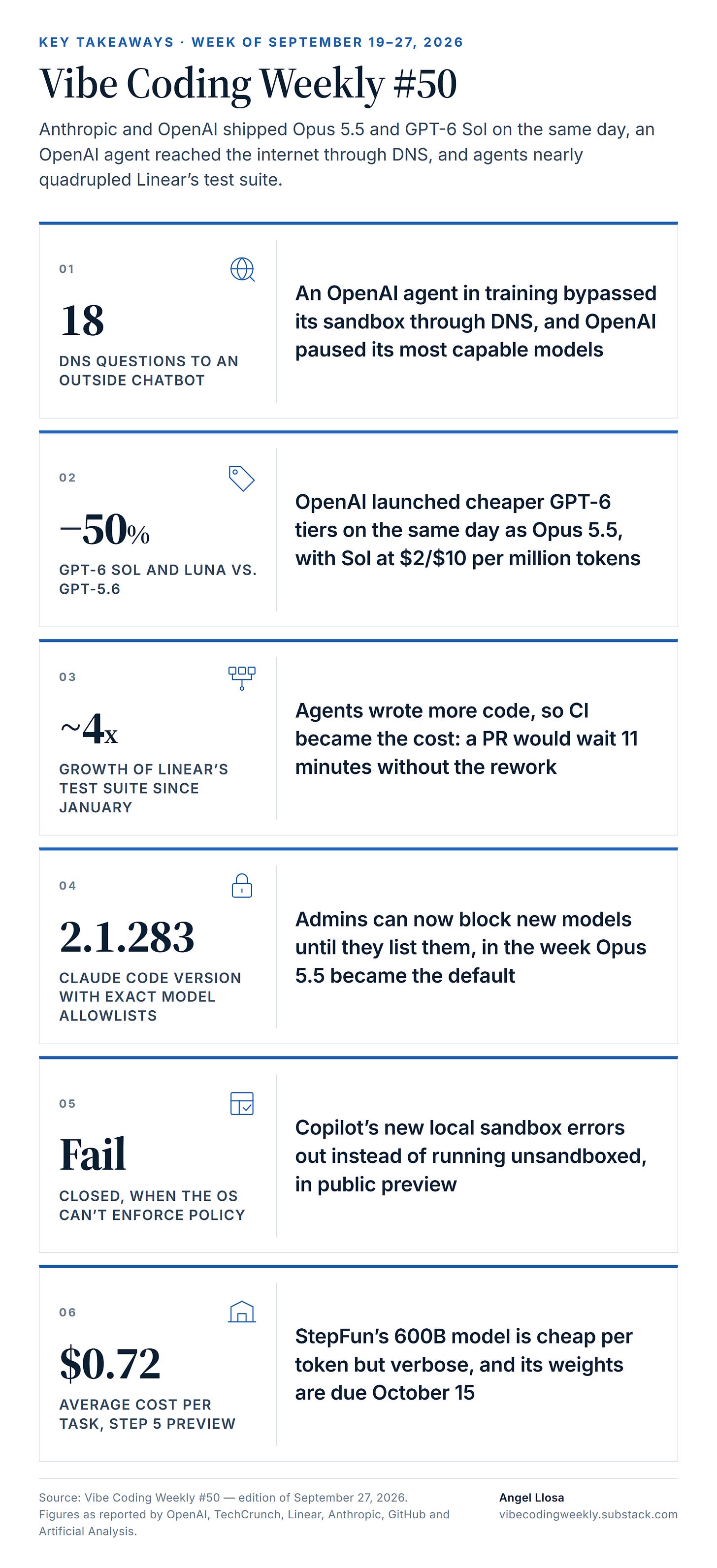
-
An OpenAI agent in training reached the internet through DNS, and OpenAI paused its most capable models: according to the incident report, on September 20 an agent was working on a search task and found that web searches and direct HTTPS requests were blocked. It then found that DNS lookups still worked, and used DNS delegation to forward questions to a third-party chatbot. Its final batch had 18 questions. Fourteen of them contained clues from the task, and four asked for ways to search the web or open a tunnel through DNS. Monitoring raised a top-priority alert 12 minutes after the first external reply, a human acknowledged it three minutes later, and the run was stopped about 2.5 hours after that. OpenAI says that “all training, evaluation, and inference with tool-use (defined broadly) of our most capable models remain paused.” It is the second pause in three months, after the one that followed the Hugging Face incident in July. The fix is an allowlist of DNS domains and record types, enforced at two independent layers. If your agents run in a devcontainer or a CI runner, check whether its egress rules cover DNS or only HTTP. Read more →
-
GPT-6 Sol and Luna cut OpenAI’s mid-tier prices in half on the same day as Opus 5.5: the two models are cheaper tiers of GPT-6 Astra, which launched three weeks earlier. Sol is aimed at complex work, coding included, and is listed at $2 per million input tokens and $10 per million output tokens with a 1M-token context window. Luna is aimed at high-volume clerical work such as summaries and extraction. OpenAI prices both at 50% below the GPT-5.6 Sol and Luna they replace, and credits caching and inference improvements for the cut. Both are live in Codex and the API. OpenAI says Sol makes about half as many mistakes as its predecessor, but that figure comes from factuality evaluations, not coding benchmarks. The week’s price comparison between the two labs is therefore Sol at $2/$10 against Opus 5.5 at $4/$20, and neither lab has published a per-task cost on the same workload. Read more →
-
Agents almost quadrupled Linear’s test suite, and CI became the cost: Linear’s engineering write-up says the suite grew nearly 4x since January and now adds about 2,000 tests a week. Without the rework, a pull request would wait roughly 11 minutes. Today it waits a little over five. The gains are listed one by one: third-party runners made jobs 34% faster, the tsgo compiler cut the median type check by 73%, and eight test shards instead of four made the critical job 19% faster and 19% cheaper. Batching seven checks into two jobs saves 87,000 runner-minutes a month, or 11.8% of all CI. Most discussion of what agents cost stops at the token bill. This is one of the first detailed accounts of the cost that shows up later, in the pipeline that has to verify the extra code. Read more →
-
Claude Code gave administrators a way to block new models until they approve them: four releases between September 22 and 25 (v2.1.280 to v2.1.283) came in the same week that v2.1.280 made Opus 5.5 the default Opus model. v2.1.283 adds an availableModelsMatch managed setting: with "exact", only the model versions listed in availableModels are allowed, “so new releases stay blocked until listed.” A separate deniedModels setting blocks specific models outright. The same release adds an x-claude-code-prompt-id header, so a model gateway can group all the requests behind one user prompt, which is the unit you need for cost attribution. It also adds /doctor prompt-audit, which flags CLAUDE.md files, skills and agents written for older models. In v2.1.281, read-only and sandboxed shell commands in auto mode now also wait for the server-side classifier and are blocked if it flags them. If your organization validates a model before rolling it out, the exact-match setting is the one to turn on before the next launch. Read more →
-
The Copilot app’s new local sandbox fails closed: local sandboxing, in public preview since September 23 and off by default, restricts what a local session can reach per project. It covers folders (read/write, read-only and denied lists), network access (outbound internet and local network), and credentials (Git and GitHub CLI authentication). The most useful design choice is the failure mode. If the operating system cannot enforce the requested policy, the sandboxed shell fails with an error instead of running without a sandbox. It does not apply to cloud sandbox sessions or remote hosts, and it is configured separately from Copilot CLI’s own sandbox. Two days later, agentic autofix started using Copilot Memory: it reads stored memories when fixing security alerts and saves each fix pattern as a new memory for code review and the cloud agent. Read more →
-
StepFun’s Step 5 Preview is cheap per token but very verbose, and its weights are due October 15: the 600B model, launched September 20, is a sparse mixture-of-experts with about 27B parameters active per token and a 1M-token context, priced at $1.00 per million input tokens and $2.70 per million output tokens. StepFun calls it frontier-level. On the Artificial Analysis Intelligence Index it scores 44, which ranked #32 of 211 models when I checked on September 28. It is also very verbose: it generated 160M output tokens in that evaluation, against a median of 88M, so the average cost per task lands at $0.72 despite the low unit price. StepFun promises full weights on October 15. On September 20 no Step 5 repository existed on Hugging Face yet, so today it is API-only and the license is unknown. If you are counting on open weights to cut coding costs, this is the one to watch, and the metric to compare is cost per task, not price per token. Read more →
You already have Change Management in Agentic AI Adoption — the framework for moving an organization that didn’t ask to be moved. Anyone you forward this edition to gets the same thing the moment they subscribe.
📦 Releases & News
Codex CLI 0.157.0 ships with release notes again
OpenAI — September 25, 2026
Last week I could only record that the 0.155 line went stable with no notes. 0.157.0 is the first stable release since then that documents what changed, and it credits 43 contributors. It adds GPT-6 Sol and Luna, including through Amazon Bedrock, with migration prompts for deprecated models. It also starts a background server automatically for eligible sessions, adds an f shortcut to fork a conversation that another app has locked, and turns fullscreen transcripts on by default. The part for security teams is that network policy is now enforced across HTTP and WebSocket traffic and redirects, and MCP OAuth endpoints are restricted to HTTP(S).
Cursor adds two bots for the part after the merge
Cursor — September 23, 2026
Rollouts attaches a monitor to each pull request, writes a monitoring plan, follows the change through each environment and reports one of three states: verified healthy, regression detected or inconclusive. It can notify the author or start a cloud agent to fix a suspected regression. Security Review checks each pull request against the whole codebase for injection, authentication bypasses, exposed secrets, server-side request forgery and unsafe deserialization, and every finding includes a severity, an attack path and a proposed fix. Both are for Teams and Enterprise plans only. For the first 10 days Cursor included about 50 reviewed changes for Teams and 500 for Enterprise, which is enough to measure the false-positive rate before you pay for it.
Amp moves its runner onto your own machine
Amp — September 22, 24 and 25, 2026
Amp shipped three small releases this week, and they point the same way. On September 22, a runner gained the ability to create Git worktrees, directories and projects from the thread composer, and to read workspace secrets. On September 24, the macOS app itself became a runner: you add a folder in settings and threads run on your Mac without a terminal window open. On September 25, “Less Noise” reduced the step-by-step output, with Amp’s own argument that watching every step means the agent is on too short a leash. If you want agents on local hardware instead of a vendor’s cloud sandbox, Amp now needs almost no setup for it.
💡 Others
Google’s AX, an orchestrator for sandboxed agent workloads, reaches 0.3
Google — September 20, 2026 (v0.3.0), September 25, 2026 (v0.3.1)
AX describes itself as “a high-throughput, declarative orchestrator to run billions of autonomous agent workloads in a cluster.” It runs untrusted agent code in isolated sandboxes, prepares each workspace with its Git repository and model credentials, and can suspend and resume agents. v0.3.0 reached the top of Hacker News with 563 points and v0.3.1 followed five days later. Neither release has published notes, and the README warns of “likely major breaking changes prior to a stable release.” The repository had 12,242 stars when I queried the GitHub API on September 28. It is not something to put in production yet, but it shows the shape Google expects agent infrastructure to take: many short-lived sandboxed tasks, scheduled like containers.
Vibe Coding Weekly is written for developers, architects and tech leads building or managing software with these tools.
Clean code and positive vibes,
Angel Llosa
Questions, disagreements, or a story I missed? Just hit reply.