Two poisoned agent-framework releases on PyPI carried a credential stealer, a cheaper GPT-6.2 model becomes the Codex default, and an OpenCode fix shows how much agent spend hides in caching.
By Angel Llosa
Published: 2026-11-23
URL: https://vibecodingweekly.substack.com/p/vibe-coding-weekly-56
Everything that mattered this week in AI-assisted development, distilled into three headlines, one must-read, and the takeaways behind them.
This week, compiled:
- The Big Story: OpenAI released GPT-6.2 Astra and GPT-6.2 Sol, and Codex makes the cheaper Sol its default model
- The Money: GitHub says its Copilot Fusion router beats the top models on a coding benchmark at a much lower cost, by its own measurement
- The Fix: an OpenCode release caches its system prompt on GPT-6.2, so the uncached part of each step nearly disappears, by the project’s own count
If you only read one thing this week: check your Python environments for two bad releases of Microsoft’s agent-framework package. On November 17, versions 1.26.1 and 1.26.2 reached PyPI with a credential stealer that runs every time Python starts, even if nothing imports the package. Both were removed within about 45 minutes. Search your lockfiles and continuous integration (CI) logs for those versions, pin 1.26.0, and rotate any secret a machine with either version could read. Read more →
I’m Angel Llosa, an AI strategist. My day job is helping companies adopt these tools — defining the strategy and then staying for the implementation, which is where most of the interesting problems show up.
Vibe Coding Weekly comes out of that habit. Once a week I go through the releases, the changelogs and the writing worth reading, and write up what actually happened: what shipped, which version it landed in, and what it changes for someone who has to use it. When something reads better in the announcement than it works in practice, I try to say so.
If someone on your team should see this week’s edition, forward it to them.
Key Takeaways
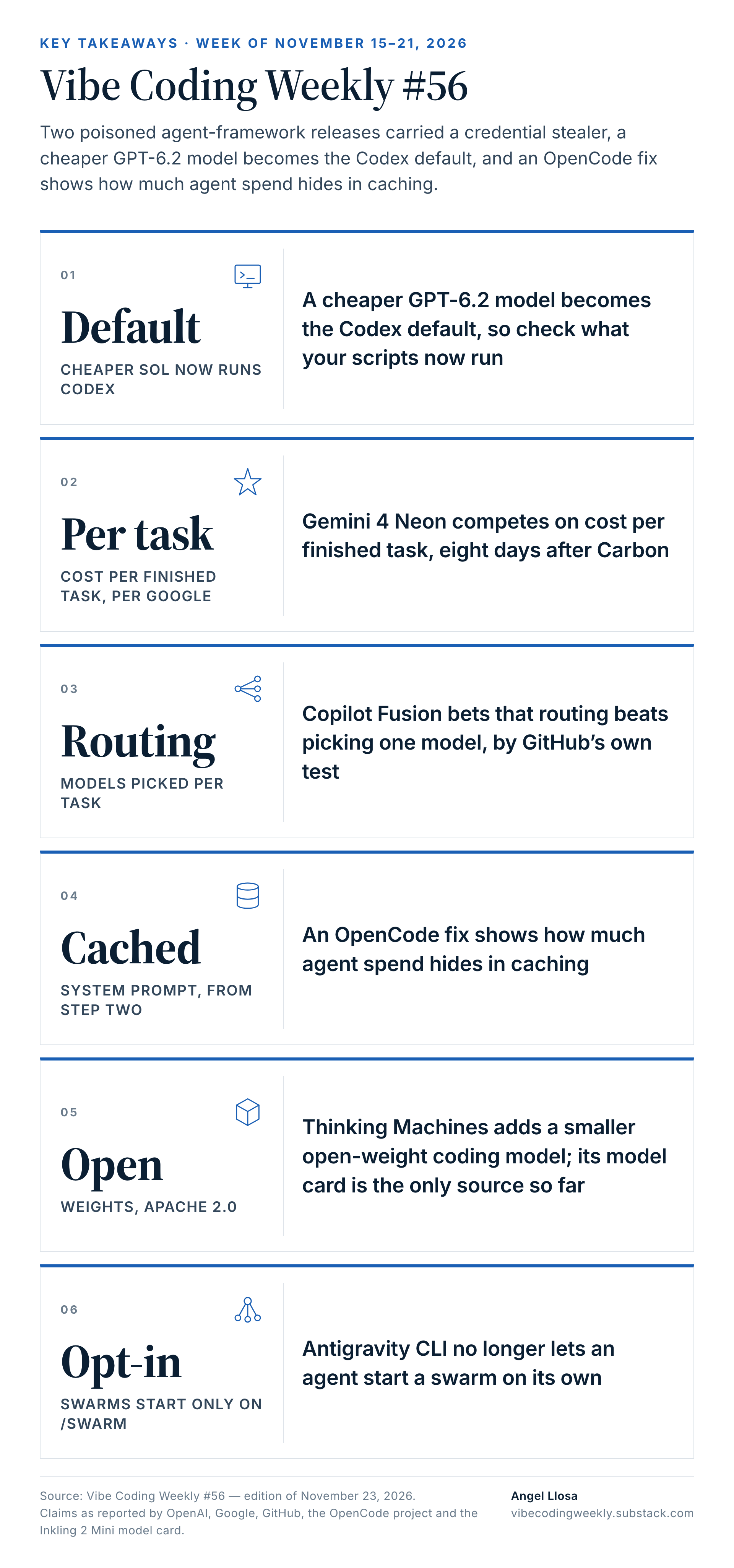
- A cheaper GPT-6.2 model becomes the Codex default: OpenAI released GPT-6.2 Astra and GPT-6.2 Sol. Astra is the top model. Sol is the cheaper one, and Codex CLI 0.171.0 now uses it unless you choose another. OpenAI says Sol at maximum effort comes close to Astra on its own coding benchmark for a fraction of the cost. The default decides what most teams run and pay for, so check which model your Codex scripts now get. OpenAI’s page gives no day; GitHub’s changelog dates it November 17. Read more →
- Google’s Gemini 4 Neon competes on cost per finished task, not on raw power: Gemini 4 Neon arrived on November 18, eight days after Carbon. Google says it leads a coding-agent index and costs about a third less per task than Carbon; both claims are Google’s. It is in AI Studio and Antigravity, and GitHub Copilot added it the same day. Models now turn over faster than most teams re-evaluate them, so compare on cost per completed task in your own repositories. Edition 55 covered Carbon and Hydrogen. Read more →
- Copilot Fusion bets that routing beats picking one model: Fusion chooses and coordinates models for each task, and GitHub added three more models to its pool this week. GitHub says its top tier beats Opus 5.5 and Fable 5.2 on Terminal-Bench 4.1 at a much lower cost. That is GitHub’s own measurement. Its benchmarks site now also compares Copilot CLI, Claude Code and Codex CLI, and GitHub makes one of the three. For anyone paying for tokens, the question moves from which model to who routes it. Test it on your own code before trusting any vendor benchmark. Read more →
- An OpenCode fix shows how much agent spend hides in the plumbing: before v2.3.2, OpenCode re-sent its system prompt to GPT-6.2 models as fresh, uncached input on every step. Now it is cached from the second step, and the project reports that the uncached part of each step nearly disappears. The bill can fall without changing the model or the work. If your team runs GPT-6.2 in OpenCode, update now; the same line of releases also turns background compaction on by default. Edition 55 covered v2.2.7 and v2.3.0. Read more →
- Thinking Machines adds a smaller open-weight coding model under Apache 2.0: Inkling 2 Mini follows the Inkling 2 Small weights from Edition 55. It is a mixture-of-experts model, so only part of it works on each request. The Apache 2.0 licence allows commercial use, which makes it a candidate for cheaper development tasks. The model card reports a strong SWE-bench Verified result, but its own table puts Qwen3.8-27B ahead on another benchmark, and it warns of long reasoning loops, so set turn limits when you test it. This rests on the model card alone; I found no announcement or press coverage. Read more →
- Antigravity CLI no longer lets an agent start a swarm on its own: in Edition 55 Google labelled
/swarm“Preview & Quota Heavy”. Since version 1.5.13, a swarm starts only when the user types/swarm. Parallel agents use up quota fast, so the person now decides when that happens. The same run of releases blocks sandboxed commands from reading~/.configby default and adds Gemini 4 Neon. If you sign in with an API key, remote control and remote agents are now off. Read more →
You already have Change Management in Agentic AI Adoption — the framework for moving an organization that didn’t ask to be moved. Anyone you forward this edition to gets the same thing the moment they subscribe.
📦 Releases & News
Claude Code 2.1.326 to 2.1.330 make Auto the starting mode and fix more Bash permission checks
Anthropic — November 16 to 20, 2026
Version 2.1.328 makes Auto mode the starting mode in interactive sessions with no permission mode set, and brings it to Opus 4.6 and Sonnet 4.6 on Bedrock, Google Cloud and Microsoft Foundry. Version 2.1.326 fixes Bash permission checks for cp, rm and compound commands. I list highlights only, because the notes I fetched were truncated. Edition 55 covered 2.1.321 to 2.1.325.
Qwen4-Max launches as a closed-weight model
Alibaba Cloud — November 16, 2026
Alibaba’s new flagship focuses on coding, but its weights are not open. The press release says it ranked 6th on Code Arena and that cost per task on Work360 fell about 60% against Qwen3.8-Max. Cache-hit input costs $0.075 per million tokens. Alibaba says smaller open-weight Qwen4 models “will soon be released”, and gives no date.
Anthropic linked billing lets a customer’s own Claude organization pay for your app
Anthropic and Warp — November 17, 2026
In this beta, a customer links their Claude organization to your app, and a billing\_policy field on each request decides who pays. The customer can set a spend cap for your app or unlink it. Warp shipped it the same day, with no shared API key. It works only for organizations that pay Anthropic directly.
VS Code removes the Local harness for Copilot agent sessions in February 2027
GitHub — November 16, 2026
VS Code 1.146 deprecates the Local harness. The Copilot harness, which shares a runtime with Copilot CLI, has been the default for new sessions since 1.143. Not every customization converts automatically, and the vscode.temporaryDefaultToLocalHarness setting will not keep it alive. A team with custom agent setups should test them on the Copilot harness now.
Kiro arrives as a VS Code extension and adds remote development
Kiro — November 17 to 20, 2026
Kiro for VS Code 1.5.0 is an extension included in every plan, with chat, specs, steering, hooks and Model Context Protocol (MCP) servers. Kiro IDE 1.5.11 adds remote development over SSH, Dev Containers and cloud sessions. Kiro Crew 0.13.0 turns usage data collection on by default, with an opt-out. Edition 55 covered Approve for me.
Vercel Board gives coding agents a shared message board
Vercel — November 18, 2026
Board is an experimental tool where agents claim tasks, post updates and set watchers, with two-way sync to Slack and GitHub. Vercel says it built Board for its own security agents and for its v0 software factory. It also says v0 merges over 50% of its pull requests. It installs with npx skills add vercel/board.
📚 Tutorials and Resources
Simon Willison: external sandboxes for coding agents
Simon Willison — November 17, 2026
Willison describes a pattern where the agent runs outside the sandbox and only the code it executes runs inside, behind one localhost API. He offers three reference servers: v86 on WebAssembly, Apple Containers and QEMU. You can point Claude Code or Codex at it, and a credential replacement mechanism lets authenticated calls work without giving secrets to the agent.
Vibe Coding Weekly is written for developers, architects and tech leads building or managing software with these tools.
Clean code and positive vibes,
Angel Llosa