Vibe Coding Weekly is your definitive source for staying current with the latest trends, tools, and techniques that are transforming the development landscape.
By Vibe Coding Weekly
Published: 2026-02-15
URL: https://vibecodingweekly.substack.com/p/vibe-coding-weekly-20
Happy Sunday!
Welcome to edition #20 of Vibe Coding Weekly.
This week in one satisfying refactor:
- The Desktop Takeover: Claude Cowork hits Windows, Gemini CLI gets prompt suggestions, and OpenCode reaches 45K stars
- The MCP Expansion: Google adds gRPC, Microsoft ships security framework, Red Hat launches RHEL server
- The New Playbook: YC’s Garry Tan explains how tiny teams beat 20x larger companies with automation-first workflows
The week of February 7-15 marked a decisive shift toward desktop-first AI agents and infrastructure maturity for the Model Context Protocol. While early February saw frontier model releases, this period brought those capabilities directly into developers’ daily workflows through desktop apps, CLI tools, and enterprise-grade MCP implementations.
At the same time, Y Combinator formalized what many have been observing: the winning strategy isn’t hiring faster—it’s automating harder. This edition captures the convergence of powerful desktop agents, production-ready protocols, and the emerging automation-first startup model.
Key Takeaways
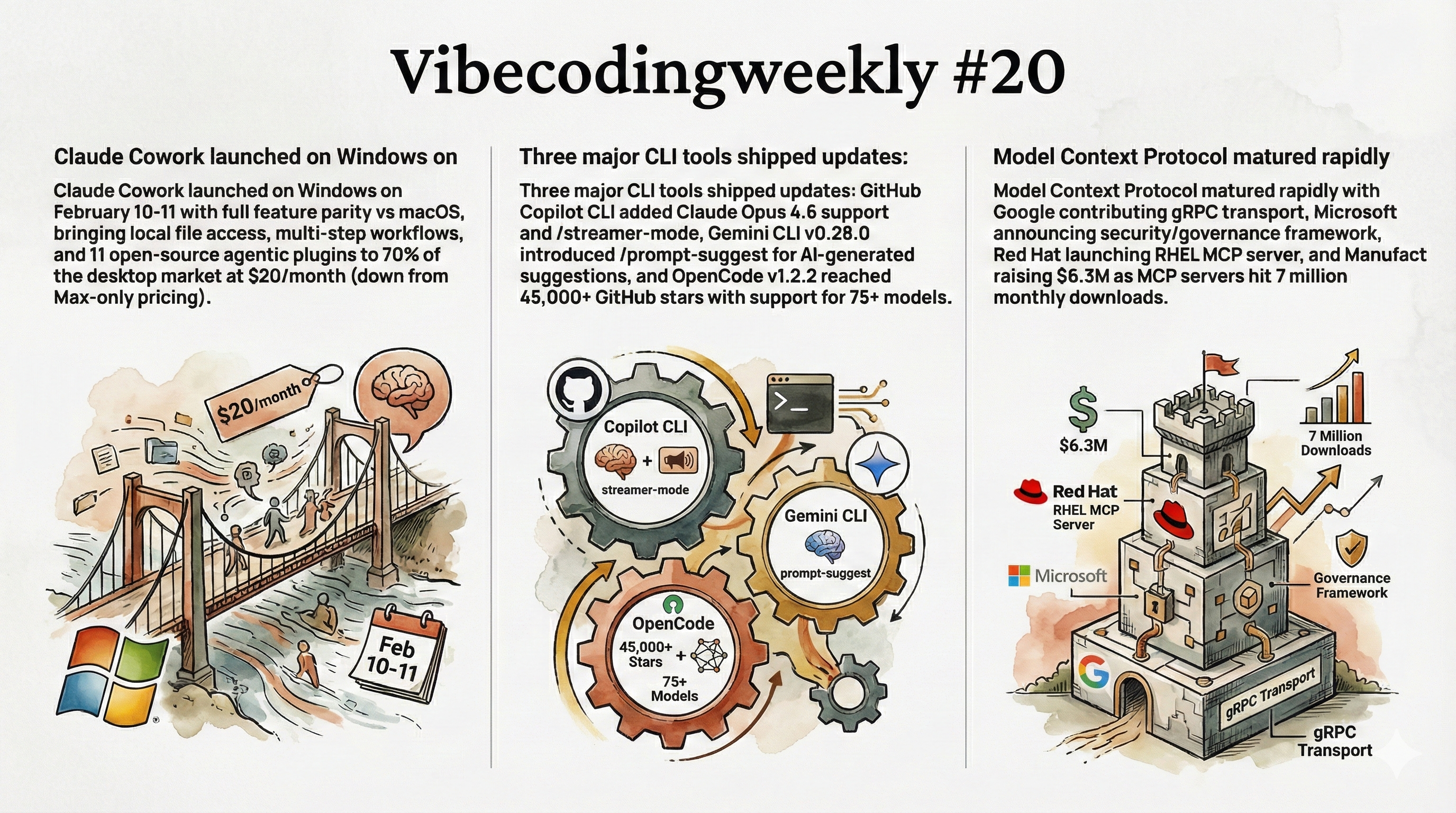
- Claude Cowork launched on Windows on February 10-11 with full feature parity vs macOS, bringing local file access, multi-step workflows, and 11 open-source agentic plugins to 70% of the desktop market at $20/month (down from Max-only pricing).
- Three major CLI tools shipped updates: GitHub Copilot CLI added Claude Opus 4.6 support and /streamer-mode, Gemini CLI v0.28.0 introduced /prompt-suggest for AI-generated suggestions, and OpenCode v1.2.2 reached 45,000+ GitHub stars with support for 75+ models.
- Model Context Protocol matured rapidly with Google contributing gRPC transport, Microsoft announcing security/governance framework, Red Hat launching RHEL MCP server, and Manufact raising $6.3M as MCP servers hit 7 million monthly downloads.
- Terminal-Bench 2.0 launched as the new gold standard for evaluating AI agents, featuring 89 curated tasks across scientific workflows, network config, and cybersecurity—with top models struggling to exceed 65% solution rates.
- Microsoft Patch Tuesday addressed AI-specific vulnerabilities (CVE-2026-21516, CVE-2026-21523, CVE-2026-21256) stemming from prompt injection flaws, while OpenAI disputed California watchdog claims about GPT-5.3-Codex safety compliance.
- Y Combinator CEO Garry Tan outlined how startups win by automating every internal function rather than hiring faster, with tiny teams beating companies 20x their size through automation-first workflows.
📦 Releases & News
Claude Cowork Launches on Windows with Full Feature Parity
Anthropic released Claude Cowork for Windows on February 10-11, bringing the agentic desktop tool to 70% of the desktop computing market. The Windows version arrives with complete feature parity compared to macOS: local file access, multi-step task execution, Model Context Protocol connectors, and 11 open-source agentic plugins spanning sales, legal, finance, marketing, and software development. Powered by Claude Opus 4.6, Cowork plans and executes complete workflows across files, applications, and connected services—unlike chatbot interfaces that respond to individual prompts.
The tool is now available on Claude Pro at $20/month, a significant reduction from the previous Max-only pricing requirement.
Gemini CLI v0.28.0 Adds AI-Powered Prompt Suggestions
Google released Gemini CLI v0.28.0 on February 10 with a new /prompt-suggest command that generates AI-powered prompt suggestions to help developers craft better queries. The release also introduced automatic theme switching based on terminal background color, updated undo/redo keybindings, and a new event-driven scheduler for tool execution that delivers more responsive performance. Gemini CLI is Google’s open-source AI agent that brings Gemini directly to the terminal with a ReAct loop architecture, MCP server support, and built-in tools including Google Search grounding, file operations, shell commands, and web fetching.
OpenCode v1.2.2: Open-Source Coding Agent Hits 45K GitHub Stars
OpenCode released v1.2.2 on February 14, cementing its position as one of the most popular open-source AI coding agents with 45,000+ GitHub stars. The terminal-based tool supports 75+ models including Claude, OpenAI, Gemini, and local models through a native UI with multi-session support. OpenCode integrates with Language Server Protocol (LSP) servers for more effective LLM-codebase interaction and is available as a desktop app and IDE extension for VS Code and Cursor. Licensed under MIT, the tool stores no code or context data, making it suitable for privacy-sensitive environments.
Developers can use existing subscriptions to ChatGPT Plus/Pro and GitHub Copilot.
GitHub Copilot CLI Adds Claude Opus 4.6 and Streaming Improvements
GitHub shipped two Copilot CLI updates during the week: v0.0.406 on February 7 added support for Claude Opus 4.6 Fast (Preview), Markdown formatting in non-interactive mode, subscription warnings, plugin-to-skills translation, and a /changelog command. v0.0.408 on February 12 introduced /streamer-mode to hide preview model names and quota details, flexible shellId handling, mouse text selection in --alt-screen mode, and fixed crashes with large output from ! commands. Promotional pricing for Claude Opus 4.6 ran February 7-16 with a 9x premium request multiplier.
Google Cloud Contributes gRPC Transport for Model Context Protocol
Google Cloud announced in early February that it’s contributing a gRPC transport package for the Model Context Protocol, addressing what the company describes as a critical gap for organizations that have standardized on gRPC across their microservices.
The MCP core maintainers agreed to support pluggable transports in the MCP SDK, enabling Google’s gRPC package to be integrated alongside the existing HTTP transport. This contribution reflects Google’s extensive use of gRPC internally and its commitment to sharing technology that enables production deployment of MCP at scale.
Microsoft Announces MCP Security and Governance Framework
Microsoft announced on February 12 comprehensive efforts to streamline MCP governance through secure-by-default architecture, automation, and inventory management. The initiative integrates Model Context Protocol with Microsoft 365 Copilot agents, delivering a faster and safer agent development environment.
This announcement comes as critical security challenges emerge across the MCP ecosystem, including the discovery of remote code execution flaws in widely used MCP servers—specifically, three vulnerabilities in Anthropic’s Git MCP server that enable RCE via prompt injection.
Red Hat Launches MCP Server for RHEL in Developer Preview
Red Hat introduced an MCP server for Red Hat Enterprise Linux in developer preview on February 10, providing a read-only interface to system information including journalctl logs, process info, and systemctl service statuses.
The server enables AI-driven root cause analysis and anomaly detection directly within VS Code and Cursor. Security features include SSH key authentication, an allow-list for log file access, and no open shell access—ensuring the system remains read-only with pre-vetted commands.
The MCP server can access CPU, load average, memory, and process usage information to identify performance bottlenecks.
Manufact Raises $6.3M to Build MCP Infrastructure Platform
Manufact Inc. (formerly mcp-use) raised $6.3 million in seed funding led by Peak XV on February 12. Founded in 2025, Manufact provides an infrastructure platform for AI agents built on Model Context Protocol—a universal, open standard popularized by Anthropic that connects large language models to other AI models, services, and datasets.
With an estimated 7 million downloads of MCP servers every month, the company aims to expand its infrastructure and become the “go-to framework” for MCP development as startups, services, and enterprises adopt the standard.
LangChain Ships Three Pluggable Sandbox Integration Packages
LangChain released three new integration packages on February 10 for pluggable sandboxes: langchain-modal, langchain-daytona, and langchain-runloop. These packages enable developers to execute code in isolated environments, addressing one of the core security concerns with AI agent operations. The same day, LangChain also released LangGraph SDK v0.3.5 with changes related to server runtime type, improving the infrastructure for building stateful, multi-actor applications with LLMs.
Simon Willison Introduces Showboat and Rodney for Agent Demos
Simon Willison introduced Showboat and Rodney on February 10, two command-line tools designed to help AI coding agents demonstrate their work beyond just running automated tests. Showboat helps agents build Markdown documents showcasing code functionality, while Rodney is a CLI browser automation tool enabling agents to interact with web interfaces.
These tools are part of Willison’s broader exploration of the “software factory” paradigm, where the relationship between programmers and their tools has fundamentally changed—transforming developers from code writers into supervisors and reviewers.
Thanks for reading! Subscribe for free to receive new posts and support my work.
📚 Tutorials and Resources
Terminal-Bench 2.0: New Gold Standard for Agentic AI Evaluation
Snorkel and the Laude Institute released Terminal-Bench 2.0 on February 13, establishing a new benchmark for evaluating AI coding agents with 89 carefully curated tasks in terminal environments. The benchmark represents frontier challenges that distinguish truly capable agents from those handling only routine operations, covering scientific workflows, network configuration, cybersecurity vulnerabilities, and data analysis pipelines. As of February 2026, top global models generally struggle to exceed a 65% solution rate, with Claude Opus 4.6 achieving the highest score at 65.4%.
The benchmark has quickly become the gold standard for evaluating AI agents’ capabilities in command-line environments.
💡 Analysis & Trends
Microsoft Patch Tuesday Addresses AI-Specific Vulnerabilities
Microsoft’s February 2026 Patch Tuesday on February 11 addressed AI-specific vulnerabilities including CVE-2026-21516, CVE-2026-21523, and CVE-2026-21256. These vulnerabilities stem from command injection flaws triggered through prompt injection that can trick AI agents into executing unauthorized actions.
The patches highlight the growing security surface area introduced by AI coding tools and the need for organizations to treat AI-powered development environments with the same security rigor as traditional production systems.
OpenAI Disputes California AI Law Violation Claims
On February 10, OpenAI disputed a California watchdog’s allegation that the company violated the state’s new AI safety law with its GPT-5.3-Codex release. The watchdog claims OpenAI should have conducted more rigorous safety testing before deployment, given the model’s “high” cybersecurity risk classification—the first OpenAI model to hit this threshold on the company’s internal preparedness framework. OpenAI maintains it deployed comprehensive safety measures including Trusted Access for Cyber (an identity/trust framework), automated monitoring, and $10M in API credits for cyber defense research.
YC’s Garry Tan: How Tiny Teams Beat 20x Larger Companies
In a February Main Function episode, Y Combinator CEO Garry Tan outlined how startups are winning not by hiring faster, but by automating as many internal functions as possible. Tiny teams are beating companies 20x their size by building automations into every workflow—from engineering to ops to customer support.
This represents a fundamental shift from the “blitzscaling” headcount model to a smarter, automation-first approach where software, AI agents, and customer success tools take center stage. The insight reinforces the broader industry trend toward agentic workflows and minimal viable teams.
That’s a wrap for this week. Stay tuned for next week’s edition and subscribe.
Vibe Coding Weekly is your definitive source for staying current with the latest trends, tools, and techniques that are transforming the development landscape.
In each update, you’ll receive:
- Deep dives into new technologies and emerging frameworks
- Optimized code patterns that enhance both efficiency and readability
- Curated tools and resources that will supercharge your workflow
- Community insights that are defining the future of development
Our goal is to provide you with concise, relevant, and actionable information that you can immediately apply to your projects.
Clean code and positive vibes,
The Vibe Coding Team