Vibe Coding Weekly is your definitive source for staying current with the latest trends, tools, and techniques that are transforming the development landscape.
By Vibe Coding Weekly
Published: 2026-02-22
URL: https://vibecodingweekly.substack.com/p/vibe-coding-weekly-21
Happy Sunday!
Welcome to edition #21 of Vibe Coding Weekly.
This week in one satisfying refactor:
- The Big Story: Claude Sonnet 4.6, Gemini 3.1 Pro, and Qwen3.5 all ship within days of each other
- The Release: GitHub Agentic Workflows brings AI coding agents into GitHub Actions
- The Wake-up Call: A prompt injection in Cline turned an AI triage bot into a supply chain attack
This week the agent ecosystem went from concept to consequence—and models did not slow down for a second. Claude Sonnet 4.6, Gemini 3.1 Pro, and Qwen3.5 all landed within days of each other, each claiming top SWE-bench scores and 1M token context windows. Meanwhile Cursor 2.4 shipped async subagents and GitHub debuted Agentic Workflows to bring AI agents into CI/CD pipelines.
On the darker side, Cline’s AI issue triager was manipulated via prompt injection into publishing a malicious npm package to 5 million developers. The tools are getting more capable. The attack surface is growing just as fast.
Free for new subscribers: Change Management in Agentic AI Adoption, A practical framework for making AI adoption actually work inside your team. Plus every week: curated tools, articles, and insights on AI-powered software development.
Key Takeaways
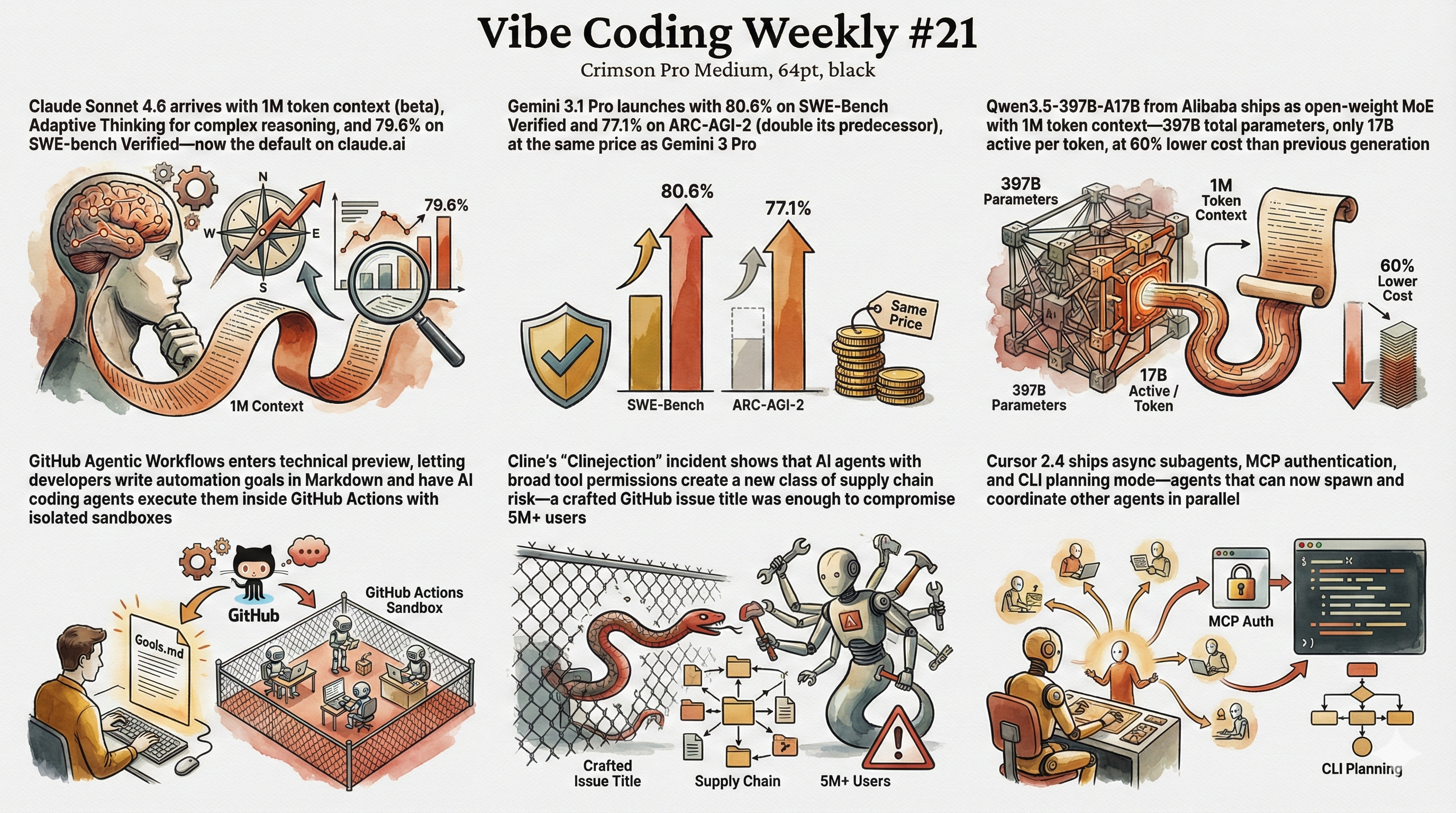
- Claude Sonnet 4.6 arrives with 1M token context (beta), Adaptive Thinking for complex reasoning, and 79.6% on SWE-bench Verified—now the default on claude.ai
- Gemini 3.1 Pro launches with 80.6% on SWE-Bench Verified and 77.1% on ARC-AGI-2 (double its predecessor), at the same price as Gemini 3 Pro
- Qwen3.5-397B-A17B from Alibaba ships as open-weight MoE with 1M token context—397B total parameters, only 17B active per token, at 60% lower cost than previous generation
- GitHub Agentic Workflows enters technical preview, letting developers write automation goals in Markdown and have AI coding agents execute them inside GitHub Actions with isolated sandboxes
- Cline’s “Clinejection” incident shows that AI agents with broad tool permissions create a new class of supply chain risk—a crafted GitHub issue title was enough to compromise 5M+ users
- Cursor 2.4 ships async subagents, MCP authentication, and CLI planning mode—agents that can now spawn and coordinate other agents in parallel
📦 Releases & News
Anthropic Claude Sonnet 4.6 Released
Anthropic shipped Claude Sonnet 4.6 this week with a 1M token context window (beta), an Adaptive Thinking engine for improved reasoning under the hood, and benchmark results that speak for themselves: 72.5% on OSWorld and 79.6% on SWE-bench Verified. The model also features automated context compaction and improved resistance to prompt injections. It’s now the default for all claude.ai Free and Pro users at $3/$15 per million tokens pricing.
Google Launches Gemini 3.1 Pro with Record Coding and Reasoning Scores
Google DeepMind released Gemini 3.1 Pro on February 19 as an upgrade to its flagship model, targeting the kind of complex, multi-step work that developers run into daily. The numbers stand out: 80.6% on SWE-Bench Verified, 77.1% on ARC-AGI-2 (more than double the previous 31.1%), and 59.0% on SciCode—a benchmark for scientific programming.
It is available immediately across Gemini API, Vertex AI, Gemini CLI, and Android Studio at the same price as Gemini 3 Pro ($2 per million input tokens), making it a free upgrade for teams already using Gemini 3 Pro.
Alibaba Releases Qwen3.5-397B: Open-Weight MoE Model Built for AI Agents
Alibaba’s Qwen team released Qwen3.5-397B-A17B on February 16, an open-weight Mixture of Experts model that challenges the economics of frontier AI. Despite 397 billion total parameters, only 17 billion activate per forward pass—delivering competitive reasoning and coding performance at 60% lower cost and 8x higher throughput than the previous generation.
The model ships with a 1M token context window under an Apache 2.0 license, available on Hugging Face. For teams running self-hosted or air-gapped infrastructure, this is the most capable open-weight coding model available today.
Cursor 2.4: Async Subagents, CLI Planning Mode, and MCP Auth
Cursor’s latest release makes a significant architectural leap: subagents can now run asynchronously, letting the parent agent continue working while spawning parallel tasks—and subagents can spawn their own subagents, creating coordinated agent trees. The update also adds CLI planning mode, MCP authentication, and increased agent limits. Cursor reports that sandboxed agents now reduce developer interruptions by 40% compared to unsandboxed workflows.
GitHub Copilot CLI v0.0.411 & v0.0.412 Released
GitHub shipped two back-to-back CLI updates this week. v0.0.411 (Feb 17) adds Claude Sonnet 4.6 model support, improved error messaging, memory storage with timeline, and crucially, MCP server support from Windows On-Device Registry.
It also introduces a new include\_coauthor config option. v0.0.412 (Feb 19) polishes the experience with accessibility improvements, hiding non-invocable custom agents, fixing config syntax errors, and signing Windows native prebuilds with Authenticode.
GitHub Copilot Coding Agent Adds Code Referencing for License Transparency
GitHub’s autonomous coding agent now flags matching code in session logs with direct links to original sources and applicable licenses—a welcome step for teams worried about AI-generated code lifting from public repositories. There is a notable caveat though: the agent won’t respect the “Block” setting in GitHub’s suggestions policy, meaning enterprises can log matches but not prevent them. Compliance teams will still need to manually review session logs before merging pull requests.
Windsurf Adds Claude Sonnet 4.6, GLM-5, and Minimax M2.5
Windsurf kept pace with a flurry of model additions. On February 17, it added Claude Sonnet 4.6 with promotional pricing, followed by GLM-5 from Zhipu AI (0.75x credits) and Minimax M2.5 (0.25x credits). February 19 brought Gemini 3.1 Pro with thinking variants. Beyond models, updates include worktree support for multi-branch development, improved Vibe and Replace functionality, and visual context window indicators—a small but welcome UX touch.
Free for new subscribers: Change Management in Agentic AI Adoption, A practical framework for making AI adoption actually work inside your team. Plus every week: curated tools, articles, and insights on AI-powered software development.
📚 Tutorials and Resources
GitHub Agentic Workflows Enter Technical Preview
GitHub has taken AI from the editor into the CI/CD pipeline with Agentic Workflows, now in technical preview. Developers write automation goals in plain Markdown—think issue triage, documentation updates, or failing test diagnosis—and a coding agent (Copilot, Claude, or Codex) interprets and executes them inside GitHub Actions. Security is baked in: agents run in isolated containers with read-only repository access, and any write operations go through a separate “Safe Outputs” job requiring human review before merge.
OpenCode: Open-Source AI Coding Agent Competing with Claude Code and Copilot
OpenCode is a terminal-first, open-source AI coding agent that positions itself as the privacy-conscious alternative to Claude Code and GitHub Copilot. It supports 75+ models—including Claude, OpenAI, and Gemini—and lets developers leverage existing subscriptions (ChatGPT Plus, GitHub Copilot) instead of paying again.
The key differentiator: code and context never leave your machine, with granular session-sharing controls designed for regulated industries and air-gapped environments where cloud-based solutions are prohibited.
Agentic Code Fixing with GitHub Copilot SDK and Foundry Local
This hands-on guide from Microsoft shows how to build a fully autonomous code-fixing agent using the GitHub Copilot SDK for agent scaffolding and Foundry Local for on-device AI inference. The agent runs a four-phase workflow: scan → fix → verify → summarize, producing PR-ready documentation of every change it makes.
The BYOK (Bring Your Own Key) integration pattern means the entire pipeline runs locally—no code or prompts leave your machine—making it viable for air-gapped enterprise environments.
💡 Analysis & Trends
Clinejection: How a Prompt Injection Turned Cline’s AI Bot into a Supply Chain Attack
Security researcher Adnan Khan disclosed a vulnerability chain in Cline’s repository where the AI issue-triage bot could be tricked, via a crafted GitHub issue title, into executing commands from an attacker-controlled fork.
The attack composed three well-understood techniques—indirect prompt injection, GitHub Actions cache poisoning, and credential model weaknesses—into a single exploit requiring nothing more than opening a GitHub issue. Eight days after disclosure, an unknown actor used the same flaw to publish a malicious [email protected] to npm, silently installing OpenClaw on developer machines during an eight-hour window before it was caught.
TechCrunch: AI Coding Tools Are Mixed Blessing for Open Source
AI coding tools are causing serious problems for open source projects. The Blender Foundation CEO reports that LLM-assisted contributions have “wasted reviewers’ time and affected motivation.” Mitchell Hashimoto launched a system limiting GitHub contributions to “vouched” users, noting that “AI eliminated the natural barrier to entry that let OSS projects trust by default.” Experts increasingly agree: AI coding tools are best suited “for experienced developers,” not as a shortcut around learning fundamentals.
CNN: No One Can Agree on AI Hype vs. Reality
CNN captures the polarization around AI productivity claims. Software stocks plummeted in early February after Anthropic released industry-specific AI helpers. A July METR study revealed that experienced developers believed AI made them 20% faster, but objective tests showed they were actually 19% slower. Depending on who you ask, AI is “your most helpful coworker, a glorified search engine, or vastly overrated.” The gap between perception and measurement has never been wider.
That’s a wrap for this week.
Stay tuned for next week’s edition.
Free for new subscribers: Change Management in Agentic AI Adoption, A practical framework for making AI adoption actually work inside your team. Plus every week: curated tools, articles, and insights on AI-powered software development.
Vibe Coding Weekly is your definitive source for staying current with the latest trends, tools, and techniques that are transforming the development landscape.
In each update, you’ll receive:
- Deep dives into new technologies and emerging frameworks
- Optimized code patterns that enhance both efficiency and readability
- Curated tools and resources that will supercharge your workflow
- Community insights that are defining the future of development
Our goal is to provide you with concise, relevant, and actionable information that you can immediately apply to your projects.
Clean code and positive vibes,
The Vibe Coding Team