Vibe Coding Weekly is your definitive source for staying current with the latest trends, tools, and techniques that are transforming the development landscape.
By Vibe Coding Weekly
Published: 2026-02-08
URL: https://vibecodingweekly.substack.com/p/vibe-coding-weekly-19
Happy Friday!
Welcome to edition #19 of Vibe Coding Weekly.
This week in one satisfying refactor:
- The Big Story: Agent teams arrive - Anthropic’s Opus 4.6 and OpenAI’s GPT-5.3-Codex both drop with multi-agent coordination on the same day
- The Mainstream Moment: Apple integrates agentic coding directly into Xcode while OpenAI launches standalone desktop command center
- The Infrastructure Play: From Vercel rebuilding v0 for production to Sapiom enabling AI agents to purchase their own tools autonomously
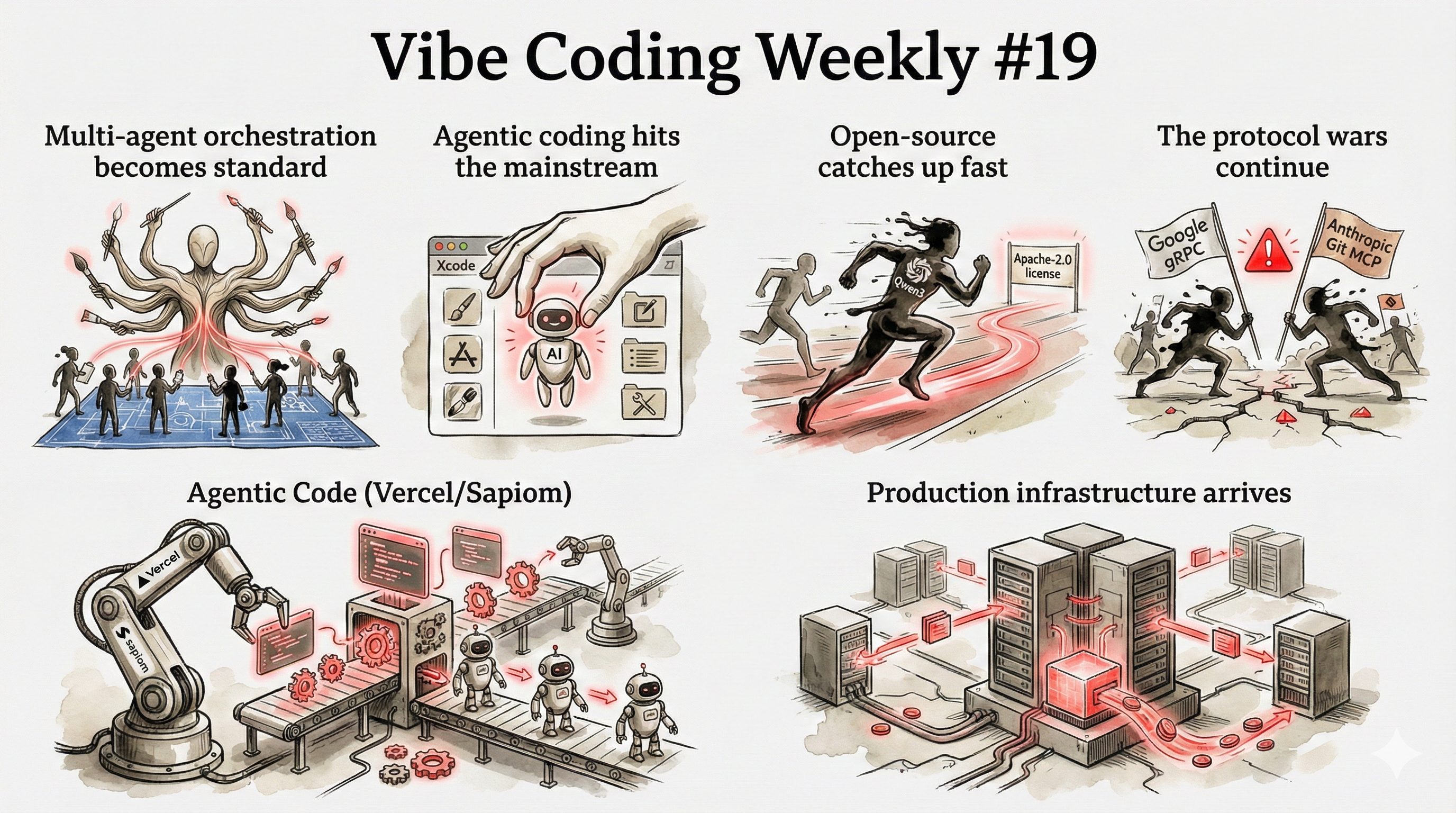
This week marked a watershed moment for agentic coding. The technology moved decisively from experimental to production-ready, from niche developer tools to mainstream IDE integrations, and from proof-of-concept to enterprise infrastructure. With Apple, OpenAI, Anthropic, and Google all shipping major updates in the span of just five days, the message is clear: the future of software development involves coordinating teams of AI agents, not just autocompleting lines of code.
Key Takeaways
- Multi-agent orchestration becomes standard: Claude Opus 4.6 and GPT-5.3-Codex both feature specialized agent teams that coordinate roles like planner, researcher, coder, and tester running in parallel
- Agentic coding hits the mainstream: Apple integrates Claude and Codex directly into Xcode 26.3 using MCP, while OpenAI ships a dedicated macOS desktop app for agent orchestration
- Production infrastructure arrives: Vercel completely rebuilds v0 to move from prototyping to production deployments, and Sapiom raises $15M to build financial infrastructure for autonomous agent economies
- Open-source catches up fast: Qwen3-Coder-Next achieves 70.6 on SWE-Bench Verified with only 3B activated parameters using Apache-2.0 license, democratizing agent capabilities
- The protocol wars continue: Google contributes gRPC transport for MCP while security researchers discover critical RCE vulnerabilities in Anthropic’s Git MCP server
- GitHub becomes model-agnostic: Copilot now offers Claude and Codex alongside its own models, with fast mode delivering 2.5x faster output tokens
Thanks for reading! Subscribe for free to receive new posts and support my work.
📦 Releases & News
Anthropic releases Opus 4.6 with new ‘agent teams’
On February 5, Anthropic launched Claude Opus 4.6, claiming it as the world’s best model for coding. The headline feature is “agent teams” - the ability to decompose large tasks into specialized roles like planner, researcher, coder, and tester that run concurrently with explicit coordination. Instead of a single model stepping sequentially through tasks, Opus 4.6 assigns responsibilities to collaborating agents that share state and hand off work.
This is also the first Opus-class model with a 1 million token context window, allowing it to process vastly more information than previous versions.
OpenAI unveils GPT-5.3-Codex as agentic coding upgrade
Just minutes after Anthropic’s announcement, OpenAI countered with GPT-5.3-Codex on the same day. The new model is 25% faster than its predecessor while achieving state-of-the-art performance on SWE-Bench Pro. GPT-5.3-Codex represents a milestone as OpenAI’s first self-improving model - the Codex team used early versions to debug its own training and deployment.
However, it’s also OpenAI’s first model to hit “high” on their cybersecurity preparedness framework, indicating it could meaningfully enable real-world cyber threats if automated or used at scale.
Claude and Codex now available in GitHub Copilot
In a major integration move on February 4, GitHub announced that Claude by Anthropic and OpenAI Codex are now available as coding agents for Copilot Pro+ and Enterprise customers. Users can start agent sessions and assign work directly from github.com, GitHub Mobile, and VS Code - launching them from issues, pull requests, and the agent sessions view. This shift toward model-agnostic development environments lets developers choose the AI that works best for their specific task.
OpenAI launches macOS desktop app for Codex agent orchestration
On February 2, OpenAI shipped a new macOS desktop app for Codex functioning as a “command center for agents”. The app allows developers to delegate multiple coding tasks simultaneously, with agents that can run for up to 30 minutes independently without supervision. It includes a library of pre-built skills for integrations with Figma, Linear, Cloudflare, and Vercel deployments, positioning itself as a standalone productivity hub for managing autonomous coding work.
Apple Xcode 26.3 unlocks agentic coding
On February 3, Apple announced Xcode 26.3 with direct integration of Anthropic’s Claude Agent and OpenAI’s Codex into its development suite. Using the Model Context Protocol (MCP), the integration exposes capabilities for project discovery, file management, live SwiftUI previews, and documentation access. This marks Apple’s official entry into agentic coding, bringing multi-agent orchestration directly to millions of iOS, macOS, and Swift developers.
Vercel v0 rebuilt from the ground up for production
Vercel announced on February 3 what they call v0’s “biggest product update yet” - a complete rebuild designed to move from prototyping to production deployments. The new sandbox-based runtime imports entire GitHub repositories and pulls environment variables from Vercel projects.
A new Git panel creates branches per chat session and opens pull requests automatically. The update includes secure integrations with Snowflake and AWS databases, transforming v0 from an experimental playground into a production-grade development platform.
GitHub Copilot simplifies model enablement
On February 3, GitHub shipped an update making newly released models available directly within Copilot without managing policies or visiting settings pages. The change applies to Copilot Pro+, Pro, and Free users, streamlining the experience of accessing cutting-edge models as soon as they’re released.
GitHub Copilot Chat shows tool calls in real-time
GitHub Copilot Chat on github.com now displays clear tool call details in real-time as of February 4, making the agent experience smoother and faster. The transparency improvement helps developers understand exactly what actions the AI is taking behind the scenes, addressing one of the key concerns around autonomous agent behavior.
Qwen3-Coder-Next: open-source agent model reaches 70.6 on SWE-Bench
Alibaba’s Qwen team released Qwen3-Coder-Next on February 3, an open-weight language model specifically designed for coding agents and local development. Using a sparse MoE architecture with 80B total parameters but only 3B activated per token, it achieves 70.6 on SWE-Bench Verified while supporting 256K context and shipping under the Apache-2.0 license.
This represents a significant democratization of agentic coding capabilities, making state-of-the-art performance accessible to organizations that need to run models locally.
Google contributes gRPC transport for MCP
On February 5, Google Cloud announced its contribution of a gRPC transport package for Model Context Protocol (MCP), addressing a critical gap for organizations standardized on gRPC across their microservices architectures. While MCP currently ships with JSON-RPC over HTTP, the gRPC transport enables better integration with existing enterprise infrastructure, signaling Google’s commitment to MCP as an emerging standard for agent communication.
OpenAI launches Frontier platform for enterprise agents
OpenAI unveiled OpenAI Frontier on February 5, an end-to-end platform for enterprises to build and manage AI agents at production scale. Unlike closed ecosystems, Frontier is an open platform that can manage agents built outside of OpenAI, positioning it as infrastructure for multi-vendor agent orchestration rather than a proprietary lock-in solution.
The timing - the same day as Opus 4.6 and GPT-5.3-Codex - suggests OpenAI views agent management as strategically important as the models themselves.
Sapiom raises $15M to build financial infrastructure for AI agents
San Francisco startup Sapiom announced a $15M funding round on February 5 to develop the financial layer enabling AI agents to autonomously purchase and access software, APIs, data, and compute. This represents critical infrastructure for the autonomous agent economy - when AI agents can independently procure the tools they need to complete tasks, they move from assisted workflows to truly autonomous operation.
Security researchers discover RCE vulnerabilities in MCP Git server
On February 6, security researchers published a report revealing remote code execution vulnerabilities in Anthropic’s Git MCP server (CVE-2025-68145, CVE-2025-68143, CVE-2025-68144). The flaws enable RCE via prompt injection, including path validation bypass, unrestricted git\_init, and argument injection. As MCP gains adoption as the standard for agent communication, security hardening becomes increasingly critical - and this report shows the protocol still has significant work ahead.
Claude Opus 4.6 Fast Mode launches in public preview
GitHub launched Fast Mode for Claude Opus 4.6 on February 7 in research preview for Copilot users. The fast variant delivers output token speeds up to 2.5x faster while maintaining the same intelligence as standard Opus 4.6, making real-time agent interactions significantly more responsive.
💡 Others
Simon Willison: The Software Factory has arrived
In an essay published February 7, Simon Willison analyzes the fundamental transformation in the developer-tool relationship through the lens of Strong DM’s “Software Factory” approach. The company has adopted two striking principles: “Code must not be written by humans” and “Code must not be reviewed by humans”. Willison argues developers are transitioning from code writers to supervisors, orchestrating teams of AI agents rather than authoring logic themselves.
This represents perhaps the clearest articulation yet of what agentic coding means in practice: humans define intent and architecture while machines generate implementation.
That’s a wrap for this week. In just five days, agentic coding moved from experimental feature to mainstream product category. When Apple ships agent orchestration in Xcode, when OpenAI builds standalone command centers, and when startups raise millions to let AI agents buy their own infrastructure, we’re not talking about the future anymore - we’re documenting the present.
Stay tuned for next week’s edition.
Vibe Coding Weekly is your definitive source for staying current with the latest trends, tools, and techniques that are transforming the development landscape.
In each update, you’ll receive:
- Deep dives into new technologies and emerging frameworks
- Optimized code patterns that enhance both efficiency and readability
- Curated tools and resources that will supercharge your workflow
- Community insights that are defining the future of development
Our goal is to provide you with concise, relevant, and actionable information that you can immediately apply to your projects.
Clean code and positive vibes,
The Vibe Coding Team