Vibe Coding Weekly is your definitive source for staying current with the latest trends, tools, and techniques that are transforming the development landscape.
By Vibe Coding Weekly
Published: 2026-02-01
URL: https://vibecodingweekly.substack.com/p/vibe-coding-weekly-18
Vibe Coding Weekly #18
Happy Sunday!
Welcome to edition #18 of Vibe Coding Weekly.
This week in one satisfying refactor:
- The Big Story: Boris Cherny shares Claude Code power user secrets—5 advanced tips from the team that built it
- The Platform: Anthropic’s MCP Apps arrive, bringing Slack, Figma, and Asana interfaces inside Claude’s chat window
- The Evolution: GitHub Copilot CLI ships three releases in a week, adding custom agent wizards and plugin installation from URLs
This week showcased the maturation of AI coding platforms through incremental improvements rather than flashy announcements. GitHub Copilot CLI evolved with three rapid releases adding agent customization and plugin flexibility, Anthropic expanded Claude’s reach with MCP Apps and Cowork plugins, and Windsurf shipped Wave 14 with Arena Mode for side-by-side model comparison.
The most valuable signal came from Boris Cherny himself—Claude Code’s creator sharing how the team actually uses the tool, emphasizing parallel workflows, plan-first execution, and autonomous bug fixing.
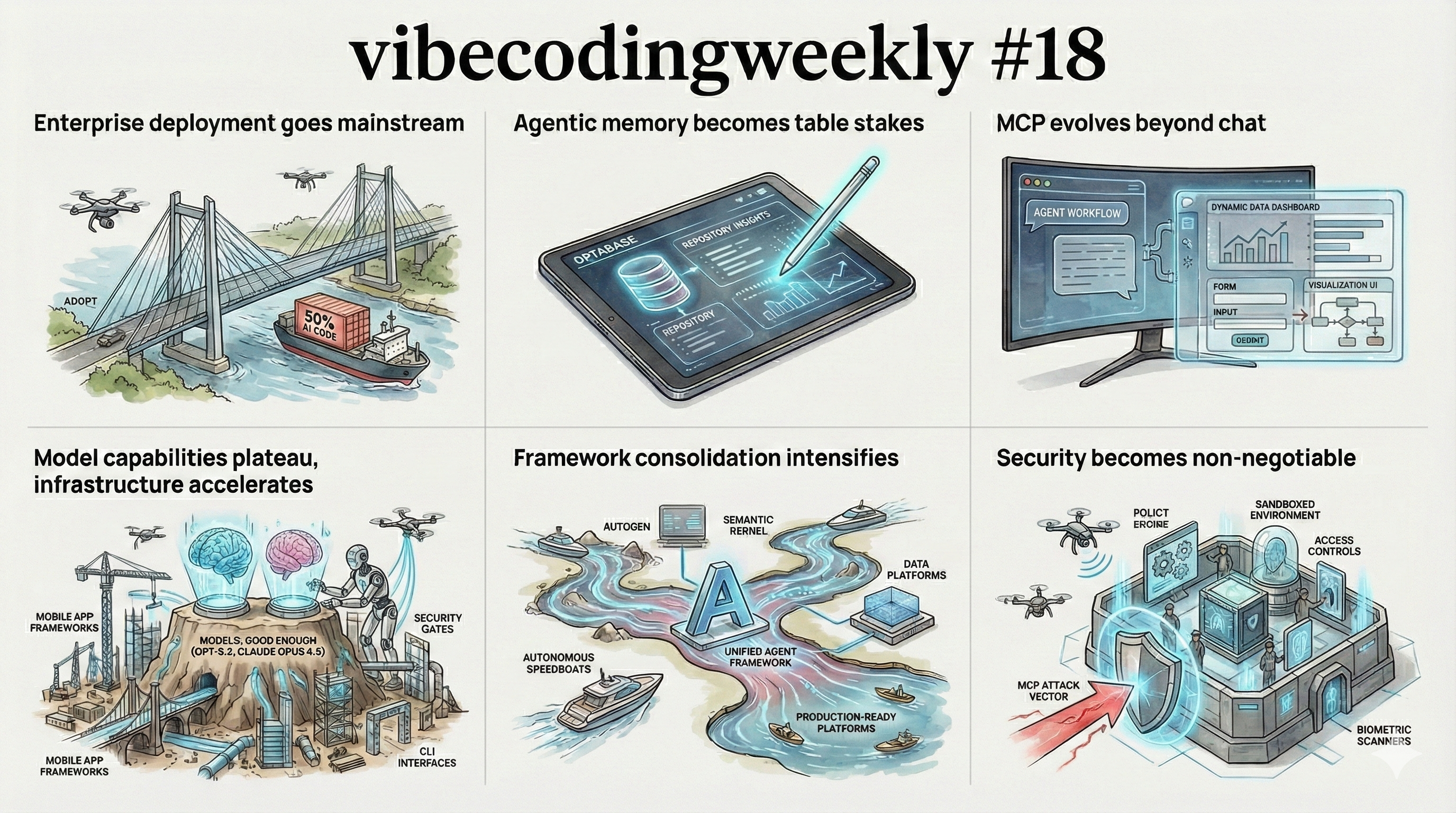
Key Takeaways
- Claude Code power user playbook revealed: Boris Cherny’s five-tip thread shows the team works in 3-5 parallel git worktrees, invests heavily in planning for one-shot implementation, continuously updates CLAUDE.md to prevent repeated mistakes, creates reusable custom skills, and trusts Claude to autonomously fix bugs from logs without micromanaging.
- MCP ecosystem expands rapidly: Anthropic’s MCP Apps bring third-party interfaces (Slack, Figma, Asana, Canva) directly into Claude, while Claude Cowork now supports custom plugins for enterprise automation. The MCP protocol is becoming the standard for AI tool integration.
- GitHub Copilot CLI velocity increases: Three releases in a week (v0.0.395, 396, 397) added AI-generated session names, MCP server management, plugin skills for agents, interactive CLI wizard for custom agents, GitHub repo/URL/local path installation, and Agent Client Protocol (ACP) server mode.
- AI coding research reveals differentiated usage: arXiv paper shows core developers (deeply invested) and peripheral developers (occasional contributors) use AI coding agents differently, providing empirical data on adoption patterns across project involvement levels.
- Windsurf introduces Arena Mode: Wave 14 enables side-by-side model comparison directly in the IDE, making it easier to evaluate AI outputs without switching contexts.
- Enterprise AI integration accelerates: Cognizant partners with Cognition to integrate Devin AI into delivery models and Flowsource platform, pairing it with Windsurf for enterprise-grade AI-assisted development.
Thanks for reading! Subscribe for free to receive new posts and support my work.
📦 Releases & News
Cognizant Partners with Cognition for Enterprise Devin Integration
Cognizant and Cognition announced a strategic partnership on January 29 to integrate Devin AI into enterprise settings. The collaboration pairs Devin with Windsurf and incorporates both tools into Cognizant’s delivery models and Flowsource platform.
This enterprise partnership signals that AI coding agents are moving beyond individual developer productivity into structured delivery methodologies at consulting scale. Cognizant’s involvement suggests they see AI-assisted development as core infrastructure for client engagements, not experimental tooling.
Anthropic Launches Claude MCP Apps
On January 26, Anthropic announced that Claude can now present third-party app interfaces (Slack, Figma, Asana, Canva, and more) within its chat window via MCP Apps. Users can view, edit, and interact with external tools without leaving Claude, transforming it from a chat interface into a unified workspace.
The launch builds on the Model Context Protocol (MCP), which has become the de facto standard for AI tool integration after reaching 100M monthly downloads. MCP Apps enable developers to create custom integrations that surface their applications directly in Claude’s interface.
Anthropic Debuts Claude Cowork Plugins
Claude Cowork, Anthropic’s automation tool, now supports custom plugins as of January 30. The current version allows users to install plugins for task automation, with an enhanced version coming soon that will enable companies to create internal plugin catalogs for employees.
This enterprise-focused feature addresses a key need: organizations want to standardize which AI capabilities their teams use while maintaining security and compliance. The plugin system follows the same MCP architecture that powers Claude’s broader integration ecosystem.
GitHub Copilot CLI: Interactive Agent Wizard and Flexible Installation
GitHub shipped three Copilot CLI releases between January 26-28, with v0.0.396 on January 27 bringing the standout feature: an interactive CLI wizard for creating custom agents. Developers can now configure agents through guided prompts without manually editing configuration files.
The release added support for uppercase letters in skill names, GitHub repo/URL/local path installation for plugins (previously limited to npm packages), and new copilot version and copilot update commands for easier maintenance. Version 0.0.397 on January 28 followed with enhanced MCP server details display, auto-save for pasted content over 30KB, and Agent Client Protocol (ACP) server mode via --acp flag.
GitHub Copilot CLI: Enhanced Management and Plugin Skills
Version 0.0.395, released January 26, introduced AI-generated session names that automatically summarize conversations, making it easier to navigate session history. The update enhanced MCP server management with better visibility into connected servers and their capabilities.
A new plugin skills system for agents allows developers to extend agent behavior with modular capabilities. Support for .claude/commands/ single-file commands enables lightweight custom commands without full plugin scaffolding, lowering the barrier for personalization.
Windsurf Ships Wave 14 with Arena Mode
Windsurf released Wave 14 (version 1.9544.24) on January 30, introducing Arena Mode for side-by-side model comparison directly in the IDE. Developers can now evaluate outputs from multiple AI models simultaneously without switching tools or contexts.
The update also brings improvements to Plan Mode features, continuing Windsurf’s focus on thoughtful, structured approaches to AI-assisted coding. Earlier in the week, versions 1.13.12 (January 25), 1.13.13 (January 26), and 1.13.14 (January 27) shipped enterprise allow/deny lists for command auto-execution, commit message generation fixes, and cascade disconnection bug fixes.
OpenAI Launches Prism: Free AI Workspace for Scientists
OpenAI introduced Prism on January 27, a free AI-native workspace designed for scientists to write and collaborate on research. The platform is powered by GPT-5.2 and targets academic and scientific workflows where collaboration, citations, and structured writing are essential. While not directly a coding tool, Prism represents OpenAI’s expansion into vertical-specific AI applications, following the same pattern that produced specialized coding models like GPT-5.2-Codex.
LangChain: January Newsletter Highlights
LangChain’s January 30 newsletter announced four major updates. Agent Builder enables natural language agent creation without code, lowering barriers to experimentation. LangChain JS v1.2.13 shipped with improved agent robustness and reliability. Deep Agents Streaming provides live progress updates from subagents, making complex multi-agent workflows more transparent. Experiment Comparison introduces side-by-side LLM evaluation for A/B testing different model configurations.
The updates show LangChain focusing on production reliability and developer experience as the framework matures.
Thanks for reading! This post is public so feel free to share it.
📚 Tutorials and Resources
Boris Cherny Shares Claude Code Power User Tips
Boris Cherny, creator of Claude Code at Anthropic, shared five advanced techniques the team uses internally on February 1. Work in parallel with 3-5 git worktrees to run Claude Code instances simultaneously across different contexts. Start complex tasks in plan mode and invest energy upfront in the plan for one-shot implementation success. Continuously update CLAUDE.md to teach Claude not to repeat mistakes—treat it as living documentation. Create reusable custom skills/commands for repeated tasks to accelerate future workflows. Let Claude autonomously fix bugs by pointing it at logs or failing CI without micromanaging—trust the agent to investigate and resolve issues independently.
Research: “Are We All Using Agents the Same Way?”
A January 29 paper accepted to the MSR ‘26 Conference investigates how core developers versus peripheral developers utilize AI coding agents differently. Core developers—those deeply invested in a project—exhibit different adoption patterns than peripheral developers who make occasional contributions.
The research analyzes pull requests and code modifications to understand how project involvement level affects AI tool usage. This empirical data provides the first systematic evidence that AI coding agent utility varies significantly based on developer relationship to the codebase, with implications for how teams should structure AI tool adoption and training.
Simon Willison: “The Five Levels: from Spicy Autocomplete to the Dark Factory”
On January 28, Simon Willison shared Dan Shapiro’s five-level model for AI-assisted programming. Level 0 is “spicy autocomplete” (code completion), progressing through higher levels of autonomy. Level 5 is the “dark software factory” where AI handles all coding and testing without human review—a fully autonomous system.
The framework provides useful vocabulary for discussing AI coding maturity and helps teams articulate where they are on the automation spectrum. Shapiro’s model acknowledges that different projects and organizations will target different levels based on risk tolerance and domain complexity.
💡 Others
OpenAI: ChatGPT Voice Search and Atlas Improvements
OpenAI shipped incremental updates to ChatGPT throughout the week. Voice search improvements on January 26 enhanced accuracy and user experience. ChatGPT Atlas Build 1.2026.21.3 on January 28 addressed bug fixes for the desktop application. ChatGPT “More Visual Responses” on January 30 improved how the model presents information with enhanced visual formatting. These updates represent OpenAI’s ongoing refinement of ChatGPT’s user experience rather than major feature launches.
Next Week: We’ll track adoption metrics for Claude MCP Apps, monitor how GitHub’s agent wizard impacts custom agent creation, watch for DeepSeek V4 launch details, and follow enterprise partnerships like Cognizant-Cognition as AI coding moves into structured delivery models.
What did we miss? Reply with links to articles, releases, or discussions we should cover next week.
Vibe Coding Weekly is your definitive source for staying current with the latest trends, tools, and techniques that are transforming the development landscape.
In each update, you’ll receive:
- Deep dives into new technologies and emerging frameworks
- Optimized code patterns that enhance both efficiency and readability
- Curated tools and resources that will supercharge your workflow
- Community insights that are defining the future of development
Our goal is to provide you with concise, relevant, and actionable information that you can immediately apply to your projects.
Clean code and positive vibes,
The Vibe Coding Team
Thanks for reading! Subscribe for free to receive new posts and support my work.