STOP WRITING CHATGPT PROMPTS IN ONE SENTENCE.
By Mr V
Published: 2026-10-06
URL: https://useaitowrite.substack.com/p/master-the-perfect-chatgpt-prompt
Hello Everyone:
I have spent hundreds of hours in various prompt engineering courses and constantly testing different possible structures to build a formula that can bring me closer to high-quality responses from (ChatGPT, Google Gemini, Claude, etc.).
In today’s post, I’ll show you 5 basic elements that make a good prompt, and you’ll see the difference they can make when you include them in your next prompt.
The 5-part B.R.I.E.F formula and the test I ran to prove which part actually does the work.
For those who don’t understand why prompt engineering still matters.
THE PROBLEM
AI models are incredibly good at generating plausible answers, but they still need direction to consistently generate the answer you actually want.
DIAGRAM: A THOUSAND WAYS CHATGPT CAN ANSWER YOUR PROMPT: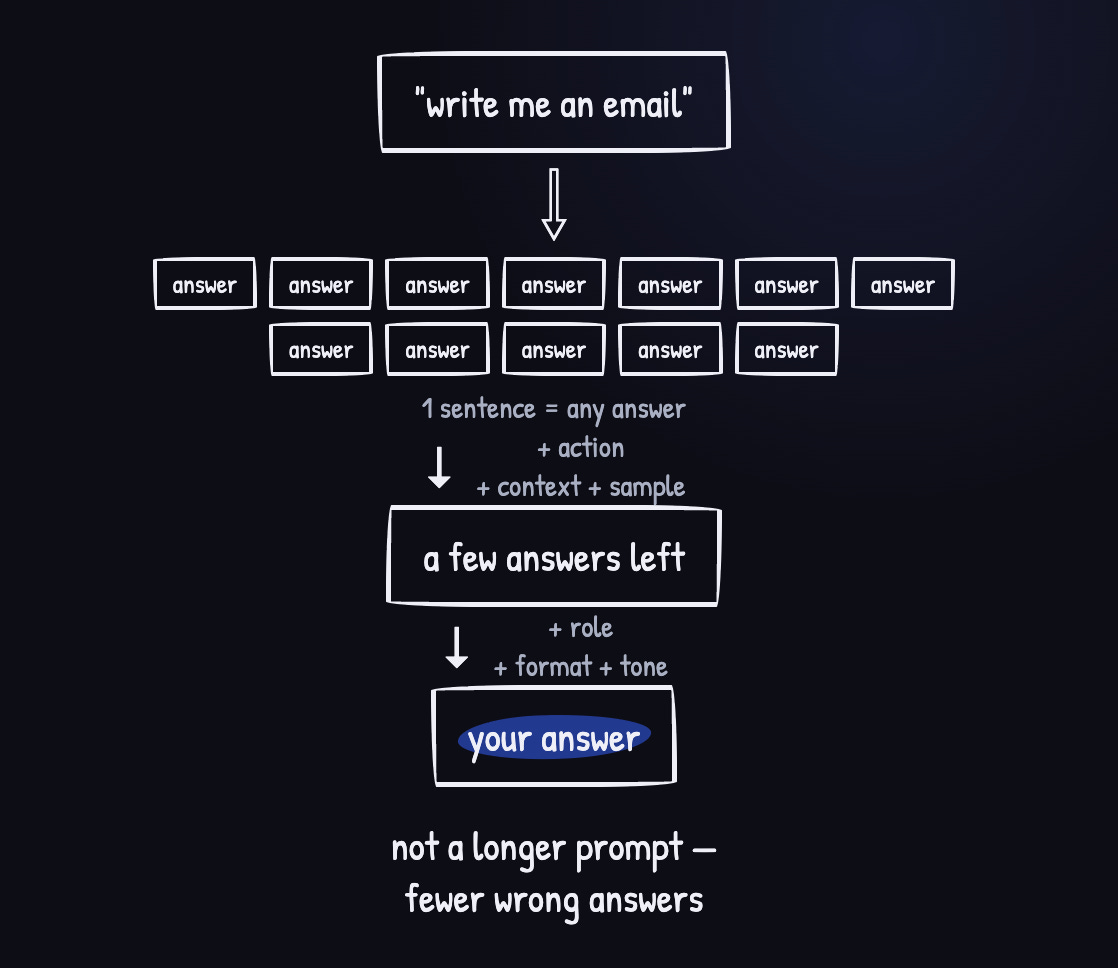 Every element you add cuts that number down until only the answer you wanted is left.
Instead of typing “write me an email” and fixing the output five times, you get a prompt that lands better on the first run.
Prompt engineering essentially means getting better results without having to fight with the AI to get there. (my definition.)
Based on the current generation of advanced models, prompt engineering has definitely become less of a specialized skill than it used to be.
You don’t need to know a bag of prompting tricks just to get ChatGPT or Claude to give you a decent answer anymore.
But that doesn’t mean prompt engineering is dead.
It means the job has moved up a level.
As models have become more capable, the engineering problem has expanded beyond the prompt itself. We’ve started talking about context engineering, harness engineering, loops, agentic workflows, and other ways of engineering the system around the model.
But all of these are still trying to solve the same fundamental problem:
How to get an AI system to do what we actually want it to do without having to fight with it to get there.
Prompt engineering is simply the part of that problem that happens at the level of the language model.
As models get better, a new kind of engineering will emerge → trying to solve the same fundamental problem.
That’s why i don’t think prompt engineering is dead.
I think the prompt engineer as someone whose main skill is knowing clever phrases and tricks is becoming less relevant.
The valuable skill is understanding how to communicate intent to an AI system — whether that’s through a simple prompt, a context window, a skill creation, a workflow, or an entire agent architecture.
Here’s the problem with a “Write me an email” prompt.
ChatGPT can answer it in a thousand different ways. 👎
Prompt engineering cuts that number down until only the answer you wanted is left.
The Sweet Ingredients:
The reason prompt engineering feels like a waste of effort is that it’s often taught as a strict formula.
E.g., people still debate whether starting your prompt with a persona is mandatory to get the most out of ChatGPT.
Let’s debug that with a simple prompt.
Example:
summarize this into 1 sentence.
“The company launched a new Al assistant. It helps users organize their work.”
A Diagram of a prompt with no context, no role, no format, no example, no constraint, yet still produces a satisfactory response.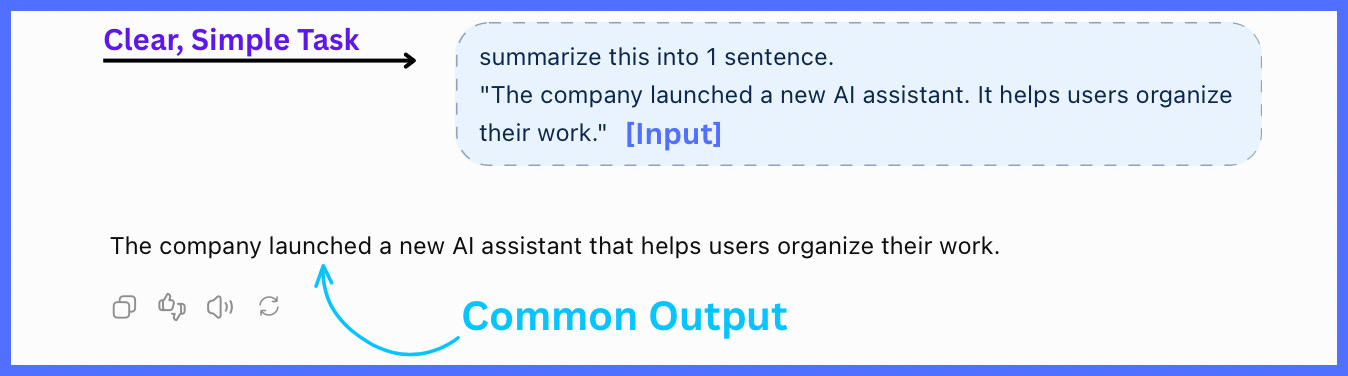
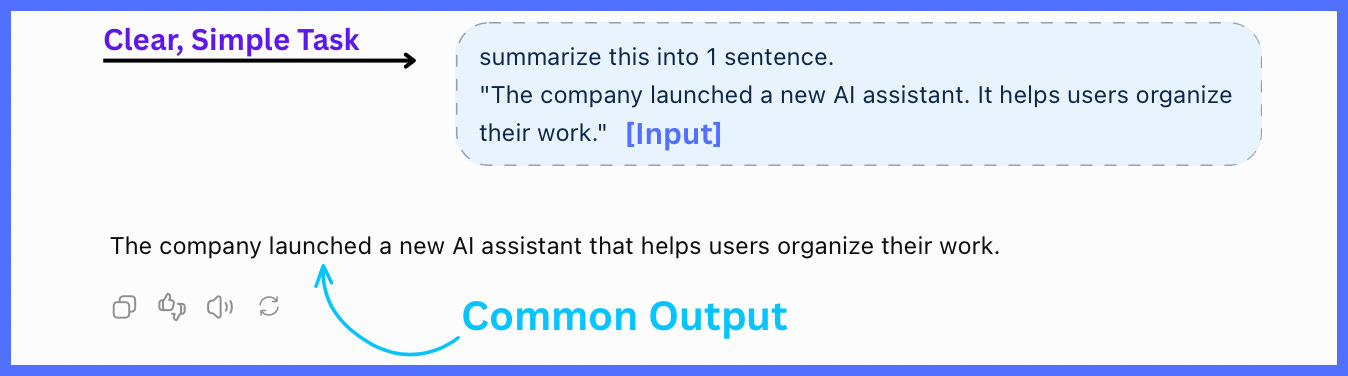
Now, I’ll demonstrate how the output remains consistent despite any additional elemen. I’ll also touch on why most prompt engineering techniques are useless when dealing with straightforward problems.
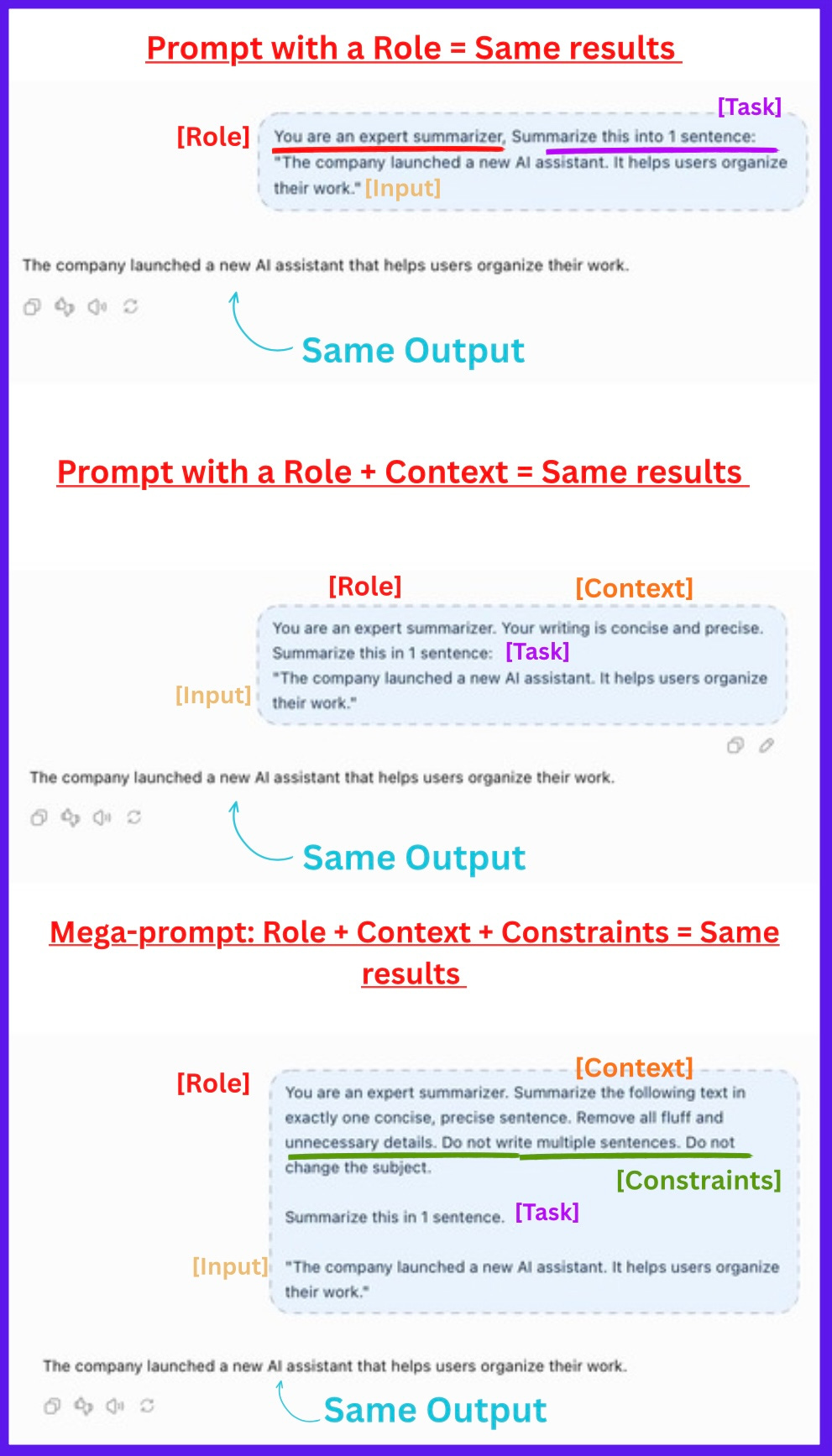
Based on the strong direction of the task and the input. The model treated every other detail as garbage.
The task and input became the signal. The output became obvious to the model.
What does this mean?
Elements of prompt engineering has become more useless for obvious tasks and more crucial for intricate, personalized stuff.
The days when “Act as an expert” used to be the game-changer for interacting with models are gone.
I’ve ranked the most important ingredients for getting ChatGPT closer to your desired output, based on how much each one matters.
The ChatGPT Prompting Hierarchy.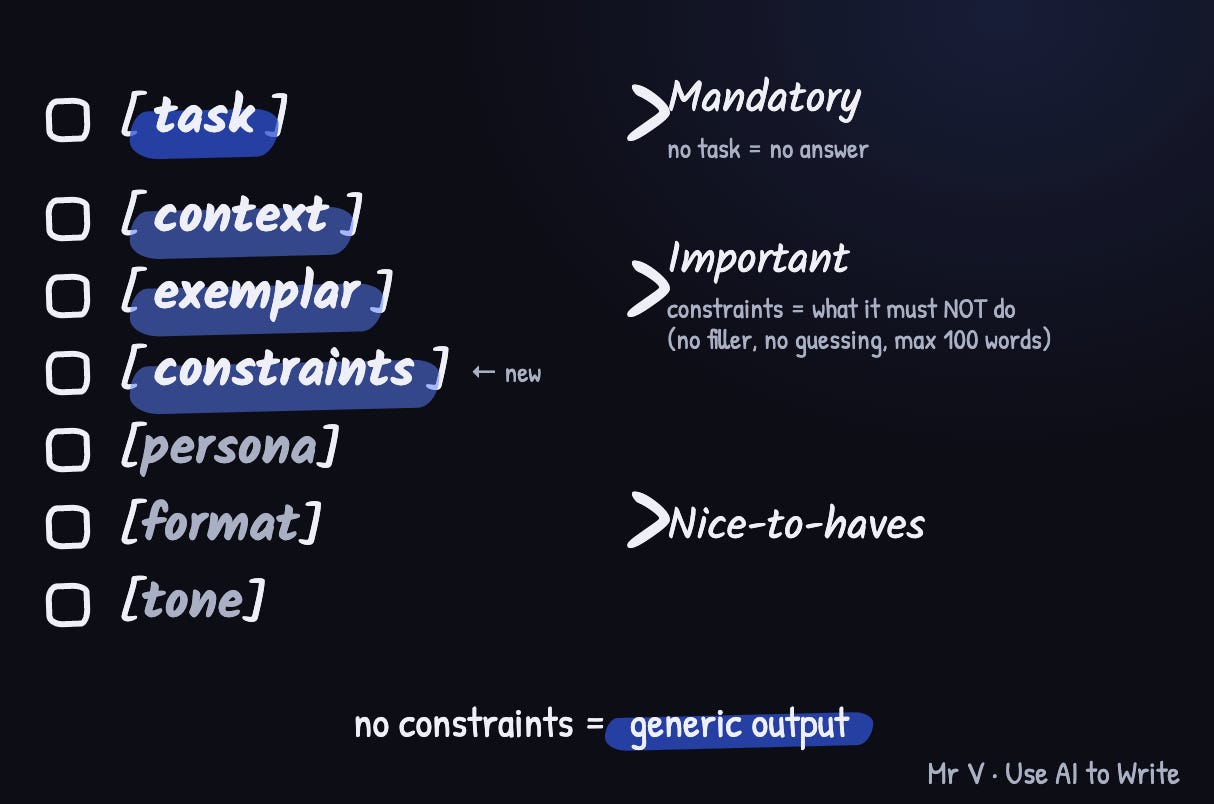 The ChatGPT Prompt Hierarchy: from “the prompt breaks without it” to “nice to have”
The order matters more than the method
The more complex and personalized the problem, the more ingredients you may need. For most problems, a clear task and a well-defined objective can do the job.
Here’s the B.R.I.E.F Method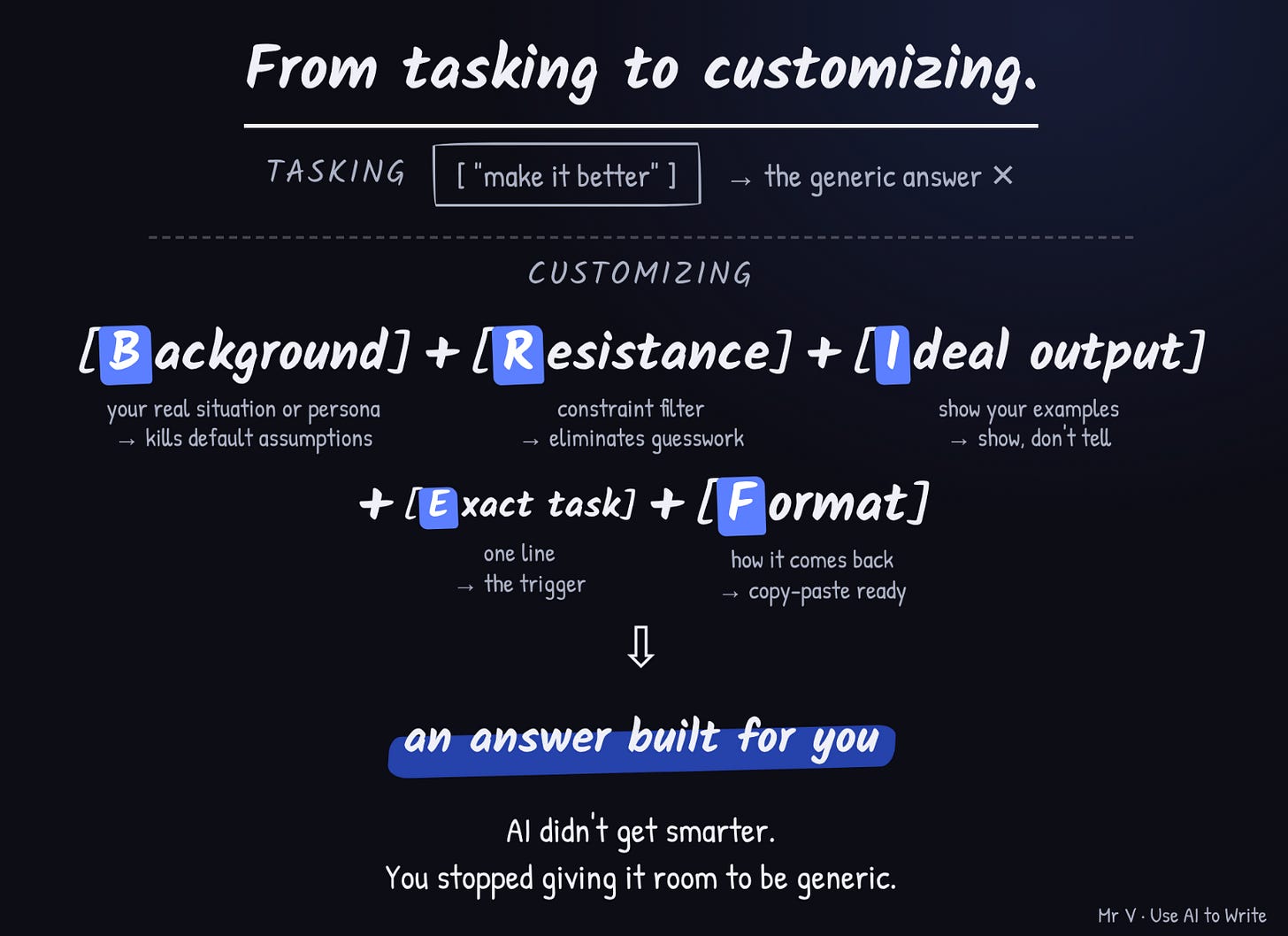
-
B — Background (Give more context about your situation)
-
R — Resistance (What you don’t want + what you’ve already tried)
-
I — Ideal output (Example of what a good answer looks like)
-
E — Exact task (the actual request)
-
F — Format and structure (how you want it returned)
I call it B.R.I.E.F so you remember all the important elements.
The formula serves as a guide that helps you know when to use each element. It’s not a strict rulebook that you have to apply in every situation.
❶ B — Background (Your actual situation)
-
Bad: “Write a newsletter about AI prompting.”
-
Good: “I write for 4,200 busy creators. My tone is direct. My audience has heard every AI tip before and hates generic advice.”
-
Result: ChatGPT reasons from your world, not its defaults. 30x more specific output on the first try.
How to build context on complex tasks:
As you can remember we use context for complex and personalized tasks
Here’s an example:
1/ Building Code From Scratch:
Instead of: 👎
“Build a prompt engine from scratch in code.”Result:
-
Outputs a generic 1,200-word boilerplate script. (There are so many possible answers the model may not match your preferences)
-
No real architecture decisions (no parsing strategy, no prompt routing logic, no memory layer).
-
Feels like a tutorial dump, not a usable system.
-
You can’t plug it into anything without debugging it.
After B.R.I.E.F FRAMEWORK:
Prompt:
B — Background

I'm building [specific app name and what it does] for [specific user type].
My stack is [e.g. Next.js, Supabase, Tailwind, deployed on Vercel].
I'm [solo / small team]. This is a real MVP I'm shipping, not a learning exercise.
That’s how you make AI operate on your terms.
Example 2.
2/ Let’s say you need expert advice:
This is an example of a personalized task.
-
The model has so many answers to give out and defaults to commonly known information.
-
This is where roles / personas are important. The best advice comes from a person who has experienced the problem and has helped others.
-
Make the model simulate the role of the expert you want to learn from instead of asking the model vaguely.
Getting advice from AI isn’t really as useful as people think it is.
You’re more likely to get generic advice than specific advice.
Instead of:
-
👎 “Become an expert.”
-
👎 “Give me advice”
-
👎 “Make it better.”
-
👎 “Explain this.”
-
👎 “Go deep.”
USE THIS AS BACKGROUND: ✅
When you don’t know the expert:
Prompt:
B — Background

My challenge is [specific situation with real stakes]. I’ve already tried [specific approaches]. With credible evidence, identify the expert who has the strongest track record of solving this challenge. Show me testimonials, referrals, case studies, and independent sources that demonstrate their expertise and explain my problem with exceptional clarity.

Context you need: [team size / company stage / timeline / what's on the line].
When you know the expert:
Prompt:
Act as Alex Hormozi listening to me. My challenge is [specific situation with real stakes].
I’ve already tried [specific approaches].
Listen to me carefully, identify the real problem underneath it, challenge my assumptions, and based on the known findings. tell me what you would do if you were in my position. Use the principles, frameworks, and publicly documented ideas associated with Hormozi to give me a direct, plain-spoken, practical answer.
Why this works:
The model stops giving generic business advice and starts reasoning through Alex Hormozi’s frameworks and ideas.
The key point is to understand that, role persona is crucial only when you desire a more personalized output than a better output.
❷ R — Resistance + Constraint
(What you don’t want + what you’ve already tried)
This is where you tell the model what you don’t want it to do:
-
Bad: “Make it better” “Make it more human”
-
Good: “We’ve tried three versions of this. Do not make it mechanical or robotic, the opening always feels forced and the explanation keeps drifting into generic advice.”
-
Reason: ChatGPT can’t suggest what you’ve already ruled out. Output goes deeper immediately.
Resistance + Constraints Prompt:
Proceeding with the expert advice prompt
Do not give me motivational advice or Vague Explanations

I've already tried [specific approaches].

Here's where each broke down:
- [Approach 1] failed because [reason]
- [Approach 2] didn't hold because [reason]
- [Approach 3] broke because [reason]

The core tension I can't resolve is [X vs Y].❸ I — Ideal output (what a good answer looks like)
Ideal Output (what a good answer looks like)
-
Bad: “Make it engaging.” “Make it clean”
-
Good: “A good writing sounds like advice from someone who has already done it. Direct. Specific. No motivation. No filler. No bullet-point fluff. Every sentence should either clarify the mechanism, remove confusion, or move the explanation forward.”
Prompt:
I — Ideal Output

A good board meeting here doesn't give me motivational advice.

- It gives me a real decision with the trade-offs named.
- I want them to disagree. I want the conflict to be specific to my situation,
not generic strategy language.
- The final plan should tell me what to do first, what to stop doing,
and what to watch for when it starts working.
In this situation, “asking for expert advice“, including examples may not be relevant and could actually lower the overall quality of the response.
But if we were using the “Coding” situation this part would be important to the output we need.
Rules for writing examples:
Add 1-2 examples for more detailed output.
Prompt:
I — Ideal Output

A good output here doesn't just give me code.

Example:
[The code uses a modular architecture with clear separation of concerns.
It handles 10,000 concurrent requests without blocking. It organizes files into distinct folders for routes, services, models, and tests. It uses PostgreSQL instead of MongoDB for relational data.
It includes Redis caching for frequently accessed data, with a fallback when the cache fails.]

A good output should have.

- Explain WHY each architectural decision was made.
- Identify multiple flags where this design will break under load and what to do about it.
- Hand me a file structure clean enough that another developer could pick it up without asking me questions.
- And if a decision is opinionated, it should say so and give me the alternative.
Why this works:
An example shows ChatGPT what you mean faster than any description.
❹ E — Exact task (the actual request)
Remember when I demonstrated how important the task is.
This is the part the model focuses on most.
Prompt:
Focus more on this task.
Task: Simulate a board meeting and debate my challenges and reach a final recommendation.❺ F — Format (how you want it returned)
Once you specify the format: ( structure + tone )
-
ChatGPT stops improvising the layout
-
It stops adding irrelevant examples
-
It locks into a predictable delivery shape
Example of a strong format:
-
Bad: “Make it look good.”
-
Good: “Return in short paragraphs. One idea per paragraph. End with one specific action the reader takes today.”
Prompt:
“Format the answer as a [TABLE / EMAIL / BULLET LIST / MARKDOWN DOC / CODE BLOCK].
Use these exact [SECTIONS / COLUMNS]: [LIST THEM].
Keep it under 1,000 words.

No intro sentence, no motivation, no summary at the end, no offer to help further.

Write in a warm, direct, plain-spoken tone for my SPECIFIC BUSINESS.

Never use these words: [e.g., delve, leverage, seamless].

Before you finish, reread it as my customers would.
If any line sounds like a press release, rewrite that line.”
The format should contain the tone and the structure of the output:
❻ The Bonus: The B.R.I.E.F Prompt Builder.
You won’t remember five blocks every time.
So I built one prompt that turns any lazy one-liner into a full B.R.I.E.F prompt for you.
Prompt:
# B — Background

I'm working on [WHAT I'M WORKING ON].

My goal is [WHAT I WANT TO ACHIEVE].

This is for [AUDIENCE / USER / CONTEXT].

Relevant context:
- [CONTEXT]
- [CONTEXT]
- [CONTEXT]

My constraints are [TIME / BUDGET / TOOLS / SKILLS / OTHER].

---

# R — Resistance

I've already tried [WHAT I'VE TRIED].

The main problem is **[WHAT ISN'T WORKING]**.

I'm concerned about:
- [PROBLEM / RISK]
- [PROBLEM / RISK]

Here's what I'm starting with:

**[EXISTING WORK / CODE / NOTES / DATA / DRAFT]**

Don't assume my current approach is correct. Challenge it if needed.

---

# I — Ideal Output

A good answer should:

- Solve the actual problem, not just answer the surface question.
- Explain **why** important decisions were made.
- Identify assumptions, risks, and tradeoffs.
- Recommend an approach instead of dumping options on me.
- Keep the solution proportional to the problem.
- Give me something I can actually use.

For important decisions, use:

Decision: [WHAT]

Why: [WHY]

Alternative: [OTHER OPTION]

Risk: [WHAT COULD GO WRONG]

If something is uncertain:

Risk: needs validation

---

# E — Exact Ask

I want you to:

[WHAT I WANT YOU TO DO]

The outcome I want is:

[DESIRED RESULT]

If there's a better way to approach this, tell me.

If my assumptions are wrong, point them out.

Don't invent information when something is unknown.

---

# F — Format

Deliver the answer in the format that best fits the task.

Prioritize:

1. What you recommend
2. Why
3. The actual work/output
4. Risks or tradeoffs
5. Next steps, if useful

Don't force this structure when it doesn't fit.

## Hard Rules

- No filler.
- Don't repeat information I've already given you.
- Don't give generic advice.
- Don't overcomplicate simple problems.
- Don't oversimplify complex ones.
- Separate facts, assumptions, and opinions.
- If information is missing but you can reasonably proceed, state the assumption and continue.
- If missing information would materially change the answer, ask me.
- Challenge bad assumptions instead of blindly following them.
- Give me the finished result when possible, not just instructions for creating it.How to use the builder (for practice)
-
❶/ Copy and paste the Builder (Prompt ❻) into ChatGPT, then paste your one-line prompt at the bottom.
-
❷/ Answer its questions in the order it asks — Action first. Then copy the assembled prompt into a fresh chat and run it there.
-
❸/ Turn on “Thinking Feature” for deeper, nuanced answers — especially when you use the Context and resistance block on a high-stakes task.
My philosophy on prompt engineering.
The skill is understanding which elements carry the most weight for the project at hand, and which elements are less useful in that specific context.
Hope this helps 😄
Mr. V