How to reverse engineer Viral Content: Crash Course.
By Mr V
Published: 2026-10-04
URL: https://useaitowrite.substack.com/p/reverse-engineering-is-my-favorite
Hey Creators:
I don’t start every post with a blank page.
I collect the pieces first.
→ find a hook that already works
→ study how competitors structure the idea
→ pull insights from research
→ identify the keywords people are searching for
→ look at what makes similar posts valuable
→ combine the strongest elements
→ rewrite everything through my own perspective
I’m basically taking the useful parts from different sources/niche and stitching them into something new.
That’s Frankensteining content.
And honestly, it’s way more useful than asking AI:
“write me a viral post about [topic].” ❌👎
Problem:
Every creator has seen a post in their niche blow up and thought:
-
“But Never know How” ❌👎
Reverse prompt engineering lets you extract that invisible structure.
You feed any piece of content to ChatGPT/Claude and ask it to deconstruct exactly why it works.
Then hand you a reusable formula to create content with the same impact.
Recent models (Opus 5, Astra, etc.) are brilliant at reverse-engineering almost anything, and they’re absolutely killing it with content.
Copy-paste reverse prompting prompts
1: Full content deconstruction🔍
Content Deconstructor:
→ Best for: Understanding why any piece of content performed well
This helps you understand how and why the content clicked with its audience.
I’m going to paste a piece of content that performed extremely well on [platform]. Deconstruct it completely:

1. Hook analysis — What type of hook is used? Why does it stop the scroll?
2. Emotional triggers — What emotions does this activate? (awe, curiosity, fear of missing out, anger, aspiration)
3. Structure — Map the exact flow (hook → body → CTA). How is information paced?
4. Tone and voice — Formal or conversational? Authoritative or relatable? What word choices create that tone?
5. Social currency — Why would someone share this? What does sharing it say about the person?
6. CTA style — How does it drive engagement? Is it direct, subtle, or implied?

Then generate the exact prompt that would produce content with this same structure, tone, and emotional impact — but about [my topic].

Here’s the content:
[paste the viral post]2: Hook formula extractor🪝
Hook Formula Extractor
Best for: Building a swipe file of proven hook formulas
I’m going to paste 5 hooks/first lines from high-performing [platform] posts in the [niche] space.

For each hook:

1. Identify the hook formula (bold claim, question, story tease, results reveal, contrarian, fear of missing out)
2. Explain why it works — what psychological trigger does it activate?
3. Create a reusable template from that hook — replace the specific topic with [BLANK] so I can fill in any topic

Then generate 3 new hooks for each formula about [my topic], using the same structure but my niche.

Here are the hooks:

[paste 5 hooks]3: Competitor content strategy analysis🏆
Competitor Strategy Decoder
Best for: Understanding a competitor’s content playbook
I’m pasting the 10 most recent Notes/posts from a creator in my niche who is outperforming me. Analyze their content strategy:

1. Content pillars — What 3-4 topics do they consistently cover?
2. Hook patterns — What hook formulas do they repeat? Which ones appear most?
3. Posting format — Carousel vs. Reel vs. static? What format dominates?
4. Voice and positioning — How do they position themselves? (expert, peer, entertainer, contrarian)
5. CTA patterns — How do they drive engagement? What do they ask for?
6. Gaps — What topics or angles are they NOT covering that I could own?

Present this as a competitive analysis brief I can use for my own content planning.

Here are their posts:
[paste 10 posts]4: Tone and voice replicator🎨
Voice DNA Extractor
Best for: Capturing the style elements that make a creator’s voice distinctive
Analyze the writing style of these 5 posts from a creator whose voice I admire.

Extract their voice DNA:
1. Sentence patterns — Average length, use of fragments, rhythm (short-short-long?)
2. Vocabulary — Common word choices, slang, jargon level
3. Tone markers — What makes this feel authentic? (humor style, vulnerability level, confidence level)
4. Structural habits — How they open, transition, and close posts
5. Distinctive elements — The quirks that make their writing recognizable

Then write a style guide document I can paste into any future ChatGPT session to replicate this voice consistently. The style guide should be under 200 words and usable as a system prompt.

Here are the posts:
[paste 5 posts]5: Viral post reverse-engineer and replicate⚡
Viral Replicator
Best for: Going from “I love this post” to “I made my own version” in 5 minutes
Here is a viral [post/Reel/video script/tweet] from [platform] that got [engagement numbers if known]:

[paste content]

Do three things:
1. Reverse-engineer the prompt — Write the exact ChatGPT prompt that would reproduce content with this same structure, tone, pacing, and emotional impact.
2. Identify what I cannot copy — What elements are unique to this creator (personal stories, specific credibility, audience relationship) that I’d need to replace with my own?
3. Create 3 versions for my niche — Using the reverse-engineered prompt, generate 3 original posts about [my topic] in [my brand voice: describe]. Keep the same structure and triggers but make the content completely original.
Creator Tip
Pro Tip
Build a swipe file system. Save 5-10 viral posts per week in your niche. Run each through the Hook Formula Extractor and Content Deconstructor.
Within a month, you’ll have a library of 20-40 proven formulas mapped to your niche and you’ll start recognizing the patterns instinctively.
The Reverse prompting workflow
Step 01: Collect high-performing content in your niche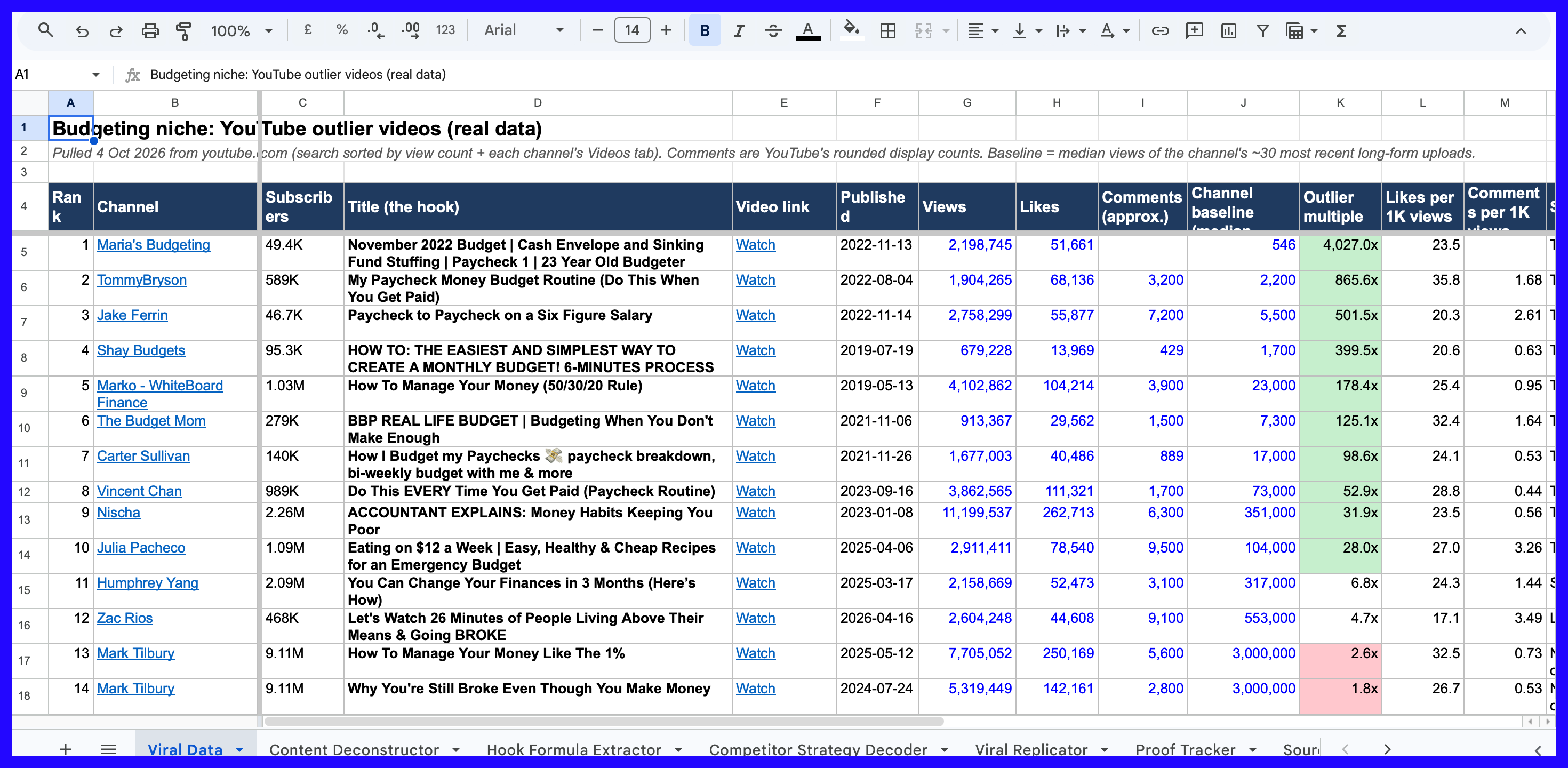 Collection of high-performing budgeting content.
Build a swipe file of content that outperforms in your space posts with disproportionate saves, shares, or comments relative to the creator’s usual numbers.
-
Screenshot or copy 5-10 viral posts per week from competitors and creators you admire
-
Note the engagement signals — a post with 500 saves on an account that averages 50 tells you more than a post with 10K likes from a million-follower account
-
Include different formats — captions, carousels, Reels hooks, YouTube titles, thread openers
✅ The quality of your reverse prompting output depends entirely on the quality of your input. Collect the best, not the most.
Step 02: Deconstruct with the right prompt
Pick the prompt above that matches your goal and feed it the content you collected.
• Content Deconstructor for understanding why a single post worked — the full breakdown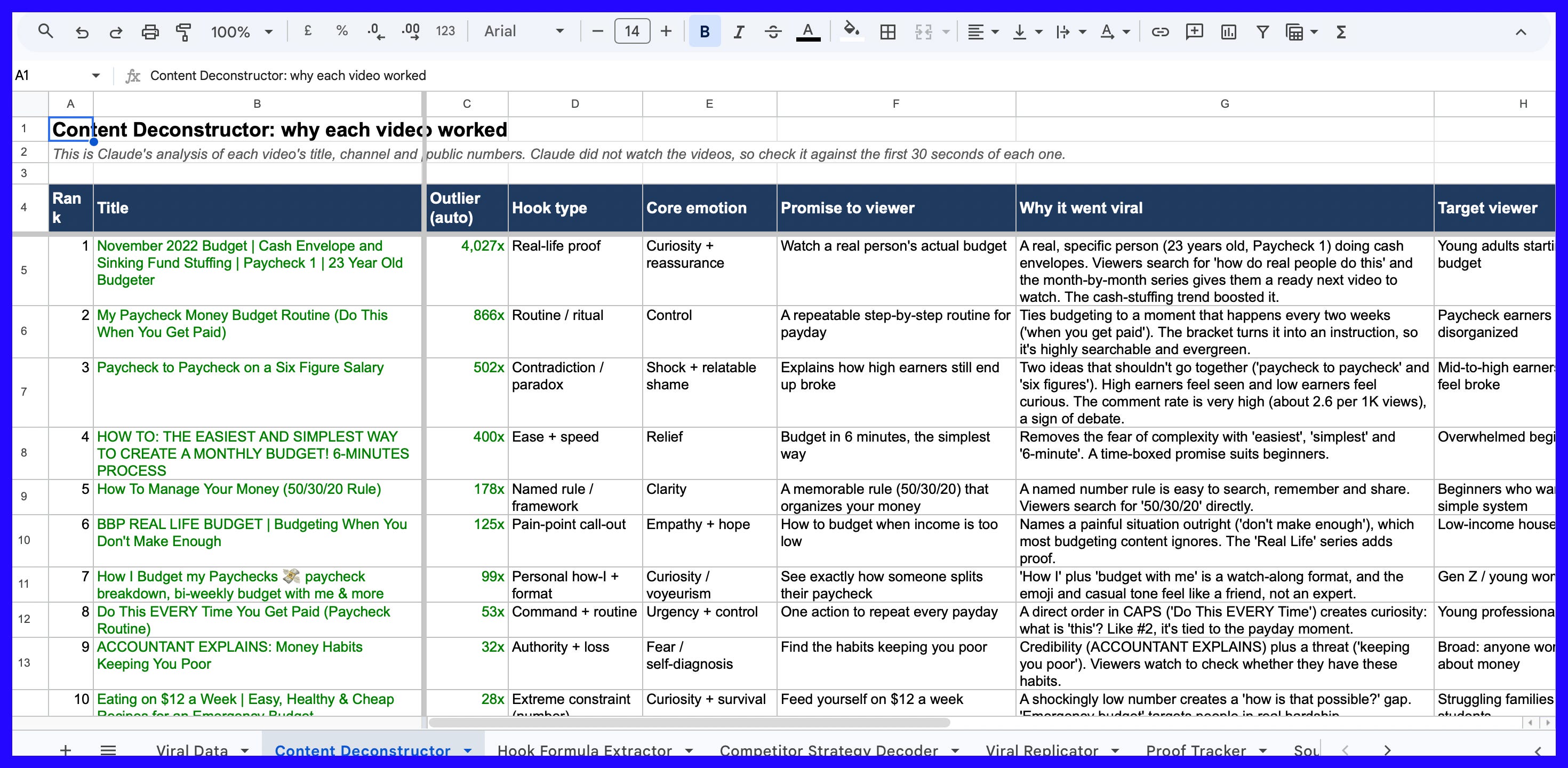 Content Deconstructor
• Hook Formula Extractor for building reusable hook templates from multiple posts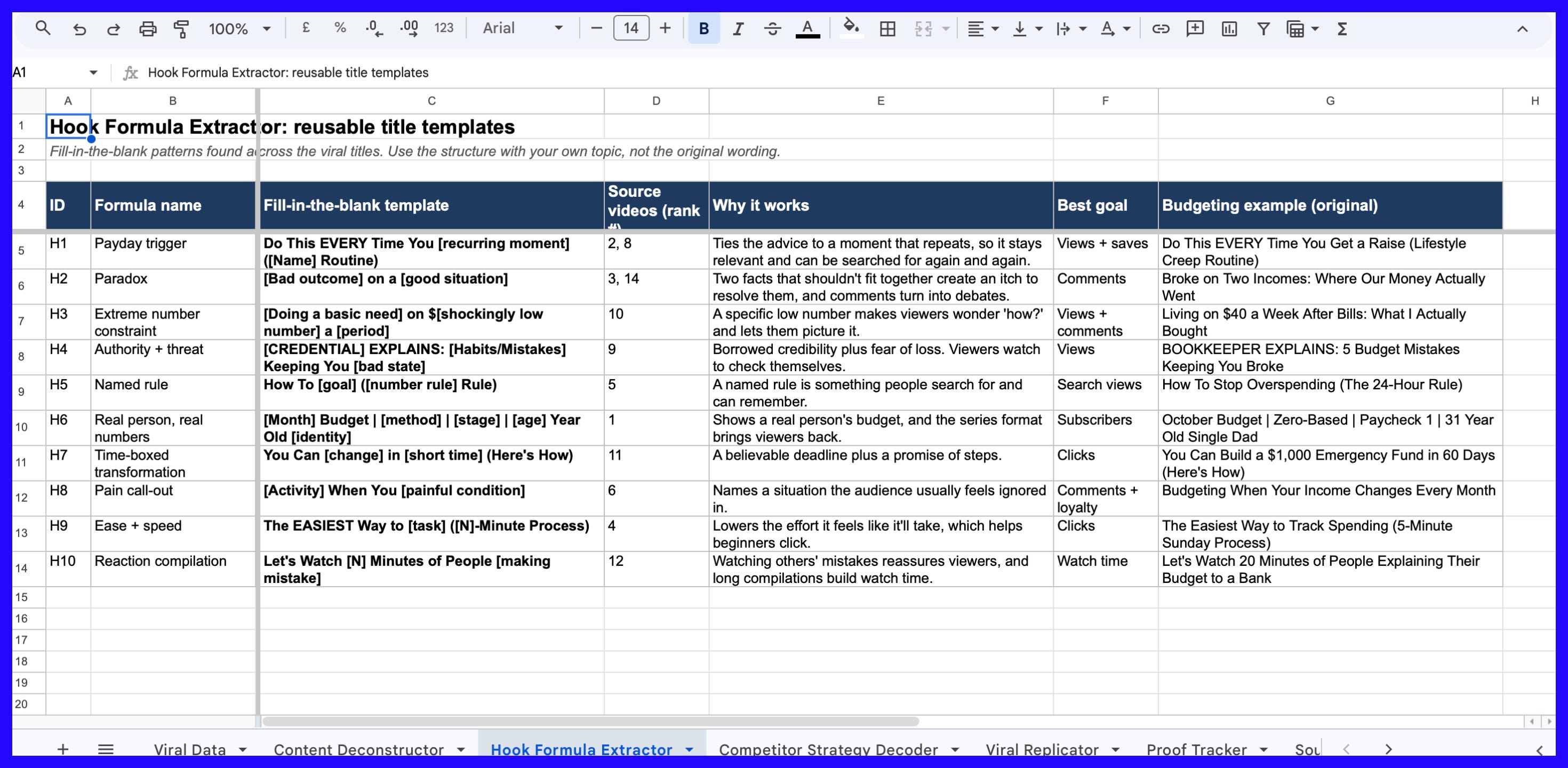 Hook Formula Extractor
• Competitor Strategy Decoder for mapping a creator’s entire content playbook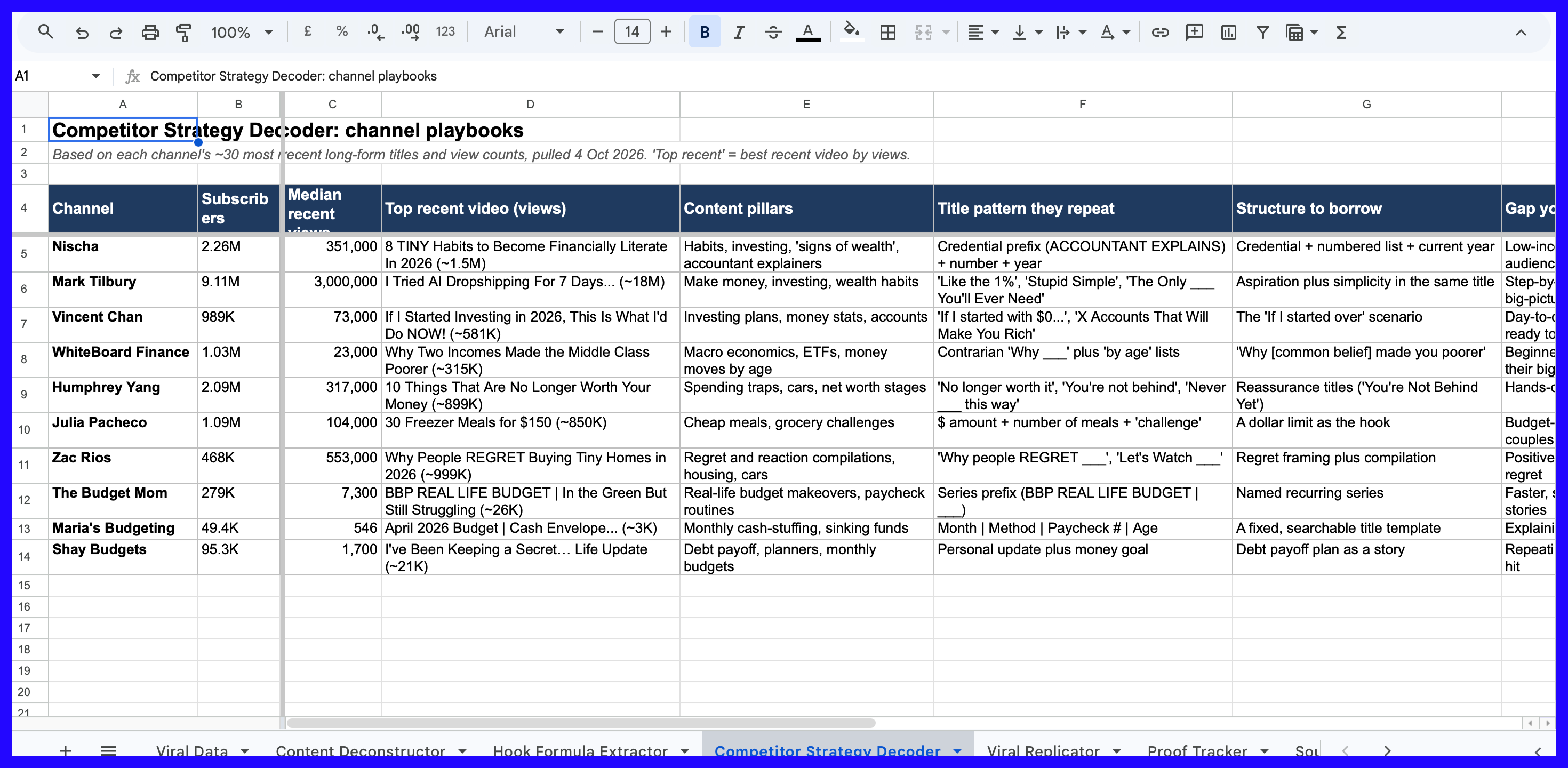 Competitor Strategy Decoder
Pro-tip:
✅ Use the Deconstructor first if you’re new. It gives you the most complete picture of how content works.
Step 03: Extract the reusable formula — not the content
The goal is to extract structural DNA — not to copy anyone. Focus on the transferable elements.
• Hook formulas — eg ‘‘The reason you’re not [result] is [contrarian insight]’’ works in any niche
• Emotional triggers — if the original uses fear of missing out, you can activate the same emotion with different content
• Pacing patterns — short-short-long sentence rhythm, or the ‘open loop → deliver → new loop’ structure
• CTA mechanics — ask-a-question CTAs perform differently than save-this-for-later CTAs
✅ When you can describe why something works in formula terms, you can replicate it infinitely.
Step 04: Generate your original content using the formula:
Tell the model to apply the extracted formula to your topic, audience, and brand voice.
Prompt:
help me turn proven formulas into original posts in my own voice.

MY FORMULA (from a post that went viral):
[Paste the formula, e.g. "Do This EVERY Time You [moment] ([Name] Routine)"]

ABOUT ME:
- My topic: [what you post about]
- My audience: [who they are + their biggest struggle]
- My voice: [3 words, e.g. "blunt, warm, funny"]
- Platform + format: [e.g. Instagram Reel, YouTube title, carousel]

MY REAL DETAILS (use these, don't invent any):
- A personal story or mistake: [ ]
- A real number or result: [ ]
- An opinion I hold that others might disagree with: [ ]

DO NOT:
- Copy the original post's wording or topic
- Make up stats, stories, or results
- Use hype words like "game-changer," "unlock," or "secret"

TASK:
1. Write 5 hook variations using the formula, each from a different angle.
2. Tell me which one is strongest and why, in one sentence.
3. Write the full post for the strongest hook, using my real details.
4. End with one clear call to action: [save / comment / follow / share].
5. Keep it short enough to read out loud in under [30 seconds / 60 seconds].
This is where reverse prompting becomes a content engine.
What to do:
• Plug your topic into the reverse-engineered prompt template
• Add your brand voice — use your own frameworks to set Role, Context, and Exclusions
• Generate 3-5 variations and pick the strongest angle
• Edit for authenticity — add your personal experiences, specific numbers, and real opinions
✅ The final product should feel like you, not like the original. The formula should be invisible, your voice is what audiences connect with.
Do’s and don’ts of reverse prompting:
❌👎 Where creators go wrong
-
Never copy content directly — reverse prompting is about structural principles, not plagiarism. Always create original content with your own voice and experiences
-
Never skip the editing step — AI-generated versions need your personal stories, specific data, and authentic perspective to stand out from generic content
-
Never reverse prompt only one post — single examples produce noisy results. Patterns become clear when you analyze 5-10 posts from the same creator or format
-
Never confuse virality with quality — engagement bait goes viral too. Only study content that builds trust and delivers real value to the audience
-
Never rely on AI analysis alone — your human judgment about what resonates with your specific audience is irreplaceable. Use AI as a starting lens, not a final answer
-
Never ignore platform context — a hook that works on Twitter may fail on Instagram. Always specify the platform in your reverse prompts so the analysis accounts for format differences
-
Avoid Vague instructions - If you start with “reverse engineer this”, it’ll pick up malicious intentions.
✅👍 How to reverse content ethically and effectively
-
Extract formulas, not content — study the hook structure, emotional triggers, and pacing rhythm. These are transferable principles, not proprietary content
-
Feed ChatGPT multiple examples — 5 posts gives much better pattern recognition than 1. The AI can identify recurring formulas across the batch
-
Use it to study your own best content — reverse prompt your top-performing posts to understand why they worked, then replicate that formula intentionally
-
Build a swipe file system — 5-10 posts per week through the Hook Formula Extractor creates a library of proven patterns within a month
The Secret Technique: HOW TO MASTER REVERSE ENGINEERING. (even as a beginner)
Claude and ChatGPT perform significantly better when you force it to “show its work” BEFORE giving the final answer.
But not just any reasoning - Structured Reasoning.
Here’s how:
Give the model a list of things to do before producing its final output.
Each step should move the model closer to the final output, not be a random list of instructions that just bloats the prompt.
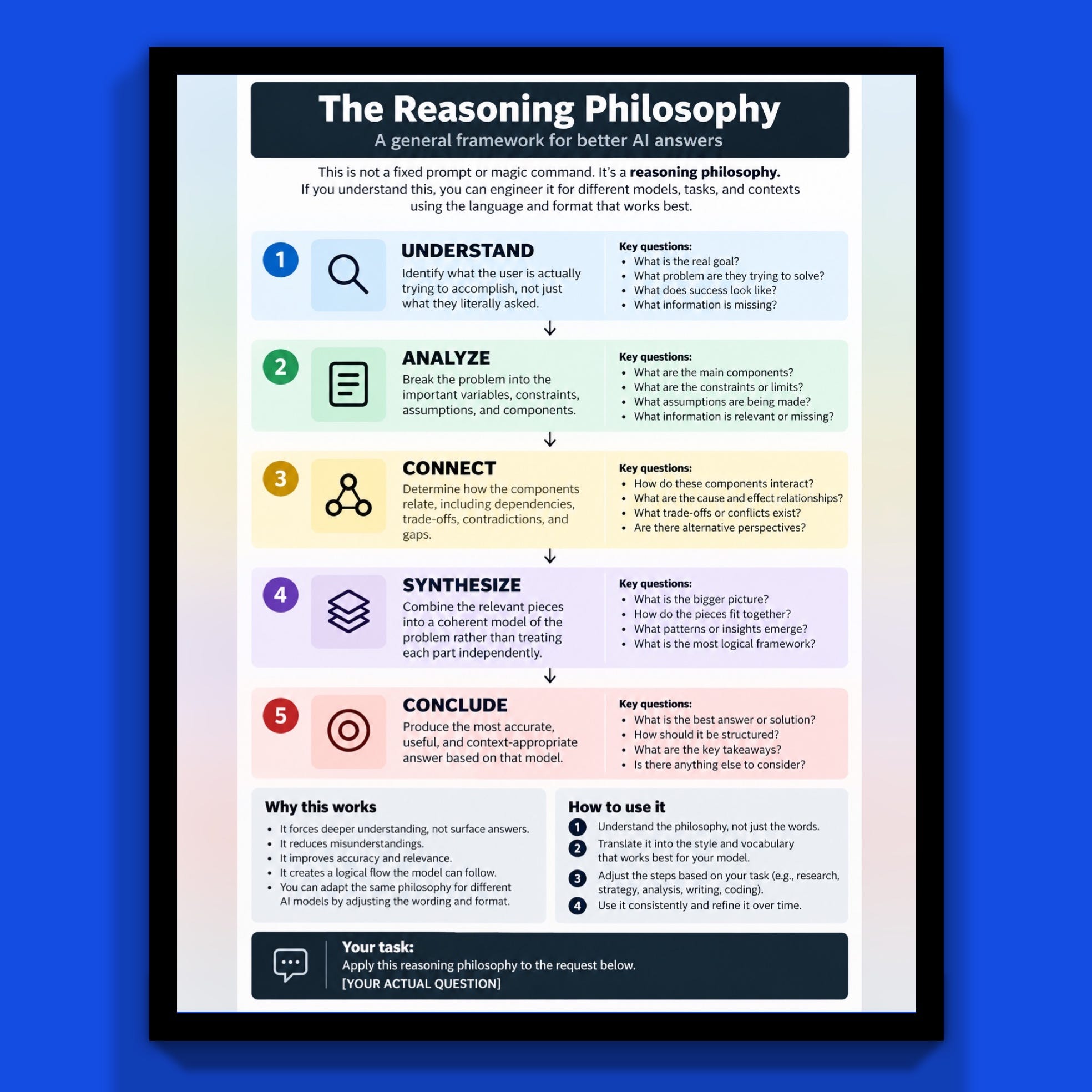
Example of structured reasoning.
AI Observes the post → deconstruct components → classify mechanisms → connect mechanisms → abstract the structure → reconstruct it for a new topic → validate → produce the best result.
EXPOSING THE CONTENT DECONSTRUCTOR PROMPT USING THE STRUCTURE: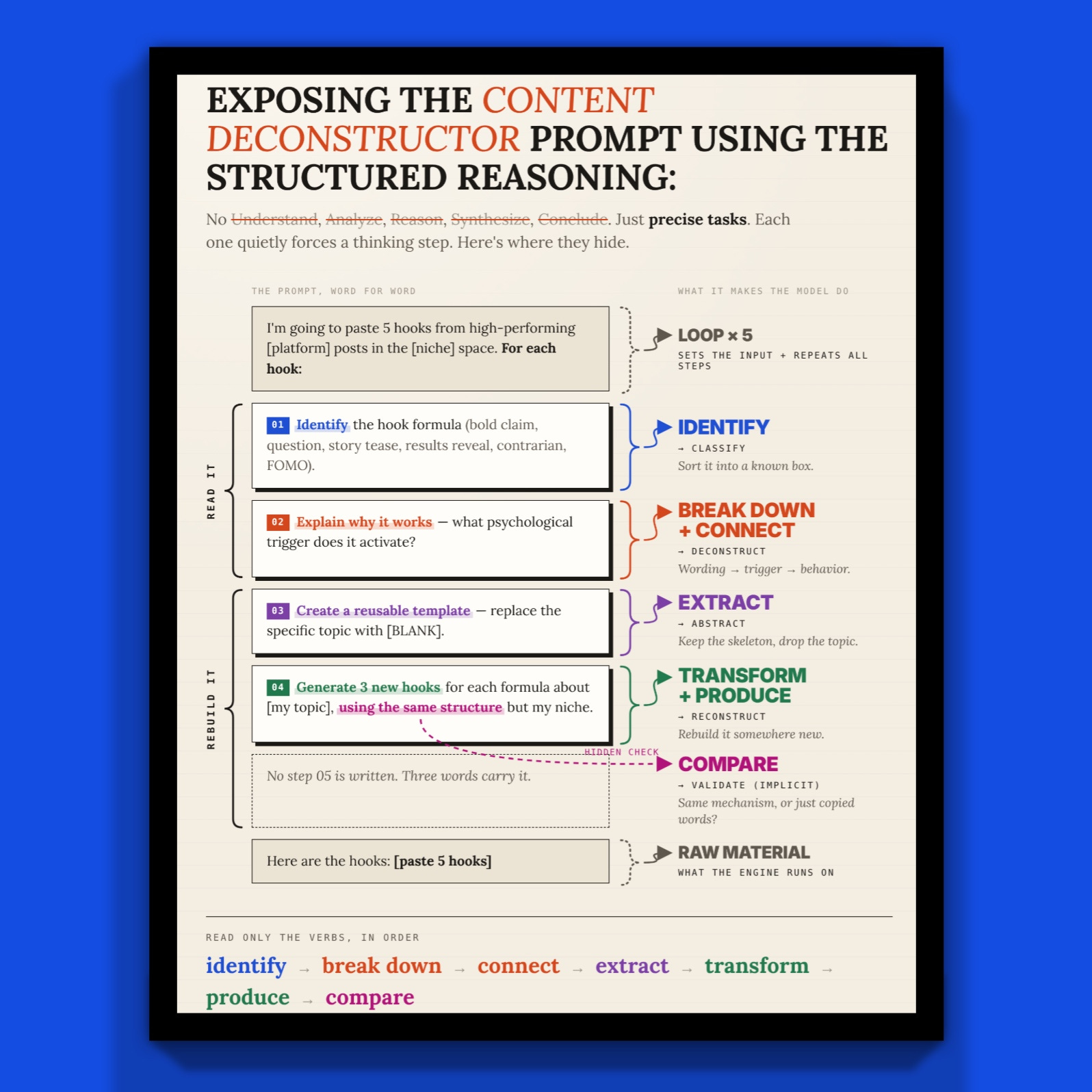
Instead of pattern-matching to generic responses, it actually reasons through your specific situation.
Example comparison:
Vague prompt:
“Explain why my startup idea might fail”Response:
The model gives you generic risks like “market competition, funding challenges, poor timing...”
With a reasoning pattern:
Before answering, work through this step-by-step:

UNDERSTAND: The startup idea, its target customer, the problem it solves, and the core question being asked.
ANALYZE: The key factors that could cause failure, including market demand, customer behavior, competition, differentiation, business model, pricing, distribution, execution, and scalability.
REASON: These factors to identify how and why each weakness could contribute to failure. Distinguish between assumptions, risks, and evidence.
SYNTHESIZE: Combine the findings into the strongest failure scenarios, prioritizing the risks most likely to kill the business.
CONCLUDE: Give the most important reasons the startup might fail, explain the underlying logic, and suggest what should be tested or changed first.

Now answer: Explain why my startup idea might fail: [STARTUP IDEA]
Response:
You get Detailed analysis of market saturation, user acquisition costs for AI apps, specific competition, customer behavior patterns, monetization challenges for subscription models, etc.
The difference is insane.
Why this works:
→ When you force ChatGPT or Claude to structure its thinking, it activates deeper processing layers. Ai models are a lot smarter than before
Simple Template to try today:
Before answering, work through this step-by-step:

1. UNDERSTAND: What is the core question being asked?
2. ANALYZE: What are the key factors/components involved?
3. REASON: What logical connections can I make?
4. SYNTHESIZE: How do these elements combine?
5. CONCLUDE: What is the most accurate/helpful response?

Now answer: [YOUR ACTUAL QUESTION]
Note: In prompt engineering, you don’t have to say Understand, Analyze, Reason, Synthesize, Conclude..… Explicitly.
Make the model perform the process through the task itself.
Define what it needs to identify, break down, compare, connect, extract, transform, and produce, and the reasoning architecture is already embedded in the prompt.
The crazy part is that AI models can now reverse-engineer Large systems and Companies, not just Content.
If you give it enough evidence outputs, examples, screenshots, documentation, behavior, data, traces and a step by step well engineered structure, it can infer the hidden structure that produced them.
I hope this was helpful.
Mr.V