From AI strategy and organizational readiness to governance, deployment, and measurable business value: a practical library for leaders responsible for making enterprise AI work.
By Alex Pawlowski
Published: 2026-10-31
URL: https://thestrategystack.substack.com/p/enterprise-ai-playbook-free-frameworks-guides-2026
 caption...

THE STRATEGY STACK · FIELD GUIDE · OCTOBER 2026
Most organizations no longer need another explanation of why artificial intelligence matters.
They need to decide what to implement, where to begin, who should be accountable, what safeguards must be established, and how to determine whether the investment is producing meaningful business outcomes.
That is a different challenge from experimenting with a chatbot or purchasing an enterprise AI subscription.
An AI initiative must fit an organization’s existing capabilities, economics, systems, responsibilities, and risk tolerance. It must improve a real business process without introducing operational dependencies that nobody understands or owns. And once the initial deployment succeeds, the organization must learn how to repeat that success.
The difficulty is not a shortage of guidance.
Public institutions, standards bodies, technology providers, universities, and research organizations have produced extensive materials on AI adoption, responsible deployment, organizational transformation, and operational performance.
The difficulty is that these resources rarely arrive as a single, coherent implementation system.
One framework explains how to prioritize AI investments. Another addresses organizational readiness. A third covers security and compliance. Others focus on engineering, change management, agent authorization, or economic measurement.
Enterprise leaders are left to assemble the operating model themselves.
This collection brings those resources together.
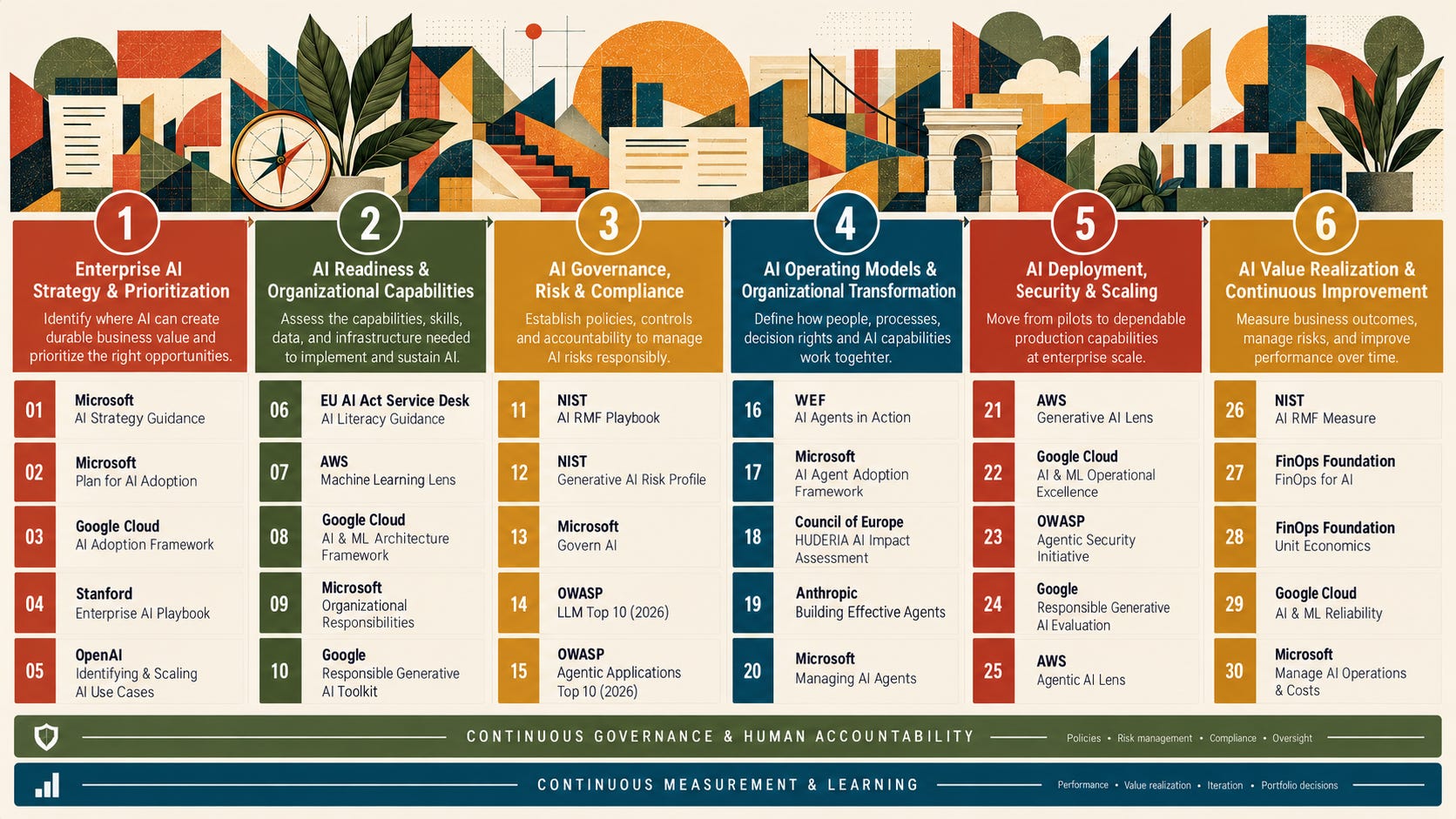
It includes 30 publicly accessible guides, playbooks, frameworks, and technical references organized around six enterprise AI implementation challenges:
-
Enterprise AI Strategy & Prioritization
-
AI Readiness & Organizational Capabilities
-
AI Governance, Risk & Compliance
-
AI Operating Models & Organizational Transformation
-
AI Deployment, Security & Scaling
-
AI Value Realization & Continuous Improvement
The directory is followed by original implementation frameworks, practical exercises, a worked enterprise example, and a 90-day roadmap.
The goal is not to recommend 30 separate initiatives. It is to help you select the few resources necessary to turn a specific organizational problem into a governed, measurable AI capability.
Access note: The linked reading materials are publicly accessible. Some providers require free registration for downloadable materials, while implementing the recommended technologies may require paid infrastructure, software, or professional services. Where a formal standard is sold separately, this collection links to publicly available explanatory material rather than presenting the paid standard as free.
How to use the Enterprise AI Playbook Library
A successful enterprise AI program does not begin by copying another company’s technology architecture.
It begins by defining the decisions that must be made.
Implementation challengeFundamental questionExpected outputStrategyWhy are we investing in AI, and where will it matter?AI investment thesis and prioritized opportunitiesReadinessWhat capabilities must exist before implementation?Capability assessment and readiness planGovernanceWhat uses, decisions, and risks require oversight?Risk register, policies, and accountability modelOperating modelWho owns implementation, adoption, and performance?Responsibilities and delivery operating modelDeploymentHow will systems operate safely and reliably?Tested architecture and production controlsValue realizationHow will we know whether AI improves outcomes?Measurement system and portfolio decisions
These six challenges are connected, but they are not always sequential.
Governance cannot wait until deployment. Business value cannot be defined only after launch. And readiness assessments must be repeated when an organization moves from a narrow pilot to broader implementation.
The library is therefore best understood as a decision-oriented reference system, not a fixed maturity ladder.
If you are developing an AI strategy, start with Section 01. If you already have a funded initiative, use Sections 03–06 to test whether its operating model is complete. If you are responsible for a portfolio of deployments, use the governance and measurement resources to establish common standards across teams.
Each entry explains what the resource covers, when it is useful, and what tangible output you should produce after using it.
Section 01 — Enterprise AI Strategy & Prioritization
Choose where AI can create durable business value before committing organizational resources.
The most expensive enterprise AI mistake may be answering the wrong question extremely efficiently.
Organizations frequently organize AI discussions around available technologies: which model to use, which platform to adopt, or which business function should receive an AI assistant.
A more useful starting point is the organization’s performance gap.
Where are important outcomes below expectations? Which processes consume disproportionate effort? Which capabilities constrain growth? Which activities depend on knowledge that is difficult to access, transfer, or apply?
Only then should leaders determine whether AI is an appropriate intervention.
01. Microsoft: AI Strategy Guidance
Provider: Microsoft Learn
Resource: AI Strategy — Cloud Adoption Framework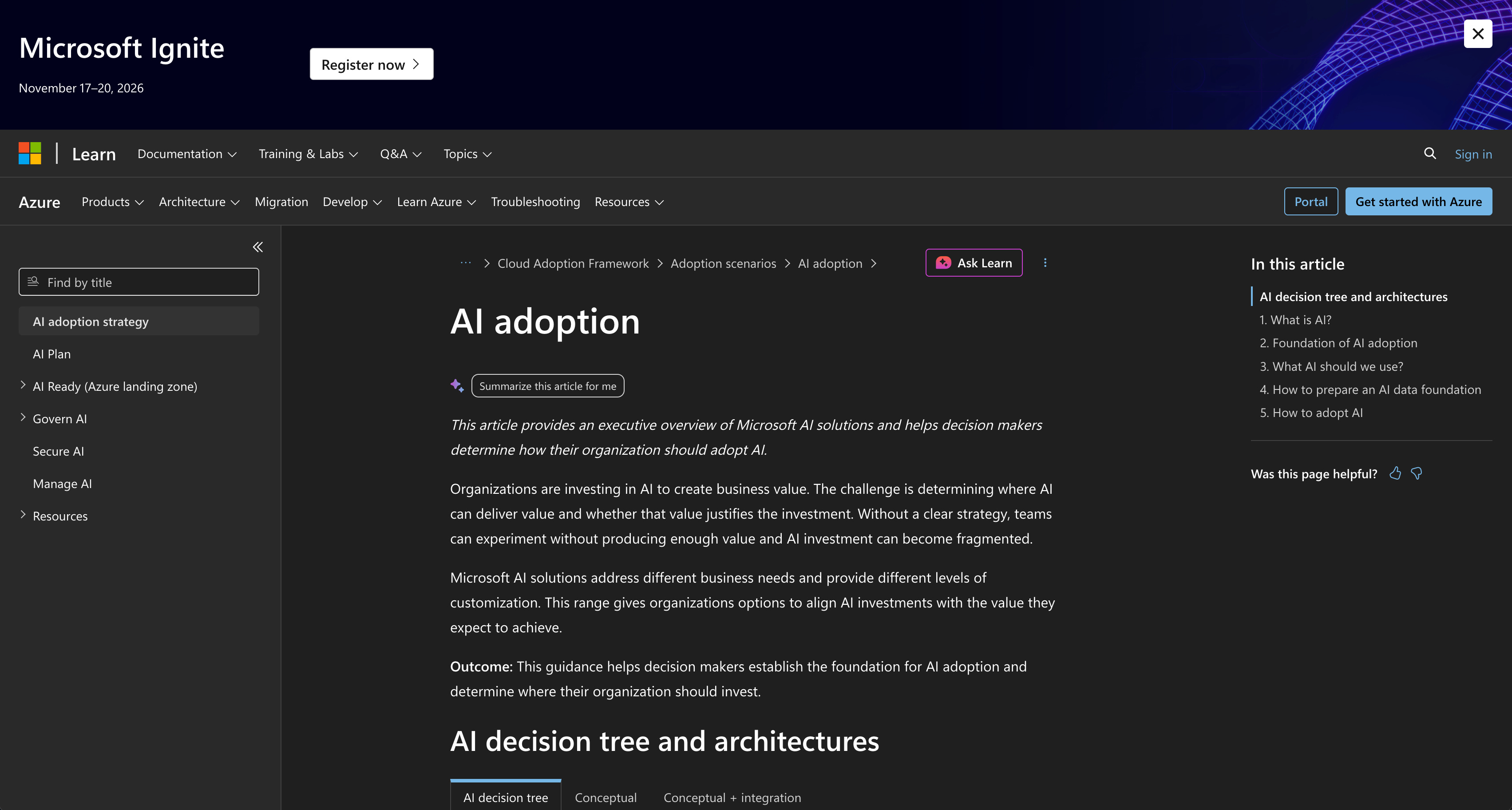
Microsoft’s strategy guidance connects business priorities with the selection and adoption of AI capabilities. It addresses decisions around use cases, organizational considerations, data foundations, and the path from AI ambition to implementation planning.
Best for: CIOs, transformation leaders, enterprise architects, and AI program sponsors.
What to take away: A structured AI strategy that identifies the business outcomes being pursued, the types of AI capabilities required, and the organizational conditions needed for execution.
Practical application: Select three business priorities and map each to one measurable operational problem. Explicitly document situations in which conventional software, process redesign, or better data management would be preferable to AI.
Access: Free documentation.
02. Microsoft: Plan for AI Adoption
Provider: Microsoft Learn
Resource: Plan for AI Adoption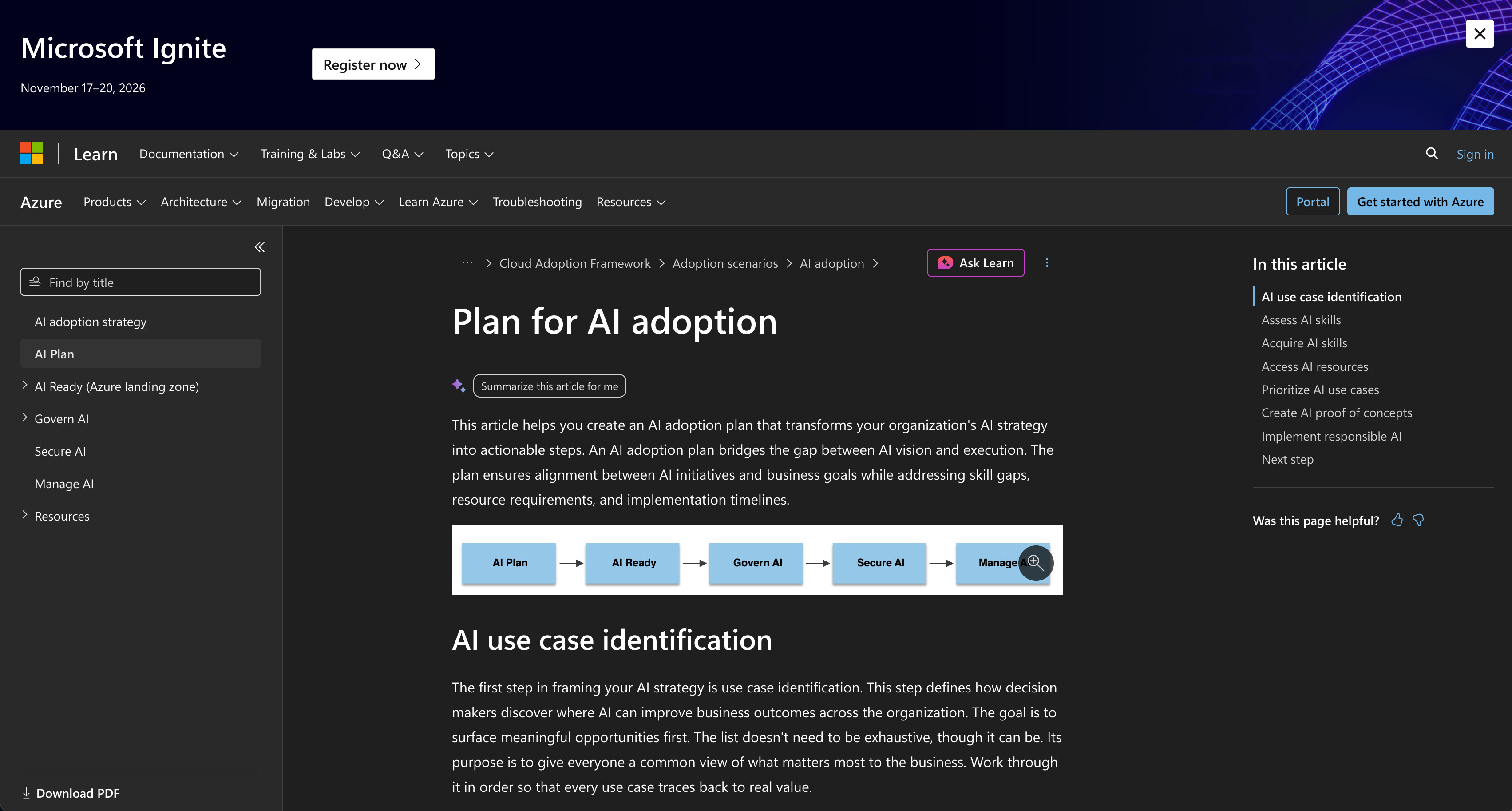
This implementation-oriented guide covers the transition from strategic ambition to actionable adoption planning, including use-case identification, skills, resources, prioritization, proofs of concept, and responsible AI.
Best for: Enterprise AI program managers and cross-functional implementation teams.
What to take away: A practical process for transforming broad strategic priorities into an actionable initiative portfolio.
Practical application: Create a one-page brief for each proposed use case: business problem, process owner, anticipated benefits, required data, risks, delivery dependencies, and decision criteria.
Access: Free documentation.
03. Google Cloud: AI Adoption Framework
Provider: Google Cloud
Resource: AI Adoption Framework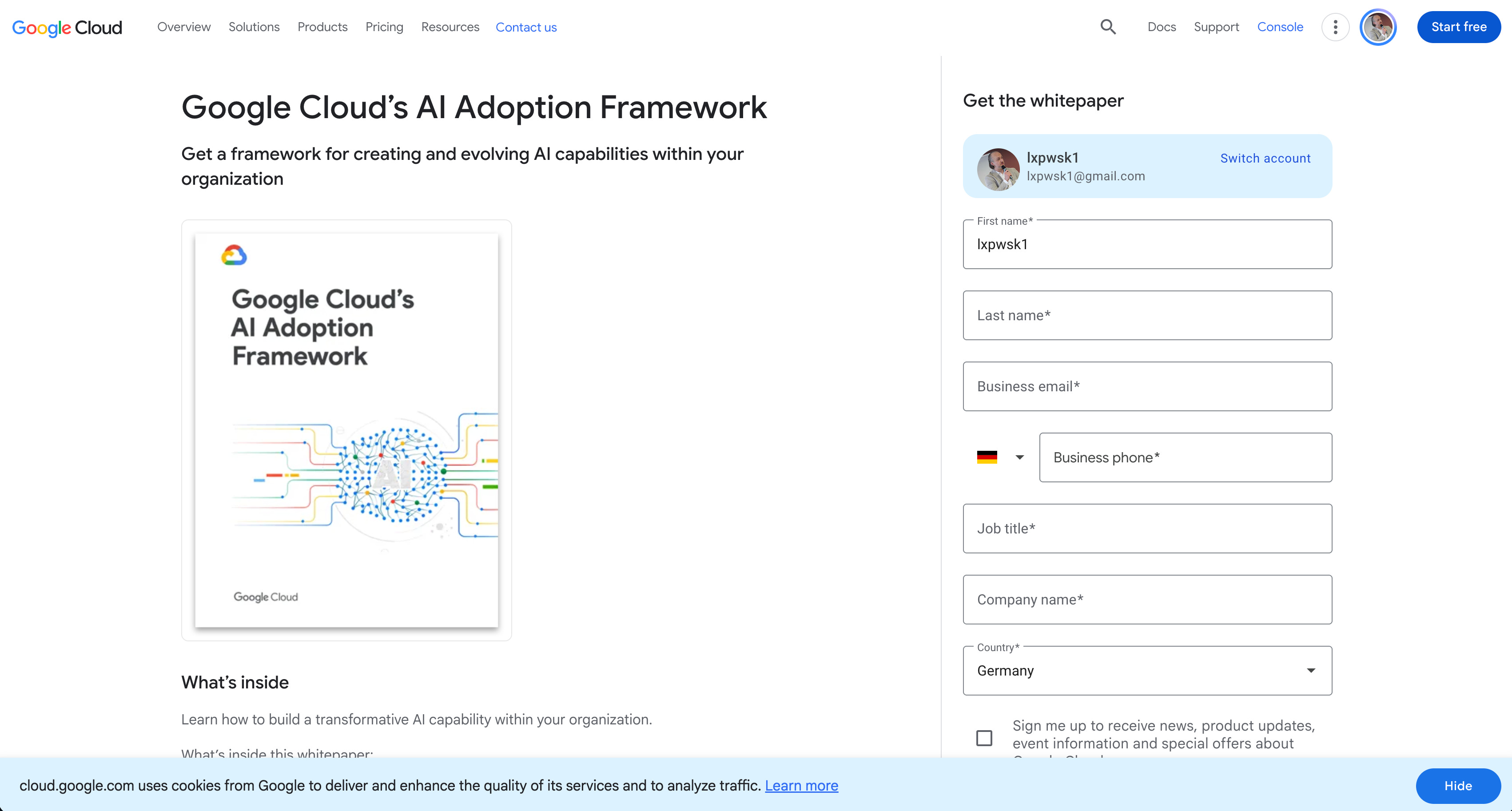
Google Cloud’s framework helps organizations evaluate their current AI capabilities and identify what must change to support more effective adoption. It offers a structured way to think about the relationship between technology, organizational capabilities, and maturity.
Best for: Leaders assessing enterprise-wide AI readiness and transformation priorities.
What to take away: A shared vocabulary for discussing present capabilities, desired future capabilities, and the gaps between them.
Practical application: Ask business, IT, data, and risk leaders to assess the organization independently, then compare disagreements. Those disagreements may reveal more than a single aggregated maturity score.
Access: Public resource page; download conditions may vary.
04. Stanford: Enterprise AI Playbook
Provider: Stanford Digital Economy Lab
Resource: Enterprise AI Playbook
Stanford’s enterprise AI research examines lessons from real AI developments, offering a useful complement to vendor-led implementation guidance.
Its value is not in presenting a universal deployment recipe, but in helping leaders examine the organizational conditions under which AI initiatives succeed.
Best for: Strategy executives, innovation leaders, researchers, and transformation sponsors.
What to take away: Evidence-informed questions about the relationship between AI systems, organizational design, human participation, and execution.
Practical application: Review the assumptions behind your organization’s three most important AI investments. Which assumptions are supported by observed operational evidence, and which are still hypotheses?
Access: Public research publication.
05. Microsoft: AI Use-Case Prioritization
Provider: Microsoft Learn
Resource: AI Adoption Planning and Use-Case Prioritization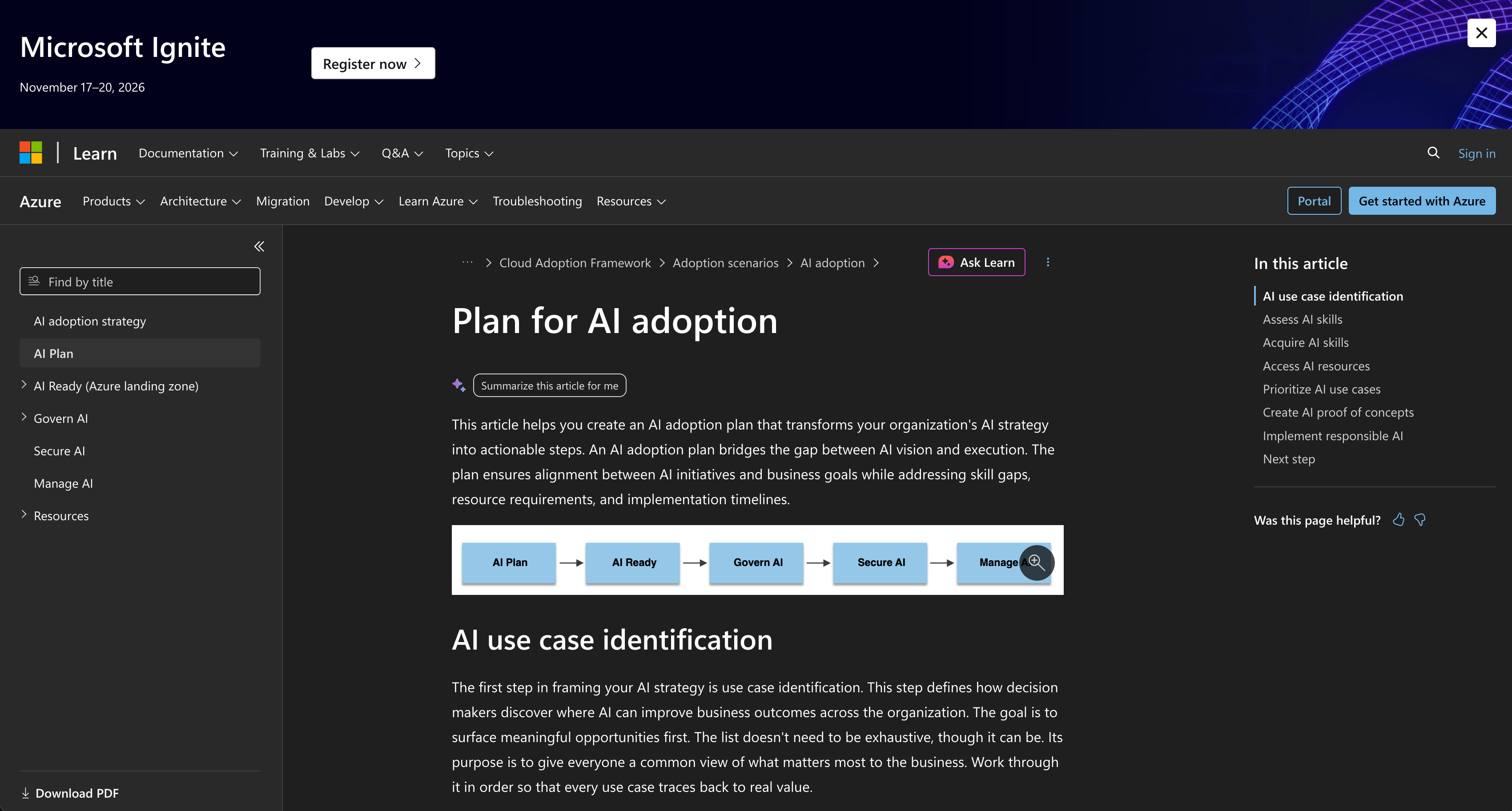
This part of Microsoft’s adoption guidance is especially useful as a decision tool: it emphasizes business outcomes, implementation feasibility, available capabilities, and sensible sequencing.
It is included separately because portfolio prioritization is a distinct leadership responsibility from defining an overarching AI strategy.
Best for: Investment committees, transformation offices, and enterprise AI portfolio managers.
What to take away: A repeatable approach for comparing competing opportunities rather than prioritizing whichever proposal has the most enthusiastic sponsor.
Practical application: Score proposed initiatives by value, feasibility, time to evidence, operational adoption, and risk. Require every initiative to identify an accountable process owner before funding development.
Access: Free documentation.
Section 01 implementation checkpoint
Before moving forward, your organization should be able to answer:
-
Which three business outcomes justify the AI program?
-
What would improve if AI were successful?
-
What alternatives to AI have been considered?
-
Who owns each business outcome?
-
What evidence would justify continuing, changing, or stopping an initiative?
Expected deliverable: An AI opportunity portfolio with explicit investment hypotheses and initial priorities.
Read next
Enterprise AI succeeds when strategic ambition translates into operational capabilities, accountable decisions, and measurable business outcomes. Yet organizations often struggle to connect AI strategy, organizational readiness, governance, deployment, and value realization into a coherent implementation system. The challenge is not finding another framework, but knowing which resources to use, how they fit together, and how to turn their guidance into repeatable organizational practices.
These collections are free to read:
-
The AI Workflow Library: 30 Real-World Examples for Business Teams — Thirty practical AI workflows across research, sales, marketing, operations, and business processes, illustrating how organizations can move from isolated AI experiments to repeatable, human-supervised execution.
-
The AI Research Stack: 30 Free Tools for Finding Better Answers — Research tools for investigating markets, evaluating emerging technologies, validating assumptions, analyzing competitors, and building stronger evidence for strategic decisions.
-
The AI Prompt Library for Work: 50 Templates That Solve Real Problems — Fifty reusable prompts for strategic analysis, business research, decision-making, workflow design, professional communication, and AI-assisted knowledge work.
-
The AI Learning Stack: 32 Resources Worth Bookmarking in 2026 — Curated learning resources for developing AI literacy, technical understanding, implementation skills, and the organizational capabilities required to adopt AI responsibly.
Build your enterprise AI implementation system
-
Operator Vault — 120+ PDFs, practical frameworks, implementation kits, and reusable templates for AI strategy, organizational transformation, operating-model design, governance, workflow automation, and strategic execution.
-
Stack Atlas — Explore how enterprise AI strategies, organizational capabilities, decision rights, automation architectures, governance mechanisms, and operating models connect across The Strategy Stack.
Essays and curated resource collections remain free. Operator provides deeper implementation materials for translating strategic ideas into organizational capabilities, including AI opportunity assessments, prioritization frameworks, decision-rights matrices, operating-model templates, deployment trackers, and performance review systems.
The complete Enterprise AI Playbook Library brings together 30 publicly accessible guides, frameworks, and implementation resources across six domains: AI strategy and prioritization, organizational readiness, governance and risk, operating-model transformation, deployment and scaling, and value realization. Subscribe free to The Strategy Stack to access the remaining 25 resources, five original enterprise AI implementation frameworks, and five practical exercises for translating external guidance into operational decisions. You’ll also find a worked enterprise AI implementation example, a six-document operating system for managing AI initiatives, and a 90-day roadmap for moving from strategic ambition to a tested, governed, and measurable AI capability.
Section 02 — AI Readiness & Organizational Capabilities
Understand the conditions required to implement and sustain AI capabilities.
Readiness is often treated as a technical assessment.
Does the company have sufficient data? Does it possess the necessary cloud infrastructure? Can its security team approve the proposed tools?
Those questions matter, but they are incomplete.
Organizations also need process ownership, skilled operators, appropriate incentives, decision rights, clear knowledge sources, and the ability to redesign work.
A technically successful AI system can still fail organizationally if nobody changes how the work is performed.
06. Microsoft: Assess AI Skills and Readiness
Provider: Microsoft Learn
Resource: Assess AI Skills and Capabilities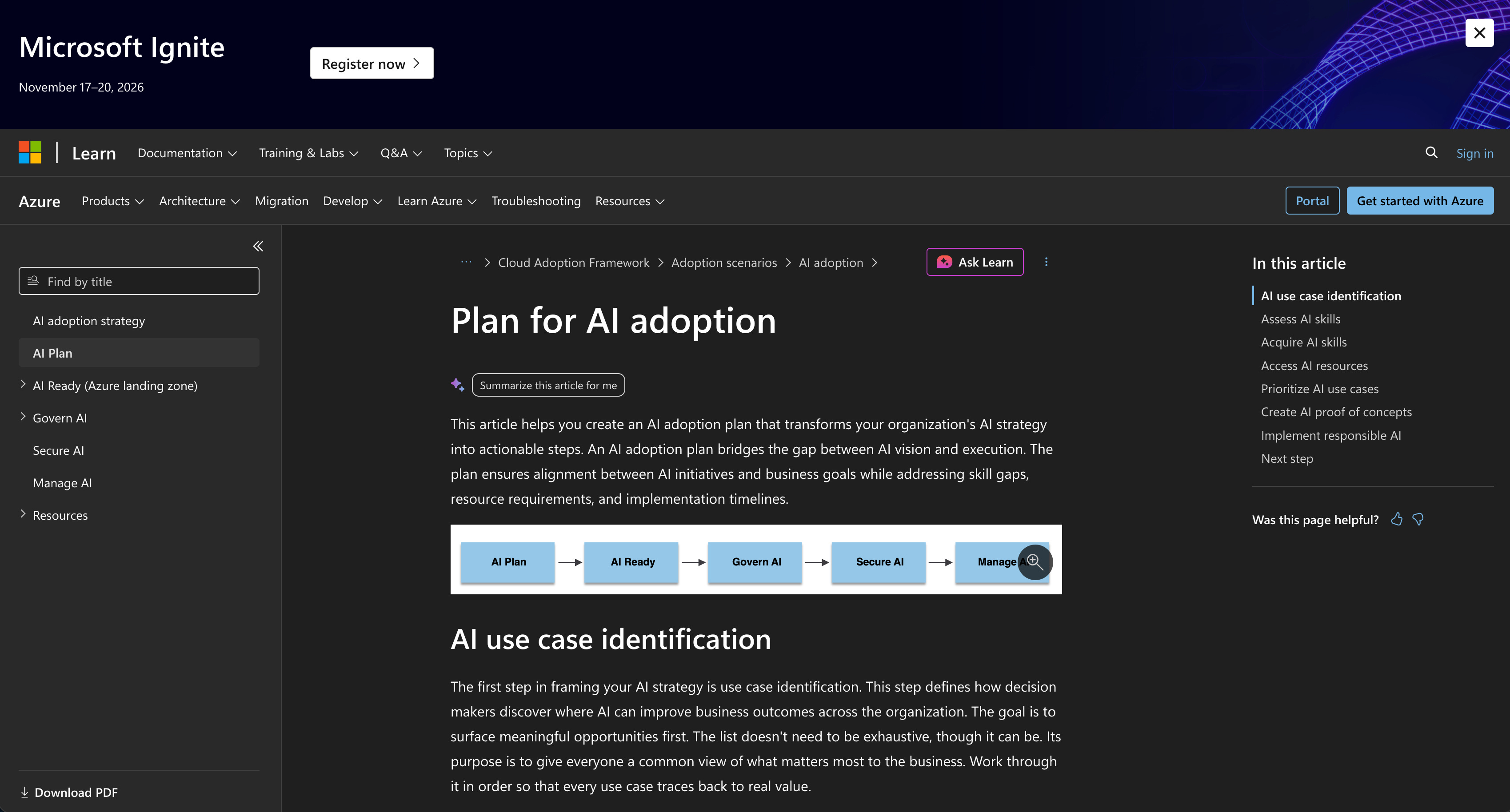
Microsoft’s adoption planning guide includes a maturity-oriented approach to evaluating skills, data readiness, infrastructure, and the technical complexity of proposed use cases.
Best for: AI program leaders, HR capability teams, and technology decision-makers.
What to take away: A practical view of which initiatives are realistic given existing capabilities.
Practical application: Evaluate each priority use case against current personnel, data, infrastructure, and operational support rather than assigning one maturity label to the whole enterprise.
Access: Free documentation.
07. Google Cloud: AI Capability Development
Provider: Google Cloud
Resource: Cloud AI Adoption Framework Whitepaper
The framework provides a broader organizational view of building and evolving enterprise AI capabilities.
While resource 03 uses it for strategic positioning, this entry focuses on the implementation gaps identified during the readiness assessment.
Best for: Enterprise capability architects and transformation offices.
What to take away: An organized capability-building agenda rather than an isolated list of technology purchases.
Practical application: Separate the gaps into three groups: capabilities required immediately, capabilities that can be developed during a pilot, and capabilities only needed when broader scaling becomes justified.
Access: Public resource page.
08. Microsoft: Prepare an AI Environment
Provider: Microsoft Learn
Resource: AI Adoption — Cloud Adoption Framework
The Cloud Adoption Framework provides an entry point to readiness, security, governance, and infrastructure design for AI workloads.
It is particularly useful for organizations that need to assess the shared technical foundations on which multiple applications will depend.
Best for: Platform engineering teams, enterprise architects, and infrastructure leads.
What to take away: A checklist of the operating conditions required to support enterprise AI workloads.
Practical application: Identify shared requirements for identity, access control, networking, data management, monitoring, and business continuity before allowing separate departments to establish incompatible infrastructure patterns.
Access: Free documentation; using Azure services may incur costs.
09. Microsoft: Organizational Responsibilities and Operating Model
Provider: Microsoft Learn
Resource: Prepare Your Organization and Define Responsibilities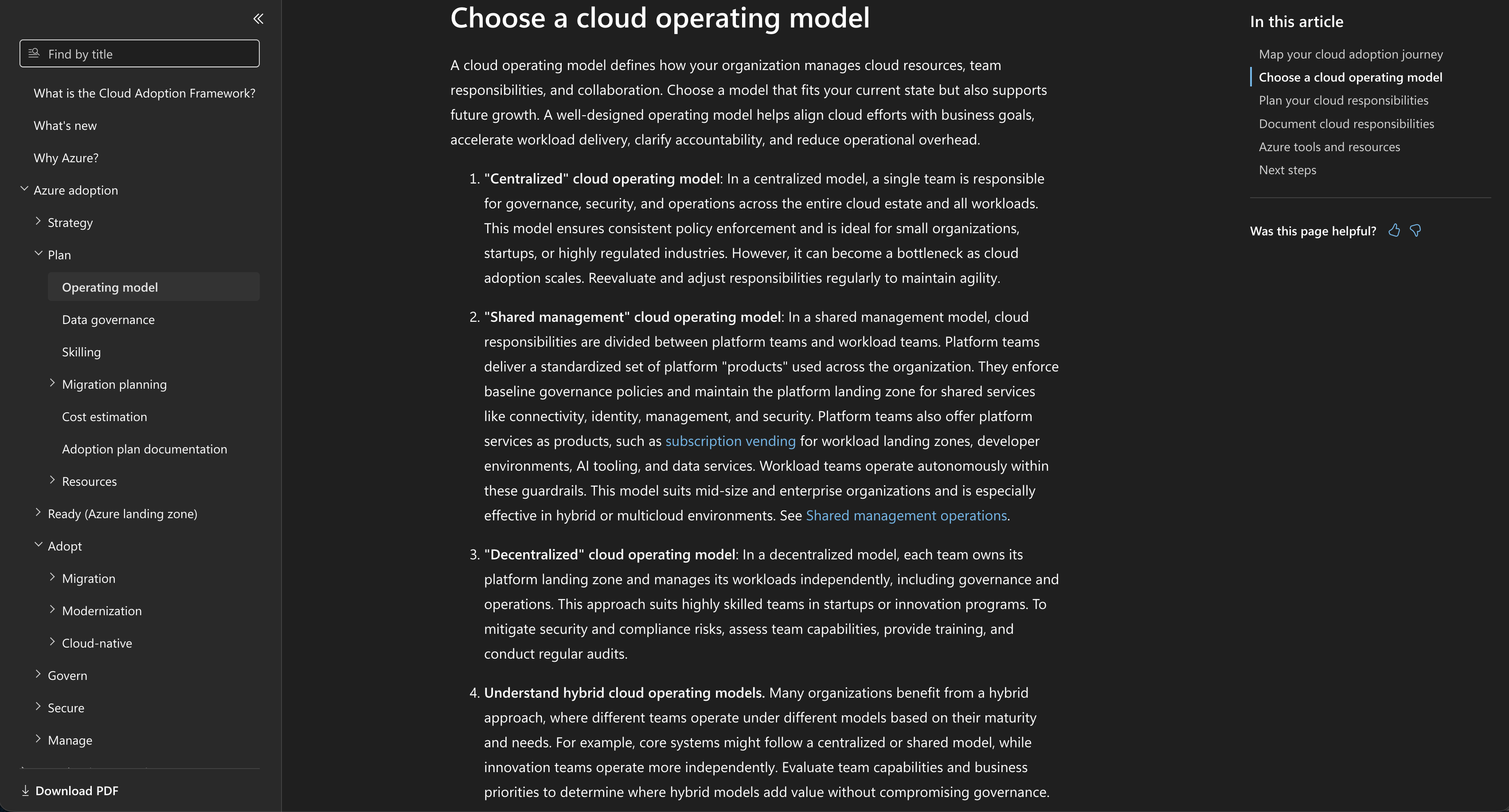
This guidance helps organizations document responsibilities and organize the relationship between central technology functions, governance teams, and workload owners.
Although developed in a cloud adoption context, its responsibility-mapping approach is useful for enterprise AI implementation.
Best for: CIO organizations, operating-model designers, and transformation leaders.
What to take away: Explicit ownership of implementation, security, operational support, and ongoing performance.
Practical application: Create a responsibility matrix for one AI workload. Assign named owners for business outcomes, data access, deployment, incident response, model changes, user support, and retirement.
Access: Free documentation.
10. Google: Responsible Generative AI Toolkit
Provider: Google AI for Developers
Resource: Responsible Generative AI Toolkit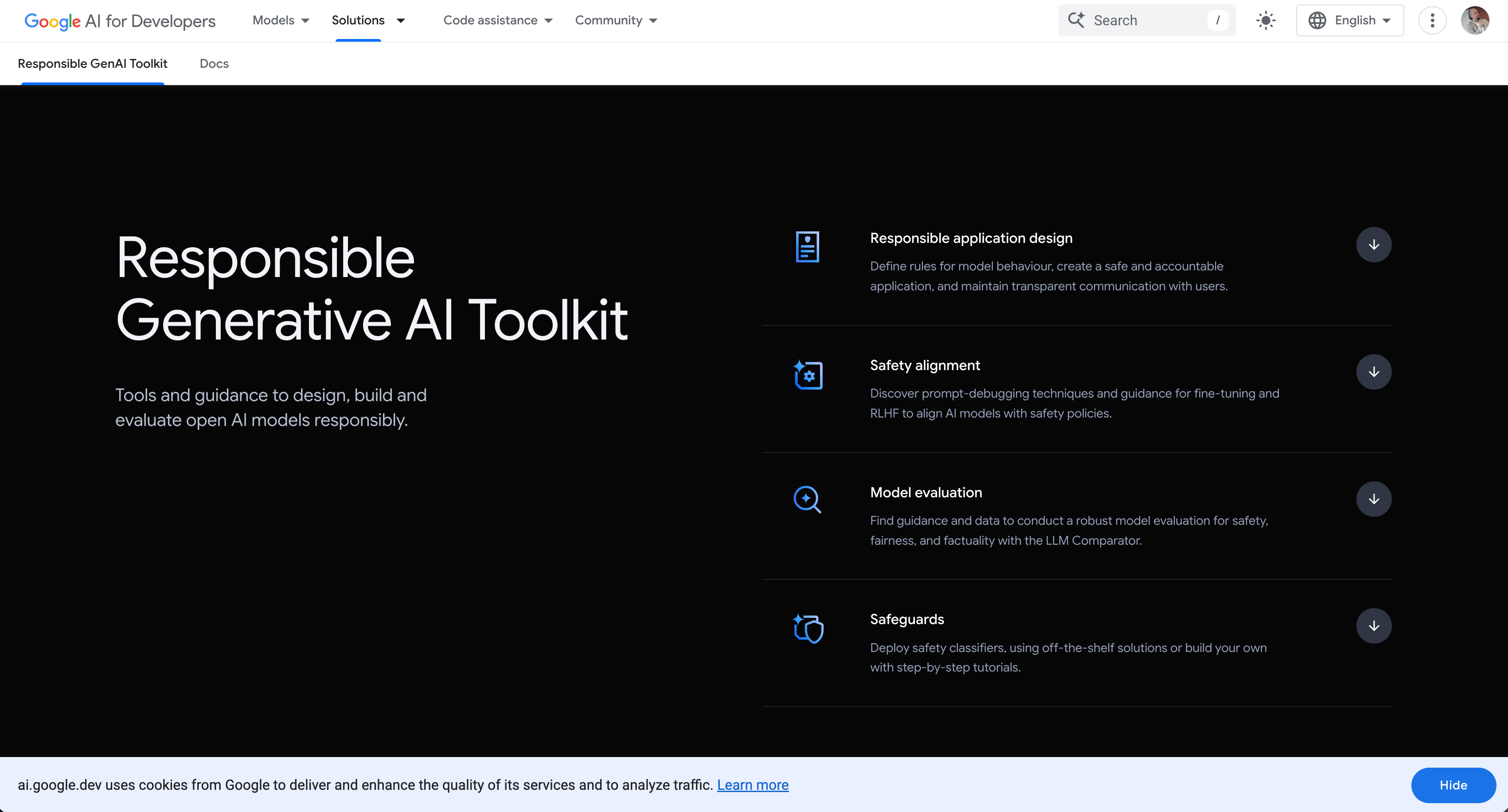
Google’s toolkit provides practical guidance for establishing model behavior expectations, evaluating outputs, and incorporating safety considerations into generative AI systems.
It is more technical than a general readiness assessment, but helpful for identifying the skills and processes that teams need before building custom AI applications.
Best for: AI engineering teams, product teams, and technical risk specialists.
What to take away: A clearer understanding of the capabilities required for responsible application development and evaluation.
Practical application: Ask the delivery team to demonstrate how it will define expected system behavior, test unacceptable outputs, and document unresolved limitations before approving a custom application build.
Access: Free educational resources and toolkit guidance; model execution and hosting costs may apply.
Section 02 implementation checkpoint
A readiness review should establish whether the organization can:
-
Access the required information lawfully and securely.
-
Identify accountable business and technical owners.
-
Operate the proposed workflow with available skills.
-
Evaluate outputs and recognize failure.
-
Support users, manage changes, and respond to incidents.
-
Absorb the cost and organizational disruption of adoption.
Expected deliverable: An AI readiness matrix, capability-gap register, and prioritized enablement plan.
Section 03 — AI Governance, Risk & Compliance
Turn responsible AI principles into enforceable operational decisions.
Governance becomes valuable when it changes what organizations are permitted to do, who can authorize an action, and what happens when a system behaves unexpectedly.
Policies that remain detached from development and deployment workflows provide little operational protection.
Enterprises need to connect governance to specific applications, data sources, decisions, human responsibilities, and technical controls.
11. NIST: AI Risk Management Framework Playbook
Provider: National Institute of Standards and Technology
Resource: NIST AI RMF Playbook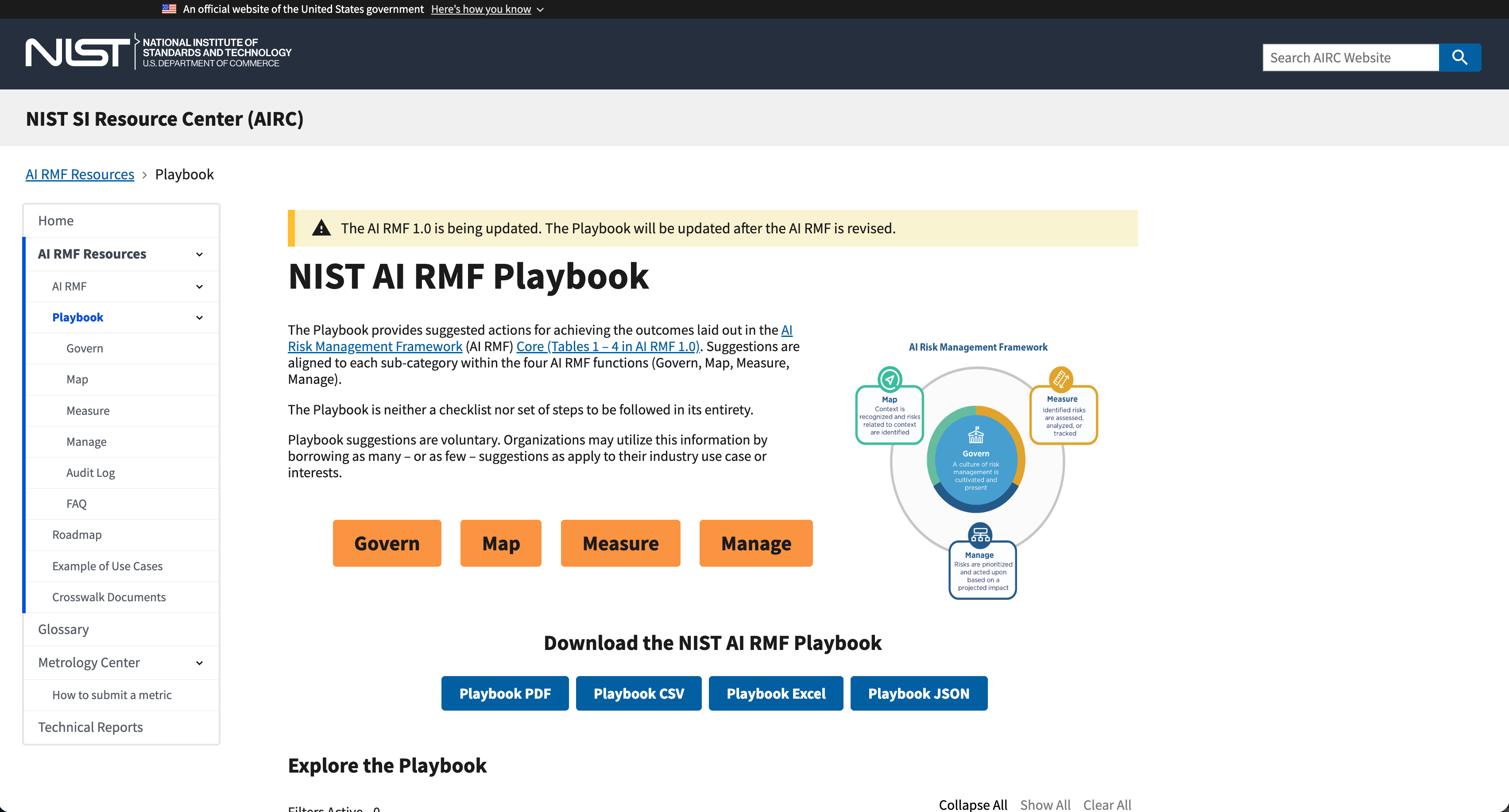
The NIST playbook translates the AI Risk Management Framework’s Govern, Map, Measure, and Manage functions into suggested actions.
It is useful because it provides multiple implementation paths instead of assuming that every organization must follow one rigid checklist.
Best for: Enterprise risk managers, AI governance teams, auditors, and program owners.
What to take away: A structured set of risk-management activities that can be adapted to individual applications.
Practical application: Select one AI use case and document its context, risks, measurement approaches, controls, and accountable decision-makers.
Access: Free web guidance and downloadable resources.
12. NIST: Generative AI Risk Profile
Provider: NIST
Resource: Generative AI Profile — NIST AI 600-1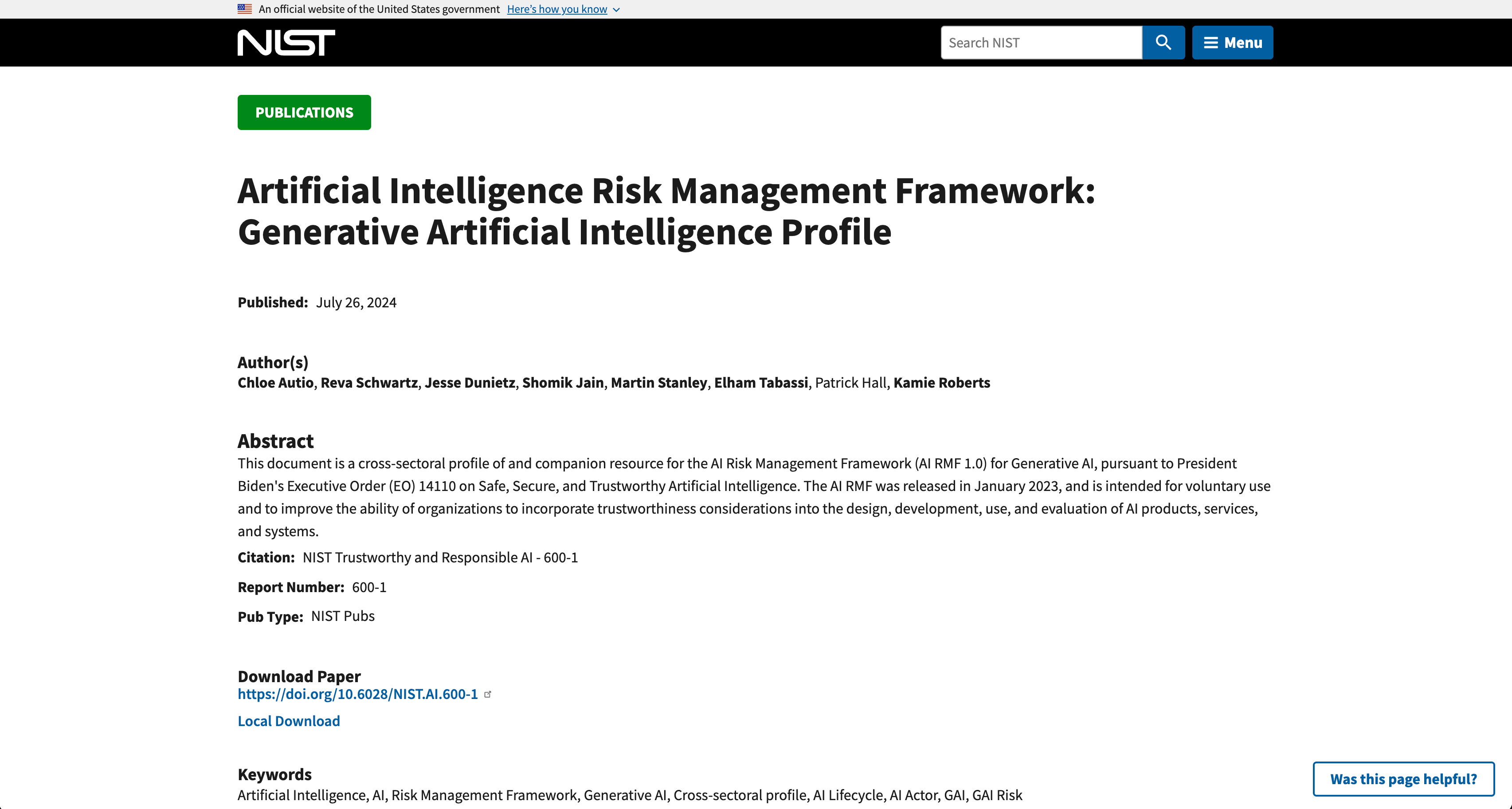
This cross-sectoral profile extends the NIST AI RMF to risks associated with generative AI systems.
It helps teams distinguish general technology risks from issues that arise when systems generate variable outputs, interact with users, or are embedded in business processes.
Best for: Responsible AI leads, risk specialists, architects, and security reviewers.
What to take away: A more specific risk vocabulary for generative AI initiatives.
Practical application: Identify the generative-AI-specific failure modes relevant to a proposed application. Document their possible consequences, detection methods, and mitigation owners.
Access: Free publication.
13. Microsoft: Govern AI
Provider: Microsoft Learn
Resource: Govern AI — Cloud Adoption Framework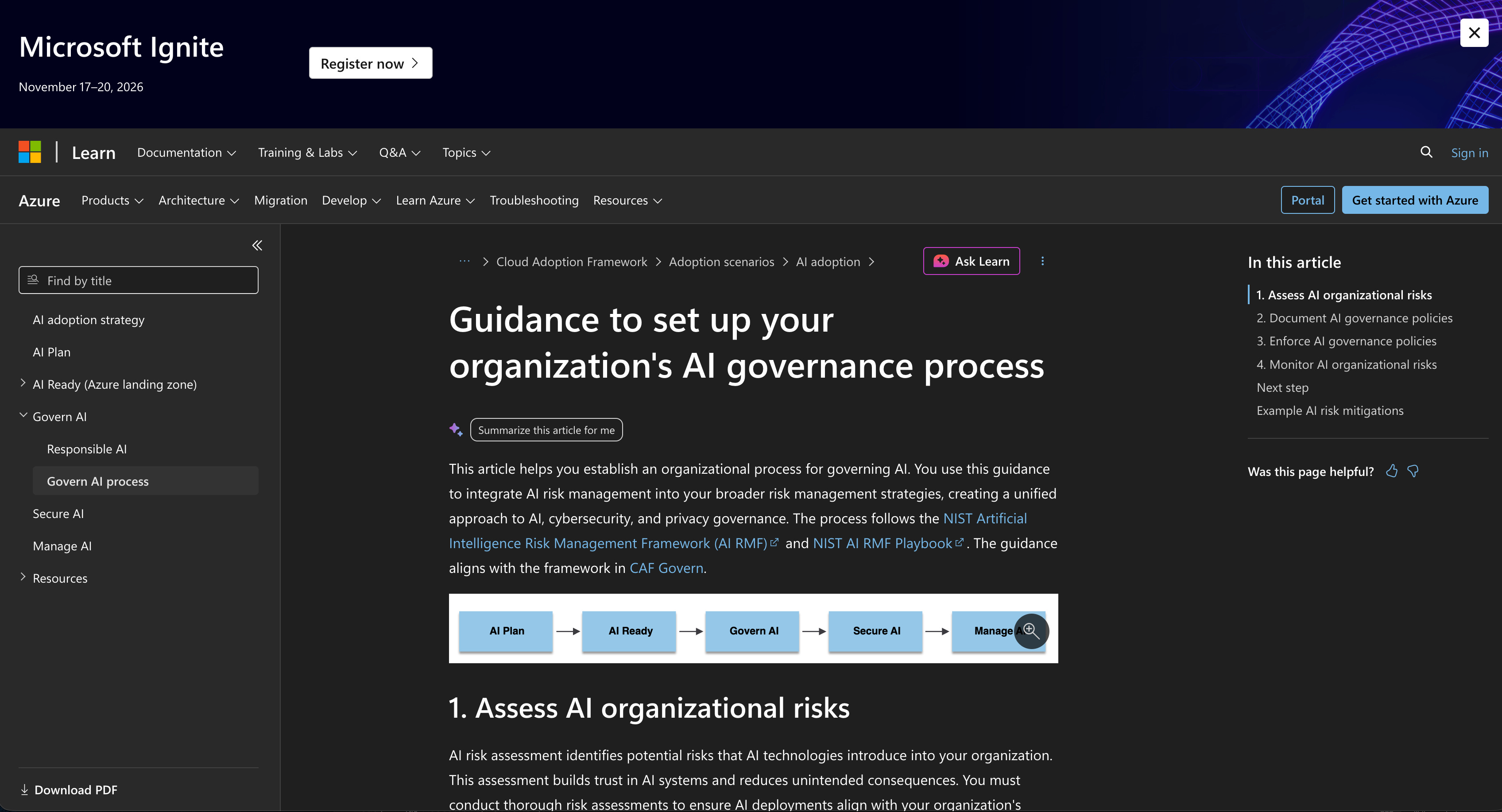
Microsoft’s governance guide focuses on establishing an organizational process that connects AI risk assessment, policies, enforcement, and monitoring.
It is particularly useful for organizations seeking to integrate AI oversight with existing enterprise risk, cybersecurity, and privacy functions.
Best for: Governance offices, security leaders, compliance teams, and enterprise architects.
What to take away: A model for operationalizing AI policies through repeatable processes and controls.
Practical application: Turn five high-priority AI risks into testable policy requirements. For each requirement, specify how compliance is checked, who reviews exceptions, and what evidence must be retained.
Access: Free documentation.
14. OWASP: Top 10 for LLM Applications 2026
Provider: OWASP GenAI Security Project
Resource: OWASP GenAI LLM Top 10 — 2026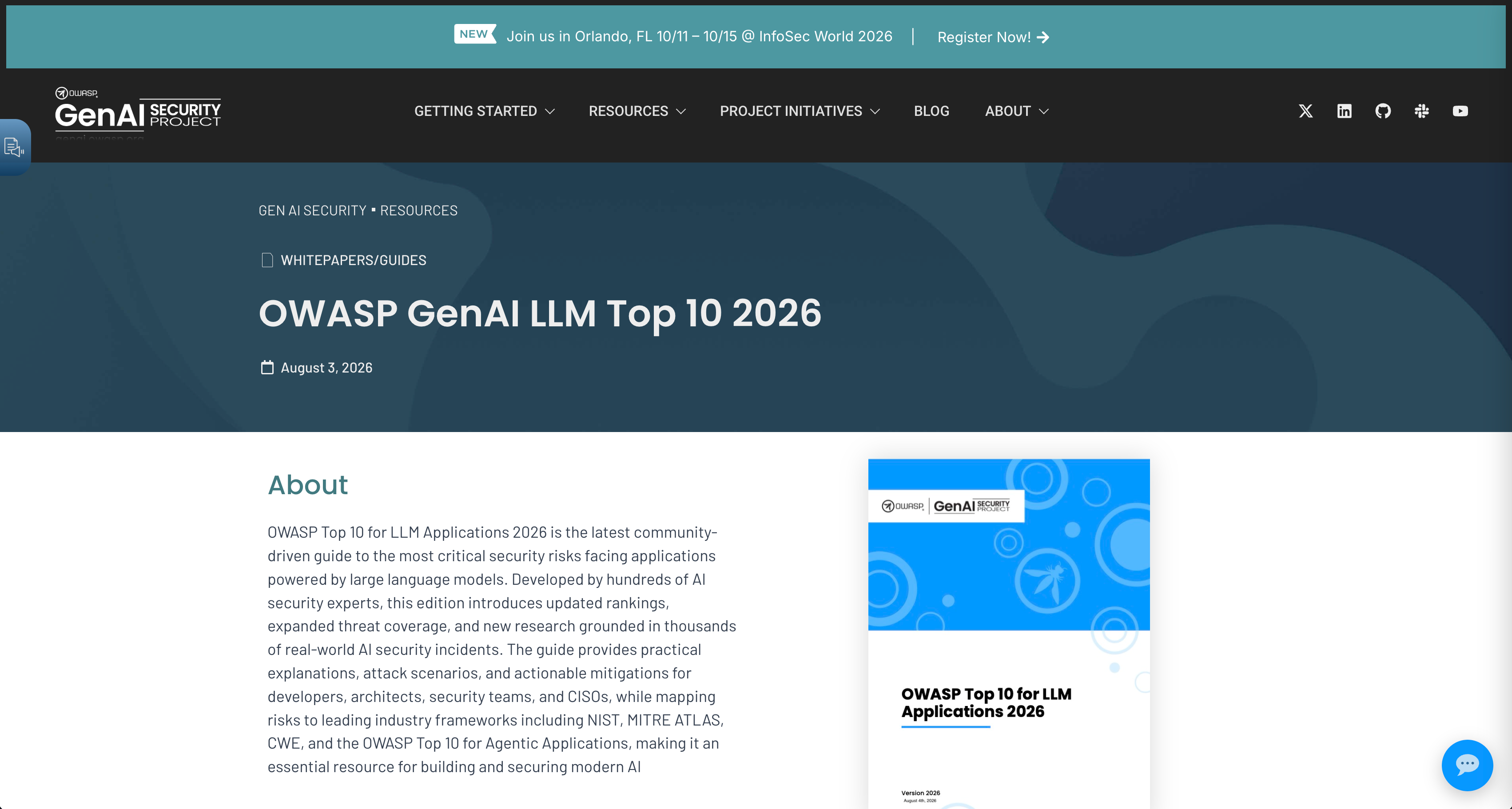
OWASP provides security guidance for applications built with large language models.
The 2026 edition is a useful reference for identifying and mitigating application-level vulnerabilities that conventional software security reviews may not fully address.
Best for: Application security teams, AI engineers, security architects, and technical risk managers.
What to take away: A security-focused review framework for LLM-enabled enterprise applications.
Practical application: Before launch, assess the application against relevant threats, document the implemented safeguards, and record the residual risks requiring acceptance or further mitigation.
Access: Free community guidance.
15. OWASP: Top 10 for Agentic Applications 2026
Provider: OWASP GenAI Security Project
Resource: OWASP Top 10 for Agentic Applications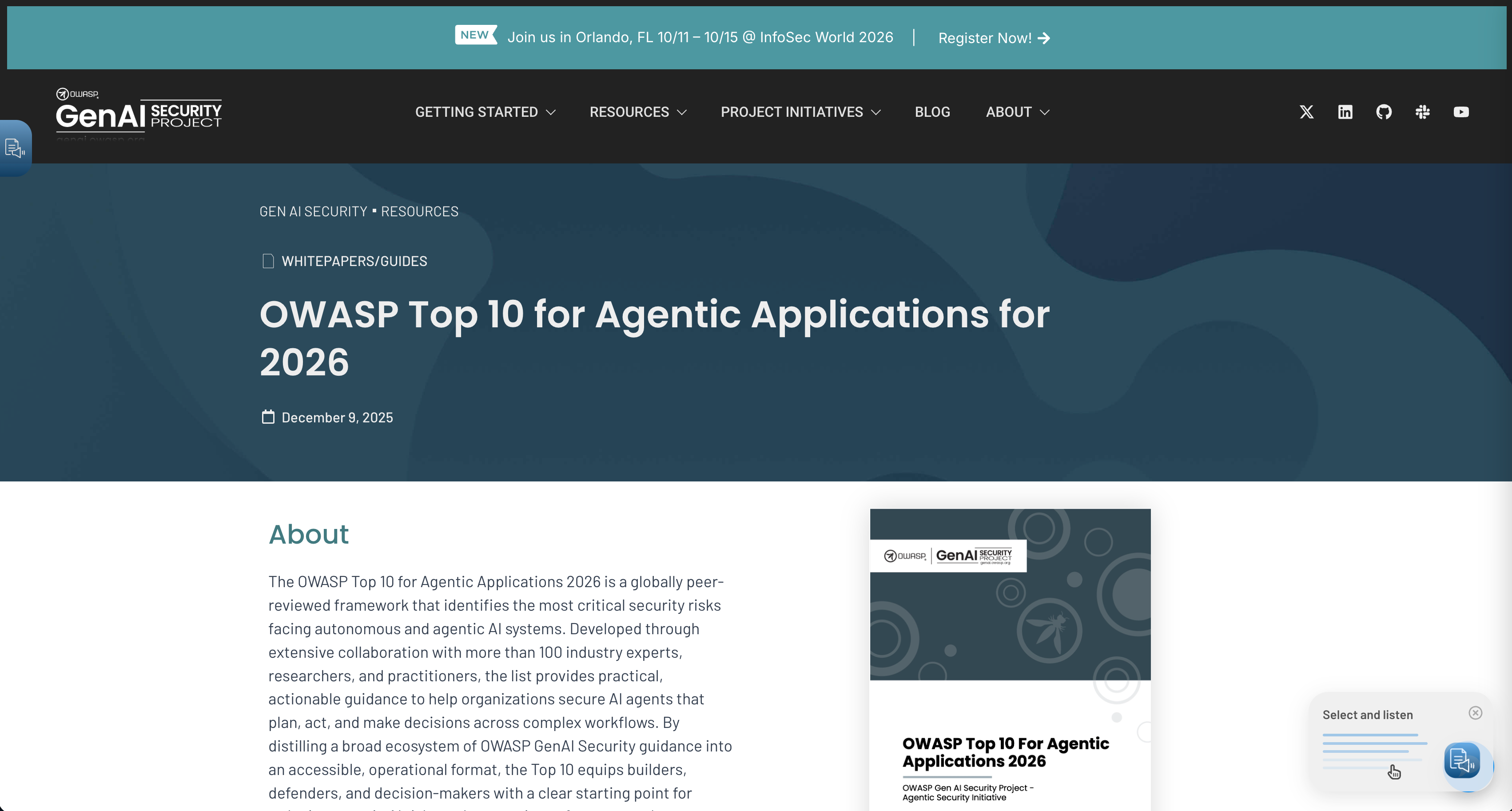
Agentic systems introduce security challenges because they may use tools, access data, and initiate actions beyond generating text.
The OWASP agentic application guidance helps organizations examine risks associated with delegated authority, tool misuse, agent communication, and cascading failures.
Best for: Teams developing autonomous or semi-autonomous workflows.
What to take away: A practical foundation for agent-specific threat modeling.
Practical application: For every agent, document its permitted actions, connected systems, credentials, approval requirements, and emergency shutdown process.
Access: Free community guidance.
Section 03 implementation checkpoint
Every AI workload should have an identifiable owner and documented answers to four questions:
-
What can the system access?
-
What can it produce, recommend, decide, or execute?
-
Which activities require human authorization?
-
How can the organization detect, investigate, and stop harmful or unintended behavior?
Expected deliverable: An AI system inventory, risk register, policy controls, and documented approval requirements.
Section 04 — AI Operating Models & Organizational Transformation
Define how people, processes, decision rights, and AI capabilities work together.
Enterprise AI changes more than the technology used to complete a task.
When appropriately implemented, it may alter the distribution of work between employees and software, the speed of decisions, the skills required in particular roles, and the information available to managers.
That requires operating-model decisions.
Who is responsible when AI produces an inaccurate recommendation? Who can approve a new autonomous workflow? Who owns the adoption process after the project team moves on? What happens when an employee needs to override the system?
These are organizational design questions, not model-selection questions.
16. World Economic Forum: AI Agents in Action
Provider: World Economic Forum and Capgemini
Resource: AI Agents in Action: A Playbook for Trusted Adoption, Authorization and Scaling
This 2026 playbook addresses the organizational and technical challenge of authorizing AI agents.
It introduces a structured approach to defining delegation and control for agentic systems, with attention to auditability, oversight, and scaling.
Best for: Enterprise AI leaders, agent platform owners, governance teams, and operating-model designers.
What to take away: A way to treat AI agent authority as an explicit organizational decision.
Practical application: Define an authorization profile for one agent: its permitted functions, prohibited actions, operating boundaries, supervision requirements, and escalation procedures.
Access: Public report page and downloadable material.
17. Microsoft: AI Agent Adoption Framework
Provider: Microsoft Learn
Resource: AI Agent Adoption Guidance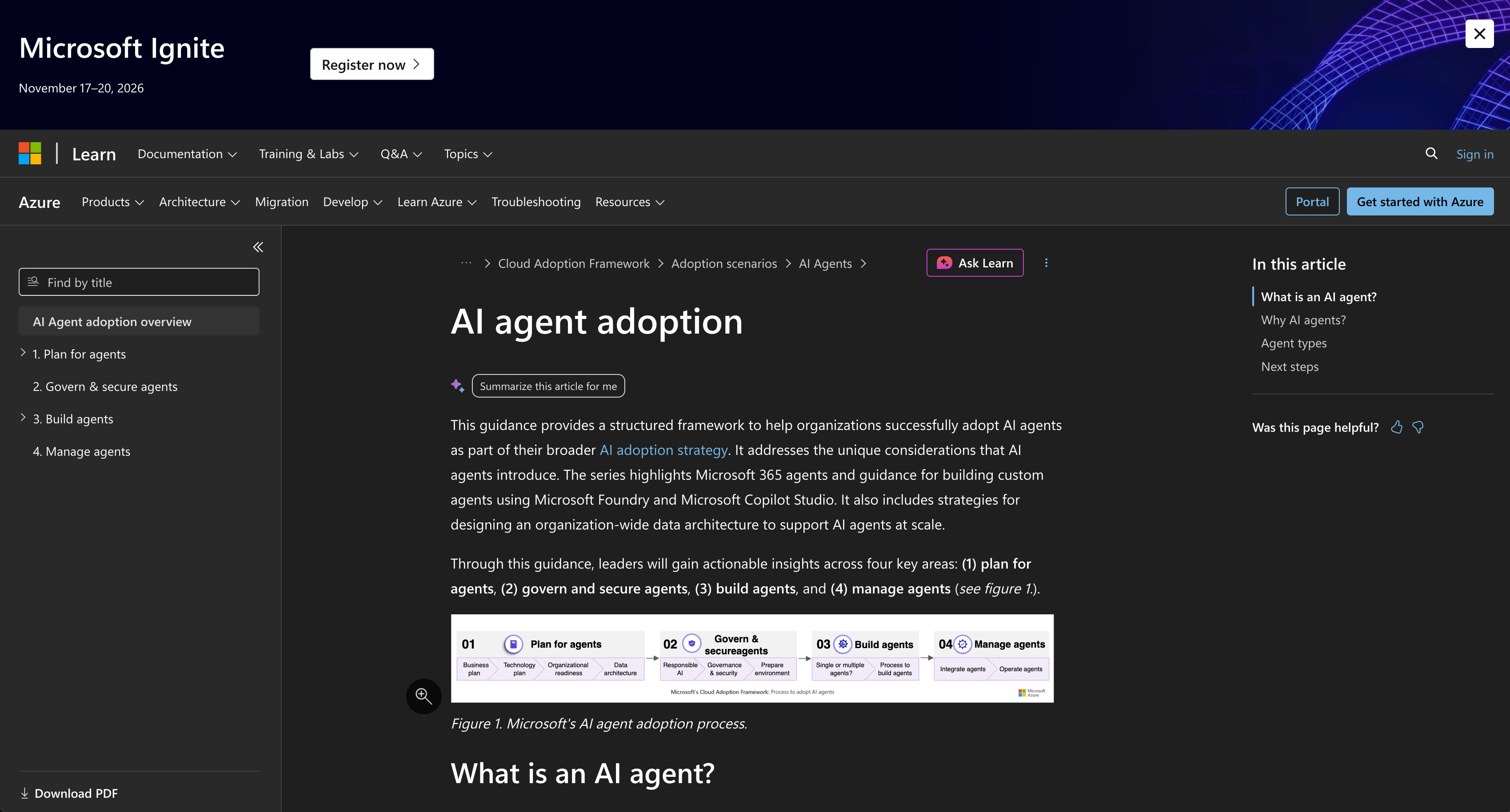
Microsoft’s agent adoption guidance organizes decisions around planning, governing, building, and managing AI agents.
It connects technical implementation with the organizational foundations required to manage agentic workloads across an enterprise.
Best for: Organizations moving from AI assistants to integrated AI agents.
What to take away: A structured view of the additional operating-model requirements introduced by agent-based systems.
Practical application: Compare an employee-facing assistant with a workflow agent that can update business systems. Document the additional responsibilities and approvals required for the second system.
Access: Free documentation.
18. Microsoft: Govern and Secure AI Agents Across the Organization
Provider: Microsoft Learn
Resource: Governance and Security for Enterprise AI Agents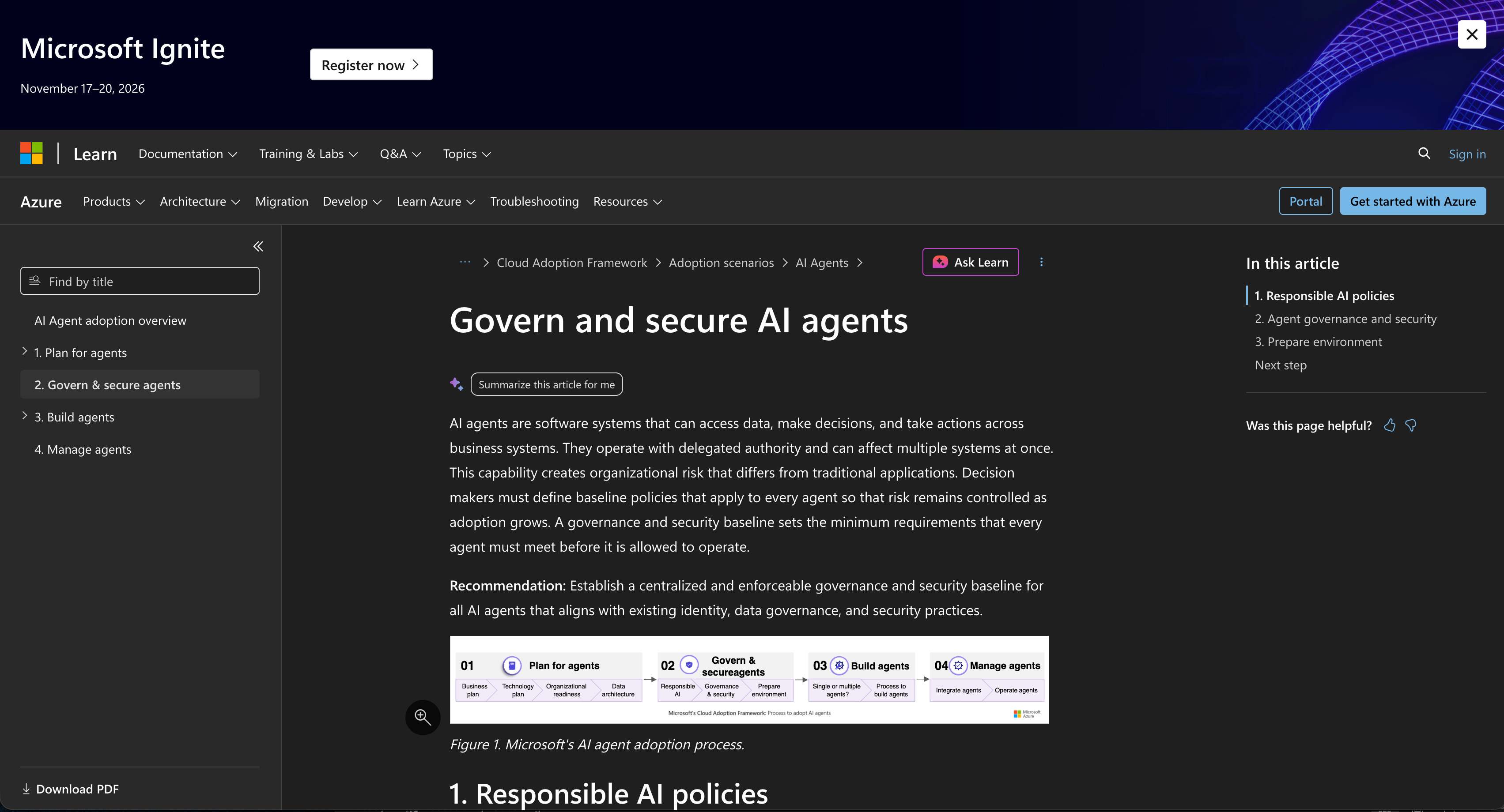
This guidance addresses the need for consistent policy and security baselines across agent deployments.
It is useful when AI applications are developed by multiple business units and the organization must establish shared minimum controls.
Best for: Enterprise architects, chief information security officers, and AI platform teams.
What to take away: A model for separating centralized enterprise standards from application-specific responsibilities.
Practical application: Write a common baseline specifying identity, permissions, logging, data access, allowed integrations, and human escalation requirements for every agent.
Access: Free documentation.
19. Microsoft: Define Organizational Responsibilities
Provider: Microsoft Learn
Resource: Define Your Cloud Operating Model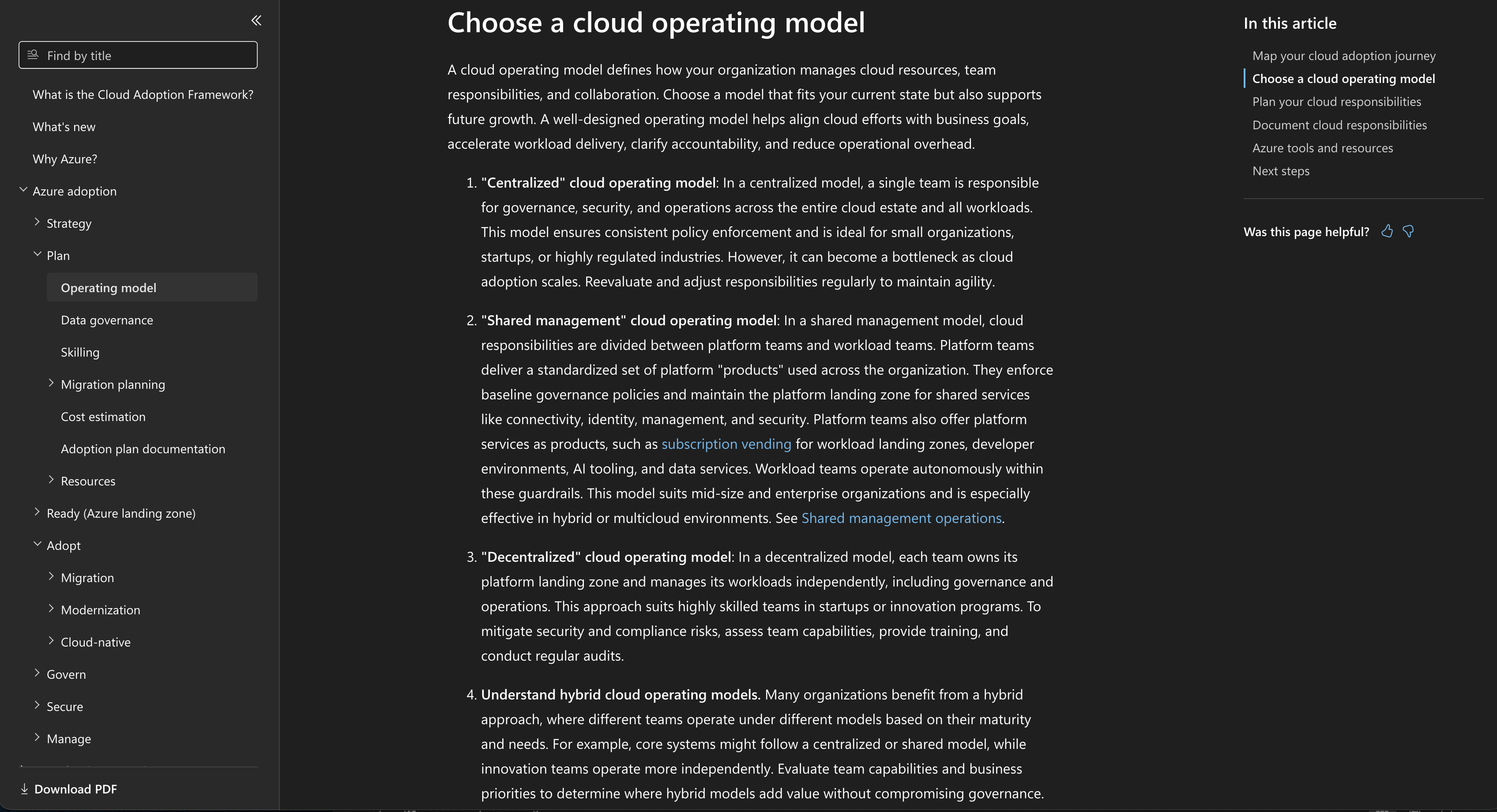
Although this guide is not exclusively about AI, its operating-model principles apply directly to enterprise AI programs.
It helps organizations clarify how centralized expertise and decentralized delivery responsibilities should interact.
Best for: Transformation leaders, enterprise architects, and operational governance teams.
What to take away: A structured approach to defining central and local ownership.
Practical application: Establish which activities belong to a central AI enablement team and which remain with business-unit process owners.
Access: Free documentation.
20. Microsoft: Operational Responsibility Framework
Provider: Microsoft Learn
Resource: Cloud Management Responsibilities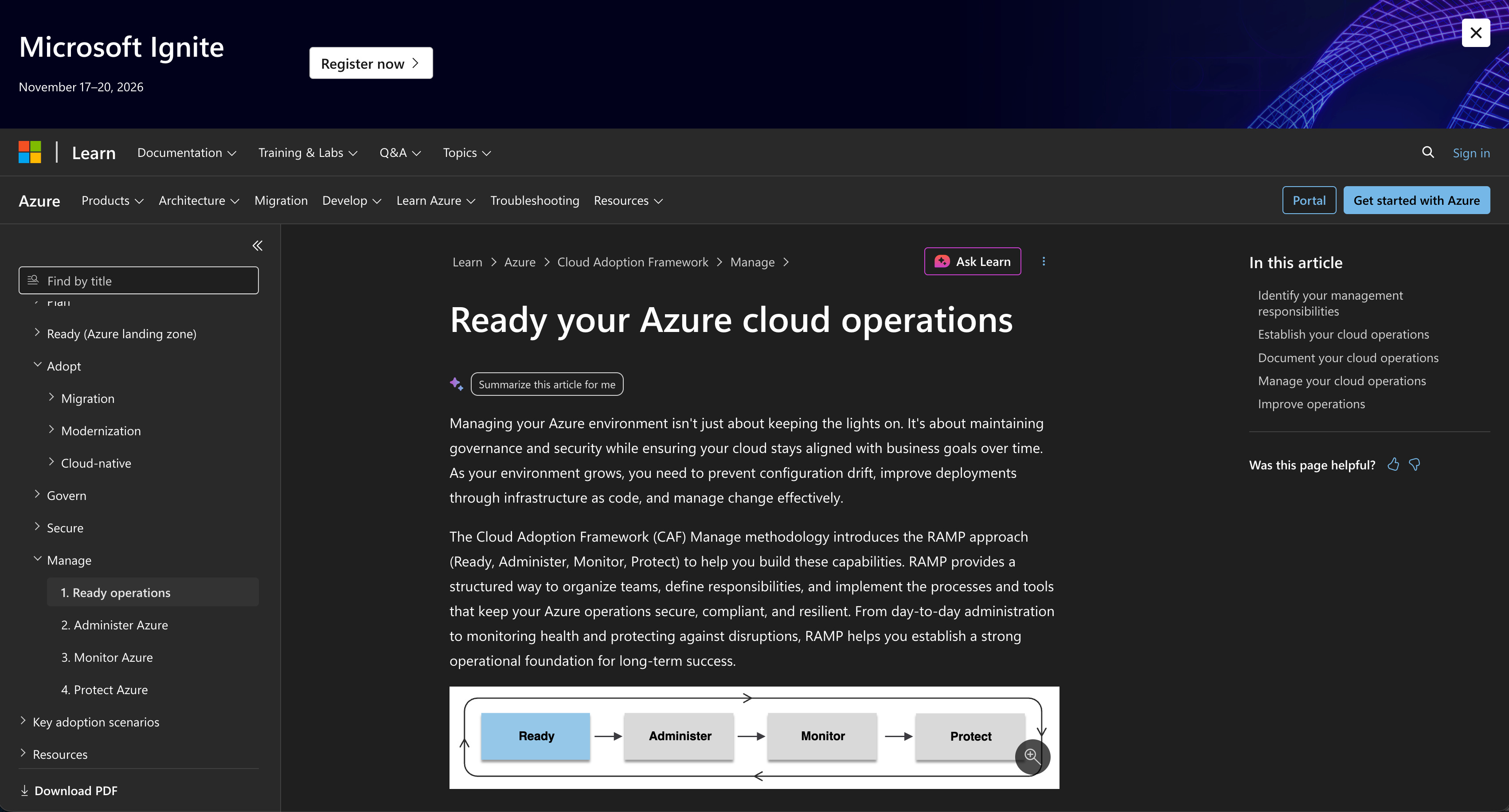
This guidance describes central and workload-level operational responsibilities across areas such as security, compliance, and ongoing management.
It provides a useful starting point for translating AI implementation projects into enduring operational ownership.
Best for: AI operations teams, IT service owners, and enterprise program offices.
What to take away: A method for preventing the ownership gap that often appears between project completion and routine operations.
Practical application: Create a service ownership document covering support, monitoring, updates, incidents, access permissions, performance review, and retirement.
Access: Free documentation.
Section 04 implementation checkpoint
Before scaling an AI capability, determine:
-
Who owns the business result?
-
Who owns the data and technical environment?
-
Who approves changes to model behavior or system permissions?
-
Who supervises consequential actions?
-
Who responds when the system fails?
-
Who determines whether the capability should continue operating?
Expected deliverable: An AI operating model, responsibility matrix, and agent authorization policy.
Section 05 — AI Deployment, Security & Scaling
Move from experiments to dependable production capabilities.
A proof of concept establishes that an idea may be feasible.
It does not demonstrate that the organization can deploy, secure, monitor, maintain, or economically operate the system.
Production readiness requires evidence across multiple dimensions: functionality, reliability, security, data protection, user adoption, operational support, and cost.
Scaling adds another challenge. A system that works for 20 employees may behave differently when used across multiple departments, languages, geographies, or interconnected applications.
21. Microsoft: AI Adoption Technical Guidance
Provider: Microsoft Learn
Resource: Cloud Adoption Framework — AI Adoption
Microsoft’s framework links AI adoption to the wider infrastructure and governance processes needed to operate enterprise workloads.
It is useful as a navigation point for readiness, architecture, security, and operational management decisions.
Best for: Enterprise platform teams and AI solution architects.
What to take away: A deployment planning structure that covers more than the AI model itself.
Practical application: Create a production-readiness checklist covering identity, networking, data flows, secrets, logging, backup, continuity, user access, and support.
Access: Free documentation.
22. Microsoft: Secure AI and Agent Deployments
Provider: Microsoft Learn
Resource: Govern and Secure AI Agents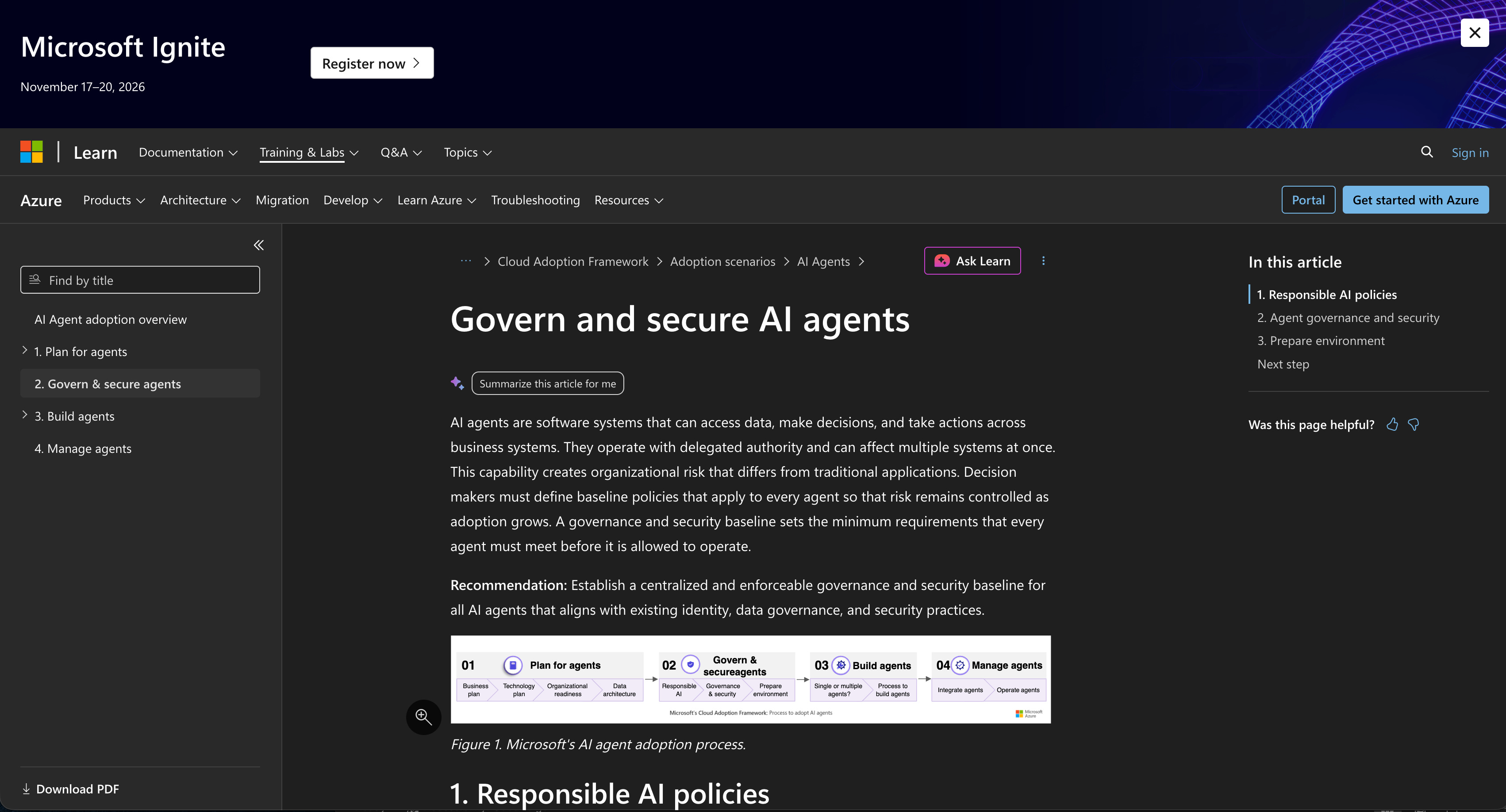
The technical security considerations in this guide help organizations think systematically about controls around agent environments, permissions, connectors, and organizational policies.
Best for: Security engineers and teams deploying connected AI applications.
What to take away: A baseline for securing the applications and integrations surrounding an AI model.
Practical application: Review the full data and action path of one proposed agent. Confirm that every connector has a documented purpose, appropriately scoped permissions, and an identified owner.
Access: Free documentation.
23. OWASP: Agentic Security Initiative
Provider: OWASP
Resource: Agentic Security Initiative
The initiative brings together community resources addressing agent-specific risks and controls.
It is useful for teams that need to evaluate security questions beyond those typically covered by a conventional LLM application checklist.
Best for: AI security architects, red teams, and agent platform engineers.
What to take away: An evolving collection of threat and control references for agentic systems.
Practical application: Conduct a structured threat-modeling workshop that tests unauthorized actions, privilege escalation, unsafe tool use, compromised instructions, and failure propagation.
Access: Public community resources.
24. Google: Responsible Generative AI Application Evaluation
Provider: Google AI for Developers
Resource: Responsible Generative AI Toolkit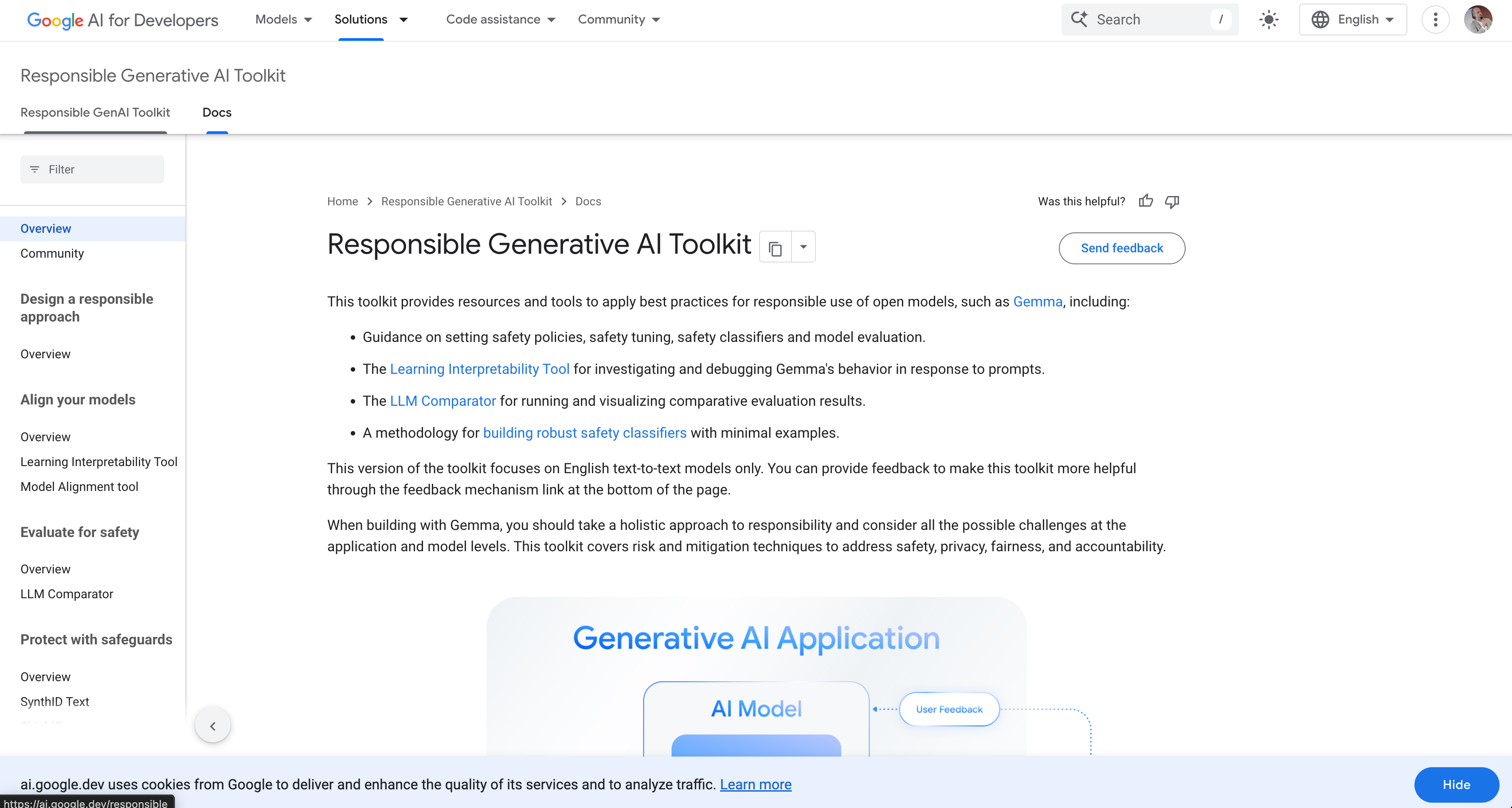
This toolkit includes methods for evaluating model outputs and strengthening responsible application behavior.
It is particularly helpful for technical teams that need more systematic tests than informal prompt demonstrations.
Best for: AI application developers, evaluation engineers, and quality-assurance teams.
What to take away: A structured approach to turning desired behavior and safety expectations into repeatable evaluation exercises.
Practical application: Create a representative evaluation dataset containing routine requests, edge cases, adversarial inputs, and situations where the system must decline or escalate.
Access: Free documentation and tooling guidance.
25. OWASP: LLM Application Security Reference
Provider: OWASP
Resource: LLM Top 10 — 2026
The OWASP LLM Top 10 can also function as a deployment assurance reference.
Its value at this stage is to translate identified risks into documented testing, remediation, and acceptance decisions.
Best for: Delivery teams preparing a generative AI application for production.
What to take away: A security release checklist grounded in recognized categories of LLM application risk.
Practical application: Before production approval, document each applicable security category, the implemented control, test result, residual risk, and accepting authority.
Access: Free guidance.
Section 05 implementation checkpoint
Do not approve a production release solely because the AI produces convincing demonstrations.
Ask for evidence that:
-
Core workflows operate correctly across representative cases.
-
Users understand limitations and escalation paths.
-
Security and privacy requirements have been tested.
-
Relevant failures can be detected and investigated.
-
Costs and operational dependencies are observable.
-
The capability can be disabled, rolled back, or retired safely.
Expected deliverable: A tested deployment architecture, evaluation report, release decision, and operating runbook.
Section 06 — AI Value Realization & Continuous Improvement
Measure business outcomes, not merely AI usage.
An organization can achieve widespread AI adoption without creating meaningful economic value.
High usage does not necessarily mean better decisions. More generated content does not necessarily mean more productivity. Faster task completion does not automatically improve customer outcomes or reduce costs.
Value realization depends on the relationship between technology performance, changes to work, and measurable business results.
26. NIST: Measure AI Risks and Performance
Provider: NIST
Resource: AI RMF Playbook — Measure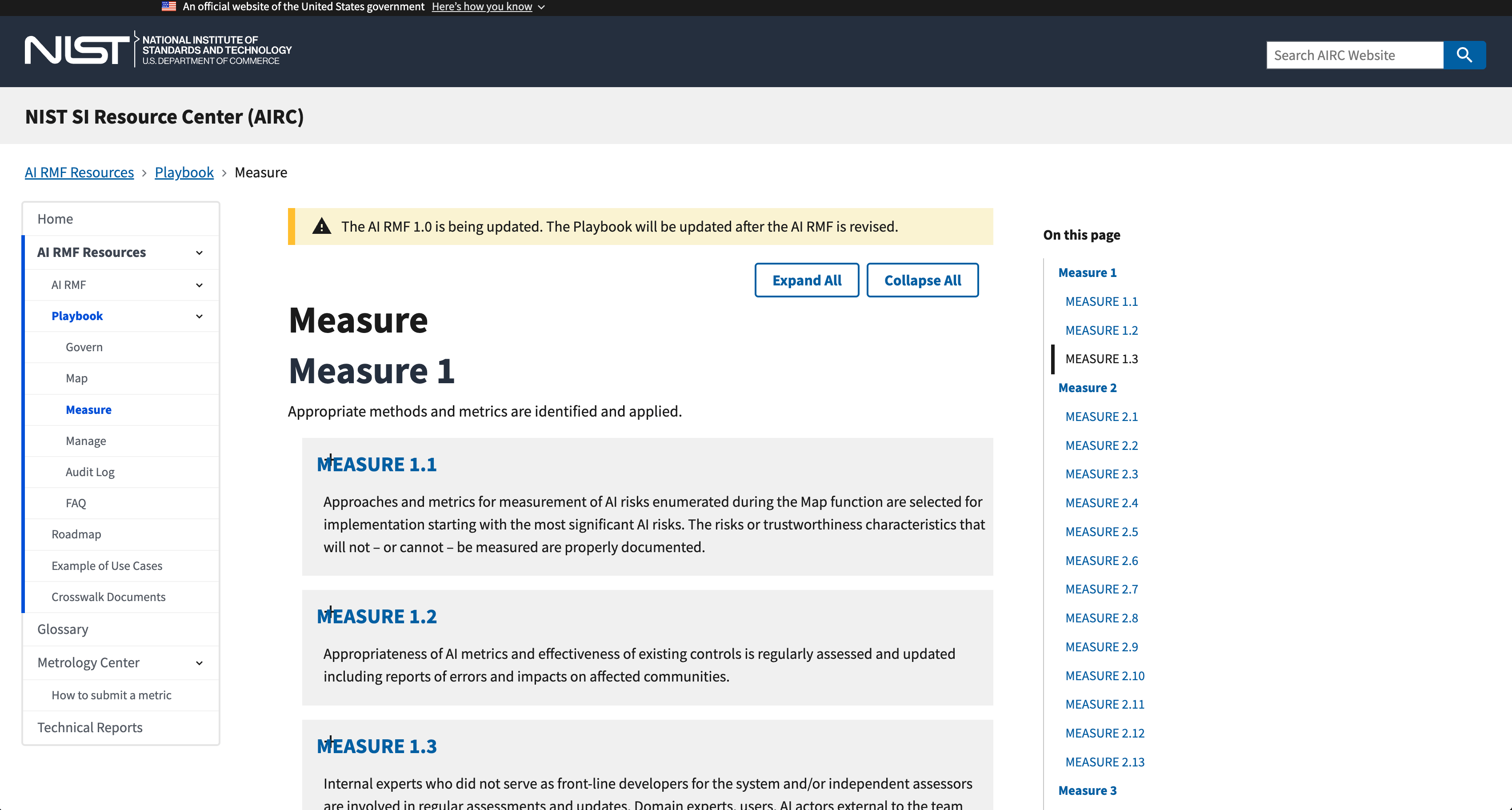
The Measure function provides suggested activities for evaluating and tracking AI risks and relevant performance characteristics.
It is useful for establishing disciplined measurement beyond simple model accuracy or user satisfaction.
Best for: AI governance teams, evaluation specialists, and operational managers.
What to take away: A method for selecting measurements aligned with the risks and intended use of an AI system.
Practical application: Define a measurement sheet that includes effectiveness, failure frequency, human intervention, operational reliability, and relevant risk indicators.
Access: Free guidance.
27. NIST: Manage AI Risks
Provider: NIST
Resource: AI RMF Playbook — Manage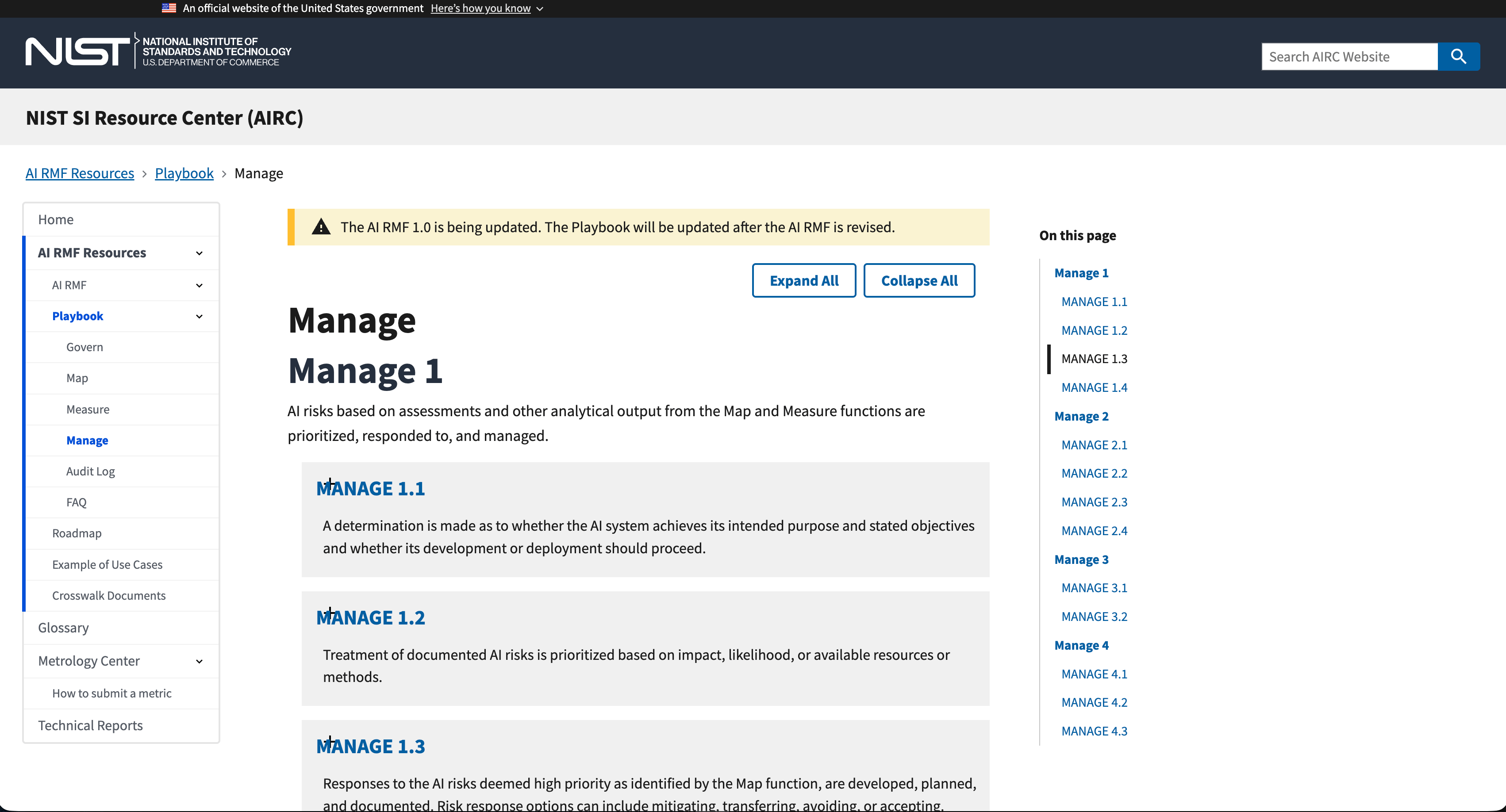
The Manage function addresses how organizations prioritize and respond to identified risks.
It supports decisions about mitigation, continued operation, adaptation, and situations in which an AI deployment may no longer be appropriate.
Best for: AI risk owners, operations leads, and governance committees.
What to take away: A disciplined process for turning observed evidence into decisions about the system.
Practical application: Establish explicit thresholds for review, corrective action, suspension, or retirement when performance or risk exceeds accepted boundaries.
Access: Free guidance.
28. Microsoft: Manage AI Operations and Costs
Provider: Microsoft Learn
Resource: AI Adoption and Management Framework
Microsoft’s broader AI adoption guidance includes operational management as a continuing responsibility after initial deployment.
Its value here is to connect technical operation with ongoing cost, security, model, and service management.
Best for: AI operations teams, FinOps practitioners, and application owners.
What to take away: A structure for continuously managing the resources and processes on which AI systems depend.
Practical application: Create a monthly operating review showing volume, cost per completed workflow, incidents, availability, intervention rates, and realized business benefits.
Access: Free documentation.
29. NIST: Map AI Context and Impacts
Provider: NIST
Resource: AI RMF Playbook — Map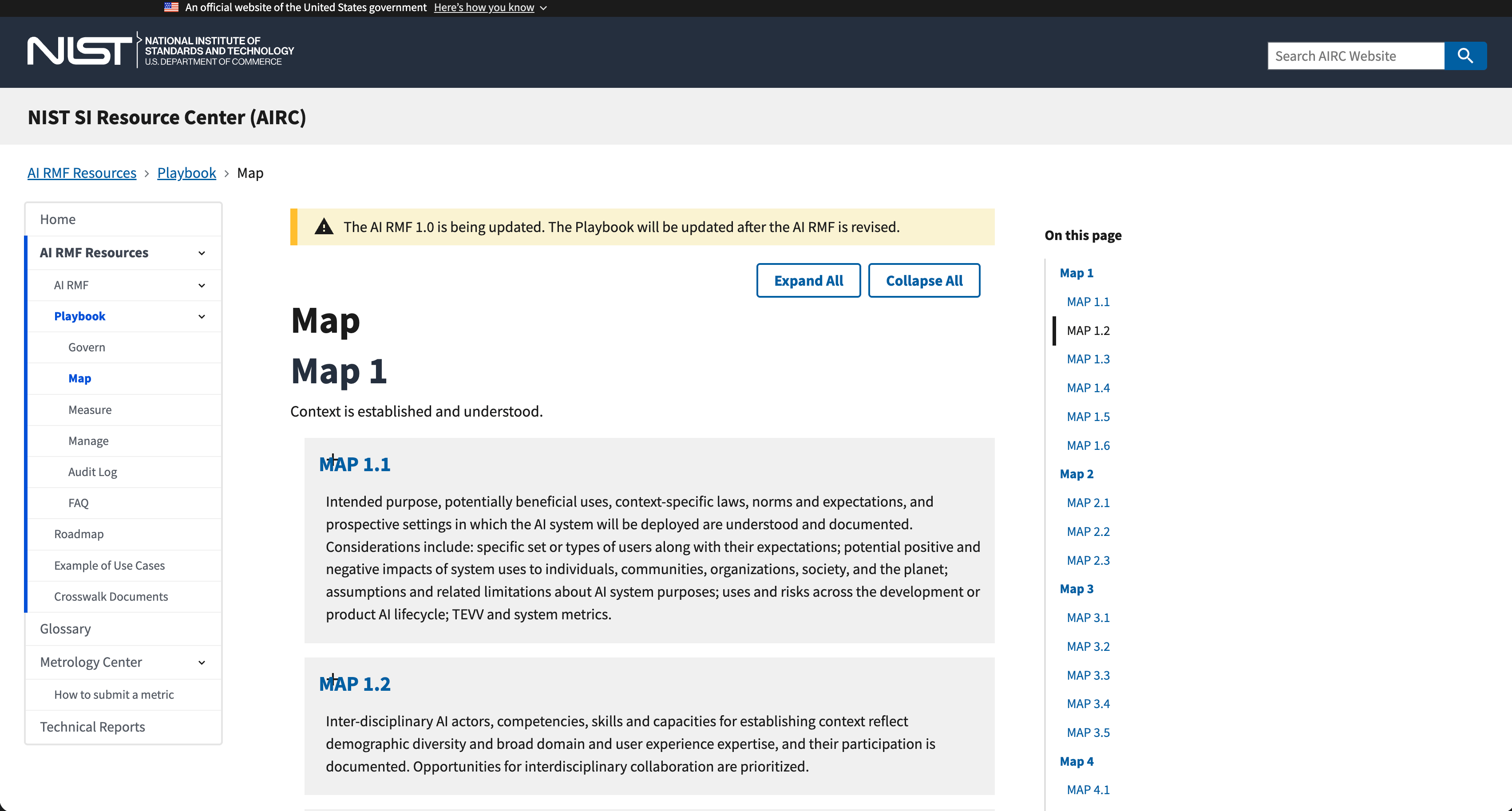
The Map function helps organizations document the context in which an AI system operates and identify affected people, uses, and risks.
This becomes especially important after deployment, when real usage may diverge from the original assumptions.
Best for: Product owners, governance teams, and enterprise risk specialists.
What to take away: A framework for detecting changes in context that may affect expected value or risk.
Practical application: Revisit the original use-case description quarterly. Identify unanticipated uses, new affected stakeholders, changes to input data, and emerging operating dependencies.
Access: Free guidance.
30. NIST: Govern AI Across the Lifecycle
Provider: NIST
Resource: AI RMF Playbook — Govern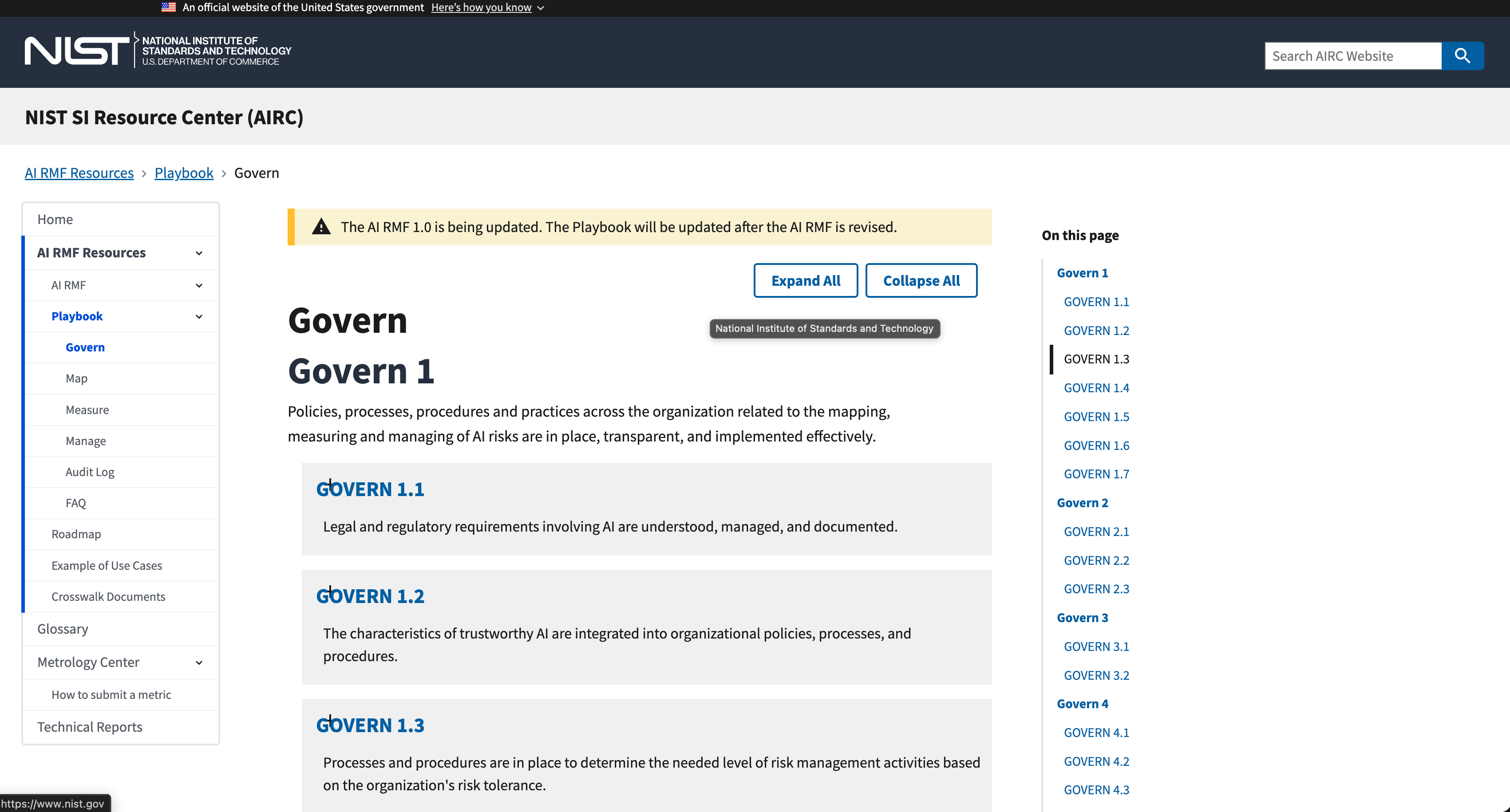
The Govern function emphasizes the policies, responsibilities, and organizational processes necessary for sustained AI oversight.
It provides a useful reference for portfolio-level review: not just whether an individual system functions, but whether the organization has developed repeatable management capabilities.
Best for: Enterprise AI councils, risk committees, and transformation program leaders.
What to take away: A mechanism for turning individual deployment lessons into enterprise-wide standards.
Practical application: Review common exceptions, recurring incidents, implementation costs, and adoption barriers across the AI portfolio. Update policies and operating standards based on the evidence.
Access: Free guidance.
Section 06 implementation checkpoint
A meaningful AI performance review should answer:
-
What changed in the underlying business process?
-
How does performance compare with the pre-deployment baseline?
-
What costs were introduced or eliminated?
-
Which outcomes improved, and which did not?
-
What new risks or operating burdens emerged?
-
Should the organization scale, refine, maintain, or retire the capability?
Expected deliverable: An AI value-realization dashboard and a recurring portfolio decision process.
Beyond the Directory: Five Enterprise AI Implementation Frameworks
The 30 resources provide external guidance. The next five frameworks translate those references into an integrated working method.
These are original synthesis tools designed for practical use within an enterprise AI program. They are not official extensions of NIST, Microsoft, Google, or any other provider.
Framework 01 — The Enterprise AI Opportunity Canvas
Before approving a project, complete these eight dimensions.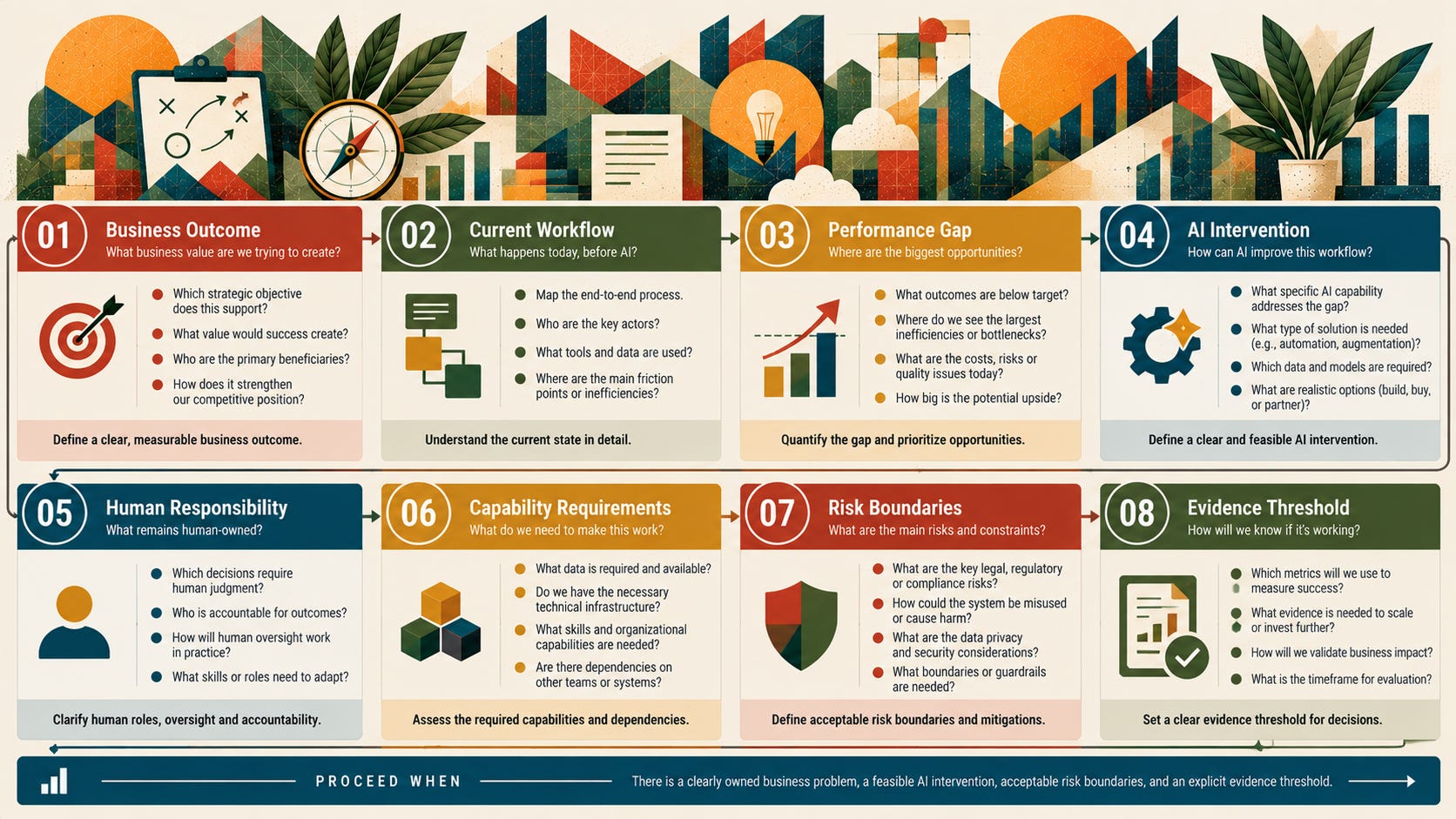
How to use it
Begin with the business outcome, not the AI product.
Interview the process owner and observe how work currently moves through the organization. Identify the costly or consequential bottlenecks, then test whether AI is an appropriate intervention.
Finally, define the experiment that would produce credible evidence.
Decision rule: Reject or defer initiatives that cannot identify a business owner, baseline performance, feasible intervention, and acceptable risk boundary.
Framework 02 — The Enterprise AI Prioritization Matrix
A promising AI use case is not necessarily a good first investment.
Evaluate each candidate on five dimensions, scored from 0 to 4.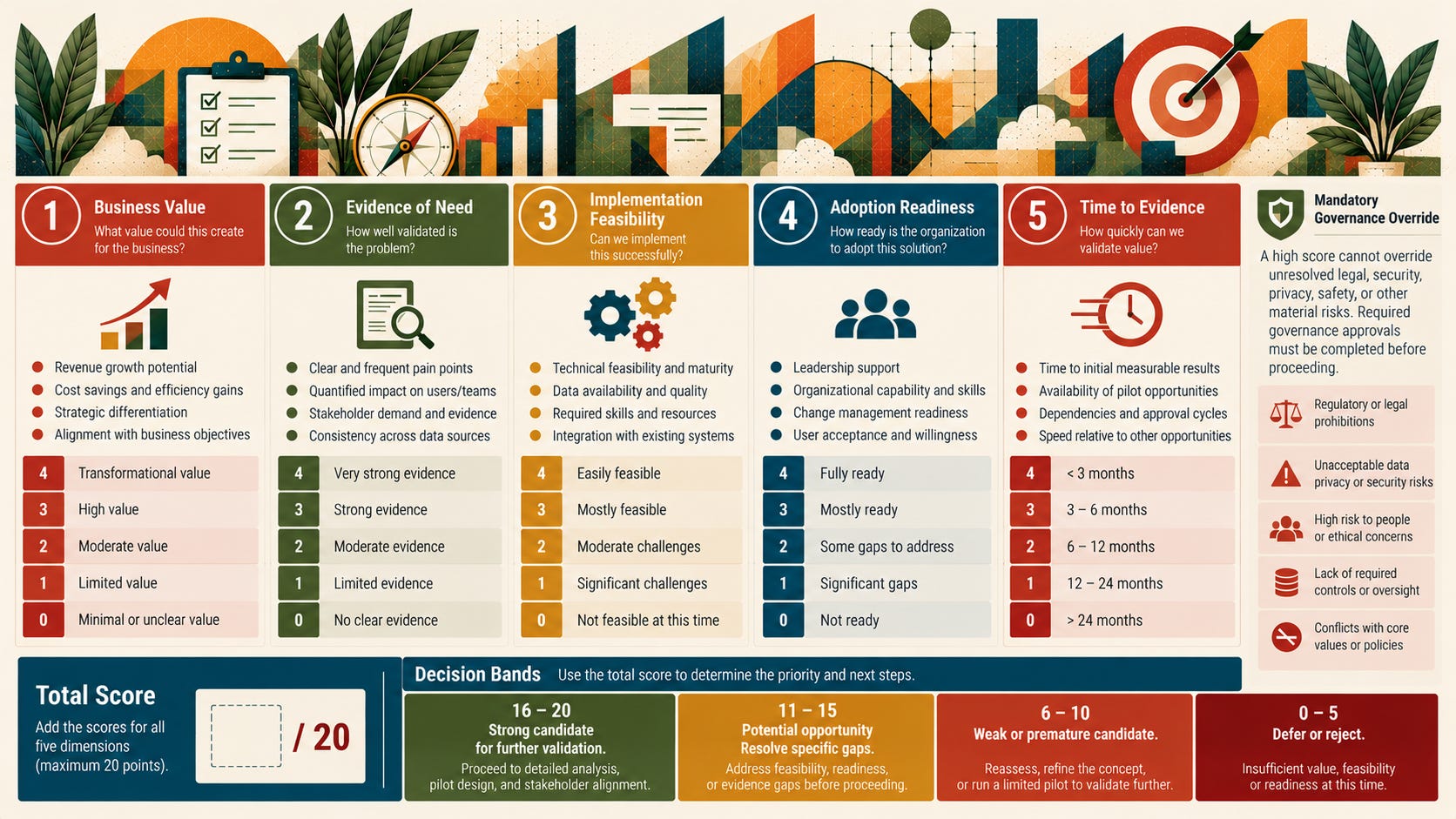
Maximum score: 20.
Proposed screening bands:
-
16–20: Strong candidate for further validation.
-
11–15: Potential opportunity; resolve specific gaps.
-
6–10: Weak or premature candidate.
-
0–5: Defer or reject.
These are editorial screening thresholds, not empirically validated investment benchmarks.
Mandatory override
The score cannot override unresolved security, privacy, safety, legal, or other material risks.
A high-value use case must still pass its required governance review.
Decision rule: Portfolio ranking determines which initiatives deserve attention. Governance and feasibility controls determine which initiatives may proceed.
Framework 03 — The AI Responsibility and Authorization Map
Enterprise AI requires clarity about two different forms of authority:
Decision authority: Who can approve a business or technical decision?
Execution authority: What may the system actually do?
Map every workflow across the following responsibilities.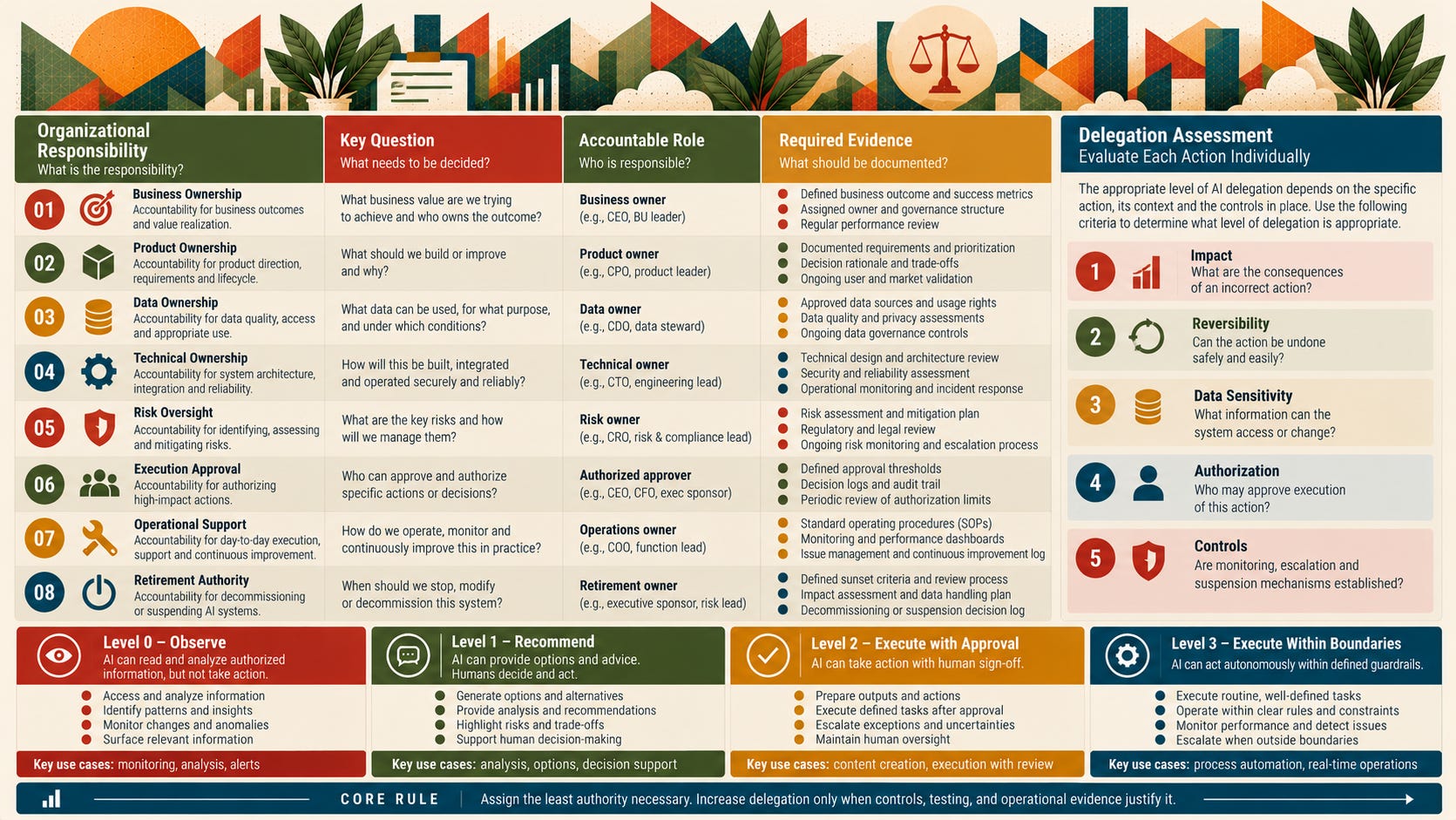
Delegation levels
Use four provisional levels when designing agentic workflows.
Level 0 — Observe: AI reads authorized information and produces analysis.
Level 1 — Recommend: AI proposes actions but cannot execute them.
Level 2 — Execute with approval: AI prepares actions and executes only after an authorized human approves.
Level 3 — Execute within boundaries: AI may take specified low-risk actions within defined permissions, monitoring, and escalation rules.
These levels are an original practical classification, not a formal industry standard.
Start with the least authority necessary. Increase autonomy only when testing, controls, and operational evidence justify it.
Framework 04 — The Enterprise AI Production Readiness Gate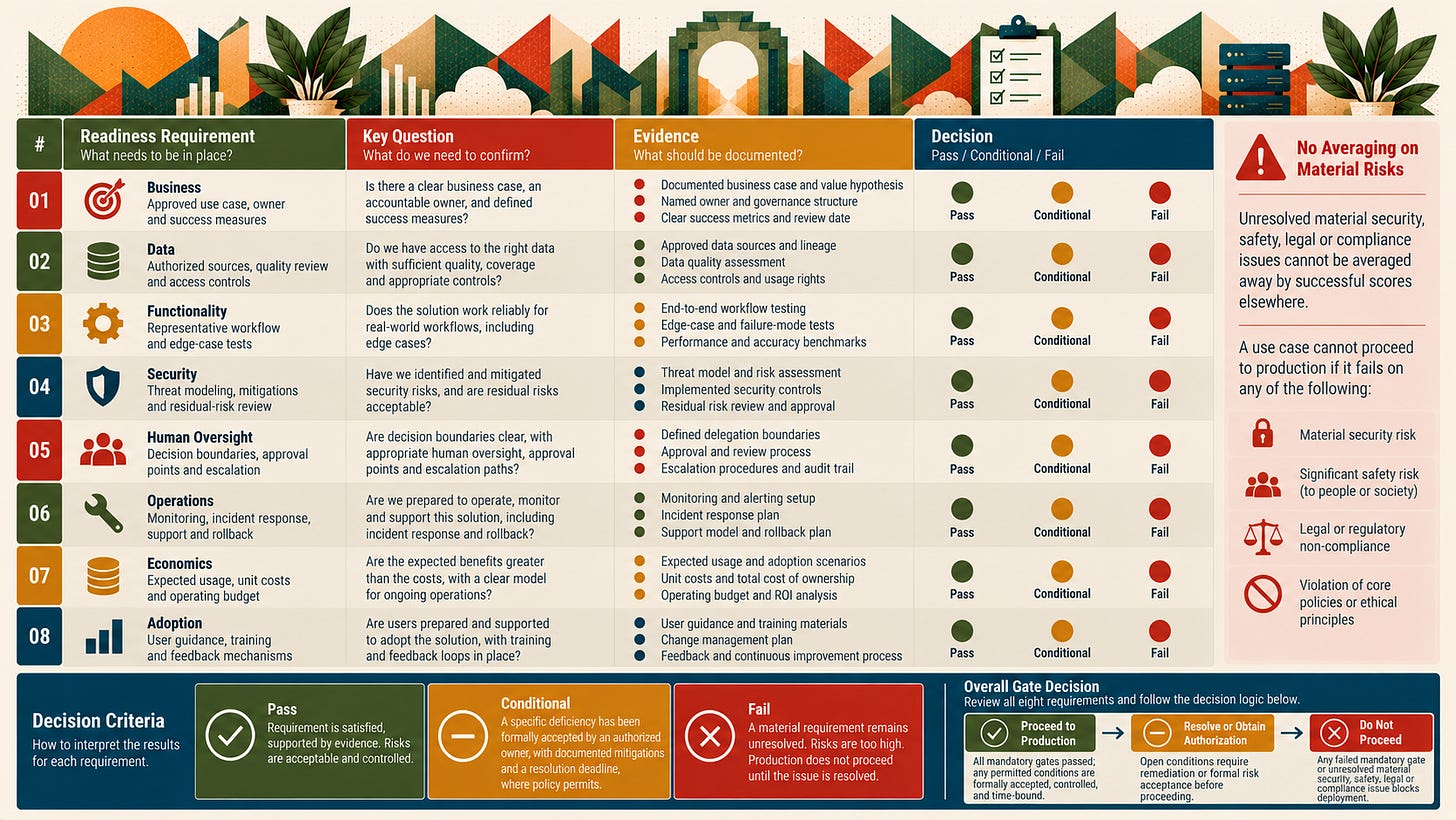
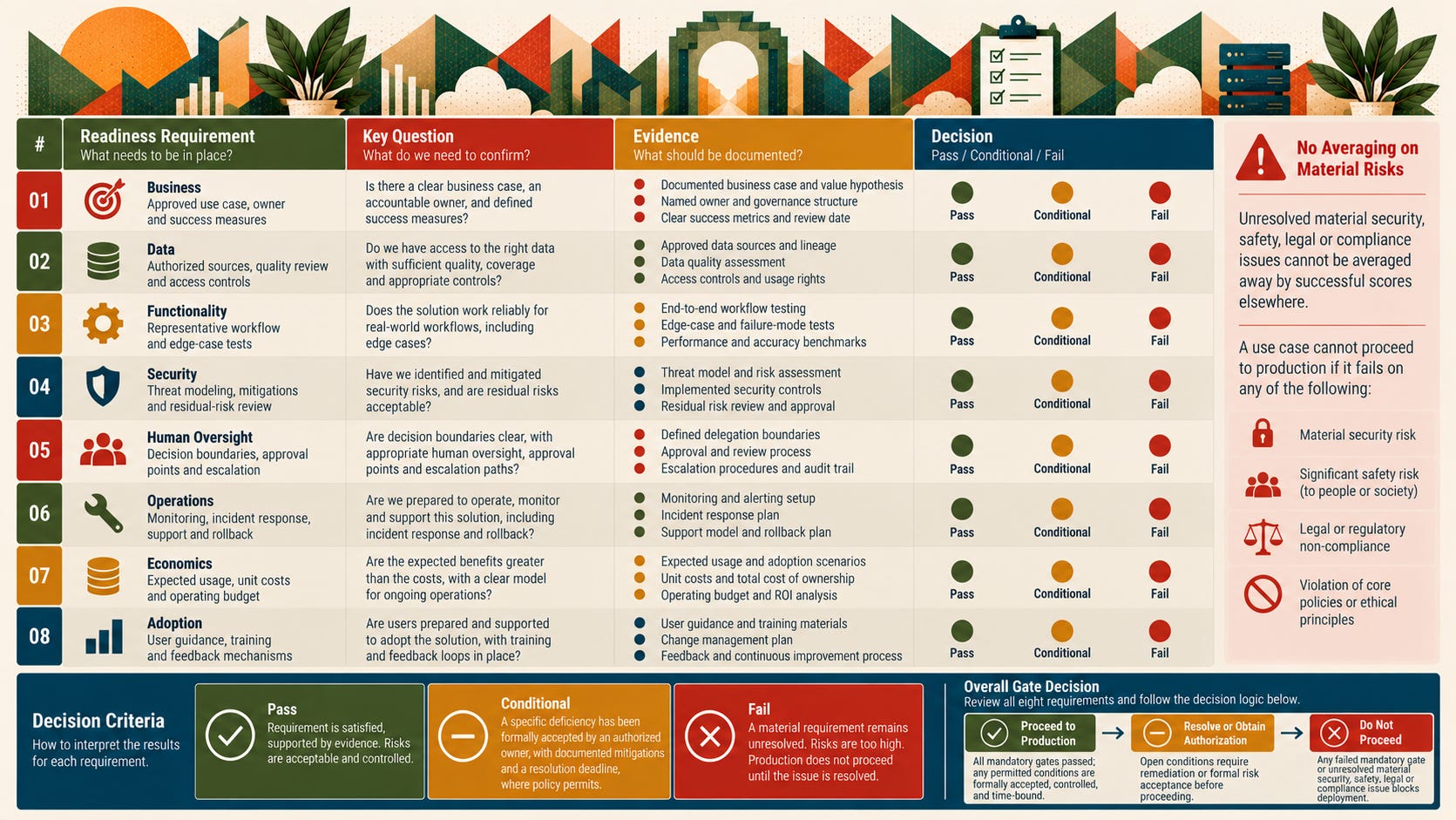
A pilot should not move into production until the following areas have been reviewed.
Each gate receives one of three statuses:
Pass: Requirements are met and evidence is documented.
Conditional: A specific deficiency is accepted by the authorized owner, with mitigations and a resolution deadline, where policy permits.
Fail: A material requirement remains unresolved; production deployment does not proceed.
No aggregate score should be used to average away a failed safety or security control.
Framework 05 — The AI Value Realization Scorecard
AI initiatives should be evaluated through a combination of business and operating measures.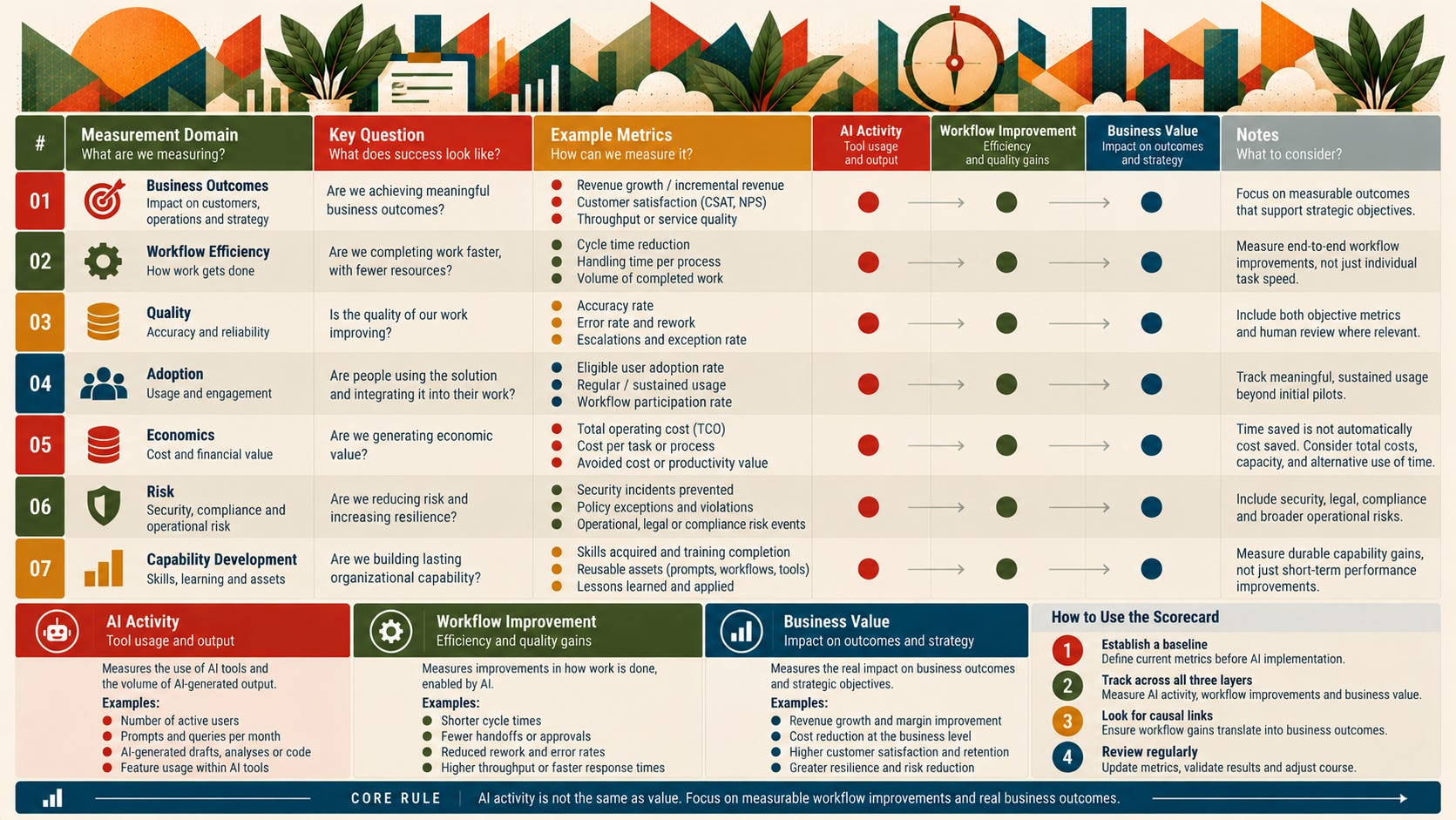
Measurement principles
Establish the pre-deployment baseline first.
Where feasible, compare similar work with and without the intervention. Account for supervision, rework, integration, support, infrastructure, and training costs.
Distinguish measured cost savings from theoretical time savings.
For example, saving an employee 30 minutes per day does not automatically reduce payroll expense. The benefit may instead appear as additional capacity, faster response, better service, or reduced overtime.
Decision rule: Evaluate value at the level of business outcomes and changed workflows, not simply activity inside the AI application.
Five Practical Exercises for Enterprise AI Teams
The frameworks above become more useful when tested against a concrete organizational decision.
Exercise 01 — Build a Business-Outcome-Driven AI Opportunity Portfolio
Objective: Identify and compare five plausible AI initiatives.
Participants: Business process owners, strategy, technology, finance, and relevant risk representatives.
Suggested time: One working session plus follow-up validation.
Steps
-
Identify three strategic business priorities.
-
Select the operational processes influencing those priorities.
-
Document current performance, pain points, and available evidence.
-
Generate AI and non-AI improvement options.
-
Complete the Enterprise AI Opportunity Canvas for each candidate.
-
Score candidates using the prioritization matrix.
-
Identify unknowns that can be resolved through a small experiment.
Output: Five use-case briefs, a ranked portfolio, and an agreed shortlist for further validation.
Exercise 02 — Conduct an AI Readiness and Dependency Review
Objective: Determine whether a priority initiative can realistically be implemented.
Steps
-
Map the workflow and all systems involved.
-
Identify required datasets, access rights, and data quality issues.
-
List the skills needed to build, evaluate, and operate the solution.
-
Document existing security and governance requirements.
-
Establish the business and technical owners.
-
Separate blocking dependencies from improvements that can follow later.
-
Create a time-bound dependency resolution plan.
Output: A readiness register with owners, blockers, and the minimum viable implementation conditions.
Exercise 03 — Design Human-AI Decision Rights
Objective: Prevent unclear responsibility and uncontrolled delegation.
Steps
-
List the decisions and actions in the proposed workflow.
-
Classify each action by consequence and reversibility.
-
Assign the minimum required execution authority.
-
Identify approval and escalation points.
-
Define what the system must never do.
-
Test scenarios involving ambiguous instructions and unexpected outputs.
-
Document monitoring and suspension responsibilities.
Output: A responsibility map and approval architecture for the workflow.
Exercise 04 — Run a Production Readiness Review
Objective: Decide whether a tested application should operate in a real business environment.
Steps
-
Assemble functional, security, legal, and operating evidence.
-
Test representative input scenarios and edge cases.
-
Review failure modes and human intervention procedures.
-
Validate access controls and connected-system permissions.
-
Confirm monitoring, support, and incident responsibilities.
-
Estimate actual operating costs and usage boundaries.
-
Record the authorization decision and remaining conditions.
Output: A documented release decision supported by evidence rather than a persuasive demonstration.
Exercise 05 — Build an AI Value Review
Objective: Determine whether the deployed capability should be improved, expanded, maintained, or stopped.
Steps
-
Revisit the original business hypothesis.
-
Measure operational results against the baseline.
-
Separate AI-generated activity from meaningful completed work.
-
Include human review and rework in economic calculations.
-
Record errors, incidents, user feedback, and policy exceptions.
-
Identify the causes of strong and weak performance.
-
Make an explicit portfolio decision.
Output: A repeatable value review and a documented investment decision.
Worked Example — An Enterprise Knowledge-Assistance Program
Consider a hypothetical industrial services company with 1,500 employees.
Its field service teams maintain specialized equipment and rely on technical manuals, internal troubleshooting notes, service histories, and experienced colleagues to resolve customer problems.
Relevant knowledge exists, but is fragmented across repositories.
The organization wants to investigate whether a retrieval-based AI assistant could help technicians locate relevant information more quickly.
All figures and assumptions below are illustrative.
Step 1 — Define the business problem
The target is not to deploy a chatbot.
The target is to reduce the time technicians spend locating reliable information while maintaining or improving service quality.
Assume the company currently experiences:
-
Long information-search times.
-
Inconsistent access to current technical documentation.
-
Frequent escalation to senior specialists.
-
Uneven knowledge transfer across teams.
The intervention is an internal knowledge assistant that retrieves approved source documents and presents cited information.
It does not independently authorize repairs, modify equipment settings, or make safety-critical decisions.
Step 2 — Establish a baseline
The company selects a representative sample of service tasks.
It measures:
MetricHypothetical baselineAverage information-search time18 minutes per taskTasks sampled200Escalation rate22%Responses supported by correct source documentationTo be established through human reviewSafety-related incidentsTracked separately
The baseline must be validated through actual observation before using it in a business case.
Step 3 — Design the intervention
The initial system retrieves information only from an approved subset of documents.
It provides source references, indicates uncertainty, and directs users to established escalation procedures when reliable evidence is missing.
Technicians remain responsible for applying service procedures and following safety policies.
The first deployment is deliberately narrow.
It is easier to establish meaningful performance evidence for one defined workflow than for a company-wide general-purpose assistant.
Step 4 — Implement governance
The project team documents:
-
Which repositories can be accessed.
-
How document permissions are preserved.
-
How outdated documentation is identified.
-
How incorrect answers are reported.
-
Which tasks are excluded.
-
Who owns system evaluation and incident response.
-
Who can suspend the application.
The security and operational reviews must be completed before live use with sensitive data.
Step 5 — Test the economics
Suppose the controlled evaluation finds:
-
Average information-search time decreases from 18 to 12 minutes.
-
The improvement is sustained across the sampled task types.
-
Answer quality does not deteriorate.
-
Human review remains necessary in defined situations.
The difference is six minutes per task, or a 33.3% reduction in information-search time.
If the company performs 10,000 eligible tasks annually, the theoretical time released would be:
10,000 × 6 minutes = 60,000 minutes, or 1,000 hours.
That is a capacity estimate, not automatically a financial saving.
If an illustrative fully loaded labor rate is $50 per hour, the theoretical labor-capacity equivalent is $50,000 annually.
Actual financial value depends on whether that time is redeployed productively, reduces overtime, increases service capacity, or produces other measurable benefits.
The company must also subtract infrastructure, licensing, integration, maintenance, evaluation, training, and supervision costs.
Step 6 — Make a scaling decision
A successful pilot could justify expanding to additional document collections or service teams.
But scaling should depend on more than the initial improvement in search time.
The company should also examine retrieval quality, system failures, adoption, security, cost per task, documentation maintenance, and the effects on real service outcomes.
The lesson: Enterprise AI creates measurable value when a technology intervention is attached to a clearly owned business process, supported by credible evidence, and operated within explicit boundaries.
The 90-Day Enterprise AI Implementation Roadmap
Ninety days is enough to establish a disciplined implementation process and potentially validate a narrowly scoped use case.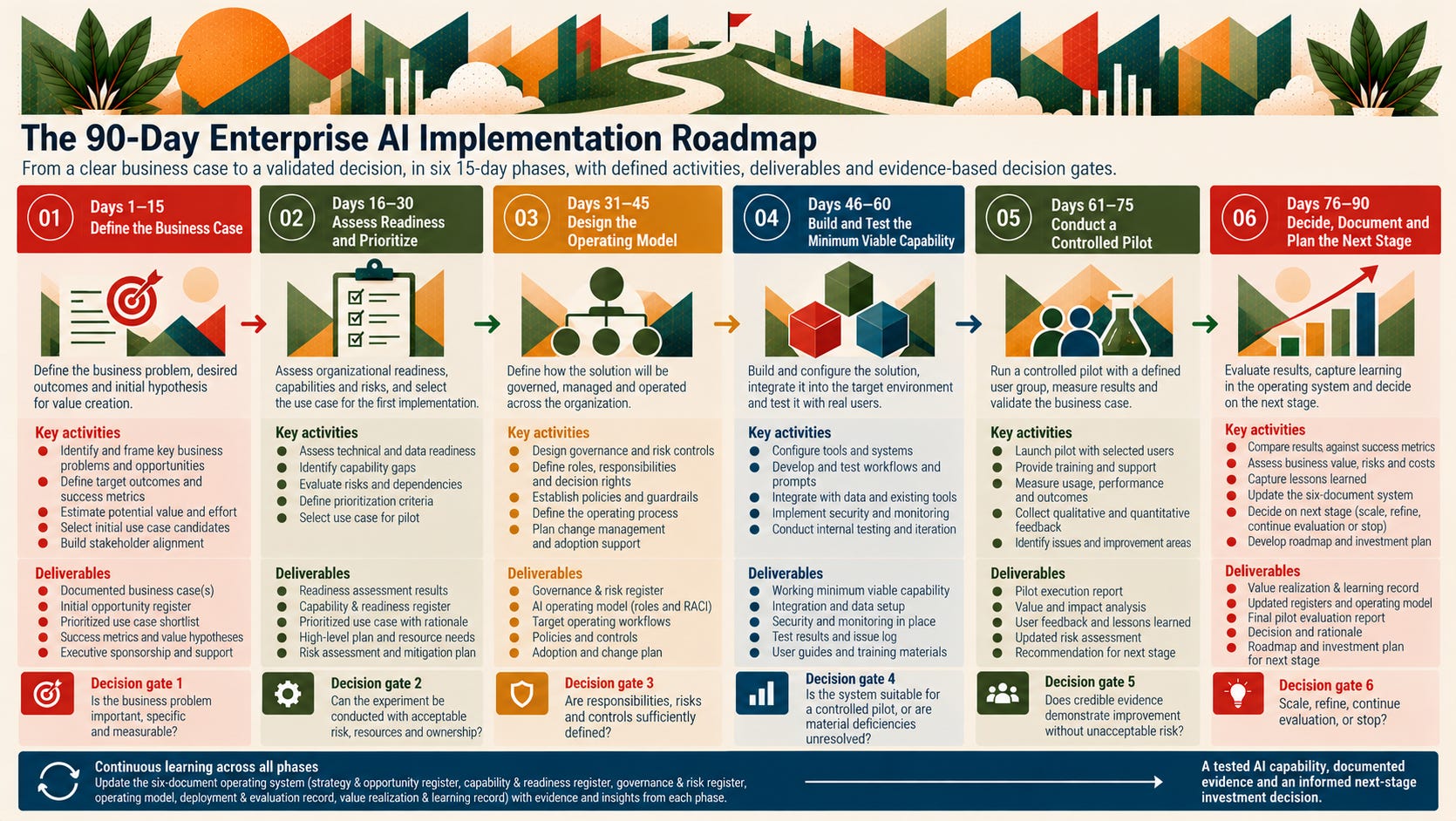
It is not a universal promise of enterprise-wide transformation or production deployment. Complex, regulated, or safety-critical initiatives may require substantially more time.
Days 01–15 — Define the Business Case
Objective: Identify the business problem and establish executive ownership.
Activities:
-
Select a specific business process.
-
Interview process owners and affected users.
-
Document current performance.
-
Define desired improvements.
-
Evaluate AI and non-AI alternatives.
-
Complete the Enterprise AI Opportunity Canvas.
Deliverables: Opportunity brief, baseline, accountable sponsor, preliminary investment hypothesis.
Decision gate: Is the business problem sufficiently important, specific, and measurable to justify further investigation?
Days 16–30 — Assess Readiness and Prioritize
Objective: Determine whether the organization can execute the proposed intervention.
Activities:
-
Assess data access and quality.
-
Review required technical capabilities.
-
Map operational and organizational dependencies.
-
Identify necessary skills.
-
Compare candidate solutions.
-
Complete initial risk screening.
Deliverables: Readiness assessment, dependency register, selected pilot scope, resource estimate.
Decision gate: Can the proposed experiment be conducted with acceptable risk, available resources, and clearly identified owners?
Days 31–45 — Design the Operating Model
Objective: Establish how the capability will be governed and used.
Activities:
-
Map the future workflow.
-
Assign business and technical responsibilities.
-
Define human approval checkpoints.
-
Set access and execution boundaries.
-
Choose evaluation measures.
-
Establish support and incident procedures.
Deliverables: Workflow design, responsibility matrix, authorization requirements, evaluation plan.
Decision gate: Are responsibilities, risks, and control mechanisms sufficiently defined to begin controlled implementation?
Days 46–60 — Build and Test the Minimum Viable Capability
Objective: Produce an implementation suitable for controlled evaluation.
Activities:
-
Configure the selected technology.
-
Connect approved data sources.
-
Implement access and security controls.
-
Construct a representative evaluation dataset.
-
Test accuracy, reliability, and failure handling.
-
Record issues and required changes.
Deliverables: Working prototype, test results, issue register, updated implementation plan.
Decision gate: Is the system suitable for a controlled pilot, or are material deficiencies unresolved?
Days 61–75 — Conduct a Controlled Pilot
Objective: Observe the system within a limited, authorized business setting.
Activities:
-
Involve a representative user group.
-
Collect workflow performance data.
-
Review output quality and user behavior.
-
Track cost and human intervention.
-
Capture incidents and unintended consequences.
-
Refine instructions, interfaces, and workflows.
Deliverables: Pilot evaluation, user feedback, cost evidence, governance findings.
Decision gate: Is there credible evidence that the capability improves the intended business outcome without unacceptable risk?
Days 76–90 — Decide, Document and Plan the Next Stage
Objective: Convert pilot evidence into a portfolio decision.
Activities:
-
Compare outcomes against the original baseline.
-
Calculate the full cost of implementation and operation.
-
Document remaining risks and technical limitations.
-
Review operating-model readiness.
-
Determine the next investment.
-
Update reusable standards and lessons learned.
Deliverables: Value-realization assessment, executive decision brief, production-readiness or remediation plan, next-stage roadmap.
Decision gate: Scale, refine, continue controlled evaluation, or stop?
What success looks like after 90 days
The strongest result is not necessarily a large AI rollout.
It may be a well-evidenced decision that a particular AI intervention deserves further investment.
Alternatively, discovering that a proposed use case is economically weak, operationally impractical, or too risky can prevent a much larger investment mistake.
A disciplined organization learns from both outcomes.
How to Build an Enterprise AI Playbook System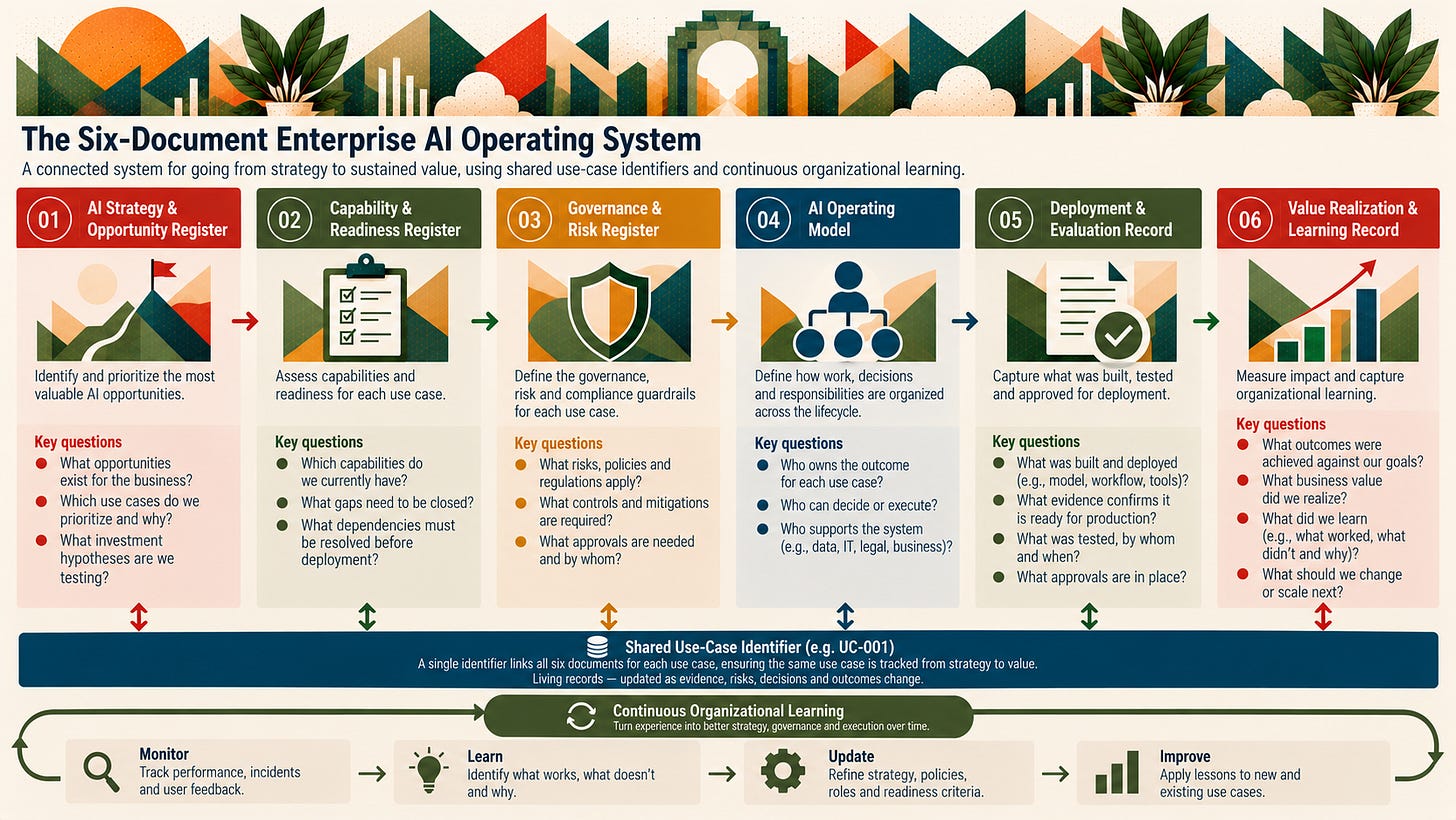
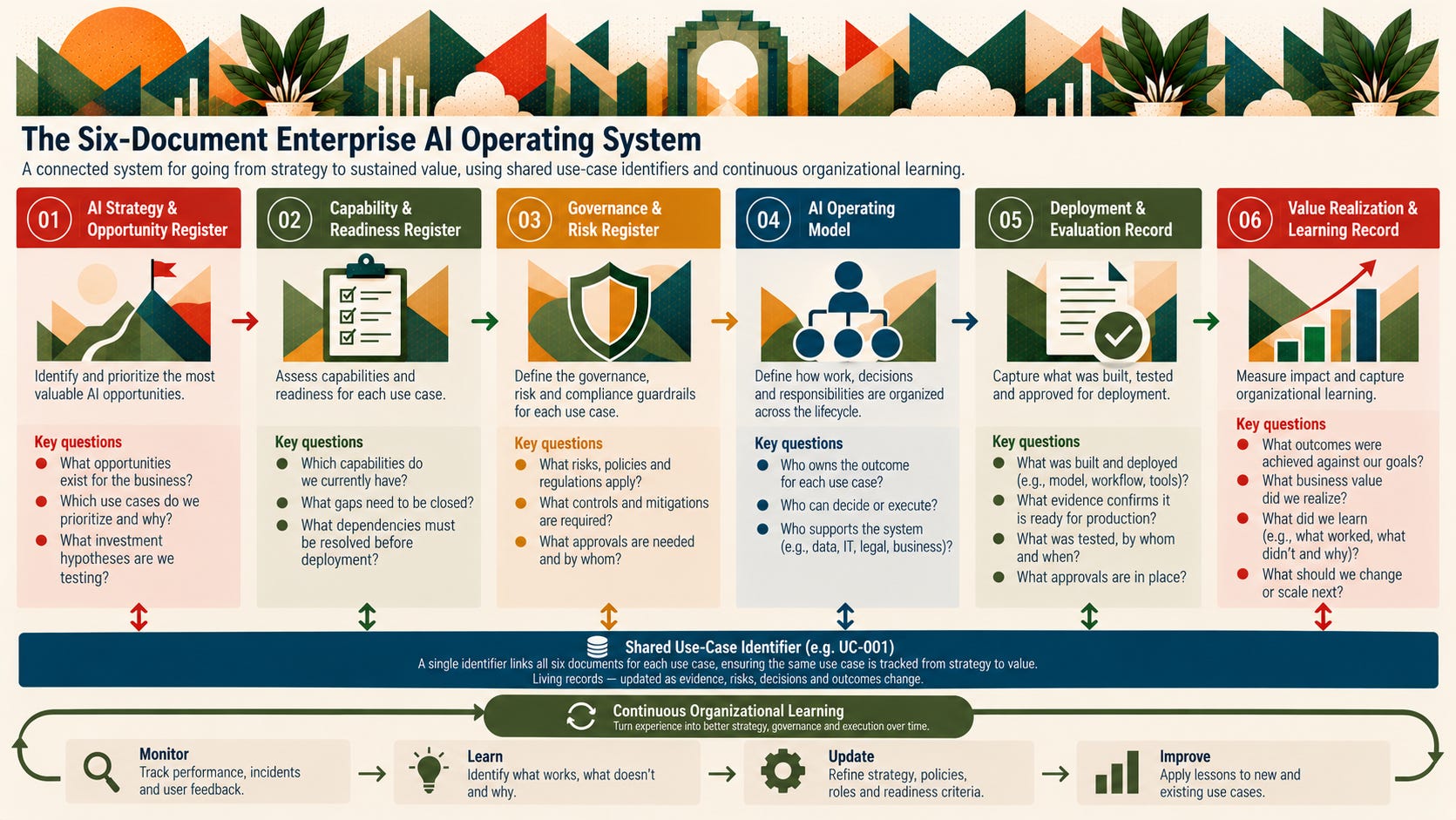
A resource library becomes strategically useful when the organization turns external guidance into its own repeatable implementation process.
The key is to avoid treating every framework as an independent management methodology.
Start by establishing six linked operating documents.
1. AI Strategy and Opportunity Register
Contains business priorities, use cases, sponsors, hypotheses, and investment decisions.
2. Capability and Readiness Register
Records data, skills, technology, organizational dependencies, and readiness gaps.
3. Governance and Risk Register
Documents systems, risks, controls, approvals, exceptions, and accountability.
4. AI Operating Model
Defines responsibilities, decision rights, human oversight, service ownership, and escalation.
5. Deployment and Evaluation Record
Stores architecture, test results, security findings, release decisions, and operational procedures.
6. Value Realization and Learning Record
Tracks performance, cost, adoption, incidents, lessons, and investment decisions.
These documents should reference one another using stable use-case identifiers.
For example, an initiative approved in the strategy register should have a corresponding readiness assessment, risk record, operating owner, evaluation result, and value review.
This creates continuity across organizational handoffs.
It also allows leaders to examine an AI portfolio without reconstructing the history of every initiative from meeting notes and presentation decks.
The deeper opportunity is institutional memory: preserving why a particular AI investment was made, under what assumptions, with which controls, and based on what results.
Choosing the Right Playbook for Your Organization
Not every organization needs every resource in this collection.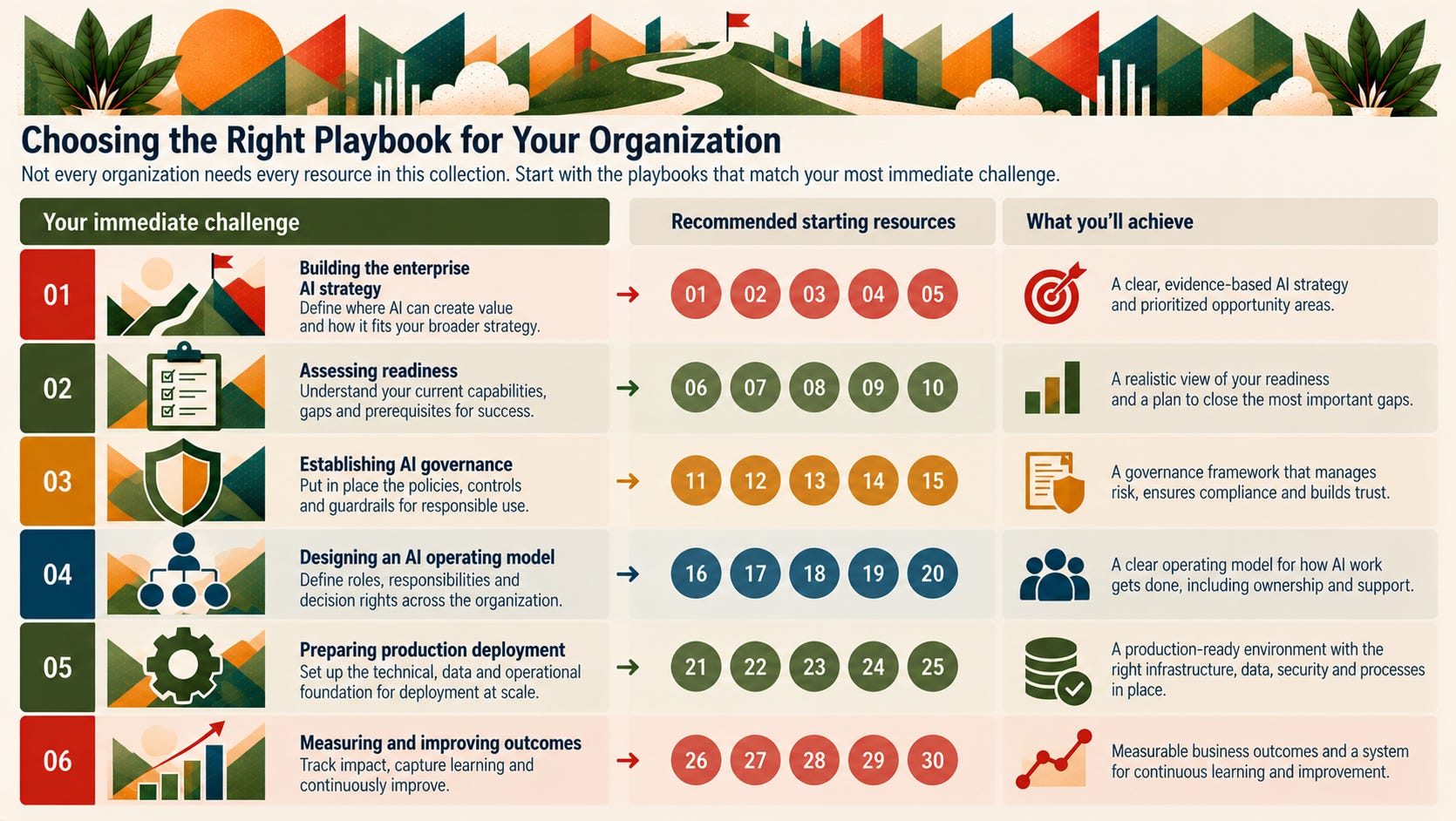
A note on frameworks and standards: NIST and OWASP resources provide useful voluntary risk-management and security references. They do not replace applicable legislation, contractual requirements, industry regulation, or formal compliance assessments. The free ISO/IEC 42001 overview may also inform management-system design, but the full standard is a paid publication and is therefore not counted among the 30 free resources.
Final Perspective — Enterprise AI Is an Organizational Capability
The defining challenge of enterprise AI is not obtaining access to increasingly powerful models.
It is developing the organizational capacity to identify valuable opportunities, implement appropriate systems, distribute responsibility, manage uncertainty, and improve performance over time.
An individual AI application may produce useful results.
An enterprise AI capability allows the organization to produce those results repeatedly.
That requires more than technology adoption.
It requires clear strategic choices, accessible knowledge, reliable systems, legitimate authority, accountable people, and mechanisms for learning from real operational evidence.
The 30 resources in this library provide different parts of that foundation.
Use them selectively. Adapt them to your organizational context. Challenge their assumptions. Translate their guidance into working documents and operating procedures.
And remember that a successful AI program is not measured by how many models, agents, or applications an organization deploys.
It is measured by the business capabilities the organization develops, the results those capabilities produce, and its ability to sustain them responsibly.