AI can generate interfaces in seconds. But understanding users, making difficult decisions, and building products worth using still require something the tools can't automate.
By Alex Pawlowski
Published: 2026-10-31
URL: https://thestrategystack.substack.com/p/ai-product-design-human-judgment
Guest essay · Xinran Ma is the founder of Design with AI, a Substack bestseller, course instructor, and author helping more than 50,000 people design better, faster, and smarter with AI. His work explores the intersection of artificial intelligence, product design, and human creativity, with a particular focus on how designers can use emerging tools without sacrificing judgment, originality, and a deep understanding of users.
Hi everyone - Alex here,
Today, I'm delighted to welcome my friend Xinran Ma as a guest contributor to The Strategy Stack.
As AI makes creating and building dramatically easier, an important question emerges: If execution is becoming abundant, what makes something genuinely valuable?
Xinran approaches this question through the lens of product design, exploring why human judgment, taste, and understanding people remain essential even as AI becomes increasingly capable.
It’s a perspective that extends well beyond design, and one I think you’ll find particularly relevant.
Over to you, Xinran.
We’ve made it cheaper to generate designs. We haven’t made it much cheaper to decide what’s worth producing. The tools got faster at the part that was already visible. The part that was always hard is still hard, and now it’s easier to skip.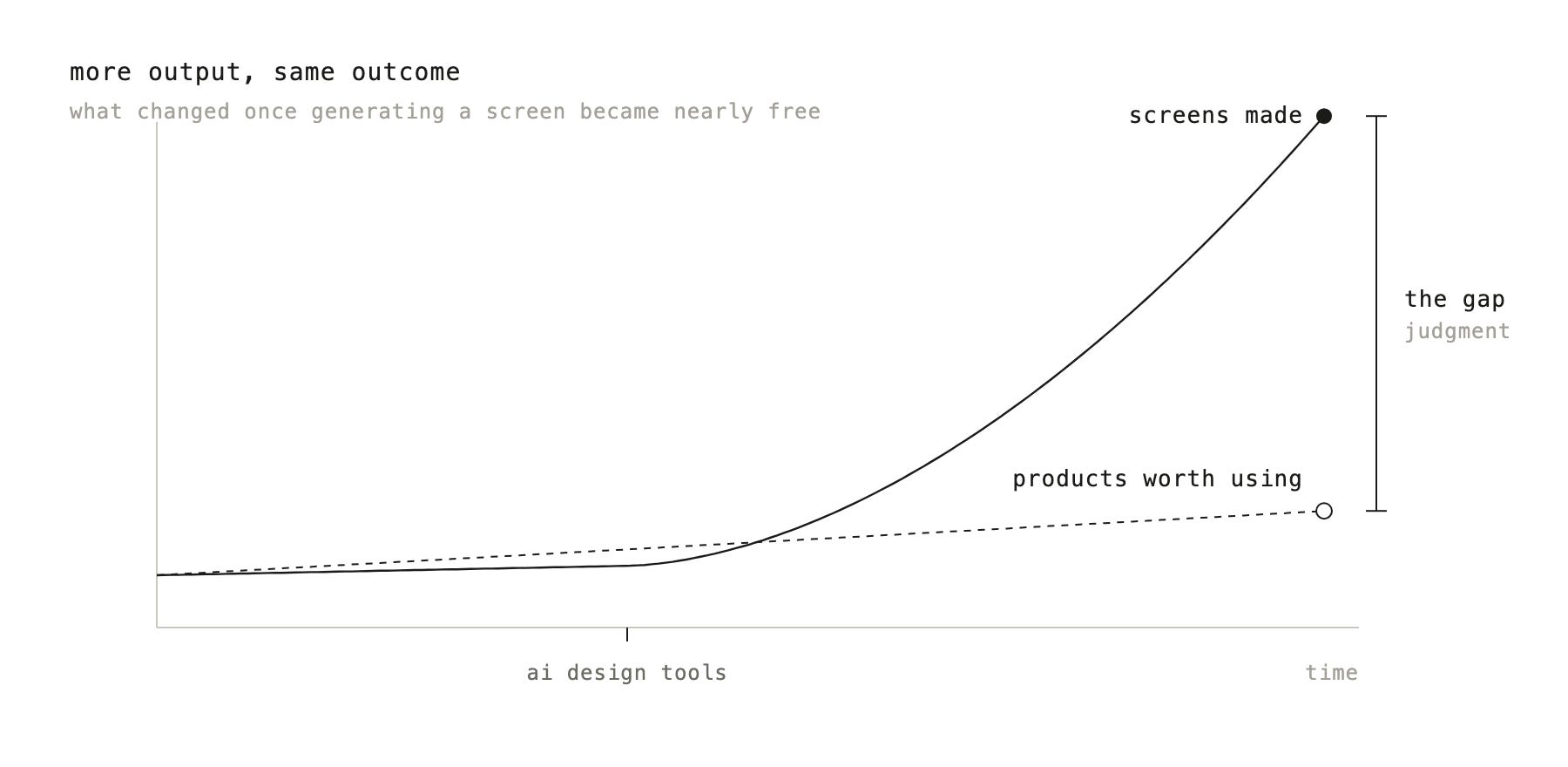
The number of screens keeps climbing. The number of products people actually love doesn’t climb with it.
So instead of asking whether AI will replace designers, I find it more useful to ask a narrower question: what can’t it do yet? Here’s my list.
Everything looks fine, and that’s the problem
Most AI design tools are built on similar models, trained on similar data. Ask them for a dashboard and you’ll get roughly the same dashboard, give or take a border radius.
I don’t think that’s a disaster on its own. Plenty of interfaces looked alike long before AI. A settings page shouldn’t surprise anyone, and a checkout flow is better when it behaves the way people expect. Convention is a feature when the task is common.
The trouble starts when the task isn’t common.
Every product has users whose needs sit far from the average: the nurse checking a chart one-handed at 3am, the small business owner who’s never used accounting software, the person on a slow connection in a second language. Those cases barely exist in the training data, so AI quietly pulls them back toward the middle. The output still looks polished. It just isn’t built for them.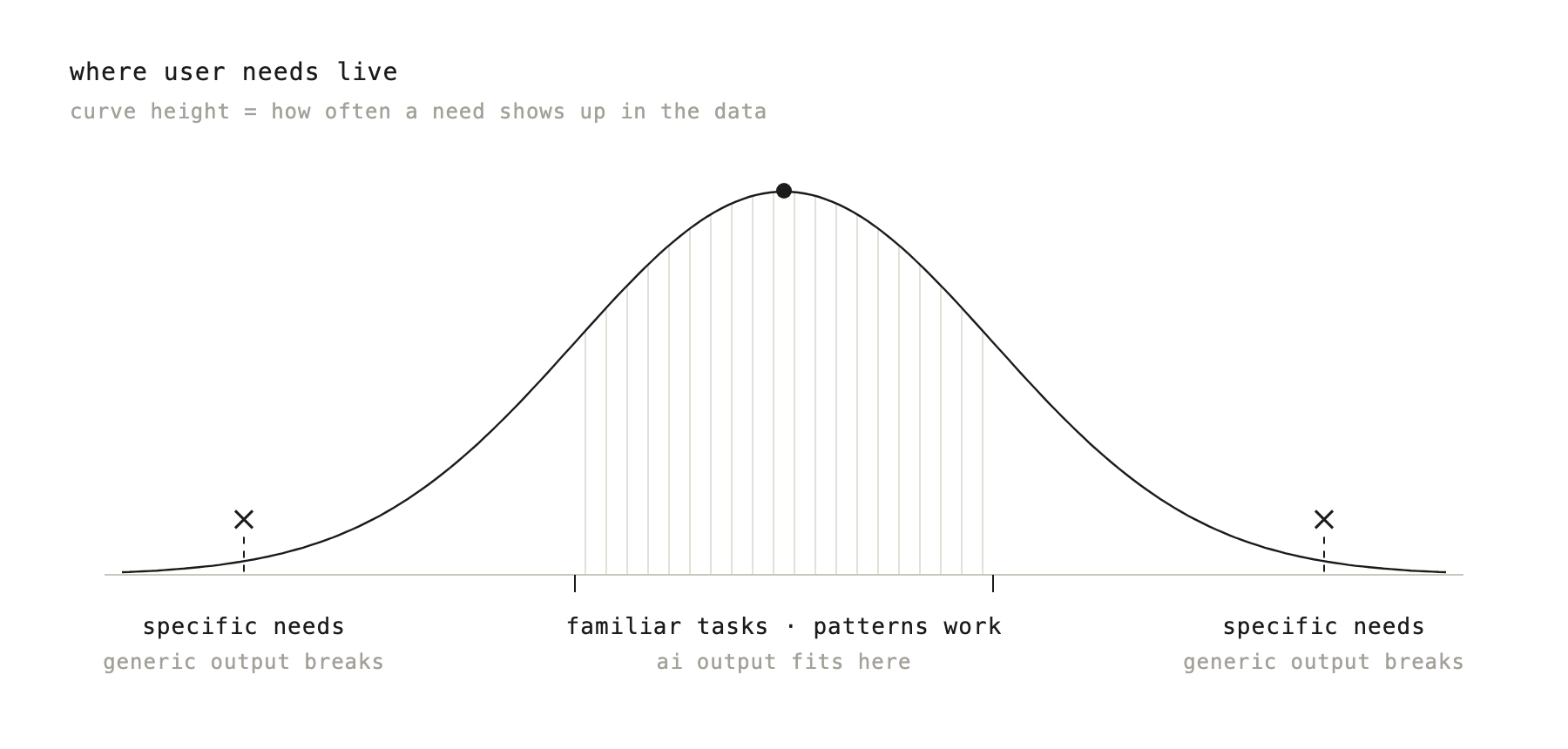
Generated work is strongest where needs are common, and weakest where a product actually earns its place.
That’s also why I think a strong point of view is becoming more valuable, not less. When the default output converges, anything that clearly comes from a specific person, for a specific user, stands out more than it used to.
The harder AI makes it to differentiate through execution, the more valuable human judgment becomes.
It can’t choose between two good options
“Taste” is the word everyone reaches for right now. I want to be more specific about what it means, because otherwise it sounds like a vibe you either have or don’t.
To me, taste is a decision. Given several options that all work, it’s the ability to say “this one” and explain why. It’s personal on purpose. Two great designers can look at the same set of screens and pick differently, and both can be right for their product.
Think about a song and its covers. The notes are the same. Most covers are perfectly competent. And yet one version makes you stop what you’re doing, and the rest you’d skip. The difference lives in tiny choices: timing, restraint, what was left out.
That’s where taste shows up in product work too. It’s sensitivity to small differences that most people can’t name, but can feel. A slightly calmer empty state. An error message that sounds like a person. A transition that’s 100 milliseconds shorter.
AI is excellent at producing the covers. It has no stake in which one is right for your users, your brand, or your moment. That choice is still yours, and it’s a muscle: the more good work you study closely, the sharper the small differences become.
It can’t sit inside a problem that isn’t defined yet
Most AI building workflows assume you already know what you want. Write the request, generate it, ship it. That’s a fine shape for building.
Design rarely works that way. The early part of a project is mostly not knowing. You sketch three directions, realize the question was wrong, go back, talk to someone, and only then start narrowing.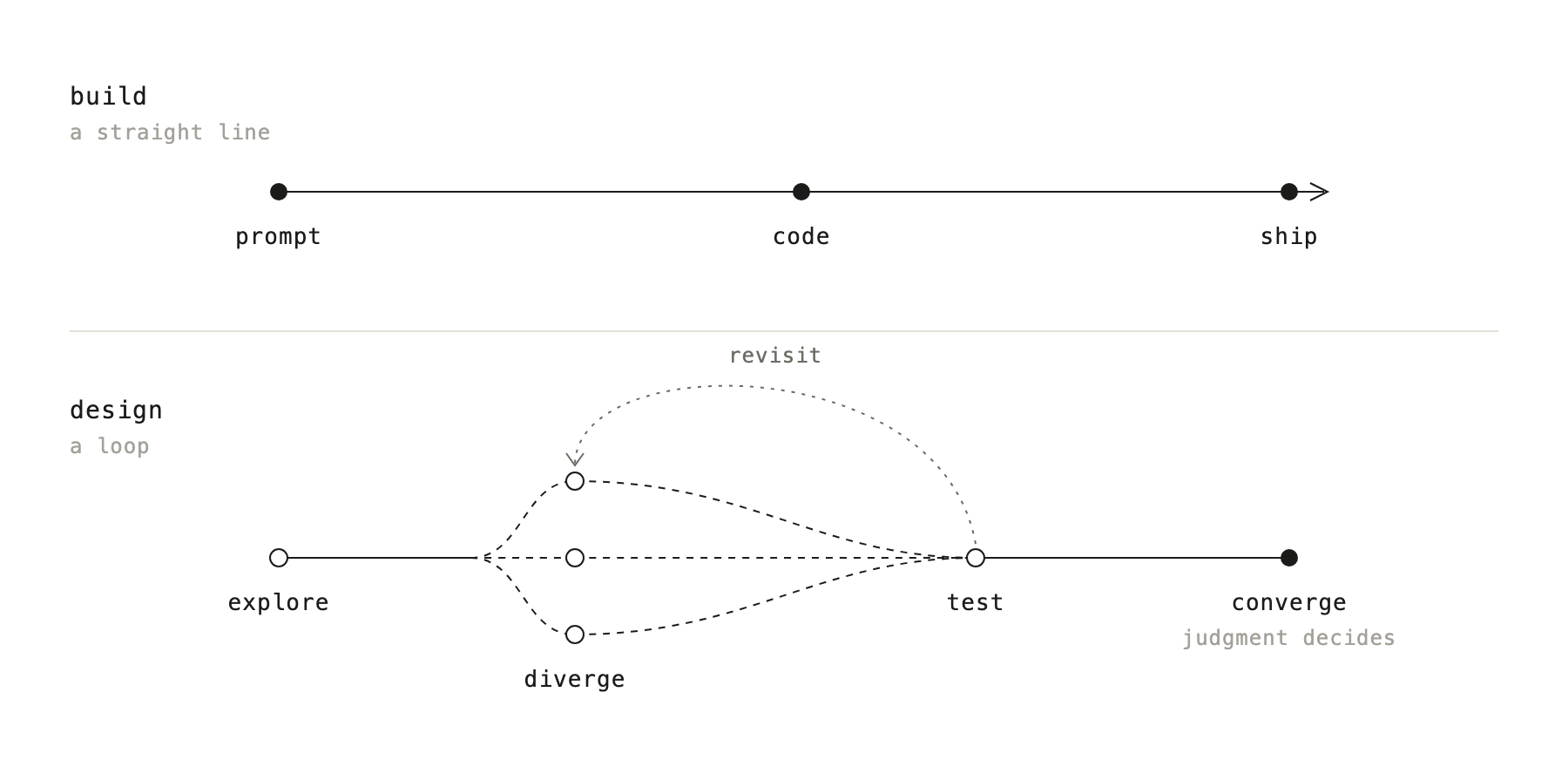
Building tolerates a straight line. Design needs room to loop.
This is why I’ve been talking about vibe designing: using AI loosely, to explore and get unstuck, without committing to details too early. It’s useful. But it’s a phase, not a process. At some point you have to stop exploring and make careful, accountable decisions, and knowing when you’ve hit that point is a judgment call the tool can’t make for you.
The same goes for work people call basic. Wireframes and layouts get treated as the part you hand off first. I’d argue the opposite. They’re where you decide what matters on a screen and what doesn’t, which is a lot like an editor cutting a draft: anyone can add, and the skill is in what you remove. Experienced designers still do this work by hand for a reason. The simplest artifacts often carry the most thinking.
You’re reading a guest perspective by Xinran Ma, author of Design with AI, published in The Strategy Stack.
The rest of this article explores why taste, user understanding, and strategic judgment matter more as AI makes building easier.
Subscribe for free to continue reading and join a community exploring the intersection of strategy, technology, and AI.
It can’t feel what a user won’t say
AI can read a hundred interview transcripts and give you a tidy summary in seconds. That’s genuinely helpful.
But a summary isn’t understanding. The most important things about users are often what they don’t put into words: the hesitation before they click, the workaround they’re slightly embarrassed about, the feature they asked for that isn’t what they need. You catch those by watching, by being in the room, by caring about the person on the other side of the screen.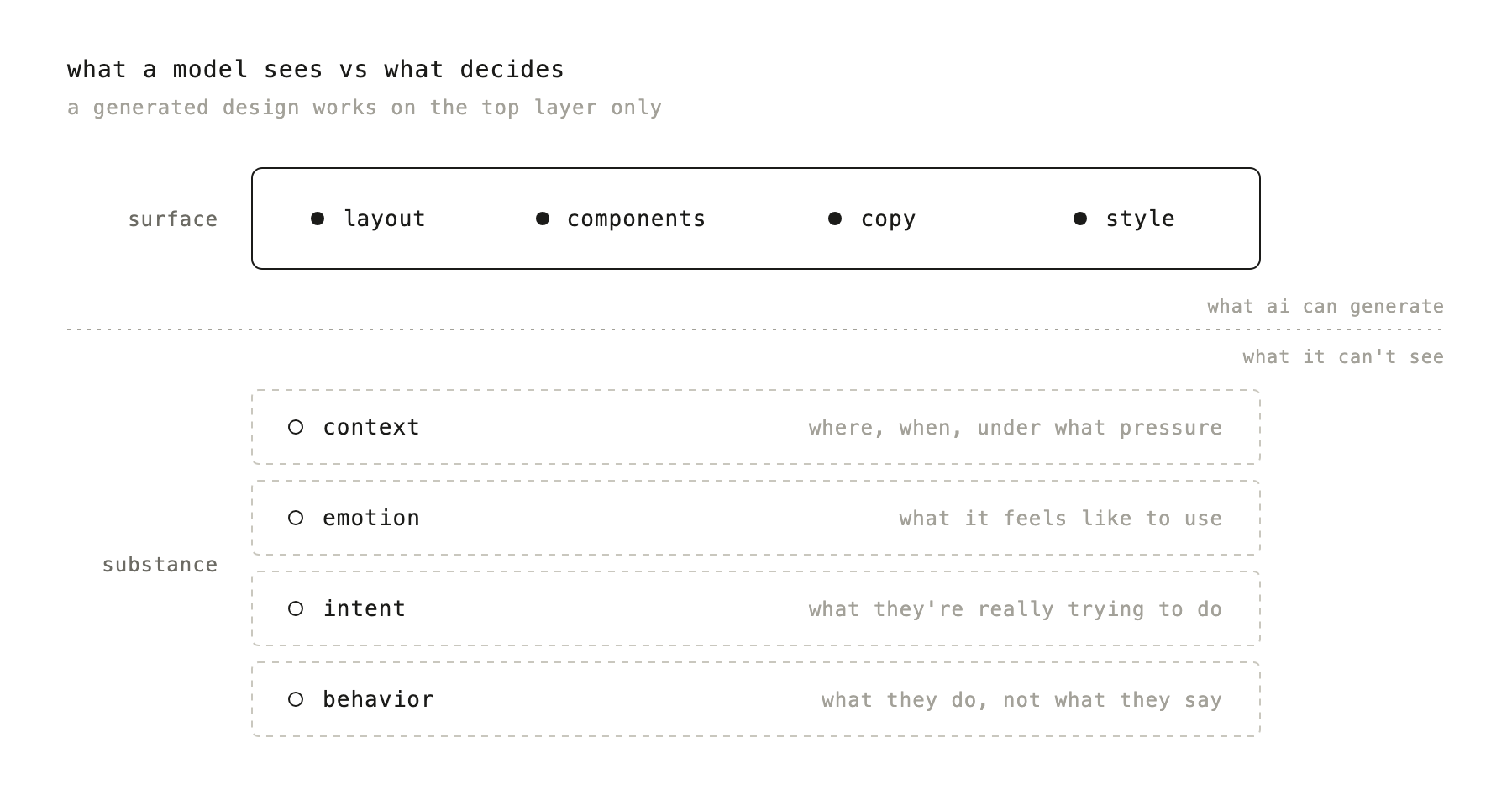
What a model can see is the layer on top. What decides whether a product works sits underneath.
That’s the gap I keep running into. Generated designs handle the visible layer well: layout, components, copy. What they can’t do is connect that layer to the human context underneath it, the emotion and intent and behavior that make one solution feel right and another feel slightly off.
The surface is easy to generate. The meaning under it still has to come from someone who understands people.
It can’t give a product a reason to exist
When teams say they want designers with taste, they usually don’t mean “makes things pretty.” They mean work that has a reason behind it. Something with a point of view that people can feel when they use it.
Claude Code is a good example. It’s a command-line tool. By any traditional measure of beautiful interface, there isn’t much to look at. And yet it’s clearly designed with a lot of care: the way the conversation flows, how much it shows you and when, how it feels to hand it a task and watch it work. People love using it, and very little of that love is about visuals.
That kind of design is about connecting decisions into a coherent experience. It’s hard to generate, because it was never only about the pixels.
More output can mean worse products
Here’s the uncomfortable part. Faster production doesn’t just fail to improve products. Sometimes it makes them worse.
The pattern I see most often comes from founders and teams without a design background. They’re confident they already know what users want. Before AI, building took long enough that reality had a chance to push back. Now they can go from idea to shipped in a weekend, so they skip the slow parts: watching real people use the thing, noticing where it confuses them, checking whether the problem was real.
AI makes that skipping even easier. It can produce user insights on demand, and those insights can be confidently wrong. It can produce a full set of wireframes before anyone has asked a single user a question.
The real risk isn’t bad screens. It’s losing the habit of thinking things through, and the curiosity to find out you were wrong. Ship faster than you learn for long enough, and you end up with a lot of product and very little understanding.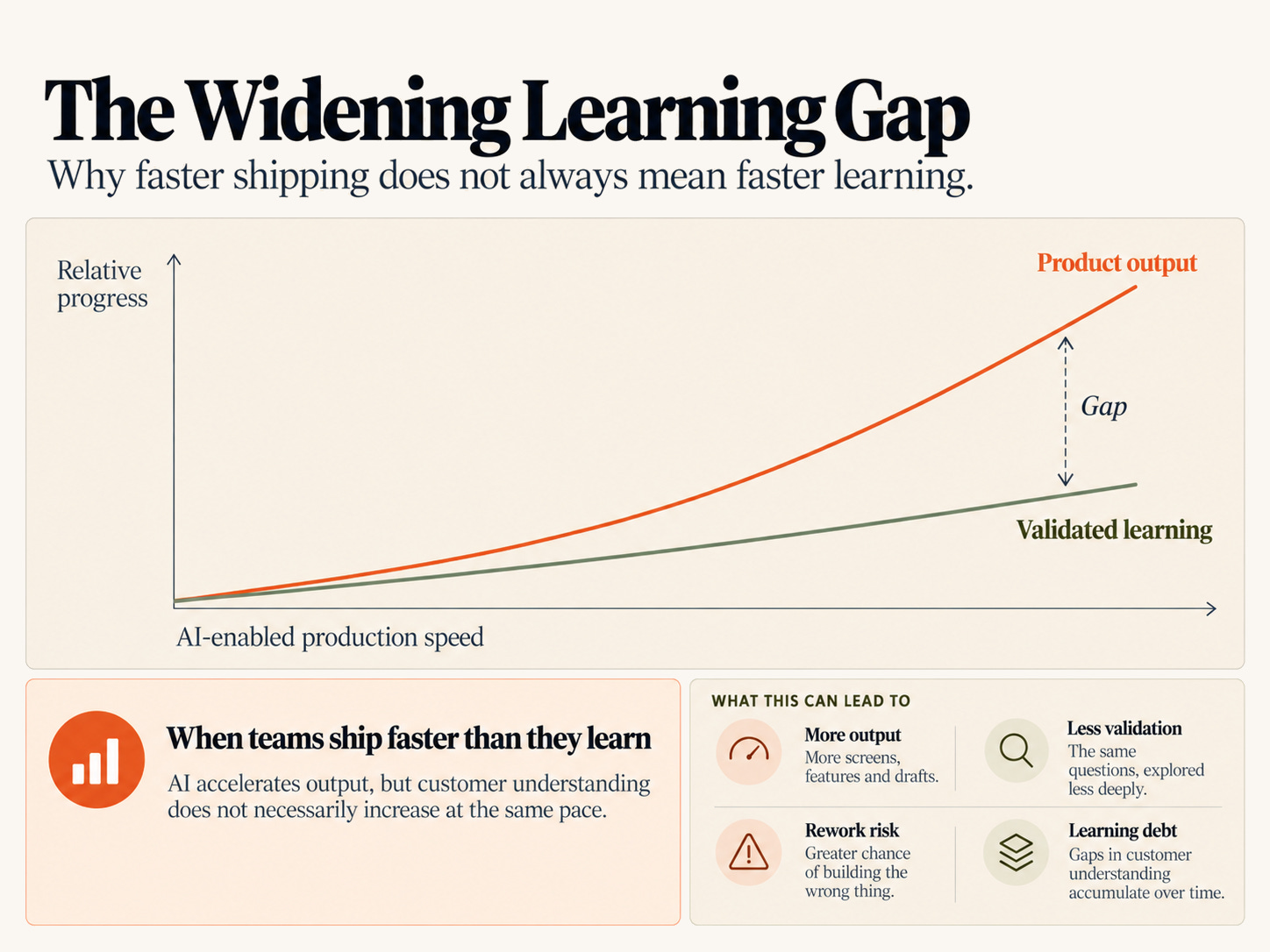
What I’d focus on as a designer right now
If you’re wondering where to put your energy, here’s where I’d put mine.
Know why you’re doing this. Early in my career, a mentor asked me why I’d chosen product design, and I’ve come back to that question many times. For most of us, the answer is some version of wanting to make things better for people. If that’s your anchor, new tools stop feeling like threats. They become more ways to do the thing you already care about, and that keeps you curious enough to keep learning.
Let your opinions form slowly. A point of view isn’t something you adopt to stand out. That kind of difference is hollow, and people can tell. Real opinions come from making things, seeing how they land, and noticing what you keep coming back to. Tools change every few weeks. A well-earned opinion doesn’t expire with them.
Train your eye deliberately. Pick an app you use every day, choose one task, and go through it slowly as a user. Ask whether each step serves that task, visually and in how it behaves. Then talk it through with designers you respect: what’s working, what isn’t, and why. Explaining your reasoning out loud sharpens it faster than anything else I know.
Learn to build, but don’t give up your depth. It’s great that people can now build more of what they imagine. The handoff between design and engineering has frustrated both sides for years. But time is finite. Go deep on what genuinely interests you, and protect the skills that make your perspective yours.
AI will keep improving. It will take in more context, understand more behavior, and some of what I’ve listed here will get smaller.
But products have never been good because they had enough screens. They’re good because someone decided what should exist, for whom, and why, and then had the patience to check.
That someone is still you.