A modern strategy toolkit for navigating uncertainty, making better choices, allocating resources, and turning strategic intentions into measurable outcomes.
By Alex Pawlowski
Published: 2026-10-31
URL: https://thestrategystack.substack.com/p/best-free-strategy-planning-templates-2026

THE STRATEGY STACK · FIELD GUIDE · OCTOBER 2026
Strategy does not fail because organizations lack templates.
It fails when analysis produces no meaningful choices, strategic priorities compete for the same resources, and execution continues long after the assumptions behind the plan have changed.
Most organizations have experienced some version of this problem.
A leadership team completes a strategic planning workshop. The resulting presentation includes market analysis, ambitious objectives, and an impressive implementation roadmap.
Everyone agrees on the direction.
Three months later, departments are pursuing different interpretations of the strategy, the most important assumptions remain untested, and operational reporting concentrates on whether activities were completed rather than whether anything meaningful improved.
The problem is not necessarily the quality of the analysis.
It is the absence of a connected system for making and revising strategic decisions.
Traditional strategy templates were frequently designed around discrete planning activities: analyzing an industry, assessing organizational strengths, defining objectives, or preparing an annual plan.
Those activities remain useful. But they are insufficient when customer needs evolve continuously, technologies reshape competitive boundaries, and strategic opportunities emerge faster than conventional planning cycles can accommodate.
Contemporary strategy requires a different combination of tools.
Organizations need to detect change, understand how value is created, evaluate strategic alternatives, test critical assumptions, allocate scarce resources, coordinate execution, and continuously learn from evidence.
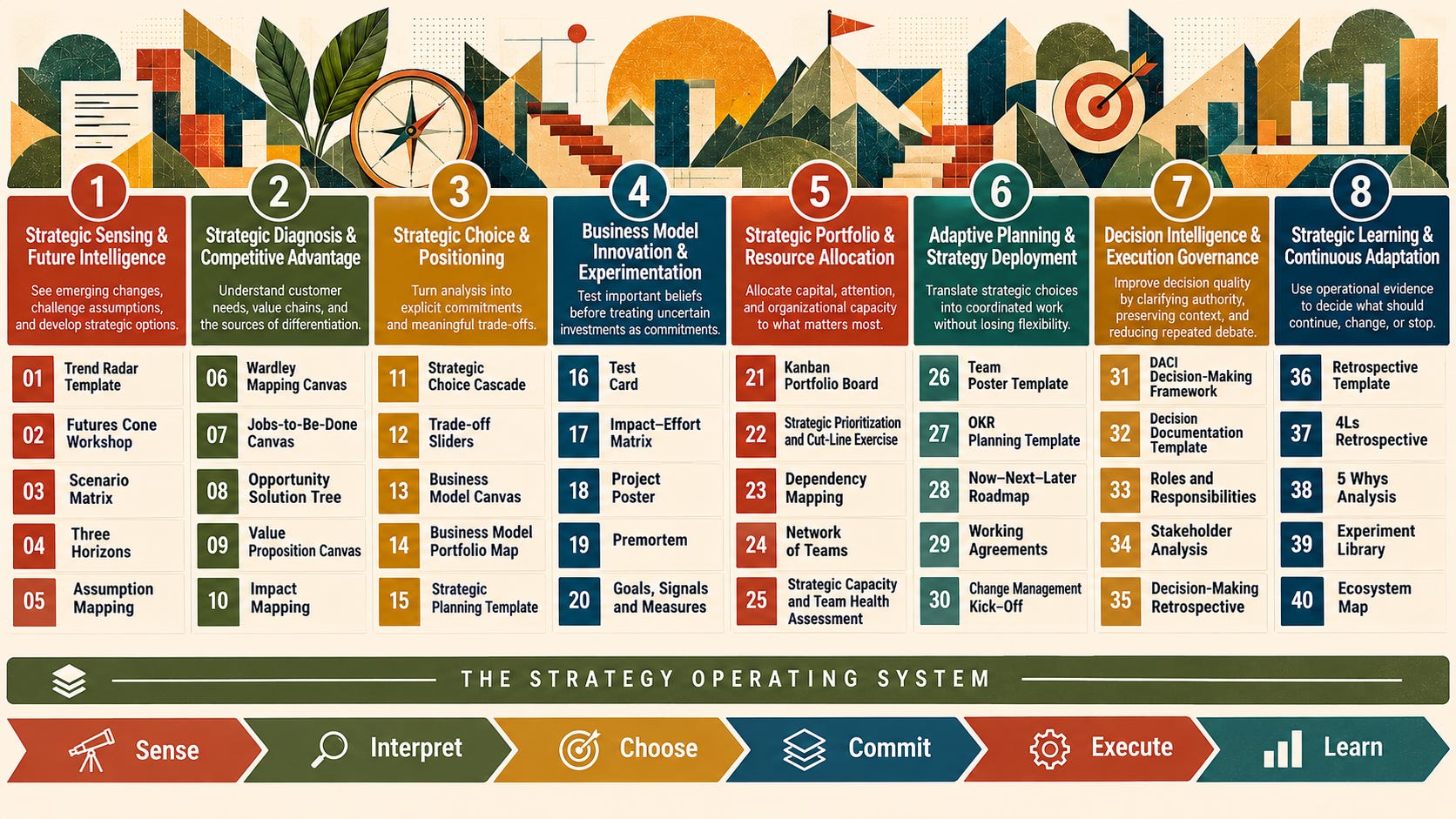
This collection brings together 40 publicly accessible strategy templates, canvases, and guided worksheets organized around eight capabilities:
-
Strategic Sensing & Future Intelligence
-
Strategic Diagnosis & Competitive Advantage
-
Strategic Choice & Positioning
-
Business Model Innovation & Experimentation
-
Strategic Portfolio & Resource Allocation
-
Adaptive Planning & Strategy Deployment
-
Decision Intelligence & Execution Governance
-
Strategic Learning & Continuous Adaptation
Each resource is selected for a practical purpose: to improve a strategic decision or make an important part of execution more effective.
The directory is followed by six original TSS implementation frameworks, a worked strategic transformation example, and a 30-day plan for connecting these tools into a functioning strategy operating system.
The objective is not to complete 40 templates. It is to build a more adaptive, evidence-driven way of practicing strategy.
What counts as a free template?
The collection includes three kinds of resources:
Free download: A reusable document, PDF, poster, or worksheet available without purchasing a product. Some providers may request free registration.
Free collaborative template: A board or editable workspace available through a provider’s free offering, subject to account and plan limitations.
Free guided worksheet: Public instructions for creating a structured strategic artifact, even when the provider does not offer a separate downloadable file.
A free explanation of a method is not automatically an editable template. Similarly, a paid facilitation product is not included simply because its introductory article is public.
When using collaborative tools for sensitive strategy discussions, organizations should assess access permissions, data handling, confidentiality, and retention requirements.
Explore The Strategy Stack
Practical frameworks for navigating AI, technology, and strategic change.
-
Start Here — Discover the publication and our most useful resources.
-
Watch on YouTube — Conversations and insights on strategy, innovation, and AI.
-
Follow on Instagram — Visual cheat sheets, frameworks, and practical ideas worth saving.
Section 01 — Strategic Sensing & Future Intelligence
See emerging changes, challenge assumptions, and develop strategic options before the future becomes obvious.
Traditional environmental scans often produce lists of trends without explaining how those trends should affect strategic choices.
Modern strategic sensing is more demanding.
A useful sensing system distinguishes observations from interpretations, identifies uncertainty, connects possible changes to organizational capabilities, and creates explicit triggers for action.
The following five resources help teams examine uncertainty without pretending to predict the future.
01. Trend Radar Template
Provider: FIBRES, via Miroverse
Resource: Trend Radar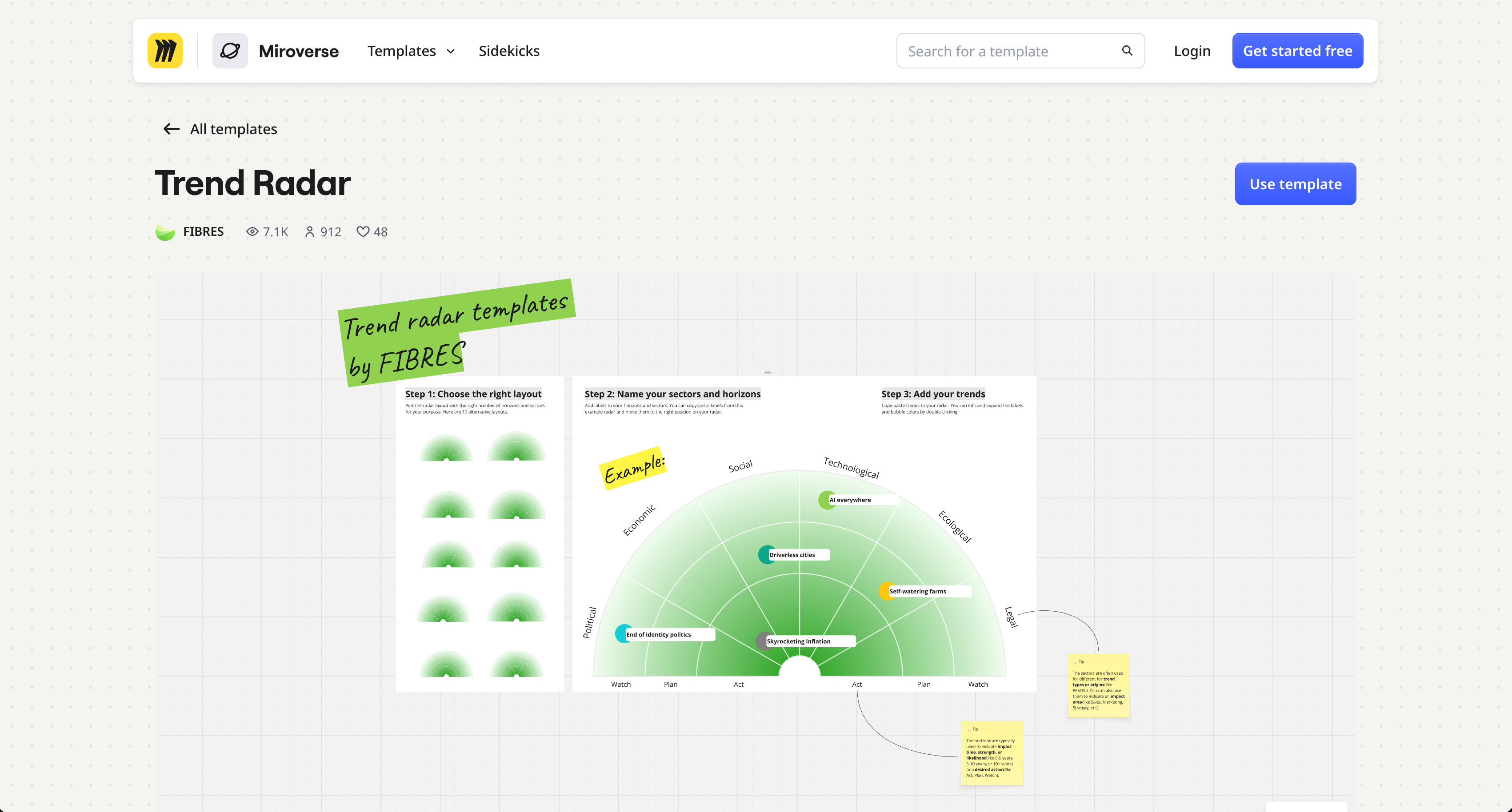
The Trend Radar provides a visual structure for organizing signals and trends across business domains and time horizons.
Rather than treating all trends as equally important, teams can identify which developments are relevant, when their effects might emerge, and which issues deserve monitoring.
Best for: Strategy teams, innovation leaders, and market intelligence functions.
Practical application: Select five external developments relevant to your organization. Record the supporting evidence, potential timing, affected capabilities, and strategic decisions each development might influence.
What to take away: An approach to continuous environmental monitoring rather than a one-off trend presentation.
Output: A strategic signals radar with named monitoring responsibilities.
Access: Public collaborative template; free-account conditions apply.
02. Futures Cone Workshop
Provider: Peter Horvath, via Miroverse
Resource: Futures Cone Workshop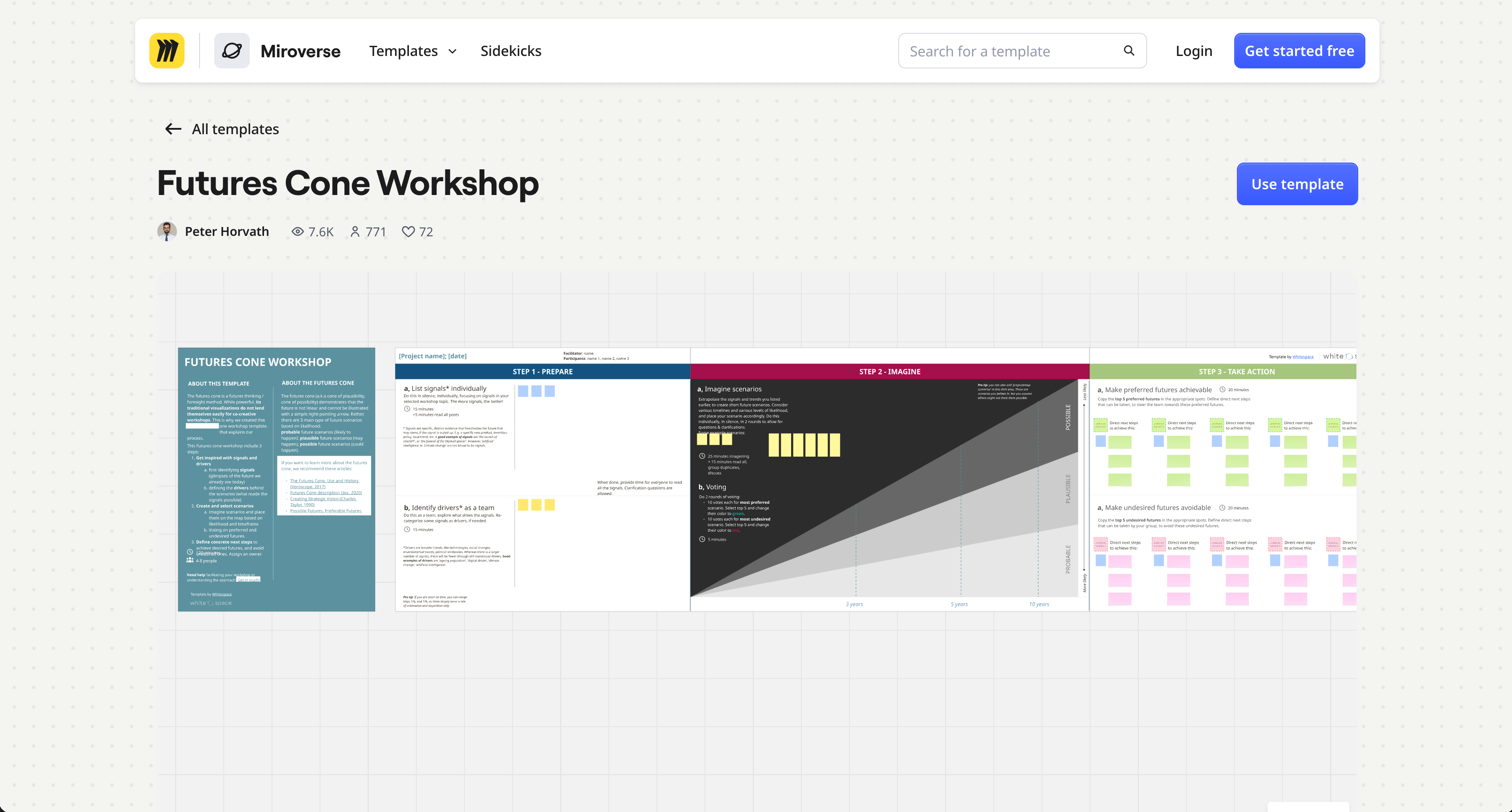
The Futures Cone helps teams distinguish possible, plausible, probable, and preferable futures.
It is particularly useful when technological or market changes make conventional point forecasts unreliable.
The objective is not to determine precisely what will happen, but to expand the range of futures considered during strategic decision-making.
Best for: Long-range planning, technology strategy, and scenario workshops.
Practical application: Select a strategic uncertainty, such as the effect of AI on professional services. Explore different future developments and identify their implications for your organization.
What to take away: A structured method for considering multiple futures without treating one forecast as inevitable.
Output: A map of alternative futures, emerging risks, and potential strategic responses.
Access: Public collaborative template.
03. Scenario Matrix
Provider: Tiremesù, via Miroverse
Resource: Scenario Matrix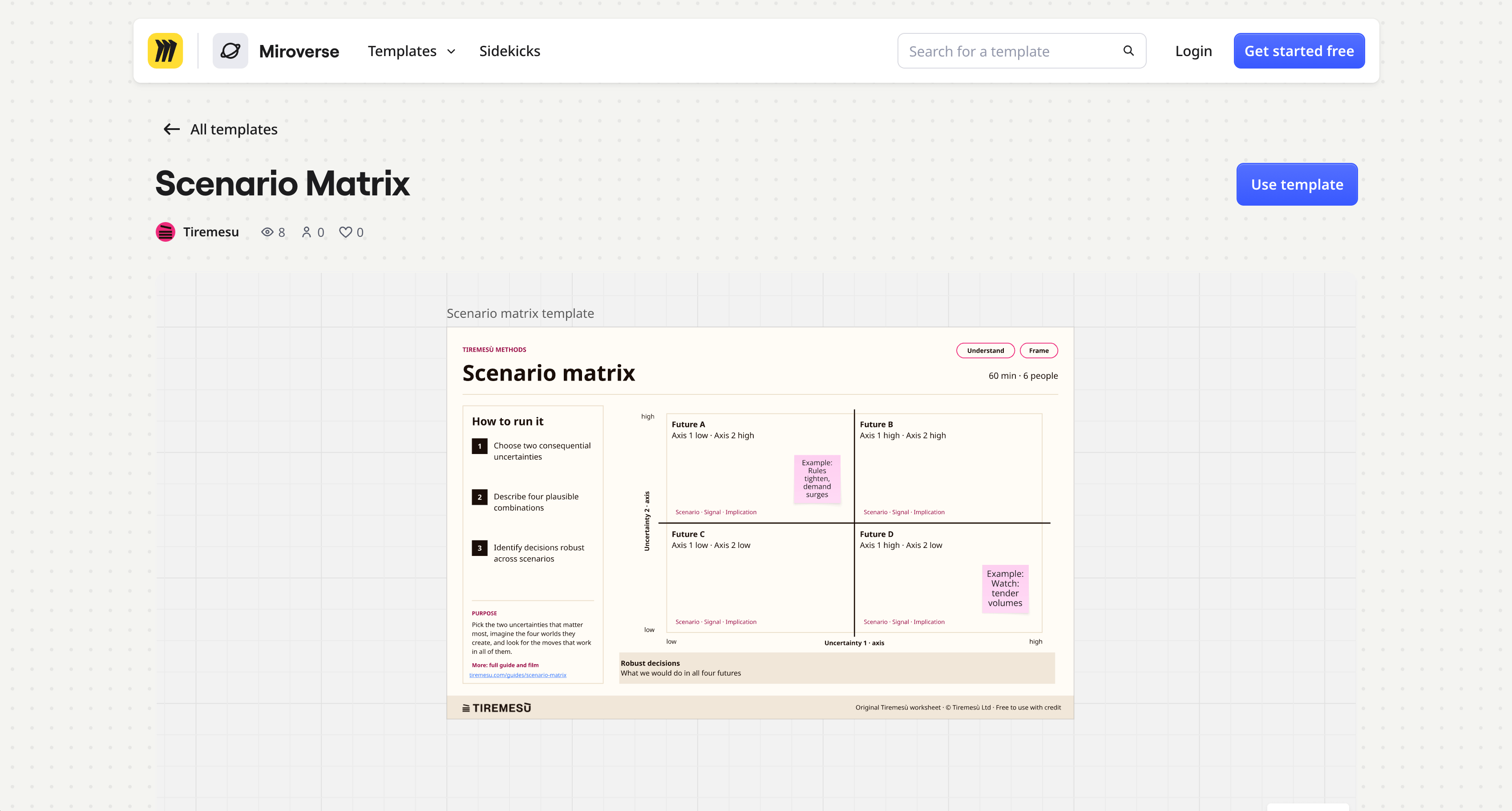
The Scenario Matrix organizes two critical uncertainties into four possible future environments.
Its usefulness comes from connecting uncertainty to practical decisions.
Some investments may remain valuable across several scenarios. Others depend on specific developments and should be treated as conditional commitments.
Best for: Leadership teams making investments under uncertainty.
Practical application: Identify two independent uncertainties that could substantially influence your organization. Develop four scenarios and distinguish robust strategic moves from conditional investments.
What to take away: A method for identifying strategic actions that remain sensible across different possible futures.
Output: Four scenarios, relevant indicators, and a portfolio of robust and conditional responses.
Access: Public collaborative worksheet.
04. Three Horizons
Provider: Tiremesù, via Miroverse
Resource: Three Horizons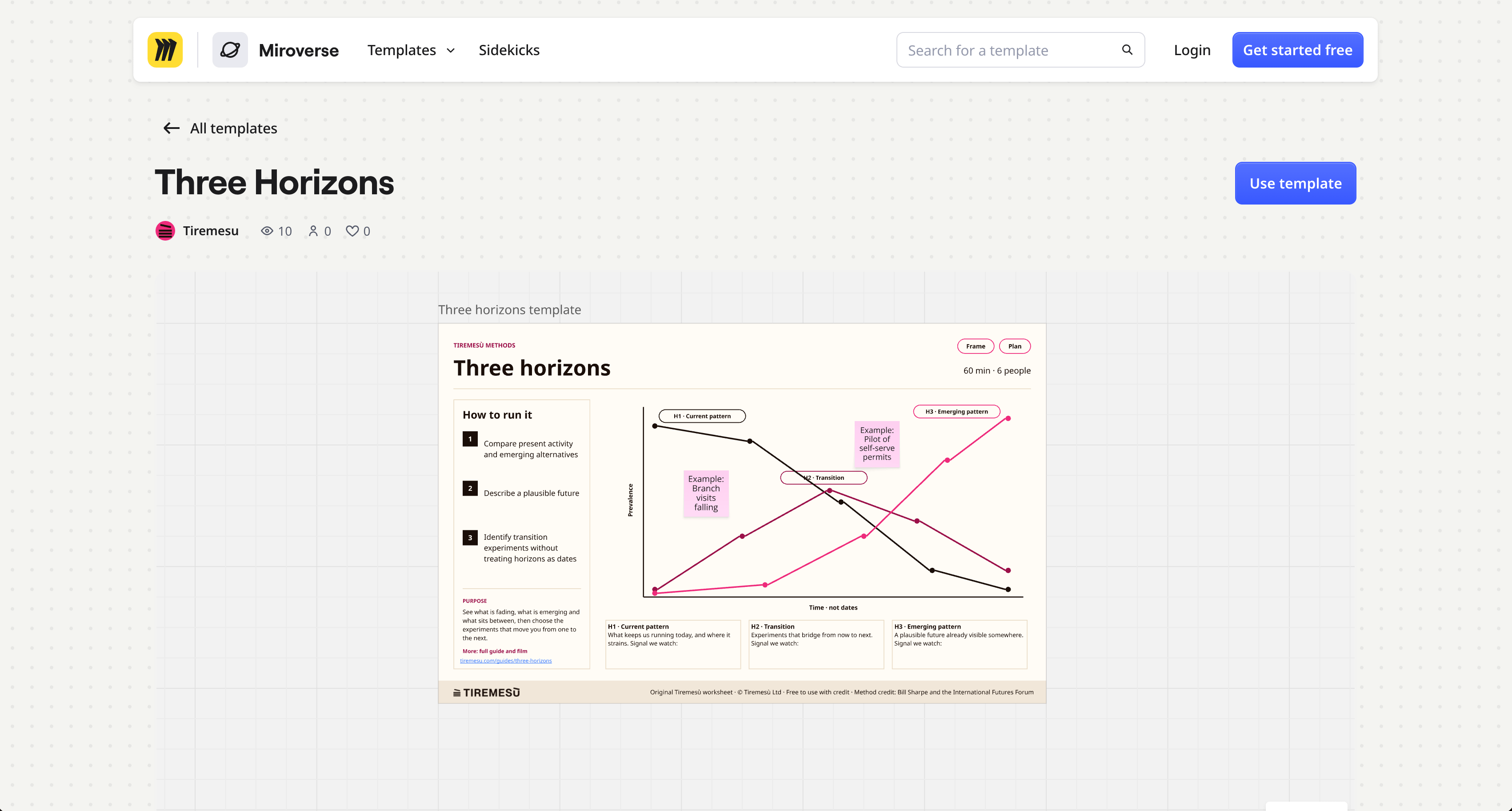
Three Horizons examines the relationship between today’s established operating model, emerging alternatives, and a desirable future system.
It is valuable when organizations must continue supporting existing businesses while preparing for structural change.
The framework helps teams examine transition paths rather than treating present and future business models as isolated subjects.
Best for: Corporate transformation, innovation portfolio design, and long-term capability planning.
Practical application: Map the capabilities supporting your current business, identify where their relevance could weaken, and define transitional experiments that support future possibilities.
What to take away: A structured view of how current operations and emerging opportunities compete for organizational attention.
Output: A transition map connecting existing operations, emerging initiatives, and future capabilities.
Access: Public collaborative template.
05. Assumption Mapping
Provider: Tiremesù, via Miroverse
Resource: Assumption Mapping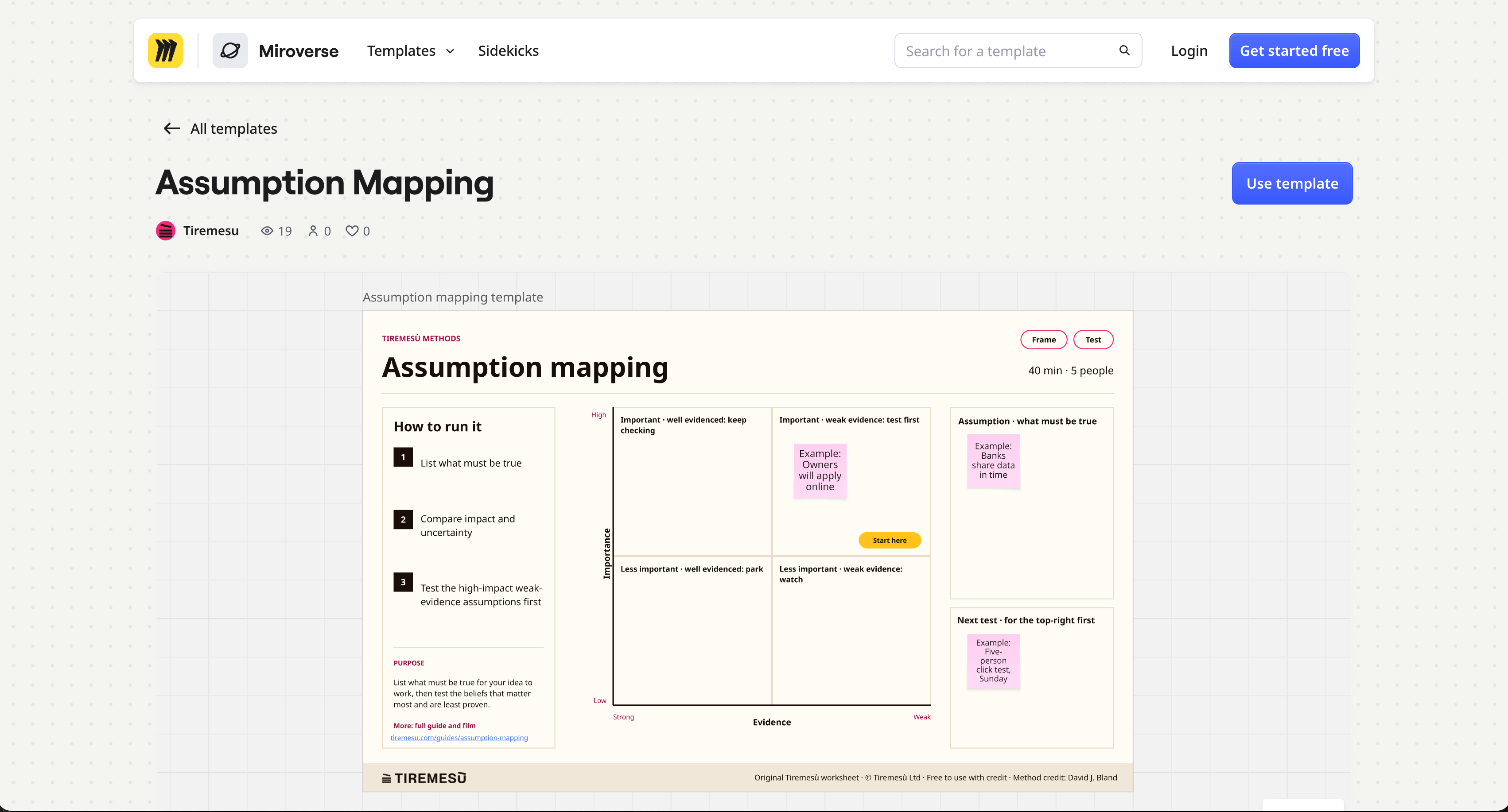
Assumption Mapping makes the hidden beliefs underpinning a strategy explicit.
The template compares the importance of an assumption with the strength of evidence supporting it.
This helps teams identify which uncertainties are dangerous to leave untested.
Best for: Strategic investment decisions, innovation initiatives, and uncertain market entry.
Practical application: List the assumptions behind one strategic initiative. Evaluate each by importance and supporting evidence. Identify those requiring immediate investigation.
What to take away: A more disciplined understanding of the beliefs on which a strategic choice depends.
Output: A prioritized assumptions map and evidence-development agenda.
Access: Public collaborative worksheet.
Section 01 implementation checkpoint
A useful strategic sensing process should produce more than a collection of trends.
At minimum, document what has changed, why it matters, which assumptions it challenges, what action may become necessary, and what evidence would trigger that action.
Expected deliverable: A strategic intelligence record connecting external signals, uncertainties, assumptions, and decisions.
Read next
Good strategy requires more than analysis, planning documents, and ambitious objectives. It depends on an organization’s ability to recognize emerging opportunities, make deliberate choices, allocate resources, and adapt when new evidence challenges its assumptions. Modern strategy frameworks can support these activities, but their real value emerges when individual templates become part of a connected system for decision-making, execution, and continuous learning.
These collections are free to read:
-
The AI Research Stack: 30 Free Tools for Finding Better Answers — Research tools for investigating markets, analyzing competitors, validating assumptions, identifying emerging trends, and strengthening the evidence behind strategic decisions.
-
The AI Workflow Library: 30 Real-World Examples for Business Teams — Thirty practical workflows for connecting research, analysis, decision-making, operations, and business execution through AI-assisted processes and automation.
-
The AI Prompt Library for Work: 50 Templates That Solve Real Problems — Fifty reusable prompts for strategic thinking, market research, problem-solving, scenario exploration, business planning, and professional decision-making.
-
The Enterprise AI Playbook Library: 30 Free Guides, Frameworks and Implementation Resources — A curated library covering enterprise AI strategy, organizational readiness, governance, operating models, deployment, and value realization, with practical implementation frameworks and a 90-day roadmap.
Build your modern strategy operating system
-
Operator Vault — 120+ PDFs, practical frameworks, implementation kits, and reusable templates for strategic analysis, decision-making, business model innovation, resource allocation, organizational transformation, and execution.
-
Stack Atlas — Explore how strategic choices, competitive advantage, organizational capabilities, business models, operating systems, and emerging technologies connect across The Strategy Stack.
Essays and curated resource collections remain free. Operator provides deeper implementation materials for turning strategic thinking into repeatable organizational capabilities, including strategy canvases, prioritization matrices, decision records, portfolio management frameworks, operating-model templates, and performance review tools.
The complete Strategy Template Library brings together 40 free templates, canvases, and guided worksheets across eight strategic capabilities: future intelligence, competitive diagnosis, strategic choices, business model experimentation, portfolio allocation, adaptive planning, execution governance, and continuous learning. Subscribe free to The Strategy Stack to access the remaining 35 resources, six original strategy implementation frameworks, and a worked example showing how a professional services firm can connect strategic sensing, competitive positioning, resource allocation, and execution. You’ll also find a six-stage Strategy Operating System, practical decision-making tools, and a 30-day implementation sprint for turning disconnected planning activities into a coherent, adaptive strategy process.
Section 02 — Strategic Diagnosis & Competitive Advantage
Understand customer needs, evolving value chains, and the sources of strategic differentiation.
A compelling market opportunity is not automatically an attractive strategic position.
Organizations must understand what customers are trying to accomplish, how value reaches them, which capabilities are becoming standardized, and where meaningful differentiation can be sustained.
Modern competitive diagnosis therefore combines customer evidence with an understanding of the systems and dependencies that shape competition.
06. Wardley Mapping Canvas
Provider: Miro
Resource: Wardley Mapping Canvas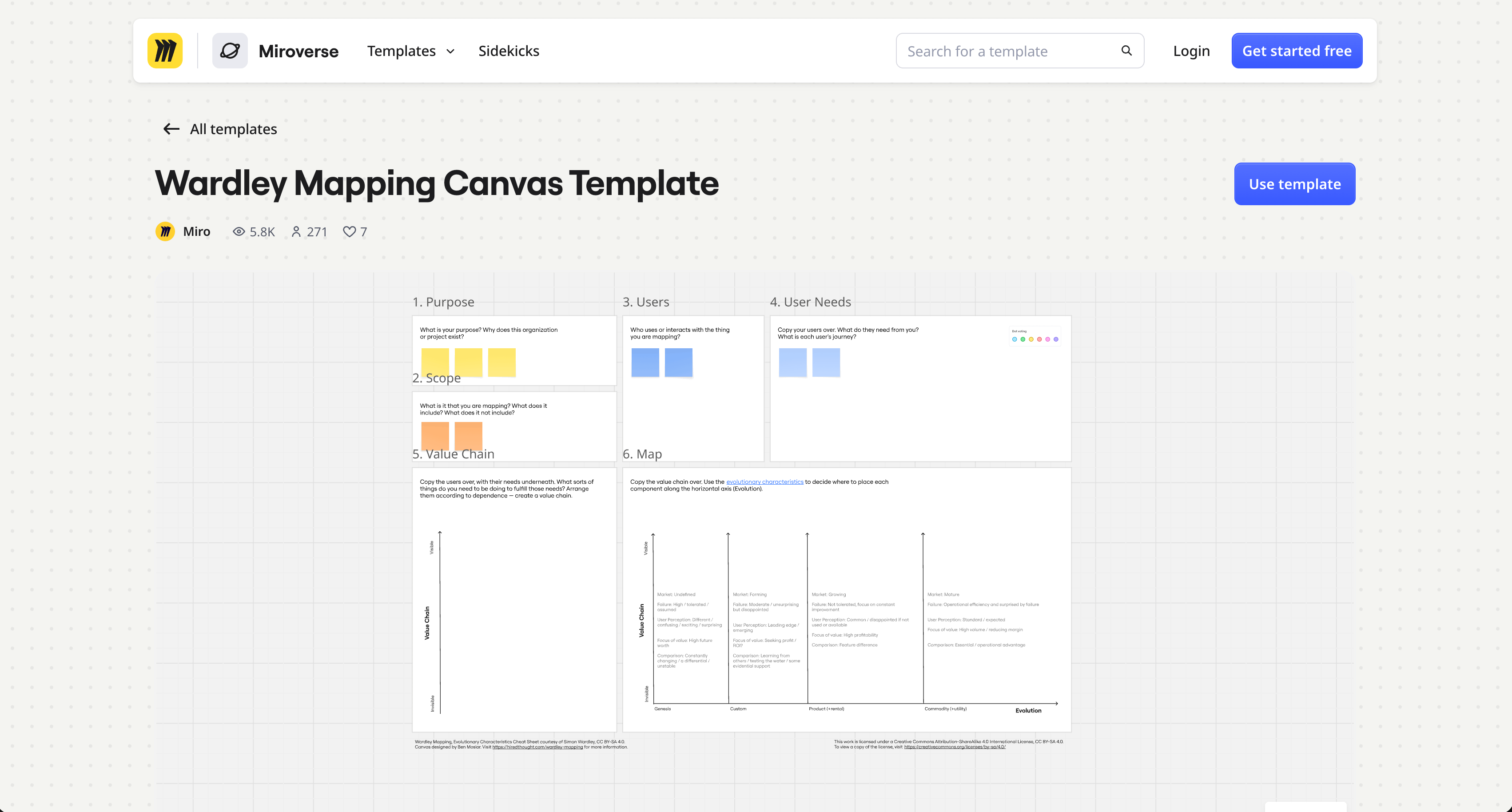
Wardley Mapping positions components of a value chain according to their visibility to users and their stage of evolution.
It helps leaders recognize that capabilities are not static. Emerging activities may eventually become products, standardized services, or commodities.
This creates strategic implications for investment, differentiation, and sourcing.
Best for: Technology strategy, platform decisions, ecosystem analysis, and competitive positioning.
Practical application: Map the capabilities required to deliver one customer outcome. Identify which capabilities should differentiate the organization and which could be sourced as standardized services.
What to take away: A dynamic perspective on value creation and competitive position.
Output: An evolving value-chain map and strategic capability hypotheses.
Access: Public collaborative template.
07. Jobs-to-Be-Done Canvas
Provider: Miro template community
Resource: Jobs-to-Be-Done Templates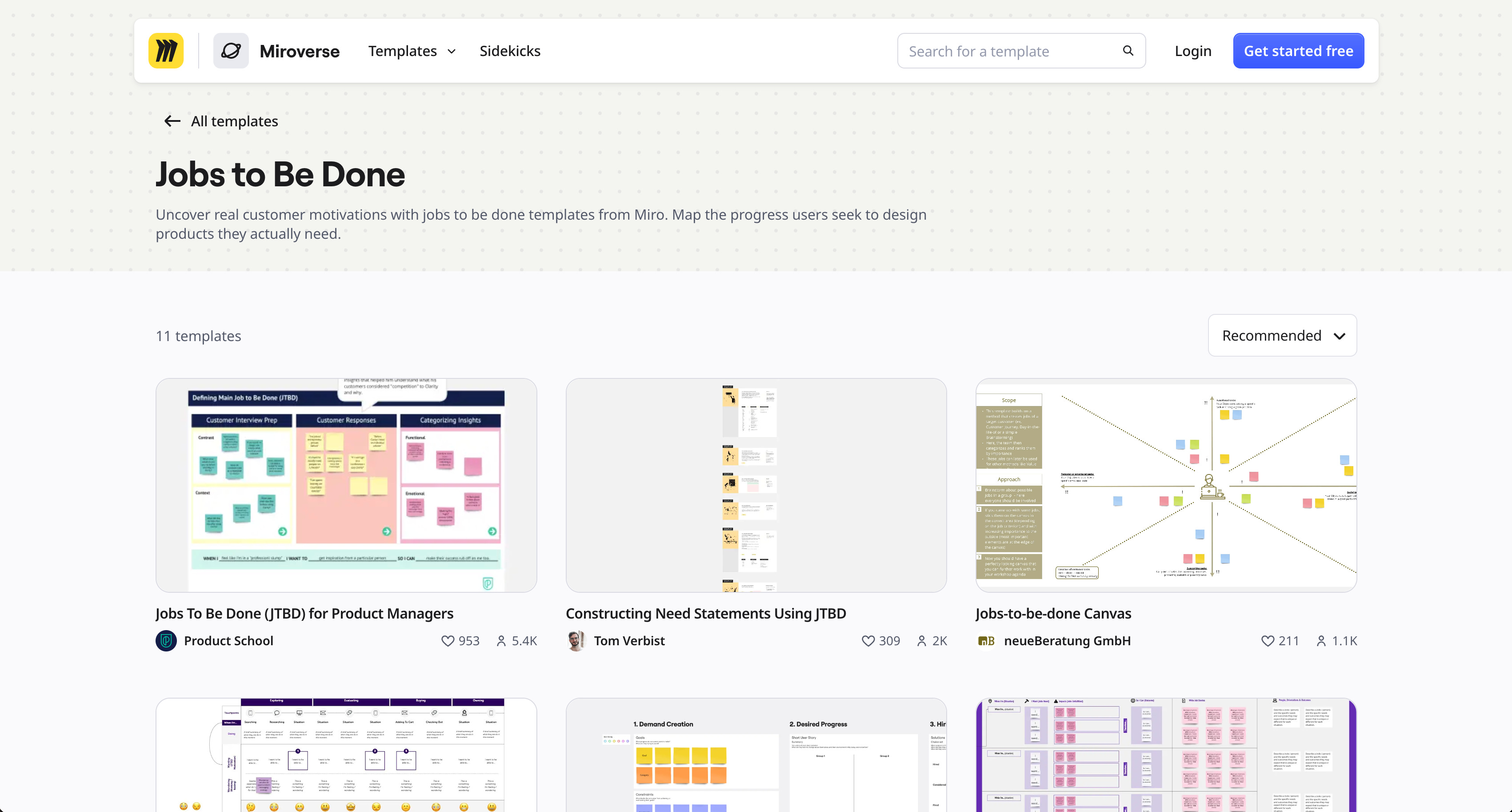
Jobs-to-Be-Done focuses on the progress customers seek rather than relying exclusively on demographic personas or conventional product categories.
Its central contribution is to reveal demand from the customer’s perspective.
Best for: Customer strategy, product discovery, market opportunity identification, and service innovation.
Practical application: Interview customers about a recent purchasing or workflow decision. Identify the situation, desired progress, competing alternatives, and obstacles encountered.
What to take away: A clearer understanding of the underlying customer problem rather than the features customers say they want.
Output: Customer job statements and evidence-backed unmet needs.
Access: Public template gallery; select a specific collaborative template.
08. Opportunity Solution Tree
Provider: Miro template community
Resource: Opportunity Solution Tree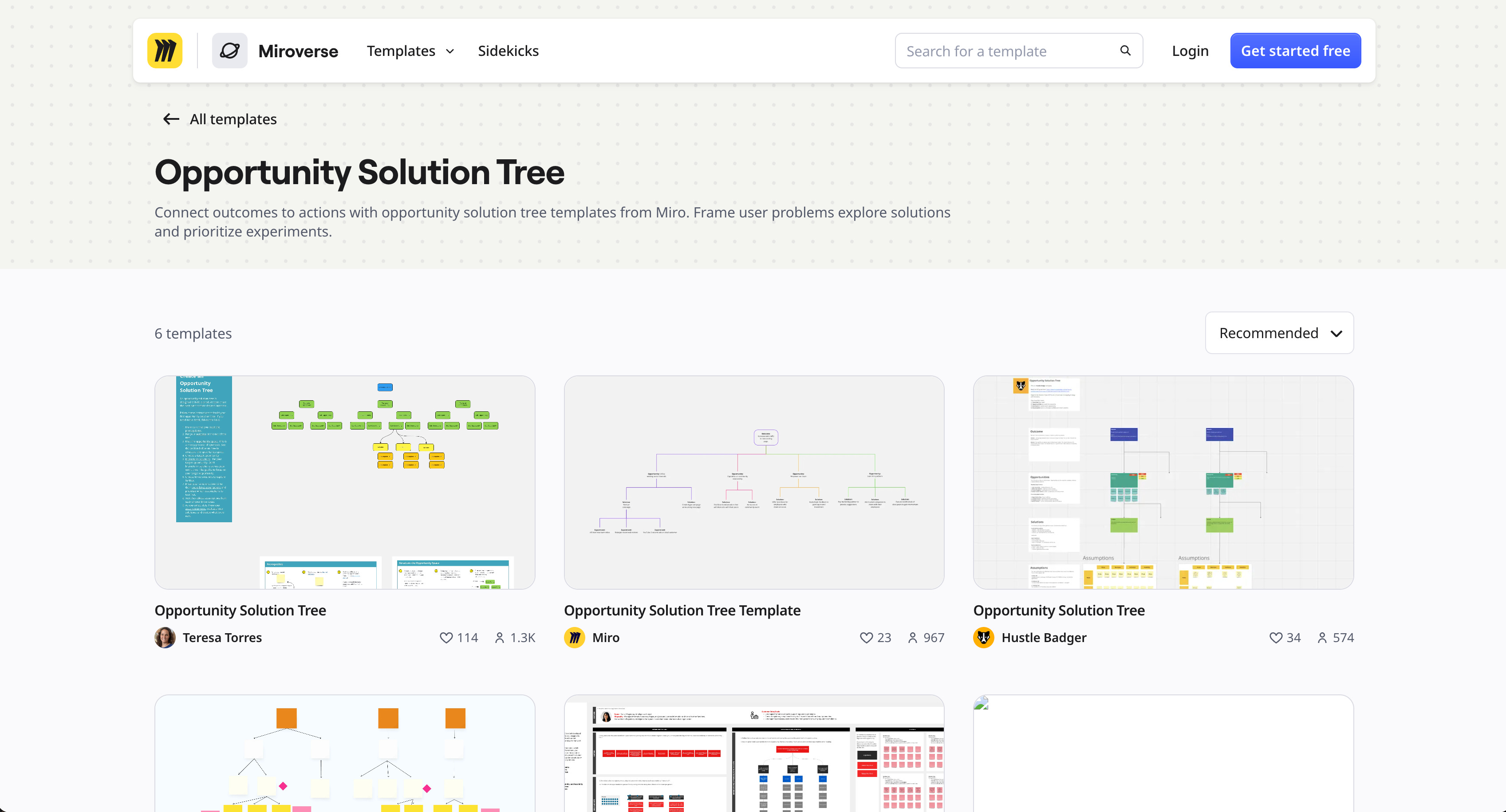
An Opportunity Solution Tree connects a desired outcome to customer opportunities, potential solutions, and experiments.
It prevents teams from committing prematurely to one attractive solution without understanding the broader opportunity landscape.
Best for: Continuous discovery, product strategy, and evidence-driven innovation.
Practical application: Define one measurable outcome. Identify customer problems associated with it, generate multiple possible interventions, and specify tests for the most promising options.
What to take away: A structure for keeping opportunity discovery connected to the business outcome.
Output: An opportunity hierarchy linked to solution hypotheses and experiments.
Access: Public collaborative template gallery.
09. Value Proposition Canvas
Provider: Strategyzer
Resource: Value Proposition Canvas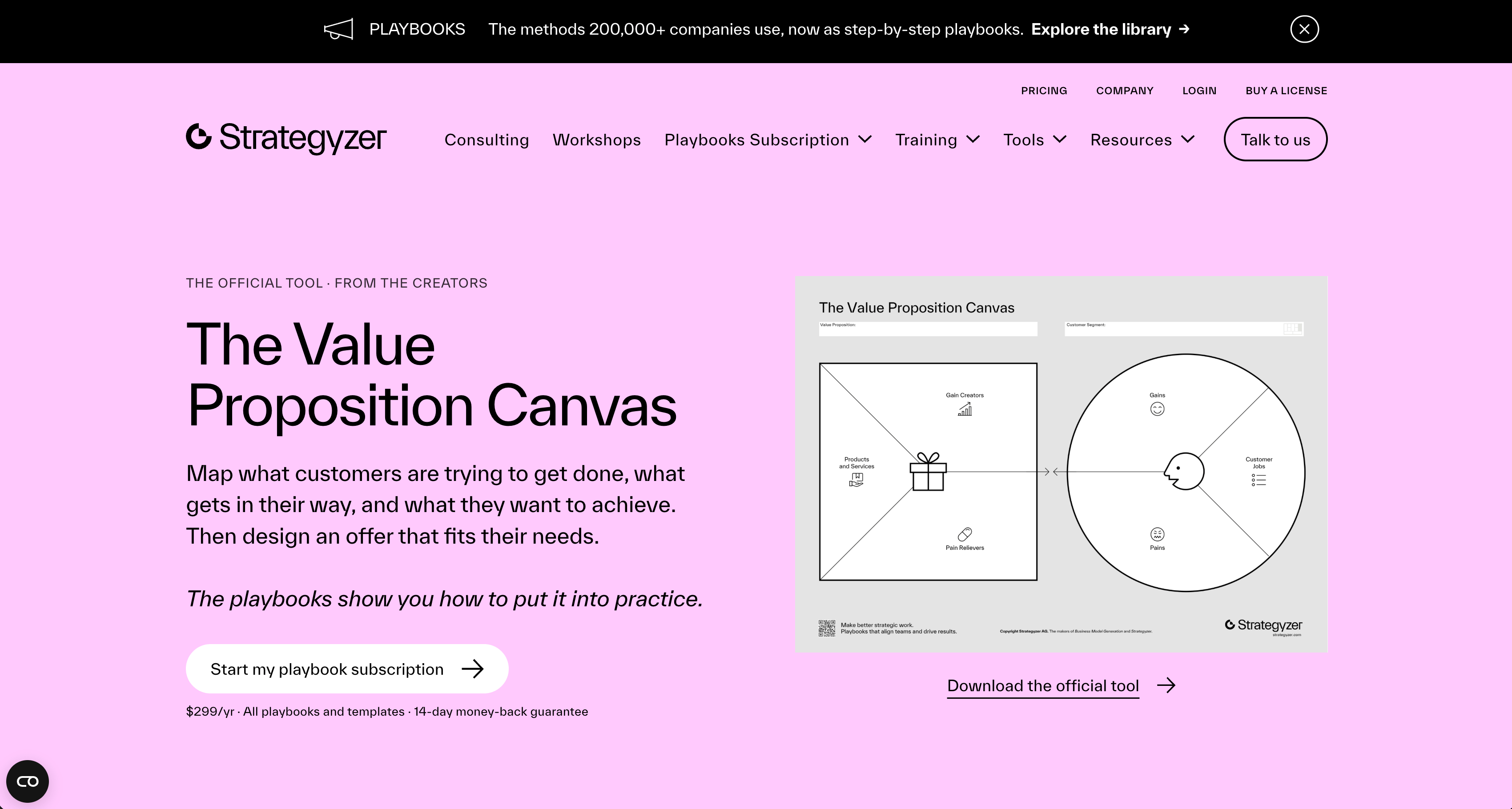
The Value Proposition Canvas connects customer jobs, pains, and gains to the products, services, and value propositions intended to address them.
Its value depends on treating the proposed fit as a hypothesis until customer evidence supports it.
Best for: Positioning, product development, service design, and go-to-market strategy.
Practical application: Complete one canvas for a specific customer segment. Identify the assumptions that matter most and validate them through customer research.
What to take away: A disciplined way to connect a proposed offering with a defined customer need.
Output: A testable customer-value proposition.
Access: Free official template; guided playbooks may be paid.
10. Impact Mapping
Provider: Miro
Resource: Impact Mapping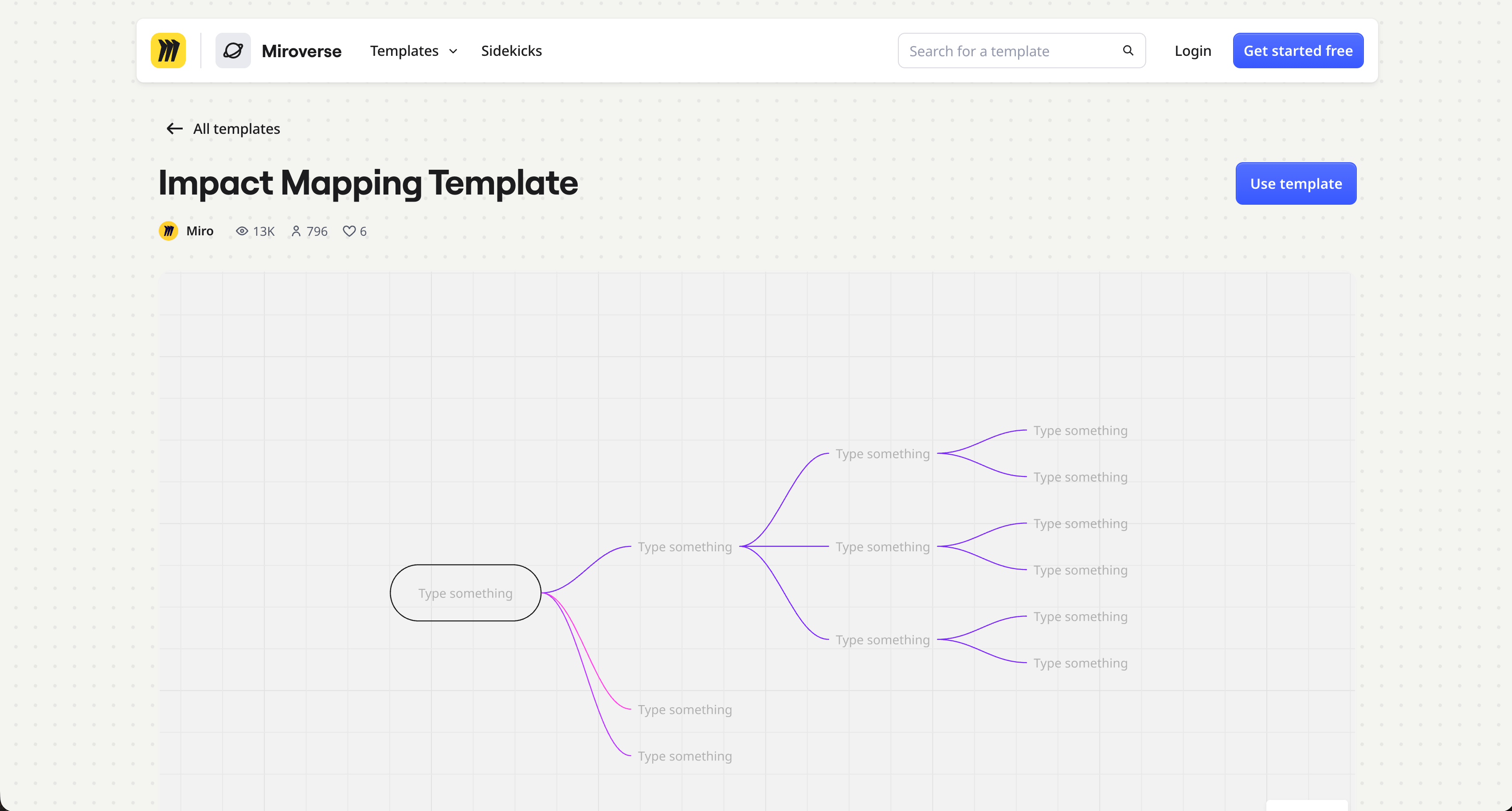
Impact Mapping connects business goals to stakeholders, desired behavioral changes, and proposed interventions.
It is useful when delivery teams maintain extensive backlogs without a clear understanding of how those activities contribute to strategic results.
Best for: Strategy deployment, product planning, and cross-functional alignment.
Practical application: Choose one strategic goal and identify whose behavior must change for the goal to be achieved. Only then define the interventions that could influence that behavior.
What to take away: An outcome-oriented way to distinguish useful initiatives from activity for its own sake.
Output: A goal-to-behavior-to-deliverable map.
Access: Public collaborative template.
Section 02 implementation checkpoint
By the end of this stage, the organization should be able to explain which customer problems matter, where value is created, which capabilities support that value, and what evidence supports its intended differentiation.
Expected deliverable: A strategic diagnosis connecting customer demand, value creation, and competitive positioning.
Section 03 — Strategic Choice & Positioning
Turn analysis into explicit commitments and meaningful trade-offs.
Strategy is not a list of everything an organization would like to achieve.
It requires deciding which opportunities to pursue, which capabilities to strengthen, and which attractive possibilities to reject.
The following tools make those decisions visible.
11. Strategic Choice Cascade
Provider: Tiremesù, via Miroverse
Resource: Strategic Choice Cascade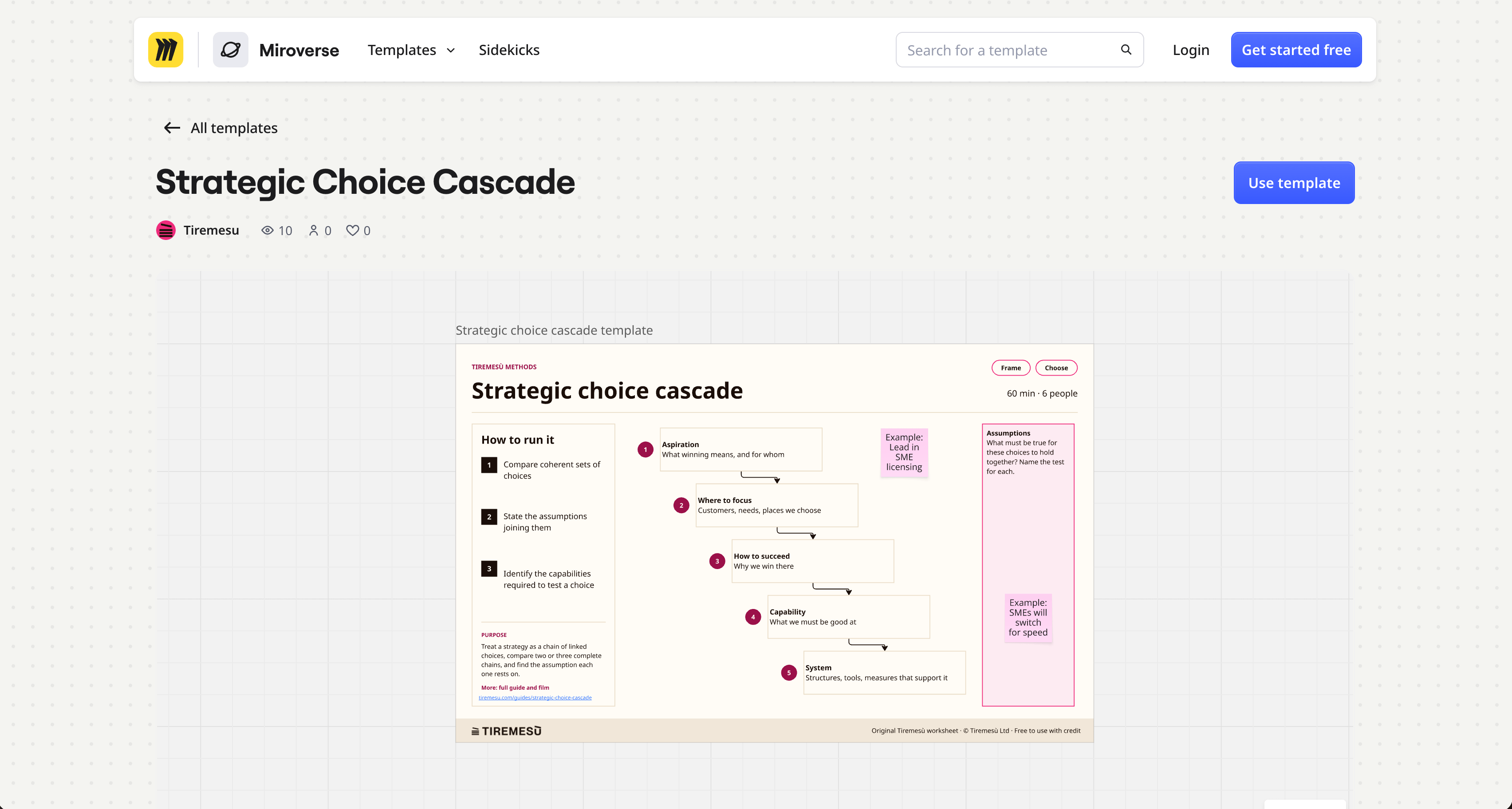
The Strategic Choice Cascade connects organizational aspiration with where to play, how to win, required capabilities, and supporting management systems.
It is particularly useful when a strategic plan contains ambitious priorities but little explanation of the choices connecting them.
Best for: Executive strategy development and business-unit positioning.
Practical application: Develop two genuinely different strategic options. Complete the cascade for each and identify the assumptions on which they depend.
What to take away: A coherent set of choices rather than an accumulation of unrelated initiatives.
Output: Competing strategic positions with explicit assumptions and capability requirements.
Access: Public collaborative worksheet.
12. Trade-off Sliders
Provider: Atlassian Team Playbook
Resource: Trade-off Sliders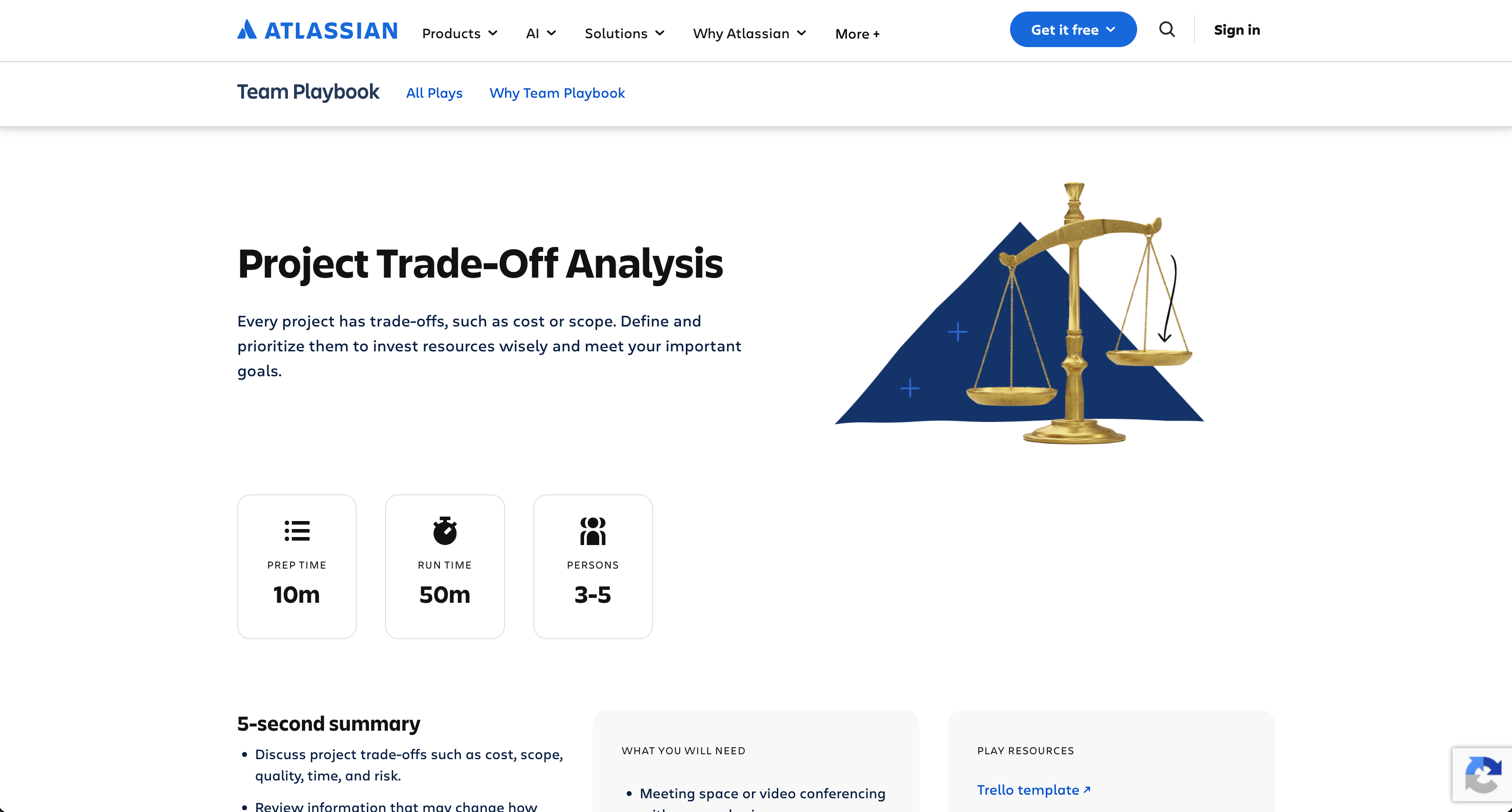
Trade-off Sliders help teams agree on which dimensions of an initiative must be protected and where flexibility is acceptable.
They reduce repeated debate when constraints arise during implementation.
Best for: Leadership alignment, transformation programs, and resource-constrained initiatives.
Practical application: Rank the flexibility of cost, timing, scope, quality, and other relevant dimensions. Record which priorities should guide future decisions.
What to take away: An explicit understanding of what the organization values most when compromises become necessary.
Output: A documented hierarchy of strategic trade-offs.
Access: Free guided exercise and associated worksheet.
13. Business Model Canvas
Provider: Strategyzer
Resource: Business Model Canvas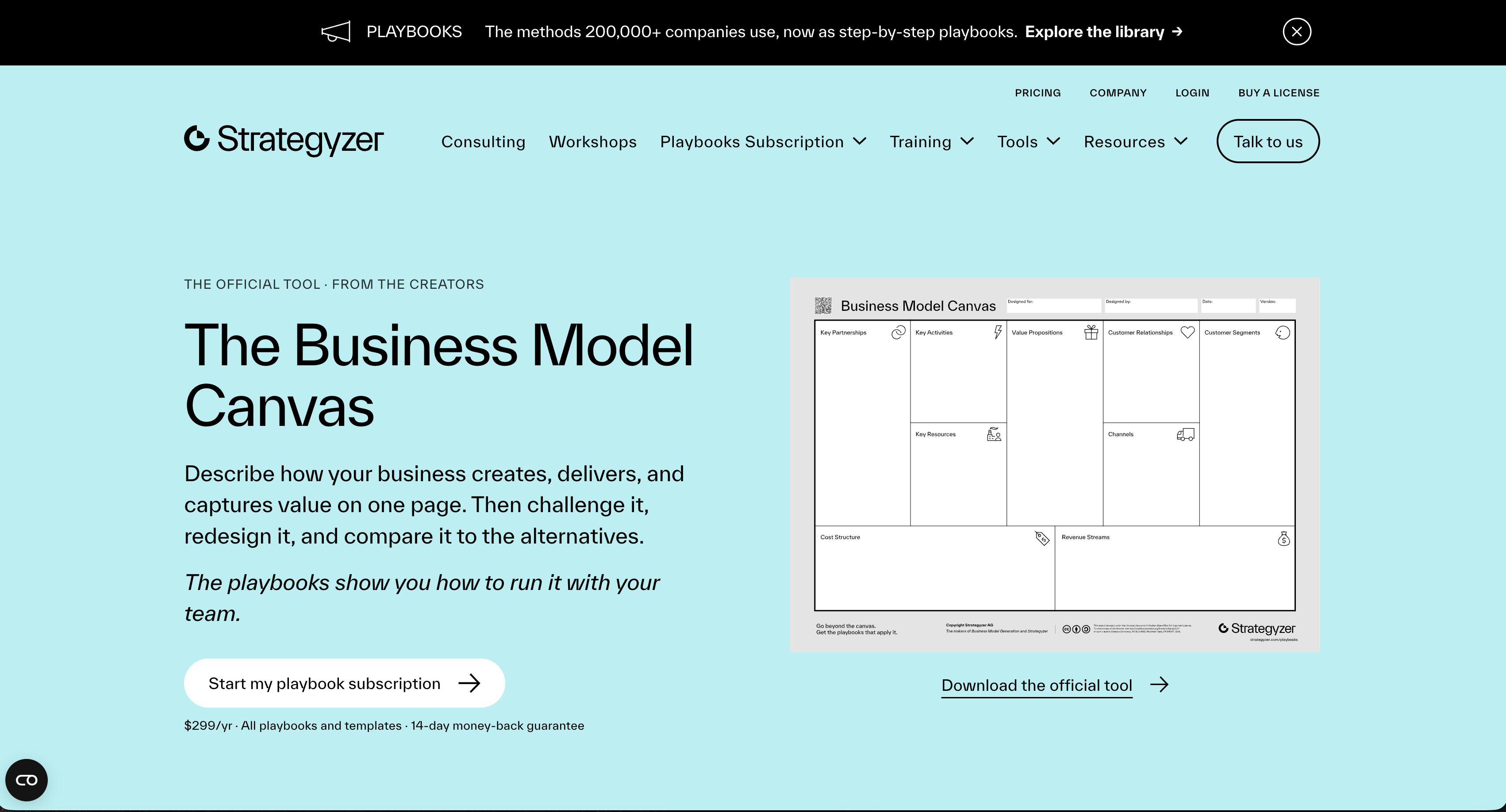
The Business Model Canvas visualizes how an organization creates, delivers, and captures value.
Although established rather than recent, it remains highly useful when applied comparatively and updated through experimentation.
Best for: Business model innovation, strategic repositioning, and venture design.
Practical application: Map the current business model and two alternatives. Identify the elements that materially differ and the assumptions associated with each.
What to take away: A structured method for comparing alternative ways of creating and capturing value.
Output: Comparable business model hypotheses.
Access: Free official template; advanced guided materials may be paid.
14. Business Model Portfolio Map
Provider: Strategyzer
Resource: Business Model Portfolio Map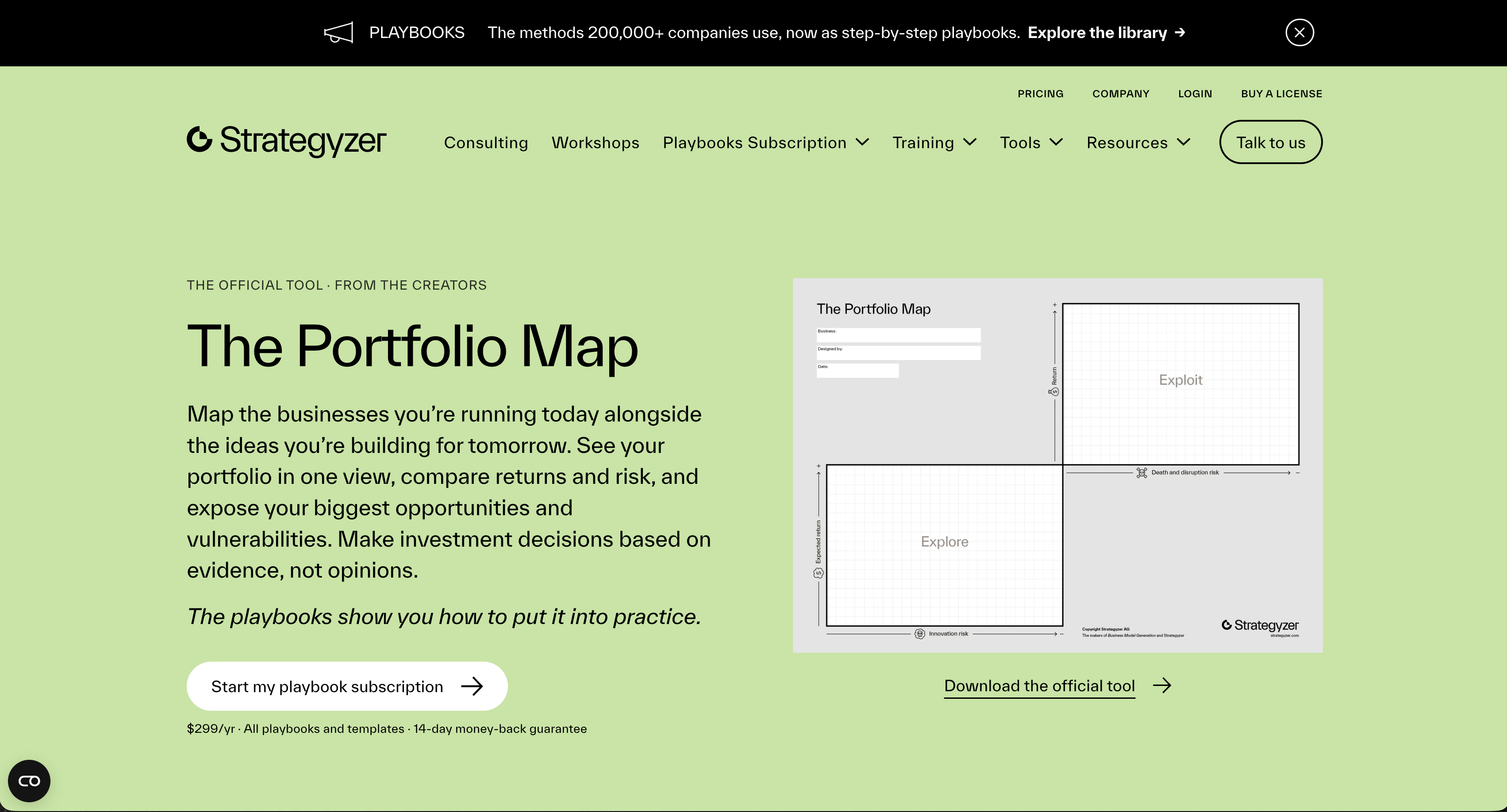
The Business Model Portfolio Map examines established business models alongside emerging opportunities.
It helps organizations assess whether resources are disproportionately concentrated in current performance or appropriately allocated to future possibilities.
Best for: Corporate innovation, business portfolio strategy, and transformation investment decisions.
Practical application: Map existing business models and exploratory opportunities. Examine how resources are distributed across exploitation, improvement, and exploration.
What to take away: A clearer picture of the relationship between today’s business economics and tomorrow’s growth opportunities.
Output: A portfolio view of business-model exposure and investment options.
Access: Official resource with a free template offering; guided playbooks are separate paid products.
15. Strategic Planning Template
Provider: Atlassian Confluence
Resource: Strategic Planning Templates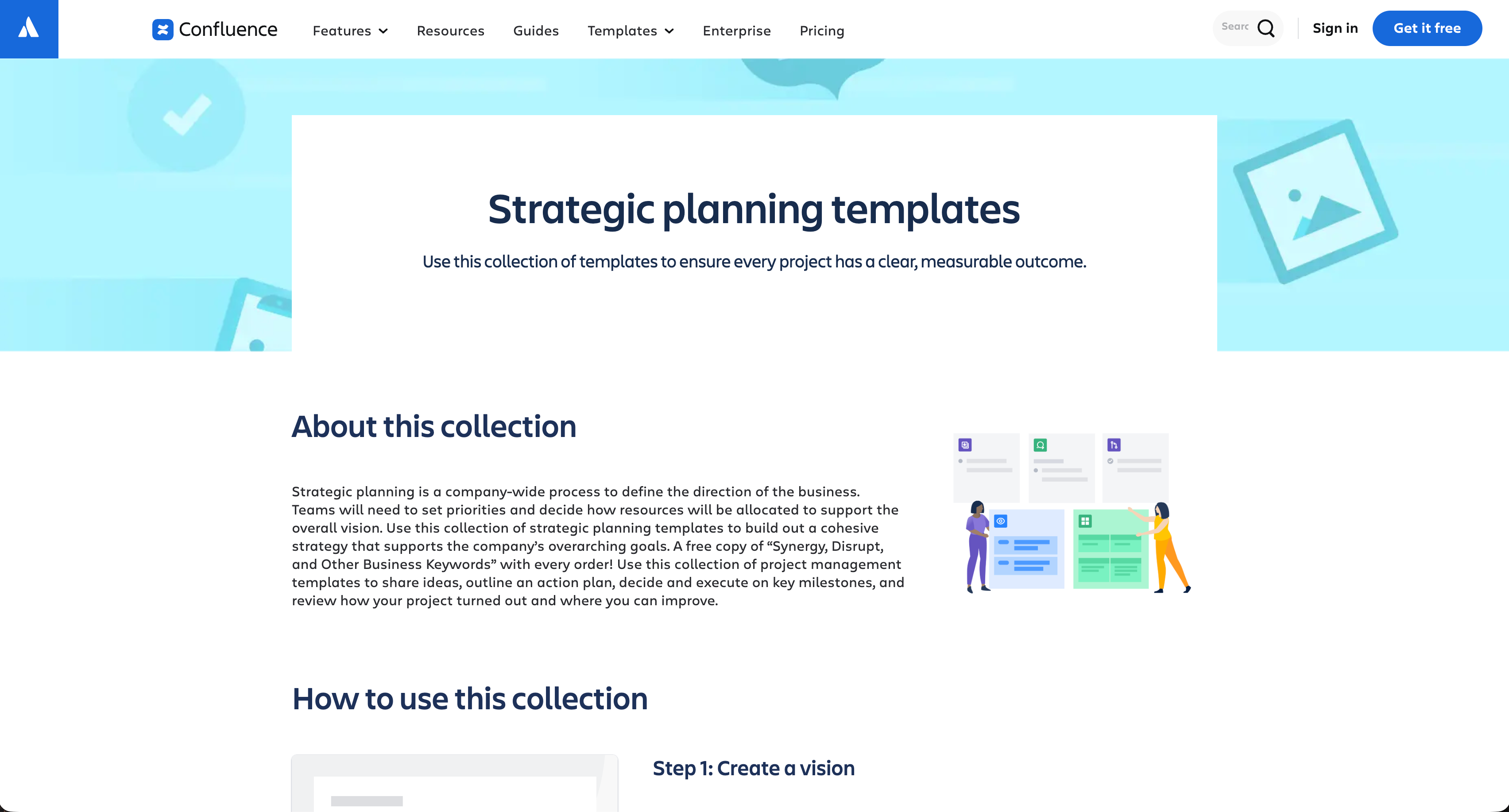
Atlassian’s strategic planning collection provides structured documents for translating organizational direction into objectives and coordinated work.
Its value is in capturing the choices emerging from analysis in a format that can be shared, revisited, and updated.
Best for: Executive teams and functional strategy leaders.
Practical application: Create a strategy summary containing the chosen direction, rejected alternatives, key assumptions, required capabilities, accountable owners, and intended outcomes.
What to take away: A concise strategy document that preserves the reasoning required for execution.
Output: A shareable strategic plan.
Access: Public template collection; editing in Confluence may require a free account.
Section 03 implementation checkpoint
A strategic choice should make three things clear: what the organization will do, what it will deliberately not do, and why the chosen position is expected to succeed.
Expected deliverable: A documented strategic choice with a supporting investment thesis.
Section 04 — Business Model Innovation & Experimentation
Test important beliefs before treating uncertain investments as commitments.
The purpose of strategic experimentation is not simply to create prototypes.
It is to reduce uncertainty around consequential assumptions.
Different assumptions demand different tests. Customer demand may require interviews or behavioral experiments. Technical feasibility may require engineering tests. Business economics may require transaction or cost evidence.
These resources connect investigation to investment decisions.
16. Test Card
Provider: Strategyzer
Resource: Validate Your Ideas with the Test Card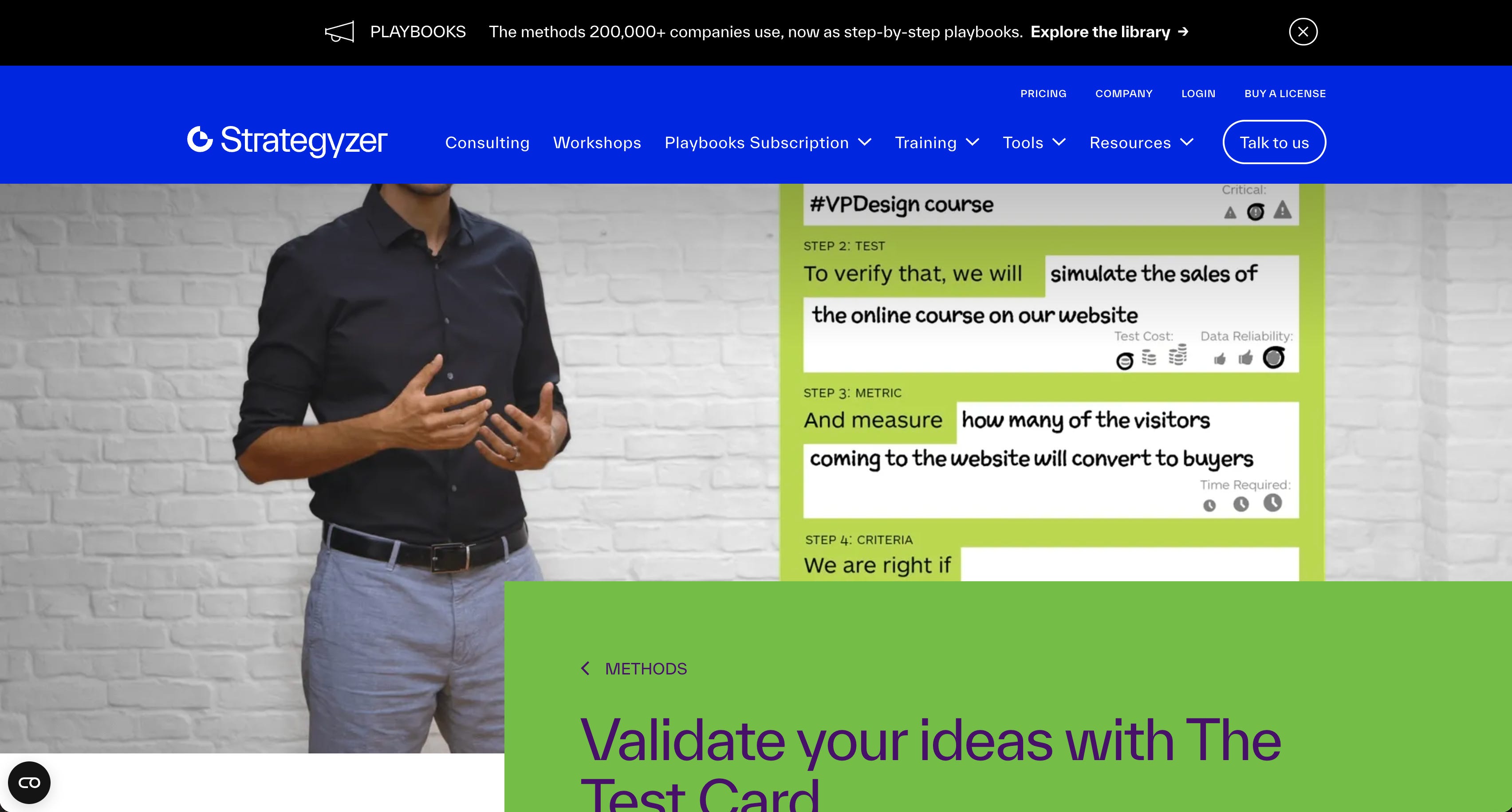
The Test Card is a structured framework for designing business experiments.
It requires four elements: a hypothesis, a test method, a measurement approach, and a success threshold.
This makes it especially useful for strategic questions that cannot be reduced to digital A/B testing.
Best for: Business model innovation, new market opportunities, product concepts, and investment validation.
Practical application: Select one critical assumption from your strategy. Define what must be true, how it will be tested, what evidence will be collected, and what result would support or challenge the assumption.
What to take away: A method for evaluating uncertain business propositions before committing significant resources.
Output: A documented, measurable strategic experiment.
Access: Free Test Card materials through Strategyzer’s knowledge resources.
17. Impact–Effort Matrix
Provider: Miro
Resource: Impact–Effort Matrix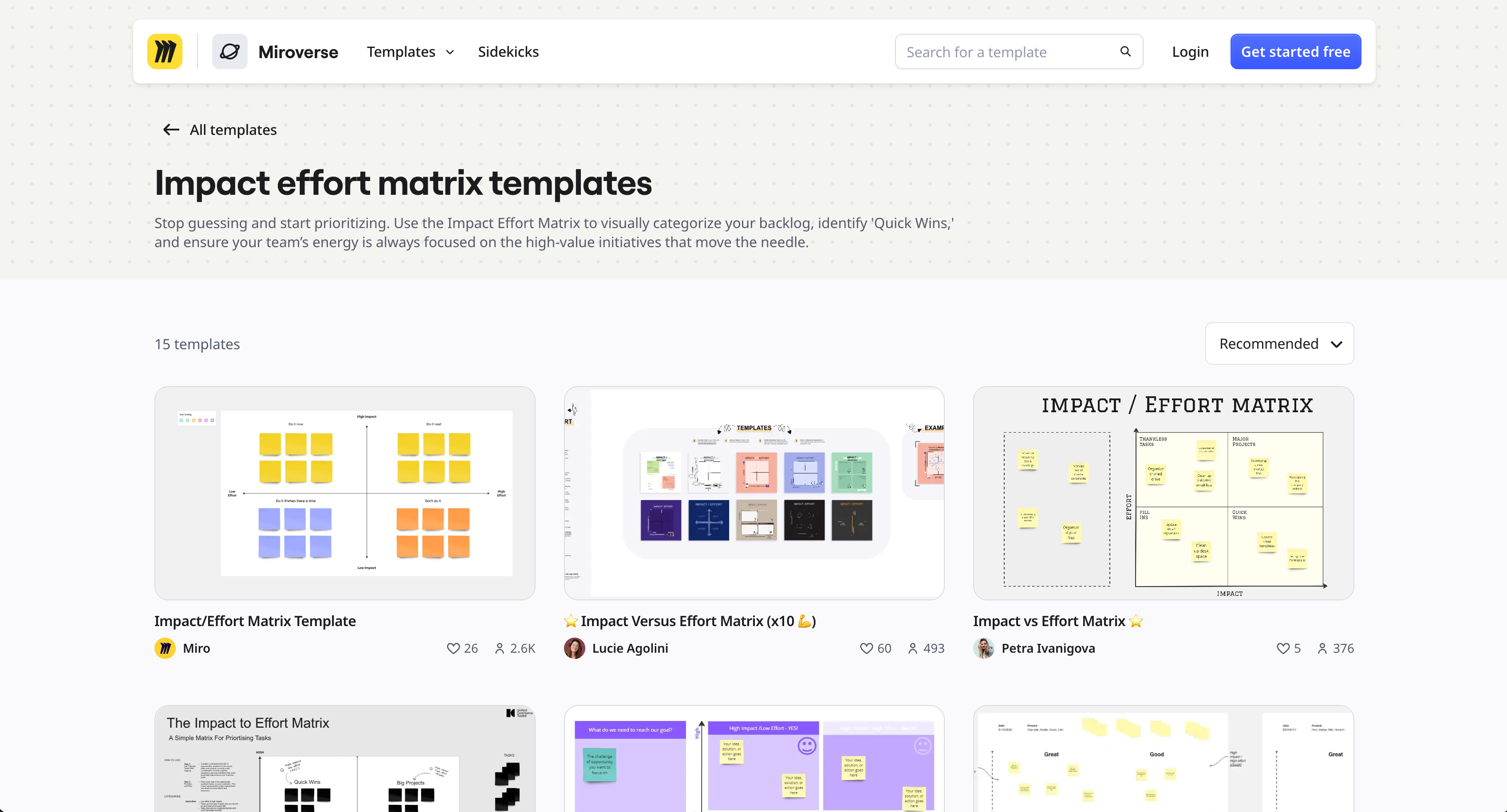
Impact–Effort matrices help compare proposed interventions according to expected impact and implementation burden.
Their simplicity makes them useful for preliminary prioritization, although major investment decisions require more detailed analysis.
Best for: Selecting experiments and prioritizing improvement opportunities.
Practical application: Compare proposed tests according to learning value, potential impact, required resources, and execution complexity.
What to take away: A way to separate quick evidence-gathering opportunities from resource-intensive commitments.
Output: A prioritized experiment shortlist.
Access: Public collaborative template gallery.
18. Project Poster
Provider: Atlassian Team Playbook
Resource: Project Poster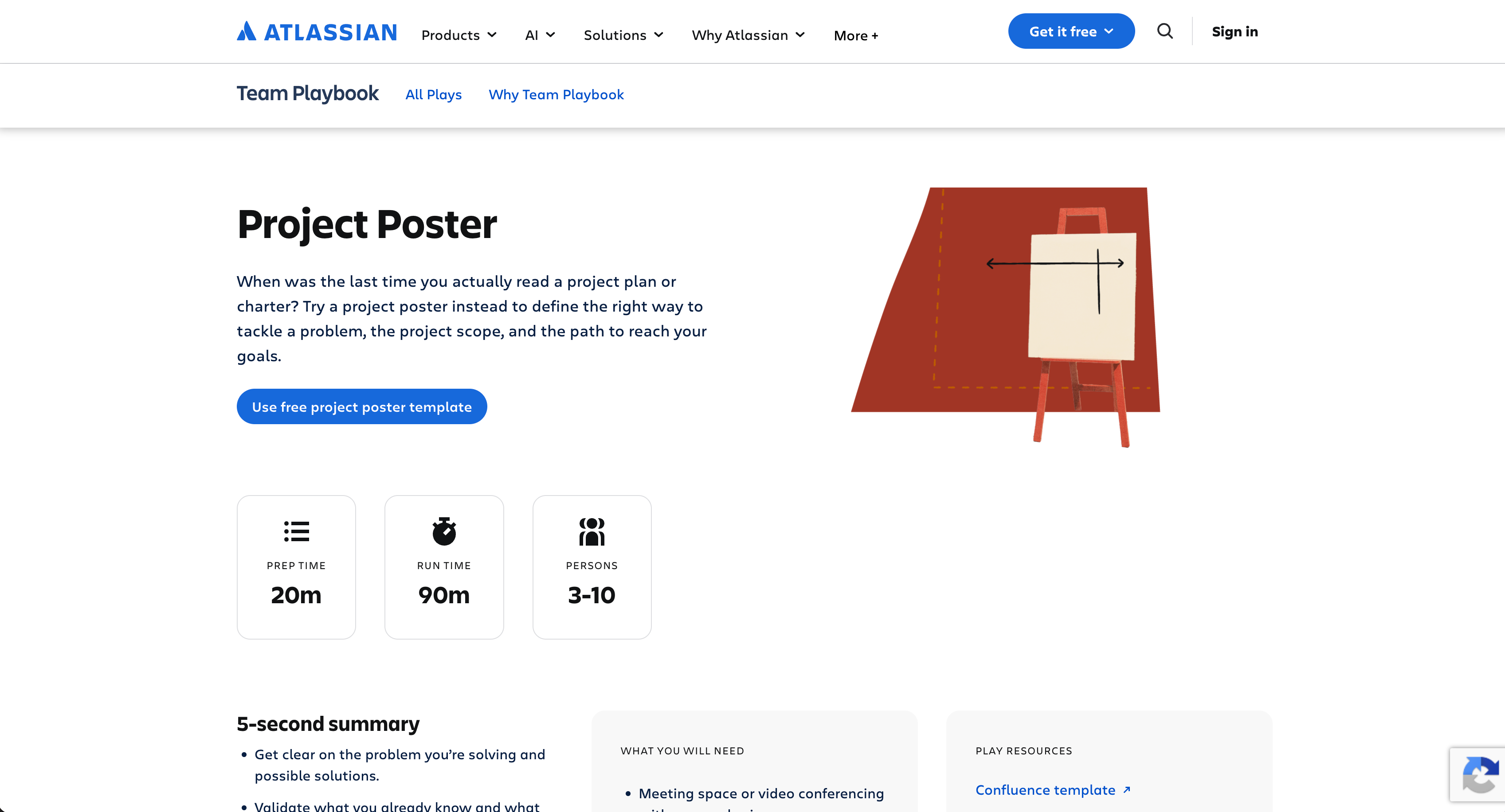
The Project Poster helps teams define a problem, establish what must be learned, and clarify whether an initiative is ready to move toward delivery.
It is valuable for preventing solution-first planning.
Best for: Innovation initiatives, transformation projects, and uncertain strategic opportunities.
Practical application: Document the problem, affected stakeholders, current evidence, unresolved assumptions, and proposed intervention.
What to take away: A living project hypothesis that can develop as evidence accumulates.
Output: A structured project problem and validation document.
Access: Free guided worksheet and associated template resources.
19. Premortem
Provider: Atlassian Team Playbook
Resource: Premortem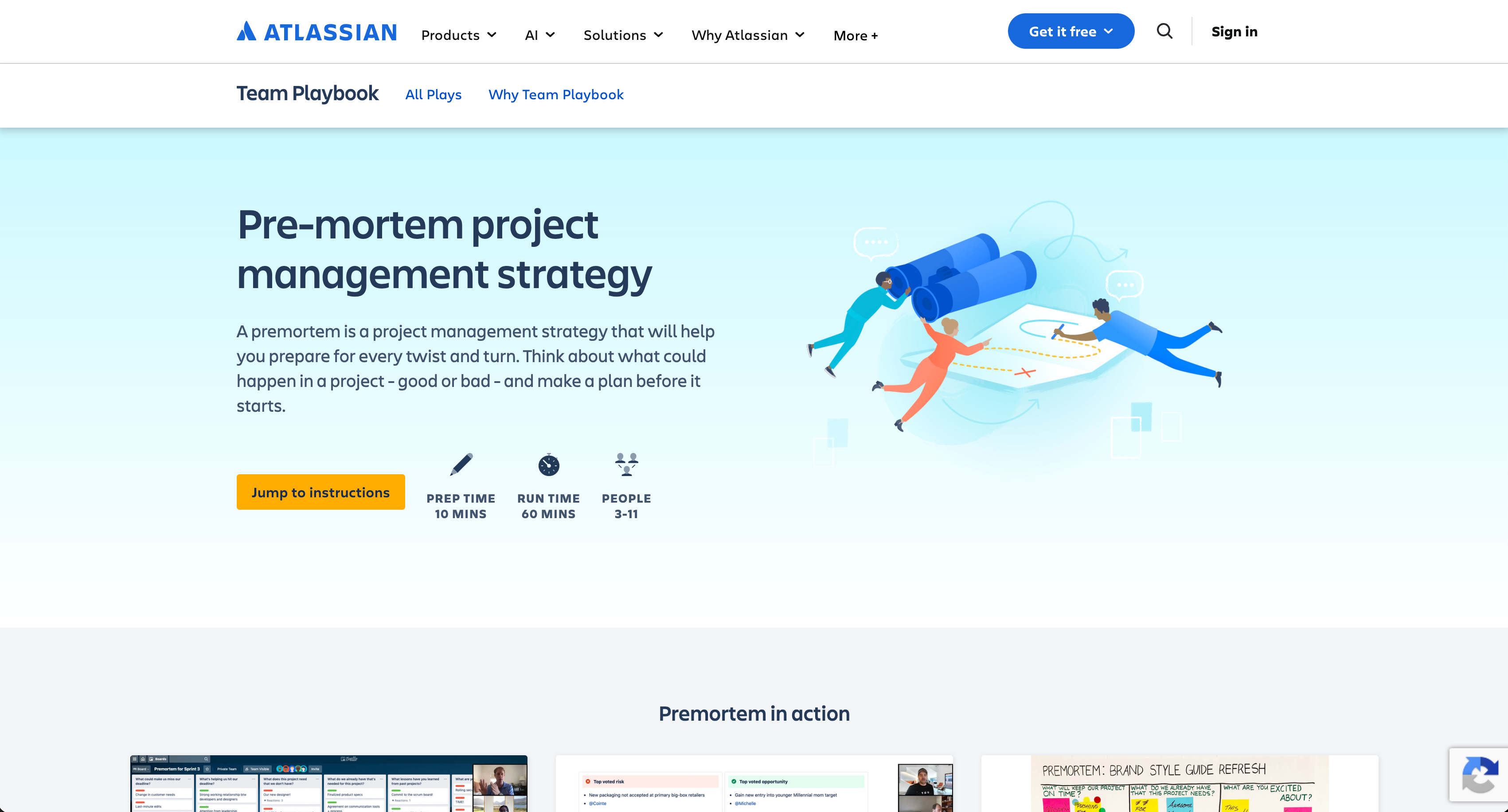
A premortem asks participants to imagine that an initiative has failed and identify plausible causes.
It helps surface concerns that may remain unspoken during optimistic strategic planning.
Best for: High-uncertainty initiatives, major investments, and transformation programs.
Practical application: Before committing resources, identify likely failure mechanisms, rank their significance, and define preventive or early-detection actions.
What to take away: A more balanced assessment of the risks embedded in a strategic investment.
Output: A failure-mode and mitigation register.
Access: Free guided exercise.
20. Goals, Signals and Measures
Provider: Atlassian Team Playbook
Resource: Goals, Signals and Measures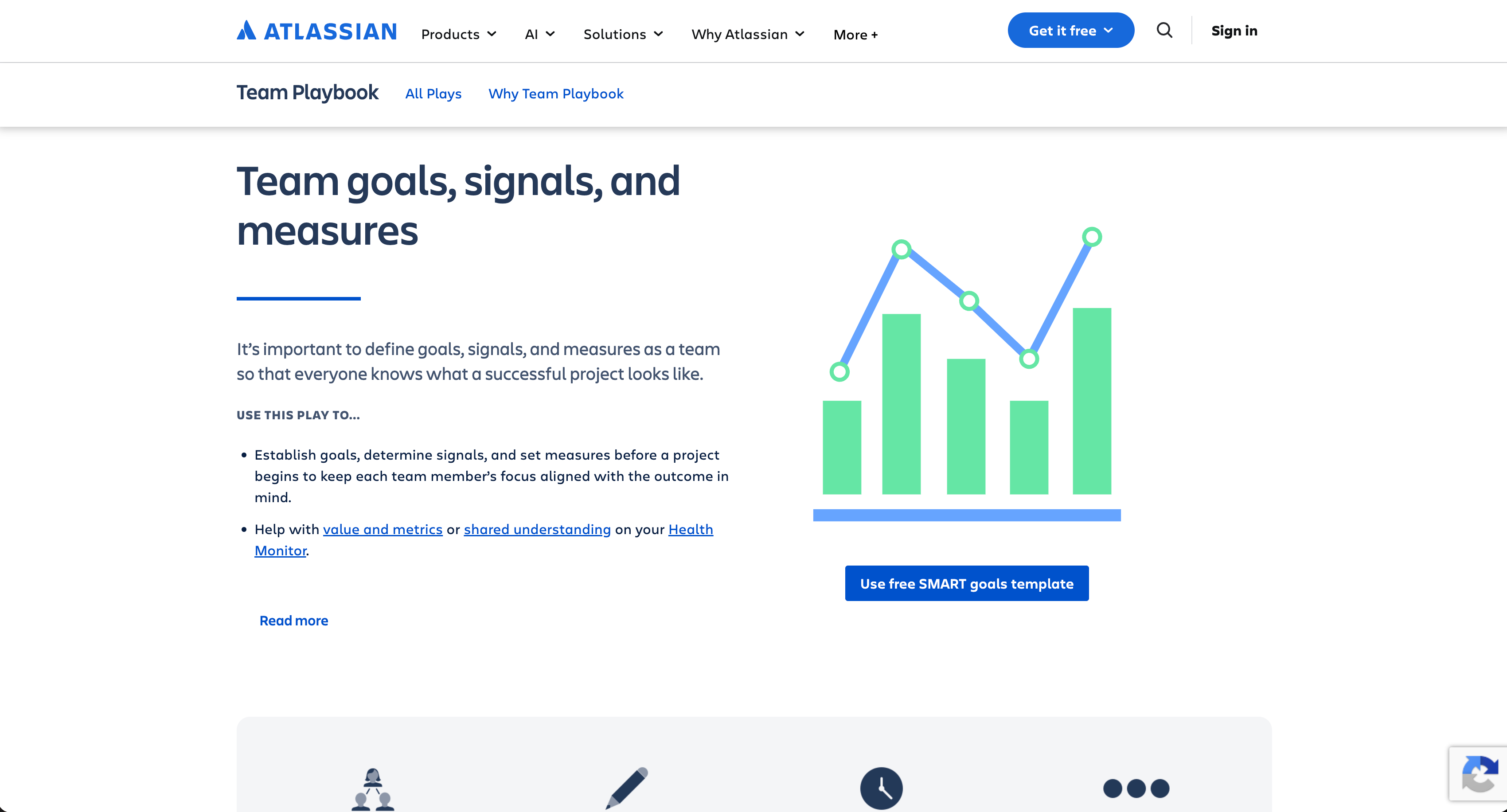
Goals, Signals and Measures distinguishes desired outcomes from observable signs of progress and the metrics used to evaluate them.
It helps teams avoid confusing delivery completion with strategic success.
Best for: Strategic experimentation, organizational alignment, and performance measurement.
Practical application: For one strategic initiative, define the desired outcome, leading signals, and the measures that would indicate progress.
What to take away: An evidence structure connecting strategic intentions with observable change.
Output: A testable strategic outcome definition.
Access: Free guided worksheet and related template resources.
Section 04 implementation checkpoint
Every consequential experiment should define what is uncertain, how evidence will be collected, what result matters, and which decision follows.
Expected deliverable: An experiment portfolio with hypotheses, owners, evidence criteria, and next-stage decisions.
Section 05 — Strategic Portfolio & Resource Allocation
Allocate capital, attention, and organizational capacity to the opportunities that matter most.
Resource allocation is where strategy becomes economically consequential.
An organization may claim innovation is essential while assigning all available capacity to current operations. It may describe an initiative as strategically critical while leaving funding and decision authority unresolved.
A portfolio system makes those contradictions visible.
21. Kanban Portfolio Board
Provider: Miro
Resource: Kanban Templates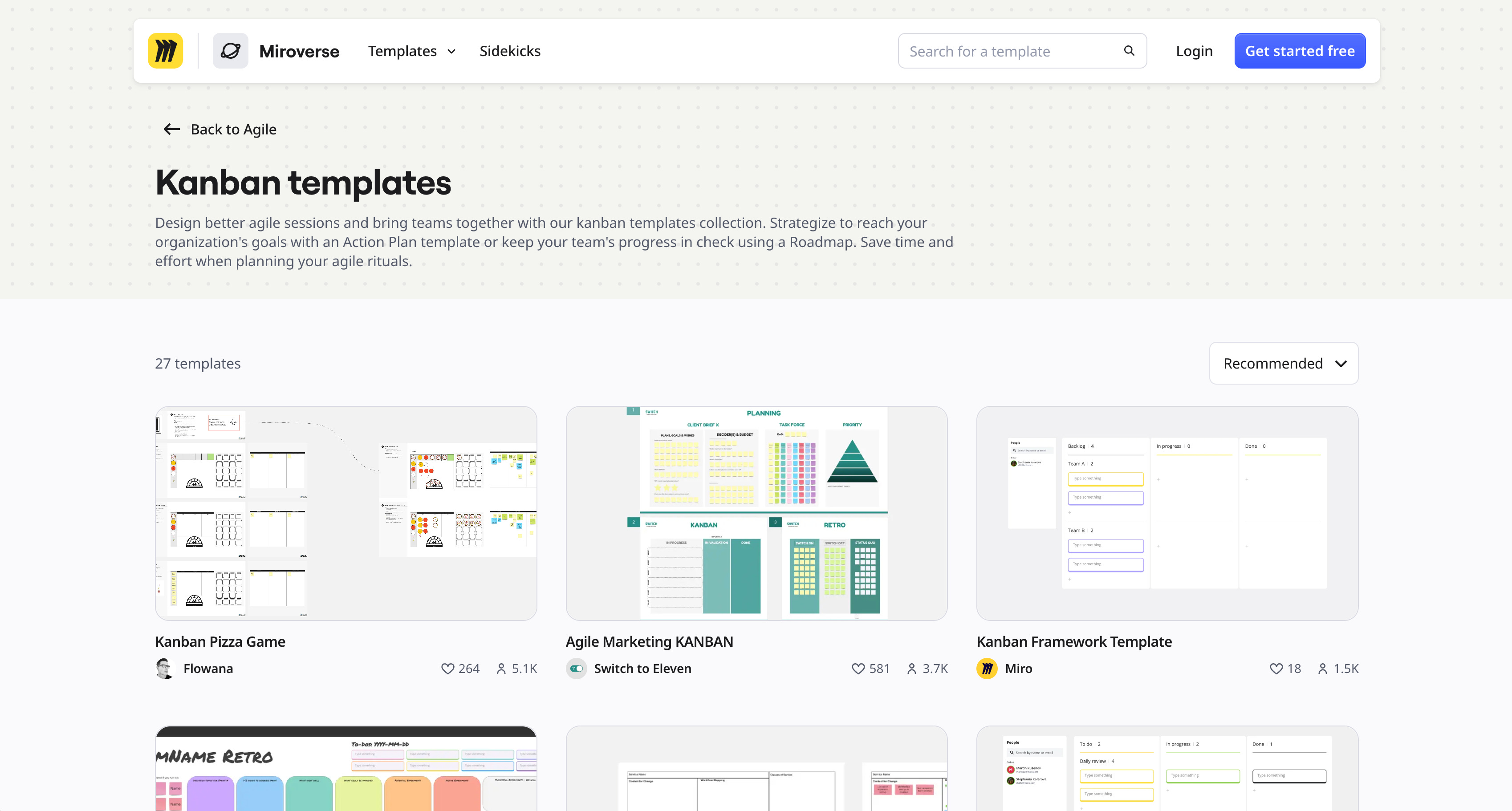
Kanban makes work and capacity constraints visible.
Applied at the strategic portfolio level, cards represent initiatives rather than individual delivery tasks.
Best for: Transformation offices, portfolio managers, and strategy execution teams.
Practical application: Establish portfolio stages such as Proposed, Under Evaluation, Approved, Active, Review, and Closed. Set limits on simultaneous initiatives.
What to take away: A clearer view of strategic commitments and organizational capacity.
Output: A visual strategic initiative portfolio.
Access: Public collaborative templates; portfolio customization required.
22. Strategic Prioritization and Cut-Line Exercise
Provider: Atlassian Team Playbook
Resource: Prioritize Tasks and Draw the Cut Line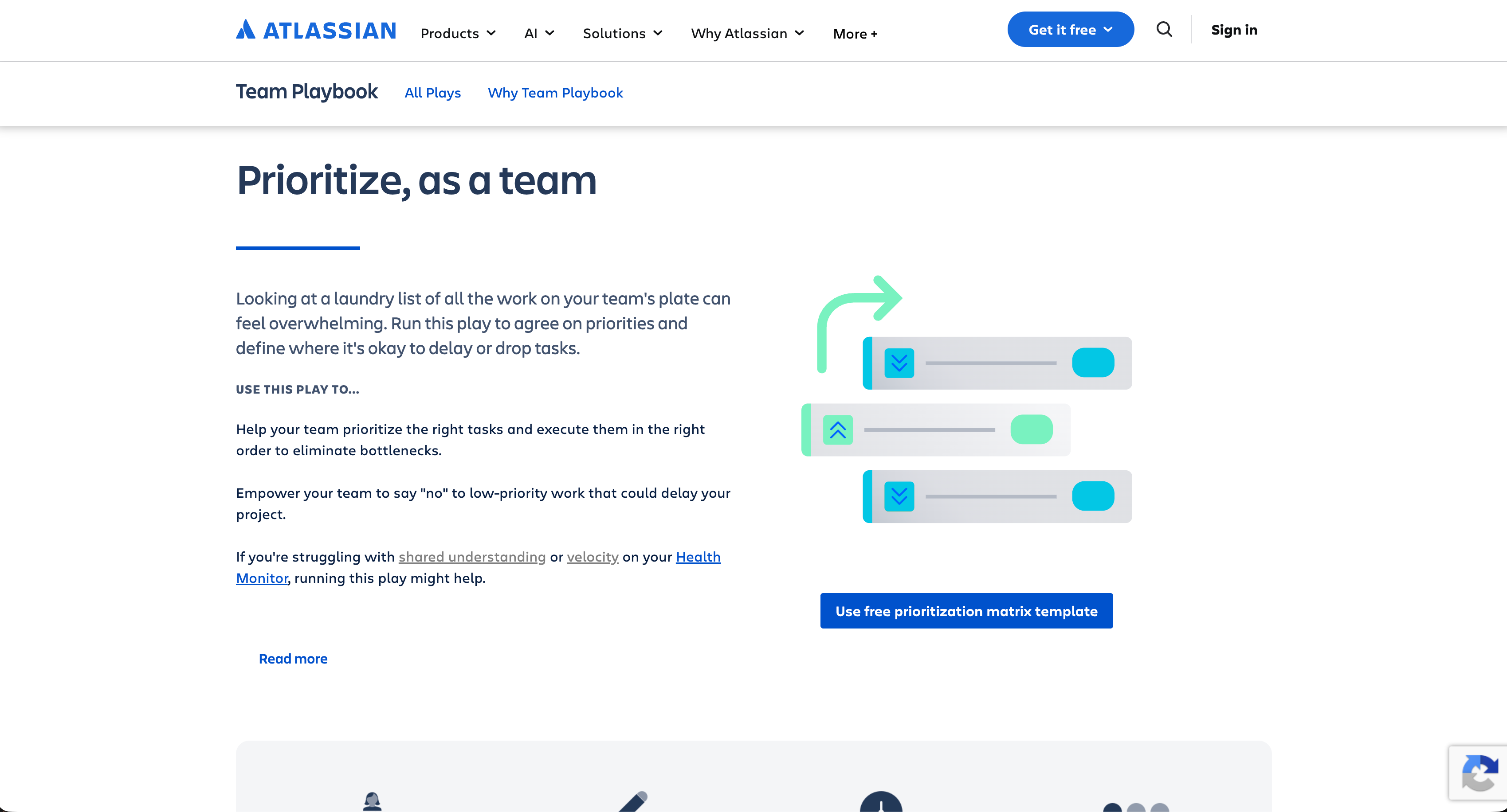
This prioritization exercise helps teams identify which work deserves available capacity and which activities must be deferred.
Its most useful feature is the explicit boundary between approved work and work the organization will not undertake now.
Best for: Resource-constrained strategic portfolios and overloaded leadership teams.
Practical application: Rank initiatives, identify critical dependencies, and draw a clear line separating funded commitments from deferred opportunities.
What to take away: A practical mechanism for making resource allocation consistent with declared strategic priorities.
Output: A capacity-constrained initiative shortlist.
Access: Free guided worksheet.
23. Dependency Mapping
Provider: Atlassian Team Playbook
Resource: Dependency Mapping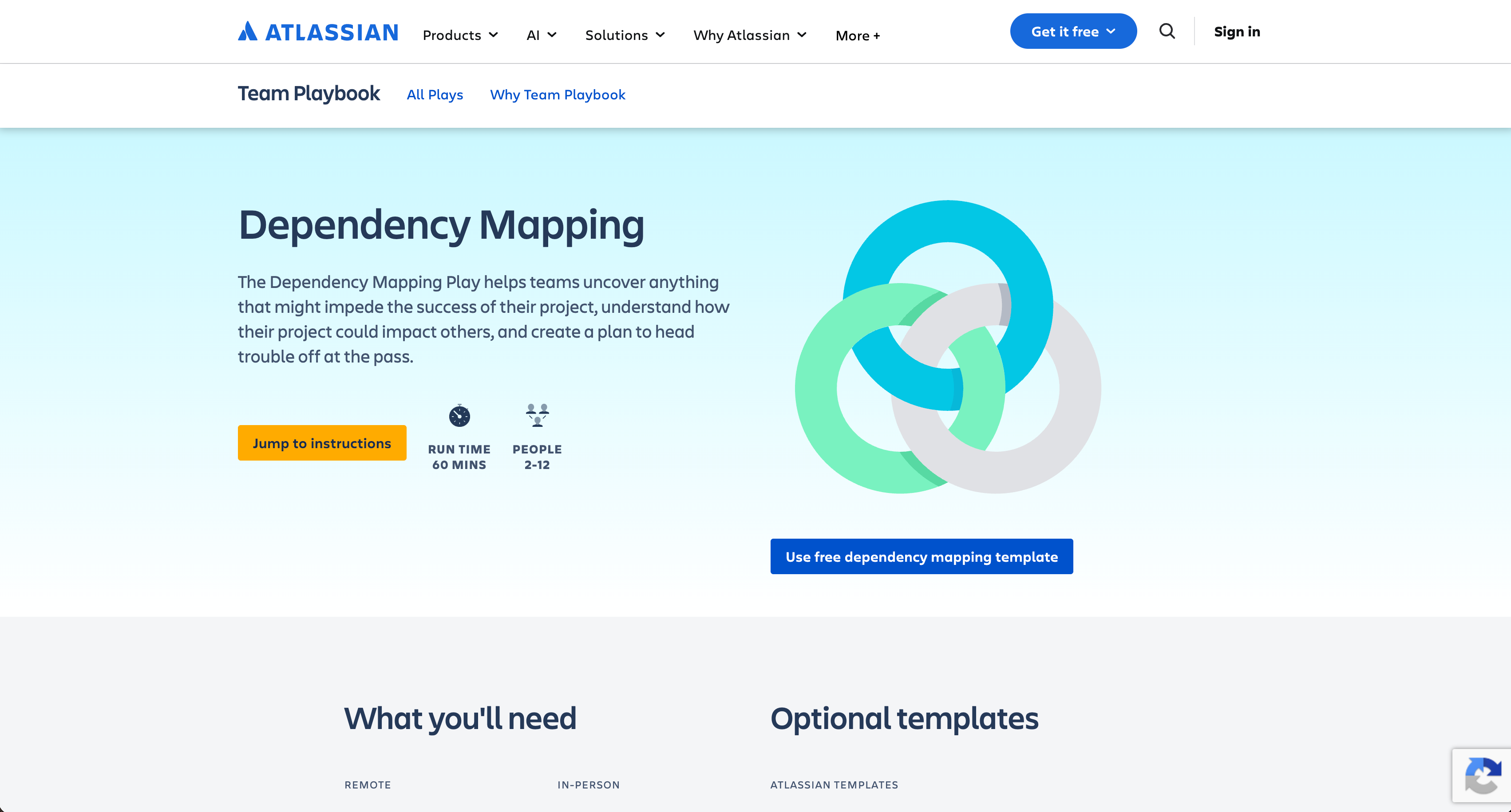
Dependency Mapping identifies relationships that could constrain an initiative’s progress.
Many strategic bottlenecks arise between organizational units rather than within individual projects.
Best for: Cross-functional programs, platform initiatives, and transformation portfolios.
Practical application: Map dependencies between initiatives, capabilities, delivery teams, and external partners. Assign owners and escalation triggers.
What to take away: A clearer understanding of which initiatives depend on shared resources or coordinated decisions.
Output: A dependency register and coordination plan.
Access: Free guided exercise.
24. Network of Teams
Provider: Atlassian Team Playbook
Resource: Network of Teams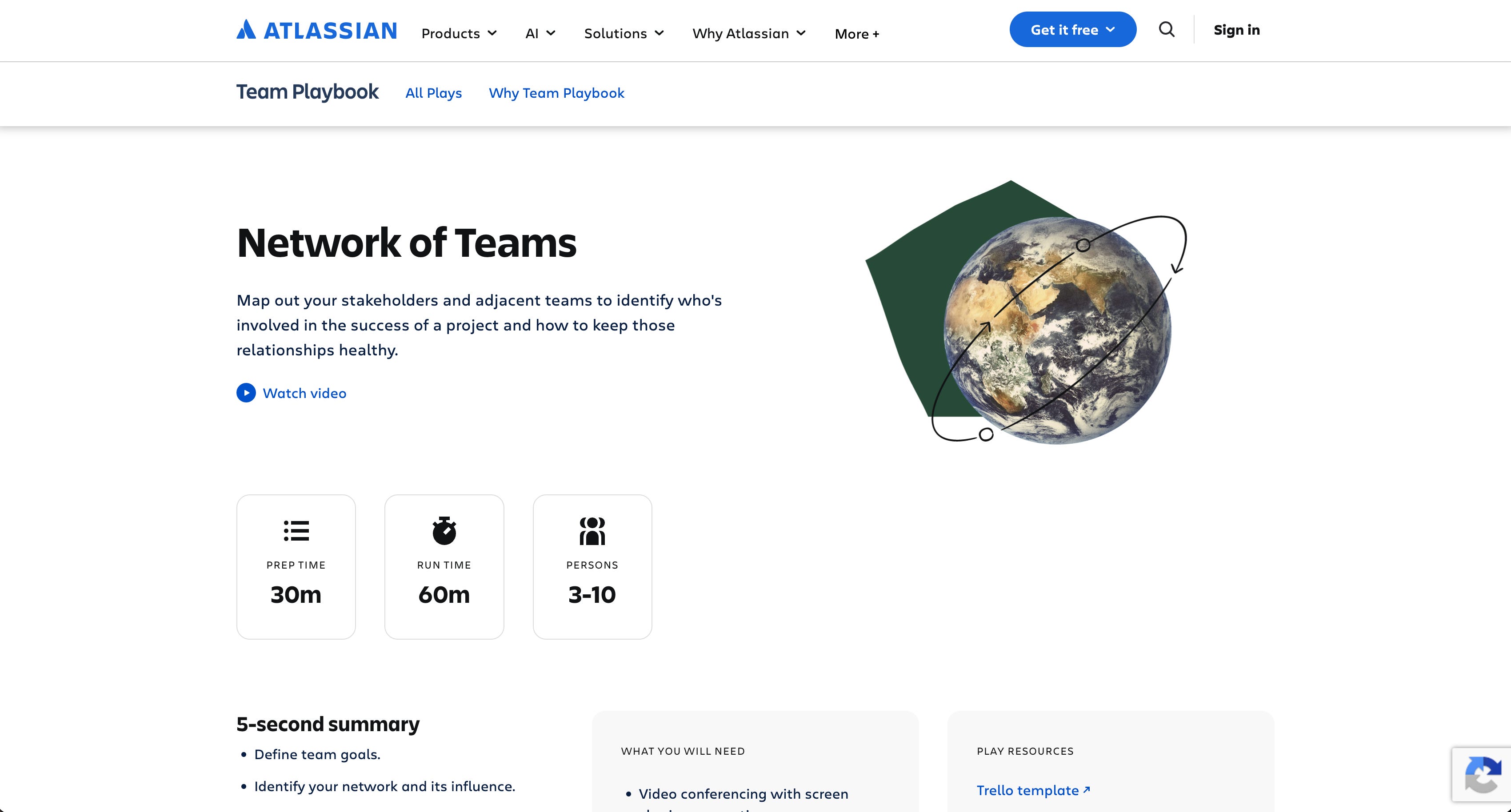
Network of Teams helps organizations understand relationships between teams and coordinate work across organizational boundaries.
Best for: Multi-team strategy execution and organizational transformation.
Practical application: Identify teams that must collaborate around a strategic priority, where goals conflict, and which relationships require clearer commitments.
What to take away: A more accurate representation of cross-functional delivery dependencies.
Output: A team coordination and relationship map.
Access: Free guided worksheet.
25. Strategic Capacity and Team Health Assessment
Provider: Atlassian Team Playbook
Resource: Team Health Monitor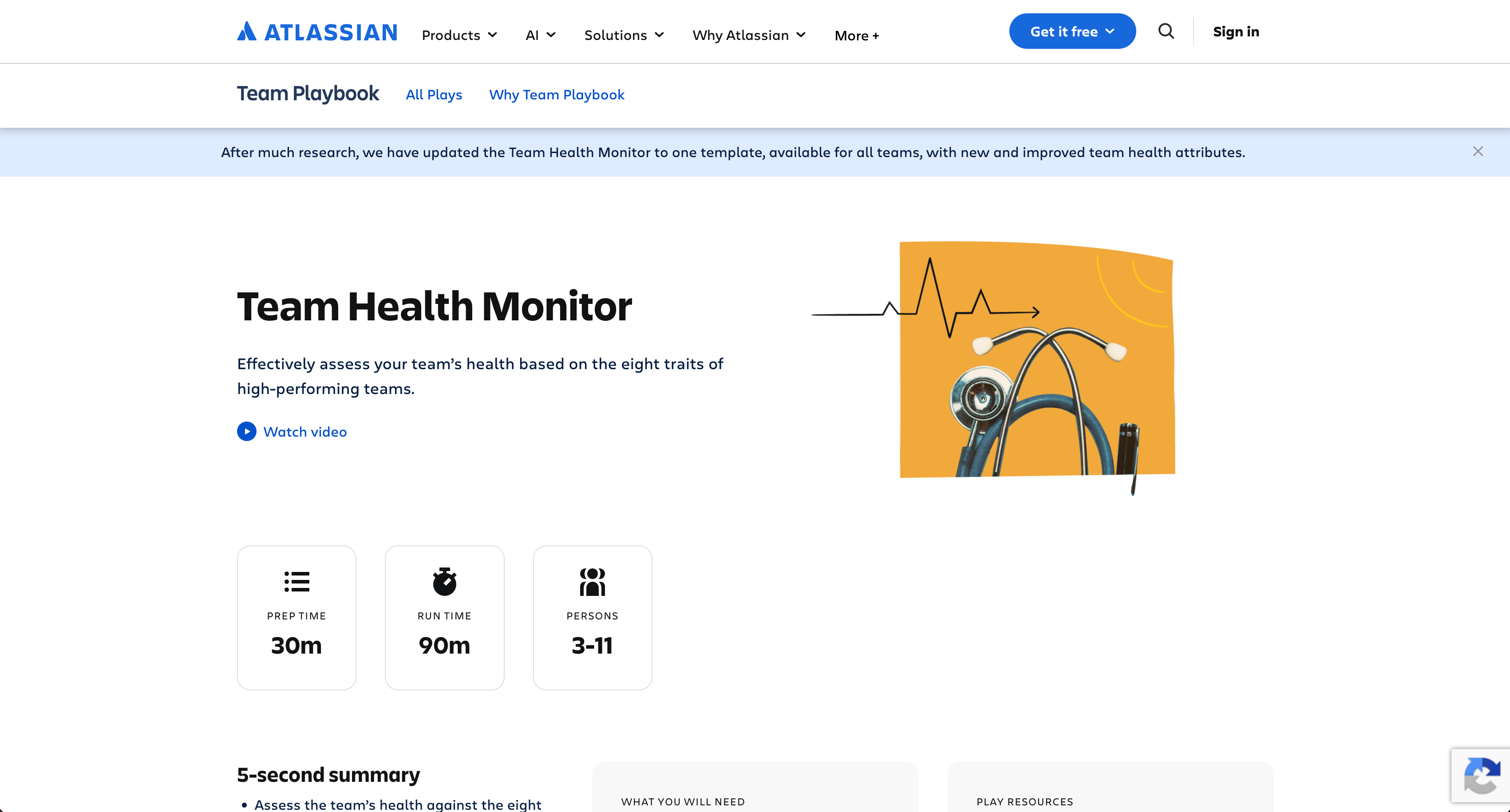
The Team Health Monitor provides a structured way to identify organizational conditions that influence team effectiveness.
Although it is not a financial resource allocation model, it can reveal capability and coordination constraints that budget analysis alone may miss.
Best for: Portfolio sponsors and operational leaders assessing execution readiness.
Practical application: Assess teams responsible for important strategic initiatives. Identify organizational conditions threatening delivery.
What to take away: An understanding of capacity constraints beyond funding and staffing numbers.
Output: An execution capability improvement agenda.
Access: Free guided assessment and supporting templates.
Section 05 implementation checkpoint
A strategic portfolio should reveal which initiatives matter and whether sufficient resources and capabilities have been committed to completing them.
Expected deliverable: A prioritized, capacity-constrained investment portfolio with visible dependencies.
Section 06 — Adaptive Planning & Strategy Deployment
Translate strategic choices into coordinated work without making the plan impossible to revise.
Conventional plans often mix strategic outcomes, project deliverables, operational tasks, and management reporting in one document.
Adaptive planning separates these concerns while preserving their connections.
The plan should remain stable enough to coordinate action and flexible enough to respond when important assumptions change.
26. Team Poster Template
Provider: Atlassian Confluence
Resource: Team Poster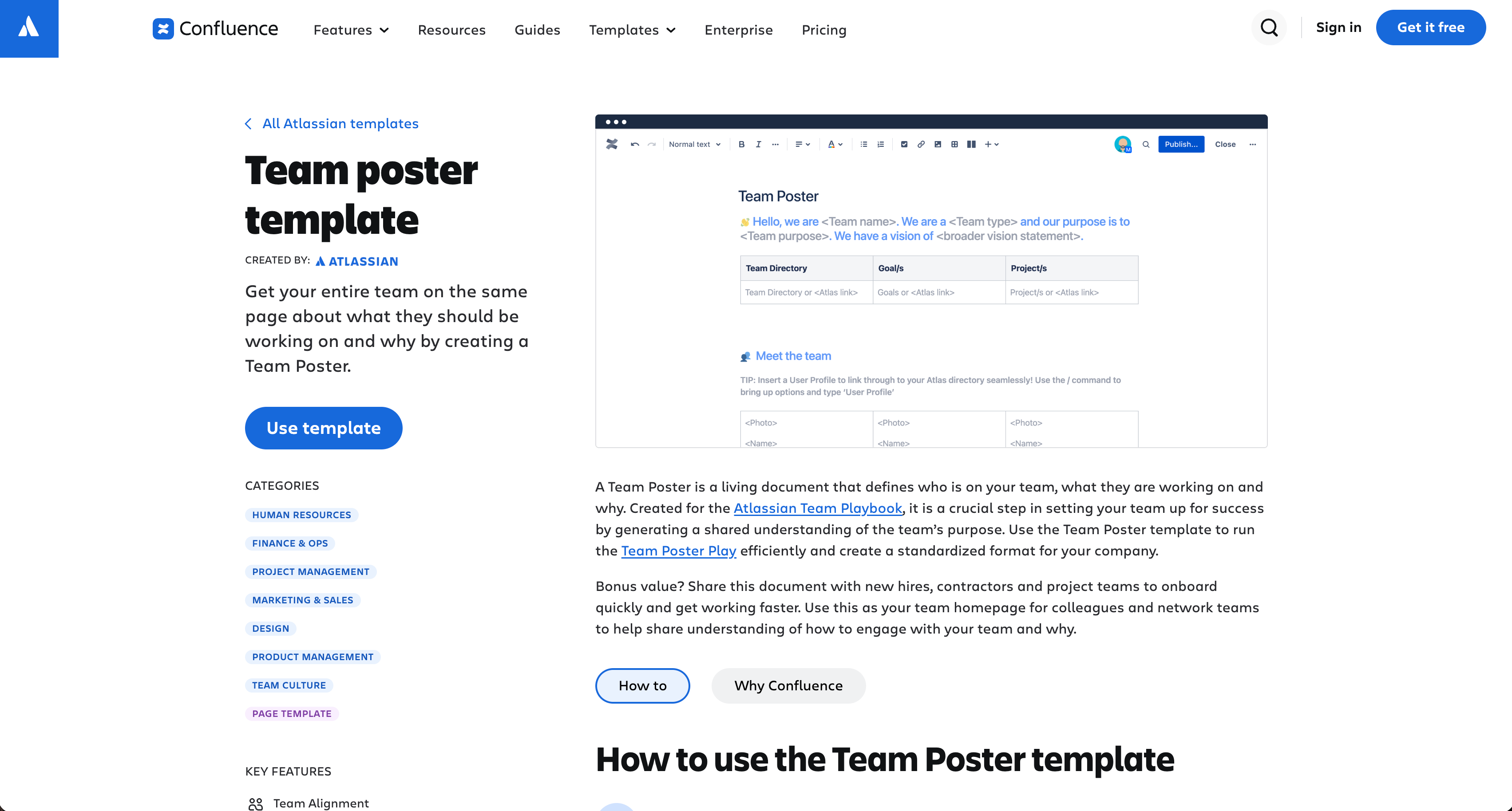
The Team Poster creates a shared record of a team’s purpose, responsibilities, members, goals, and relationship to broader organizational objectives.
It is a useful bridge between enterprise-level strategic choices and the teams expected to execute them.
Best for: Functional strategy deployment, new teams, and cross-functional initiatives.
Practical application: Create a Team Poster for one strategic initiative. Define why the team exists, what outcome it owns, how it contributes to the organizational strategy, and how other teams should engage with it.
What to take away: A practical method for translating strategic direction into shared team purpose.
Output: A living team charter and alignment document.
Access: Public Confluence template; using it in Confluence may require a free account.
27. OKR Planning Template
Provider: Atlassian Confluence
Resource: Strategic Planning and OKR Template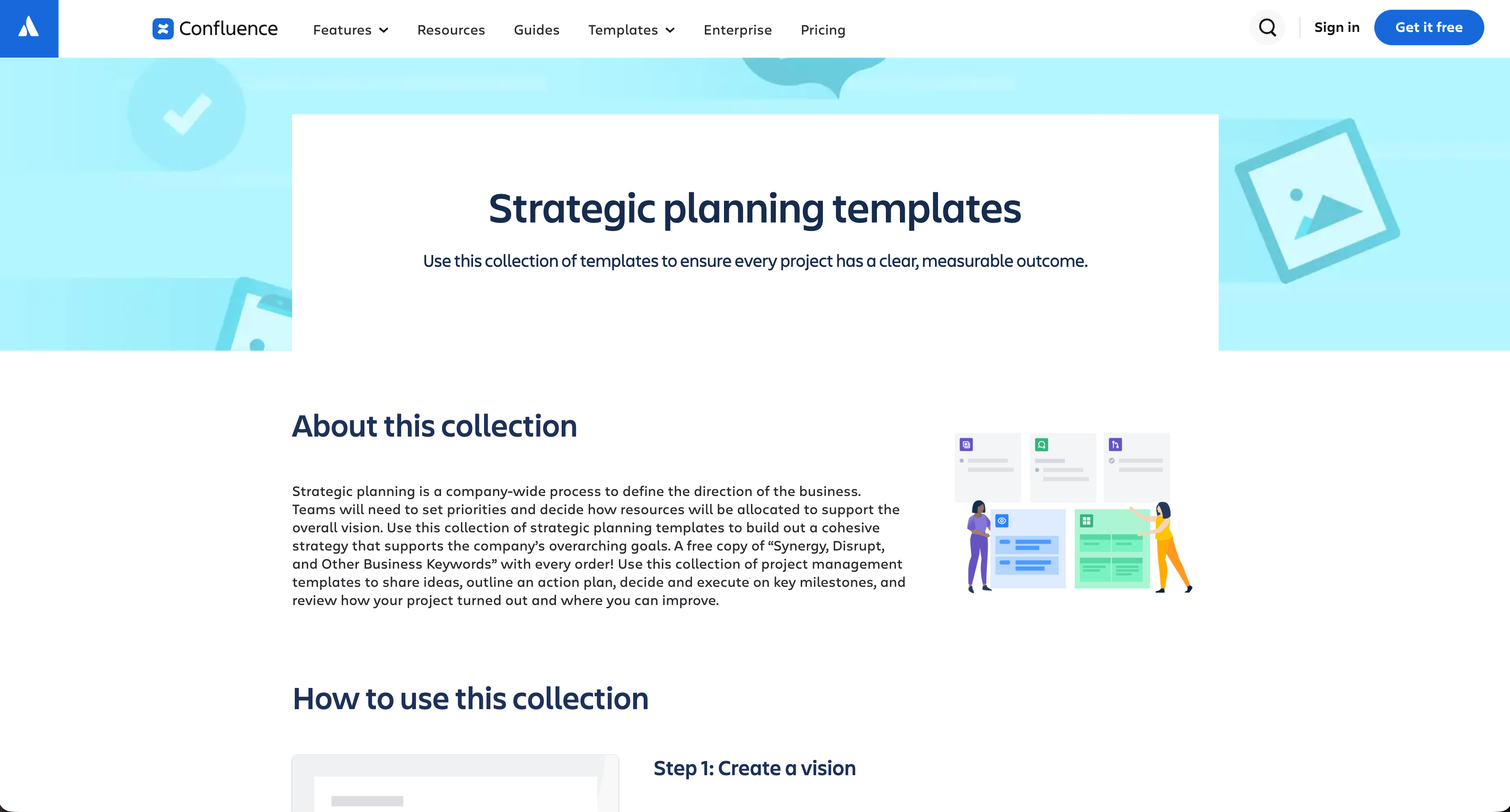
Objectives and Key Results connect strategic objectives with measurable results.
The method is most useful when key results describe meaningful outcomes rather than simply confirming completed tasks.
Best for: Quarterly strategy deployment and organizational alignment.
Practical application: Translate one strategic priority into an objective with measurable results and named accountability.
What to take away: An outcome-based structure for coordinating strategic commitments.
Output: A measurable quarterly objective and key-result set.
Access: Public template collection; select an appropriate editable template.
28. Now–Next–Later Roadmap
Provider: Miro
Resource: Now–Next–Later Roadmap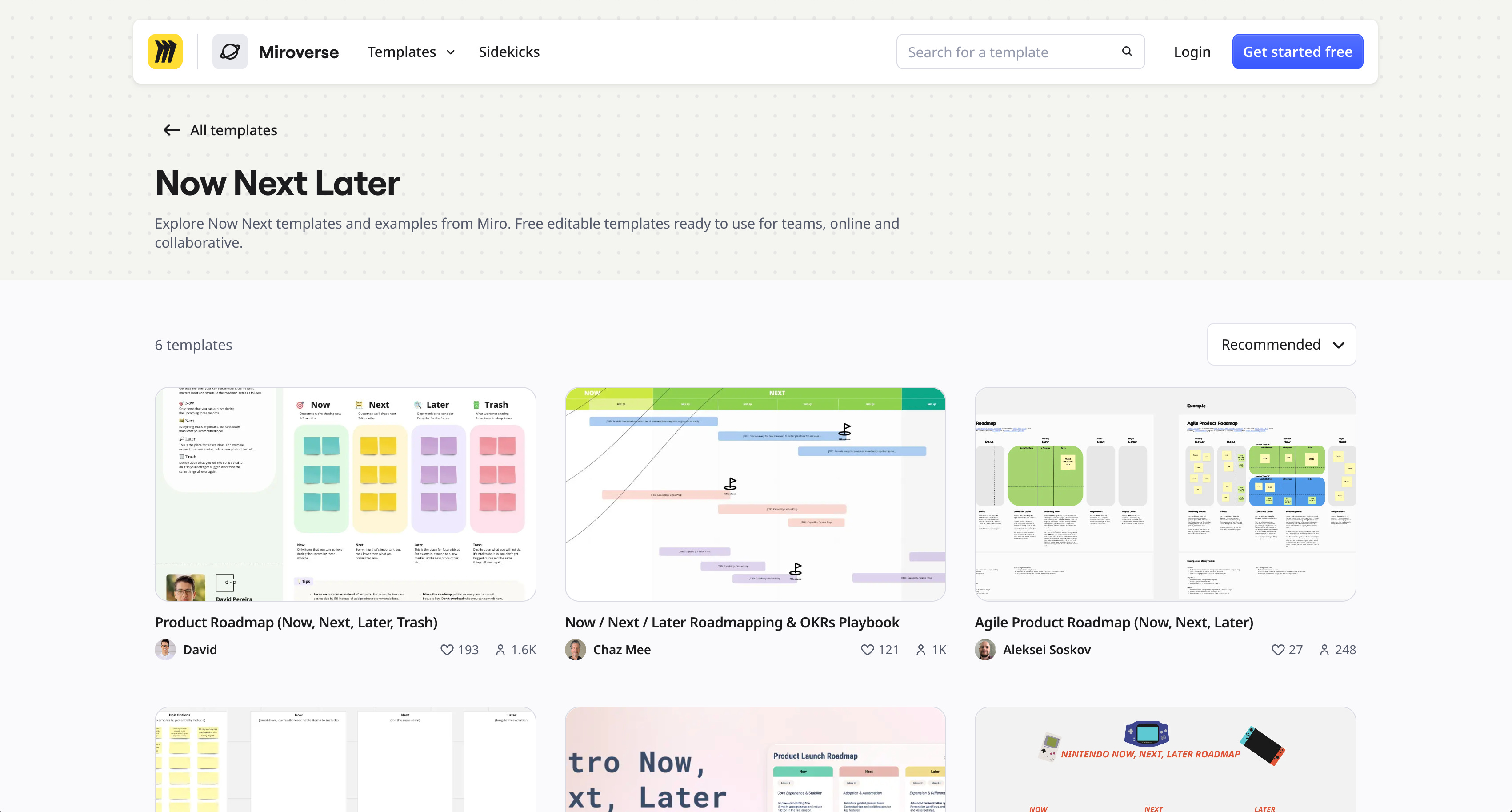
The Now–Next–Later roadmap organizes initiatives according to planning horizons rather than committing every activity to an artificially precise delivery date.
This makes it useful in environments where outcomes are known but the path to achieving them remains uncertain.
Best for: Adaptive planning, product strategy, transformation portfolios, and evolving business priorities.
Practical application: Organize initiatives into immediate commitments, likely subsequent priorities, and longer-term possibilities. Document the evidence or dependencies that would move an initiative between horizons.
What to take away: A planning method that balances directional clarity with flexibility.
Output: An adaptive strategic roadmap.
Access: Public collaborative template; free-account conditions may apply.
29. Working Agreements
Provider: Atlassian Team Playbook
Resource: Working Agreements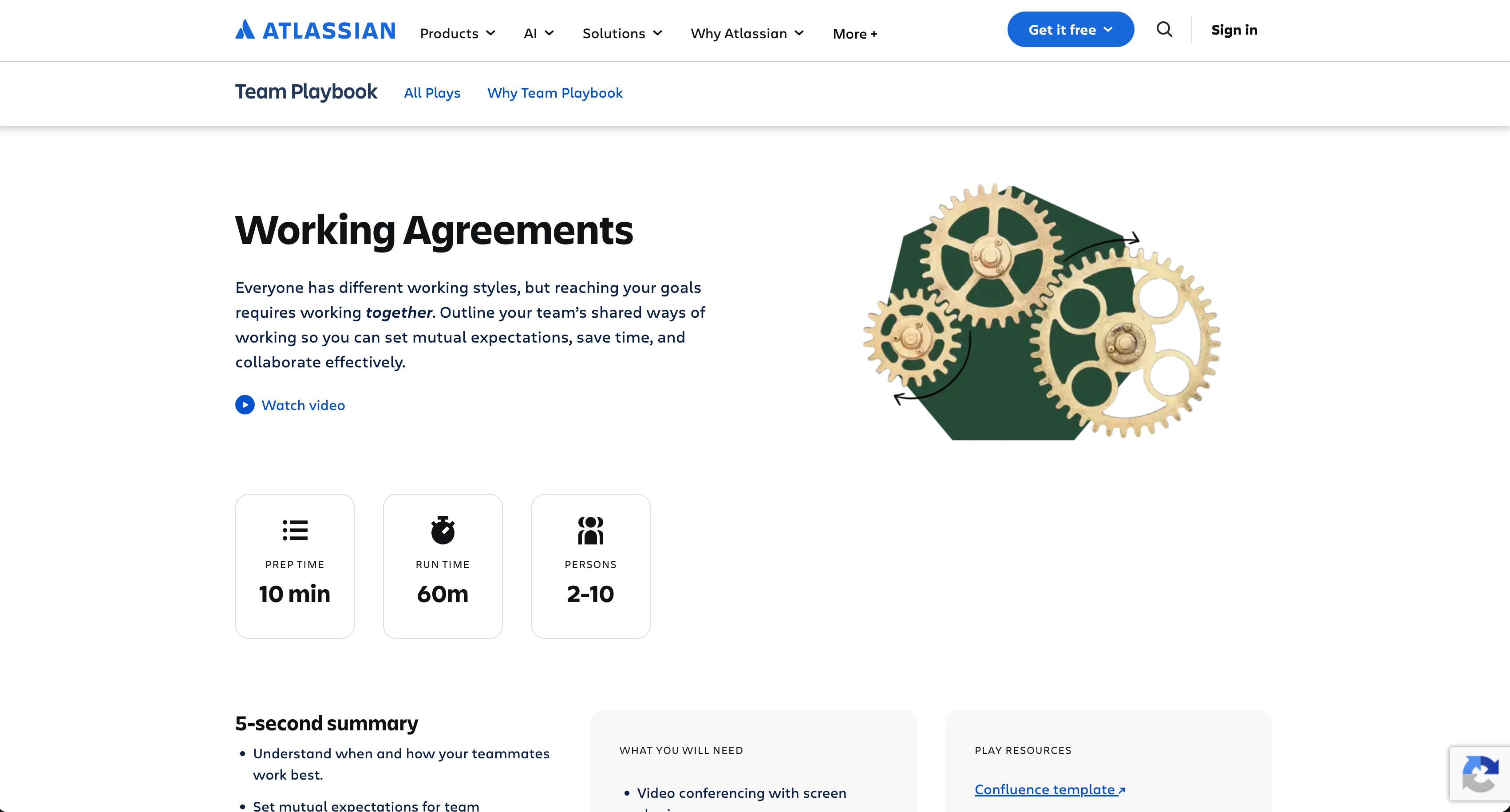
Working Agreements help teams establish explicit expectations for communication, coordination, collaboration, and decision-making.
They are particularly valuable when implementation requires people from different functions to work together in new ways.
Best for: Cross-functional programs, transformation teams, and strategy execution groups.
Practical application: Facilitate a session defining how the team communicates, resolves disagreements, escalates blockers, and reviews commitments.
What to take away: A practical method for reducing coordination friction during implementation.
Output: A documented team operating agreement.
Access: Free guided exercise with supporting template resources.
30. Change Management Kick-Off
Provider: Atlassian Team Playbook
Resource: Change Management Kick-Off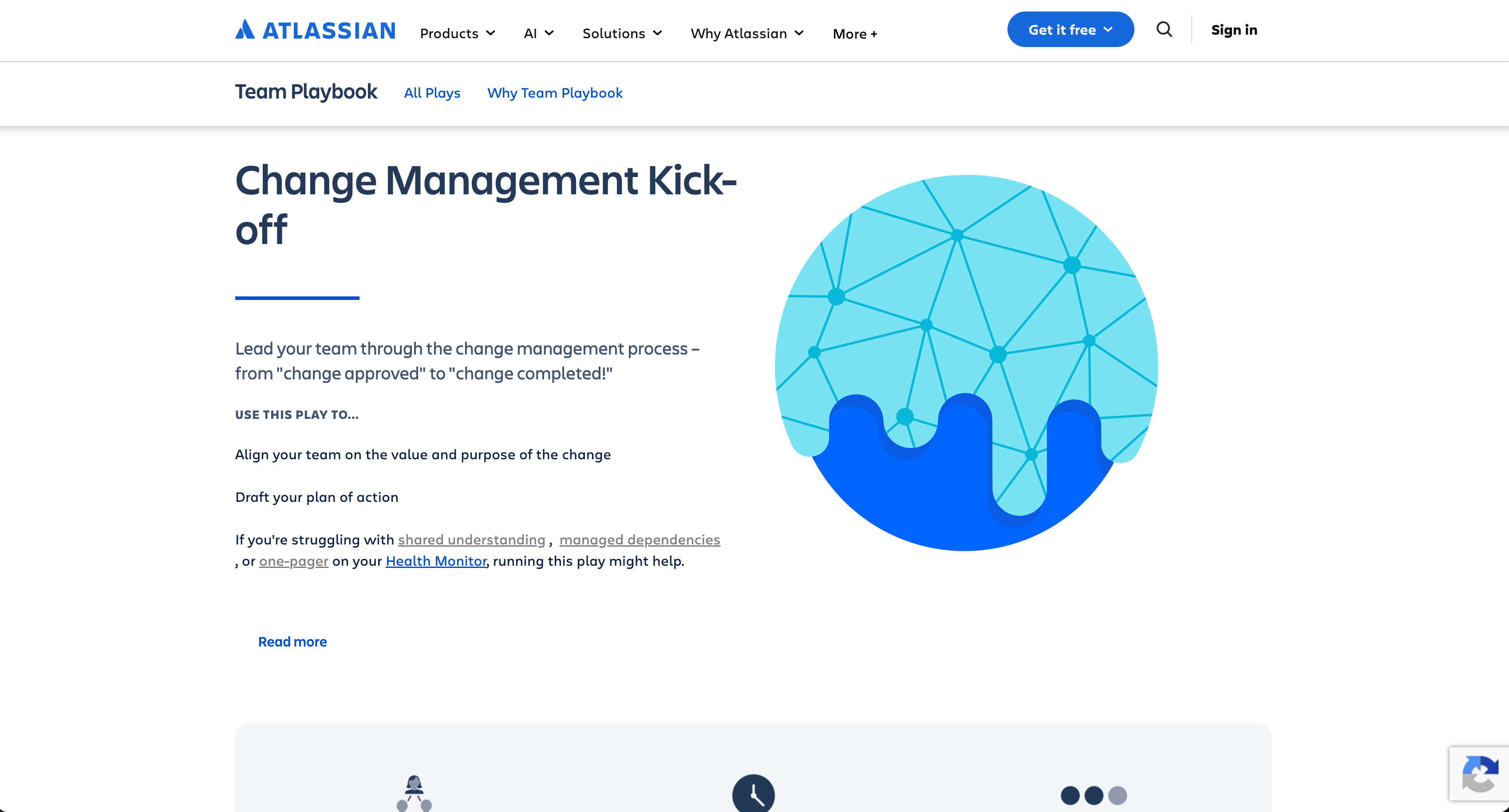
This exercise helps teams plan organizational adoption, stakeholder communication, and responsibilities during change.
It recognizes that completing a technology or process implementation is different from changing how an organization works.
Best for: Strategic transformation programs affecting established workflows.
Practical application: Identify affected stakeholders, required behavioral changes, communication commitments, feedback mechanisms, and accountable owners.
What to take away: A structured approach to the human and organizational side of strategy execution.
Output: An organizational change and adoption plan.
Access: Free guided exercise.
Section 06 implementation checkpoint
The execution plan should make clear which outcomes matter, what work is required, who owns it, and which developments would justify revising the plan.
Expected deliverable: A coordinated, adaptive execution roadmap with accountable owners and measurable results.
Section 07 — Decision Intelligence & Execution Governance
Improve decision quality by clarifying authority, preserving context, and reducing repeated debate.
Organizations often record what they decided without preserving why they decided it.
This makes adaptation difficult.
When assumptions change, leaders may be unable to reconstruct the alternatives considered, the evidence available, or the conditions under which a decision was expected to succeed.
A stronger governance system preserves that context.
31. DACI Decision-Making Framework
Provider: Atlassian Team Playbook
Resource: DACI Decision-Making Framework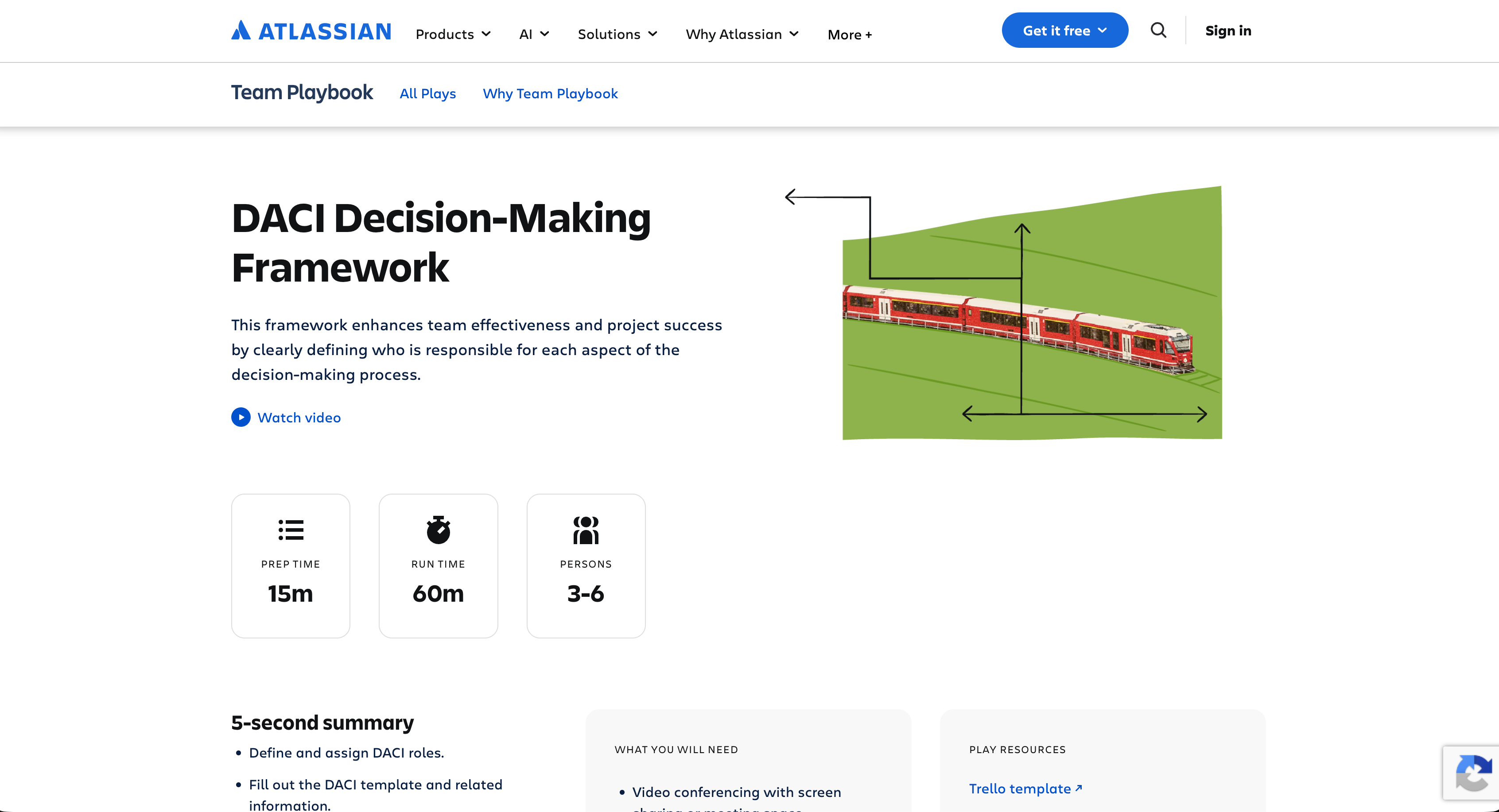
DACI assigns a Driver, Approver, Contributors, and Informed stakeholders to an important decision.
It clarifies who prepares the decision, who makes it, and whose expertise should be considered.
Best for: Cross-functional strategic choices and consequential organizational decisions.
Practical application: Apply DACI to an unresolved strategic question. Define the decision, options, evidence, accountable approver, and deadline.
What to take away: Clear decision authority and preparation responsibilities.
Output: A structured decision responsibility record.
Access: Free guided play with supporting templates.
32. Decision Documentation Template
Provider: Atlassian Confluence
Resource: Decision Documentation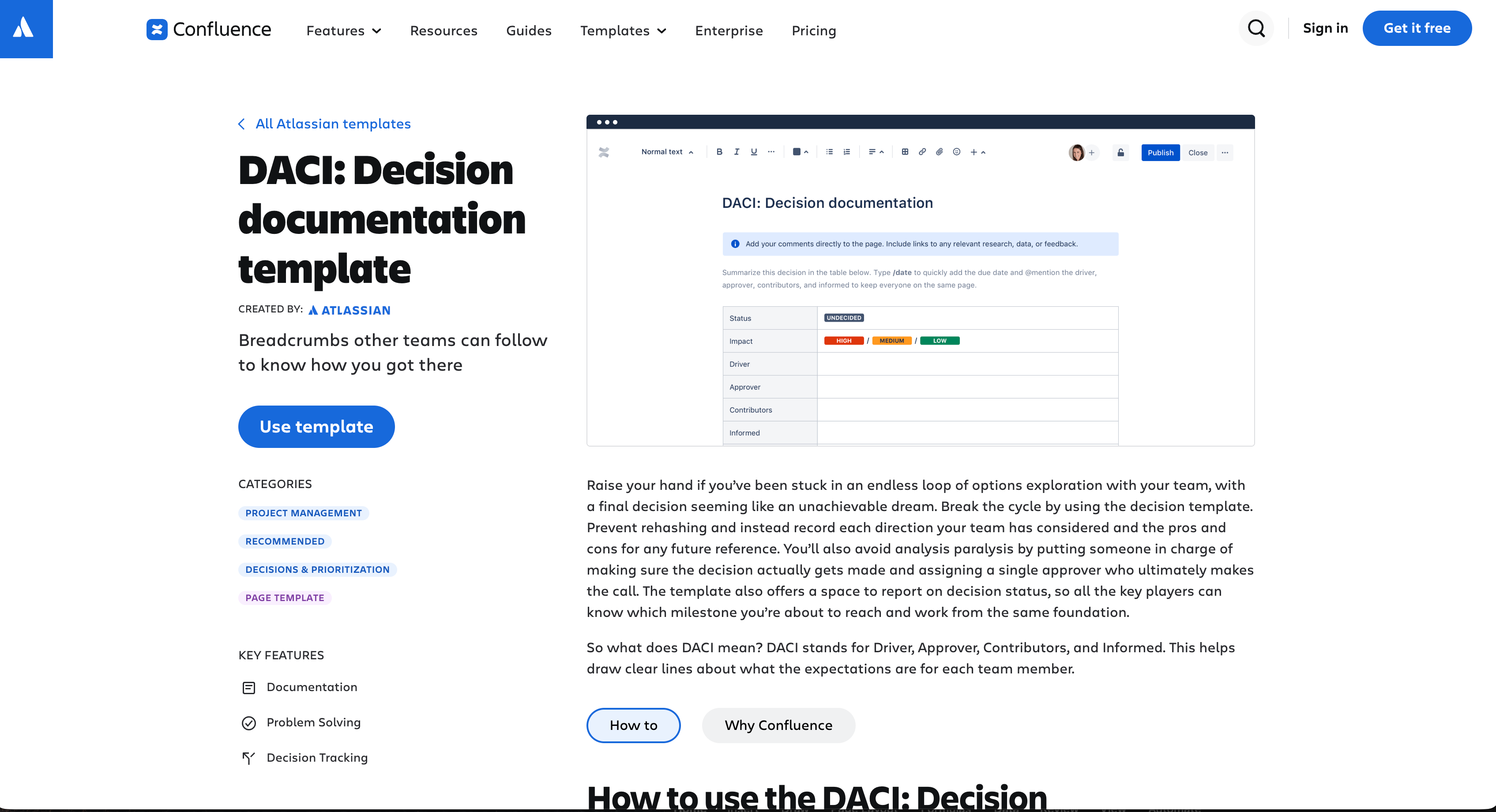
This template records alternatives, reasoning, stakeholders, and decision status.
Its primary value is organizational memory: future teams can understand why a direction was chosen.
Best for: Executive decisions, product strategy, and transformation governance.
Practical application: Document one significant decision, including rejected alternatives and the evidence that would justify revisiting it.
What to take away: A method for preserving decision context across organizational handoffs.
Output: A traceable strategic decision record.
Access: Public Confluence template; account requirements may apply.
33. Roles and Responsibilities
Provider: Atlassian Team Playbook
Resource: Roles and Responsibilities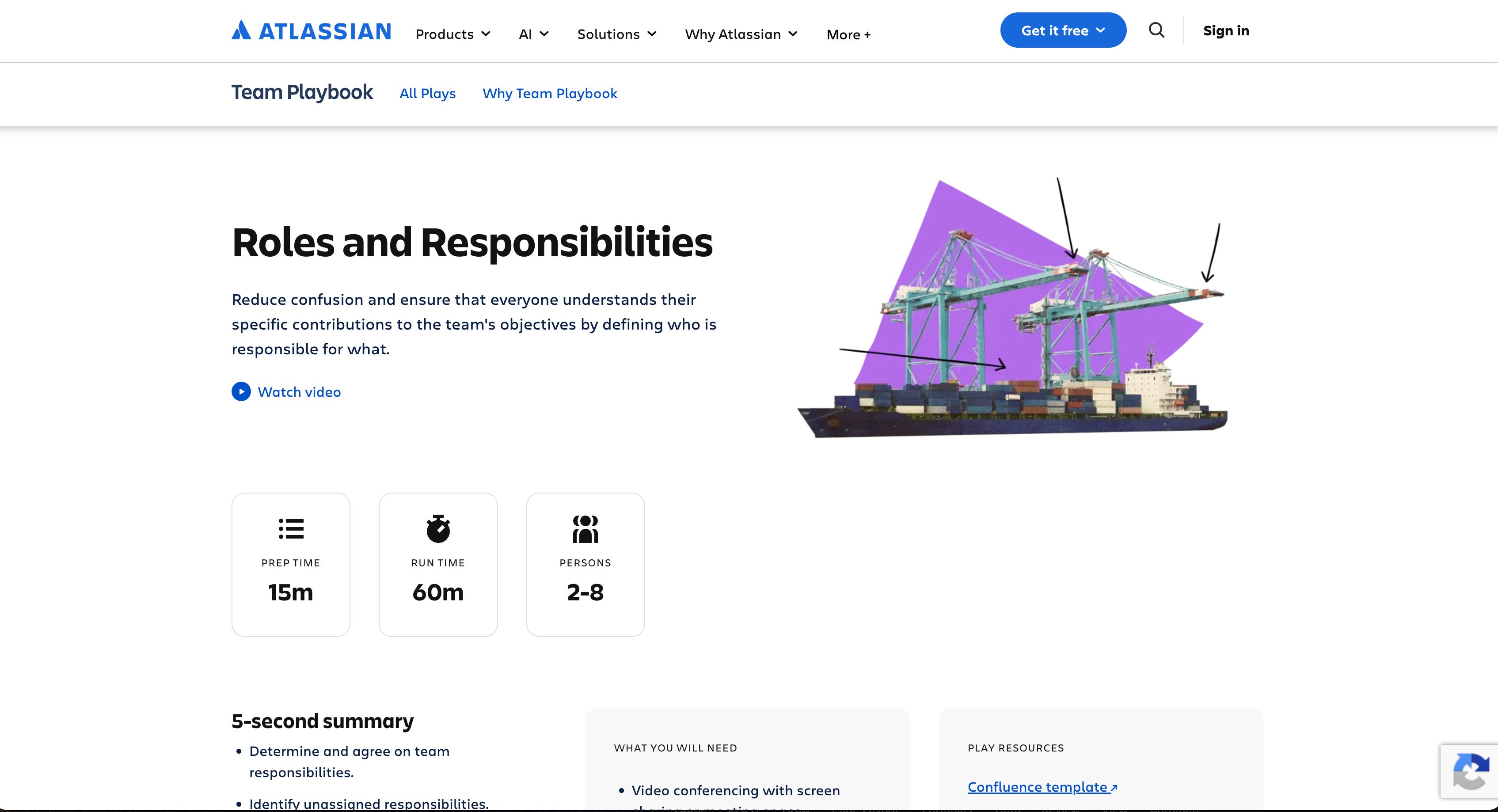
This exercise helps teams distinguish formal roles from actual responsibilities and identify work without clear ownership.
Best for: Strategy execution, operating-model design, and organizational restructuring.
Practical application: Map responsibilities for one strategic initiative and resolve overlaps or unassigned obligations.
What to take away: A clearer understanding of who is responsible for carrying out strategic commitments.
Output: An agreed responsibility map.
Access: Free guided worksheet.
34. Stakeholder Analysis
Provider: Miro
Resource: Stakeholder Analysis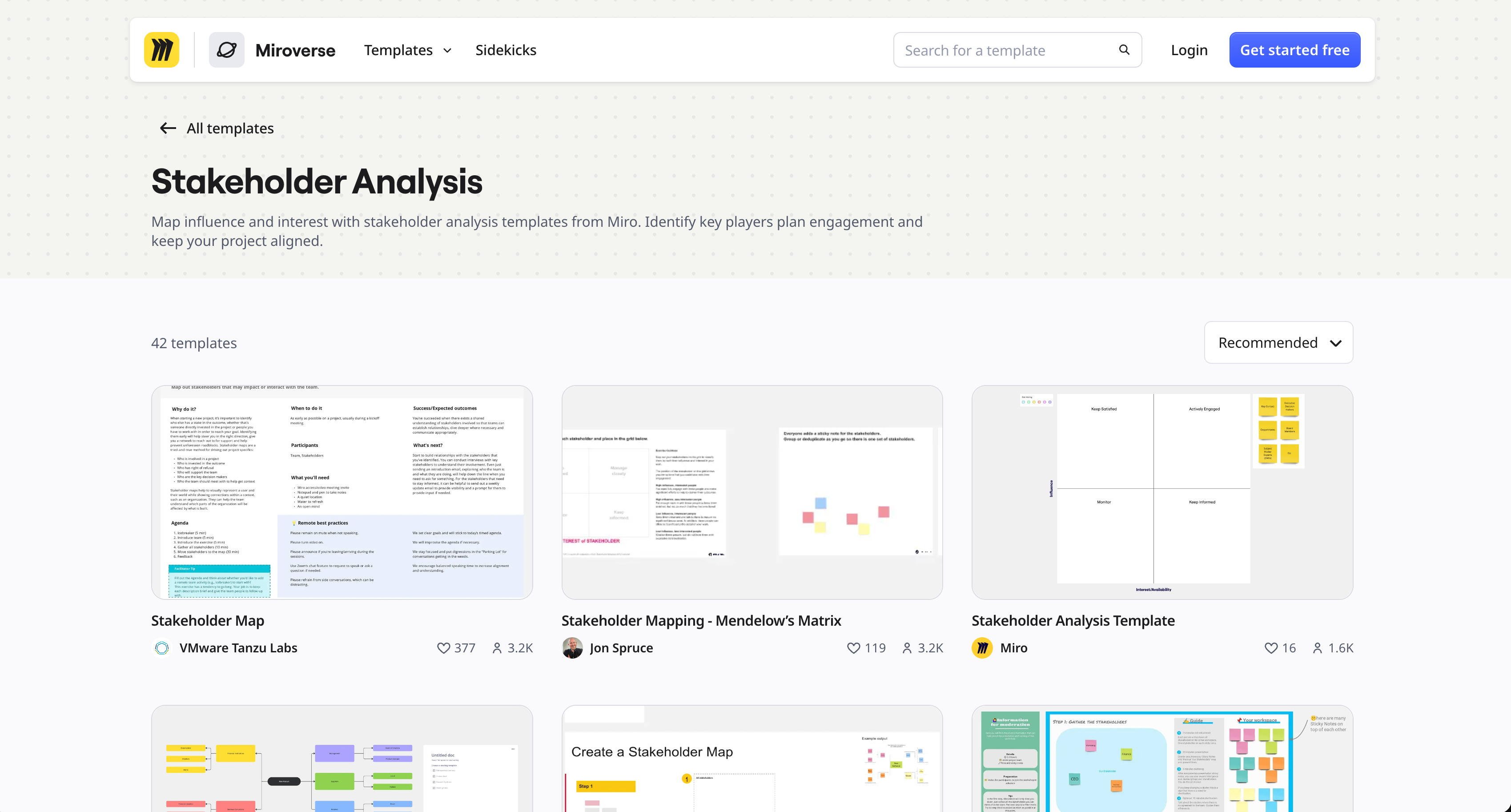
Stakeholder Analysis identifies individuals or groups that influence or are affected by strategic decisions.
It helps teams distinguish formal decision authority from informal influence, adoption concerns, and communication needs.
Best for: Transformation programs, organizational change, and complex strategic initiatives.
Practical application: Identify stakeholders, assess their interests and influence, document their likely concerns, and assign appropriate engagement actions.
What to take away: A clearer understanding of the organizational relationships affecting strategic execution.
Output: A stakeholder engagement and influence map.
Access: Public collaborative template gallery.
35. Decision-Making Retrospective
Provider: Atlassian Team Playbook
Resource: Decision-Making Retro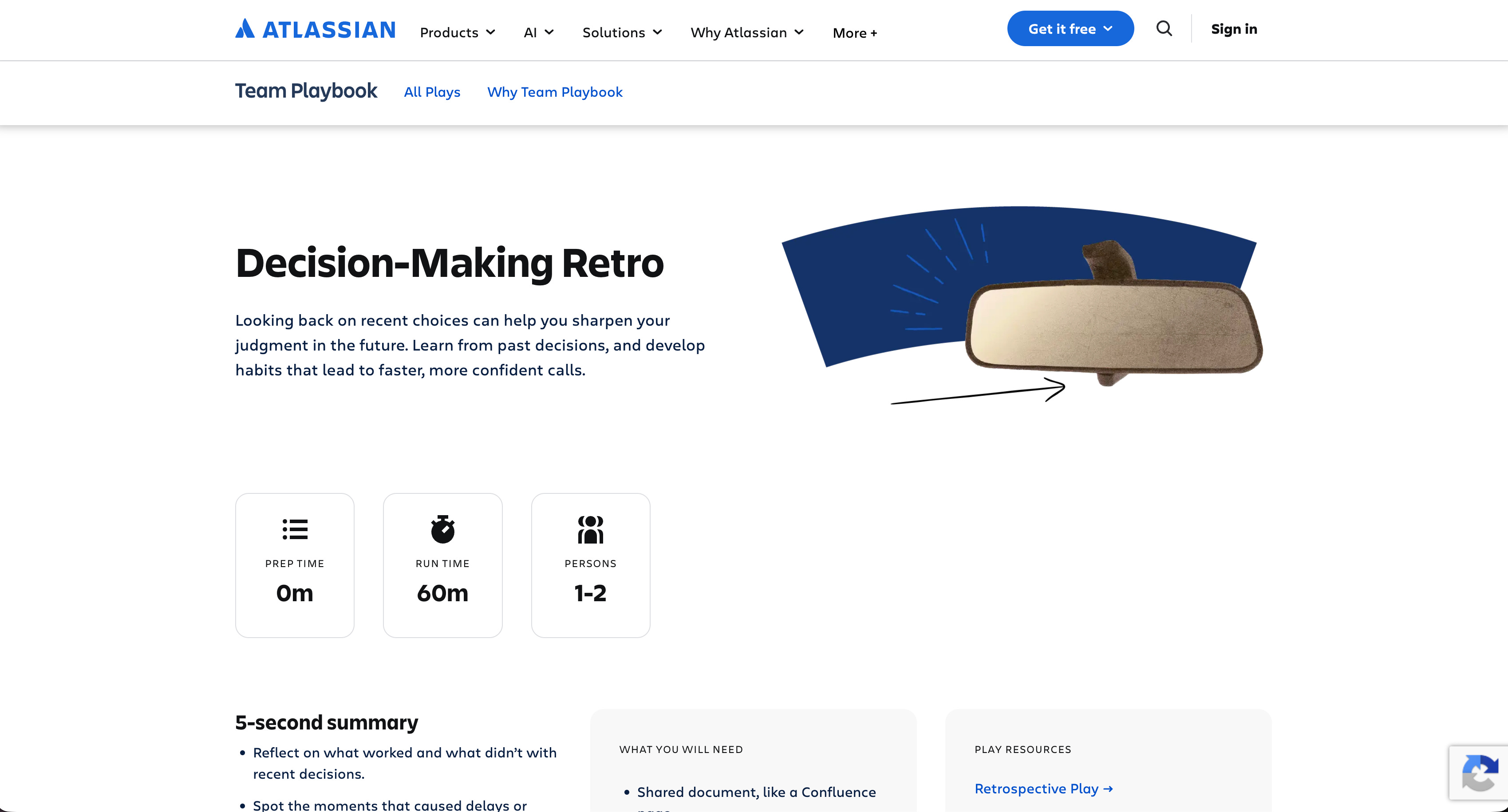
This exercise examines how decisions were made, which uncertainties created delays, and where responsibility or evidence was insufficient.
It is more specific than a general project retrospective.
Best for: Leadership teams seeking to improve decision quality and execution speed.
Practical application: Review three to five recent decisions. Identify recurring causes of friction and agree on improvements to decision preparation, authority, and communication.
What to take away: A better understanding of the organization’s decision-making capability.
Output: A decision-system improvement plan.
Access: Free guided worksheet.
Section 07 implementation checkpoint
Important strategic decisions should have a named owner, documented alternatives, explicit evidence and assumptions, and a review trigger.
Expected deliverable: A decision governance system preserving reasoning and accountability.
Section 08 — Strategic Learning & Continuous Adaptation
Use operational evidence to decide what should continue, change, or stop.
Strategic execution should produce learning.
That learning becomes valuable only when it influences decisions.
A performance dashboard that reports unfavorable results without changing priorities is not a learning system. Nor is a retrospective that generates observations nobody owns.
The following five resources support structured reflection, investigation, and adaptation.
36. Retrospective Template
Provider: Atlassian Confluence
Resource: Retrospective Template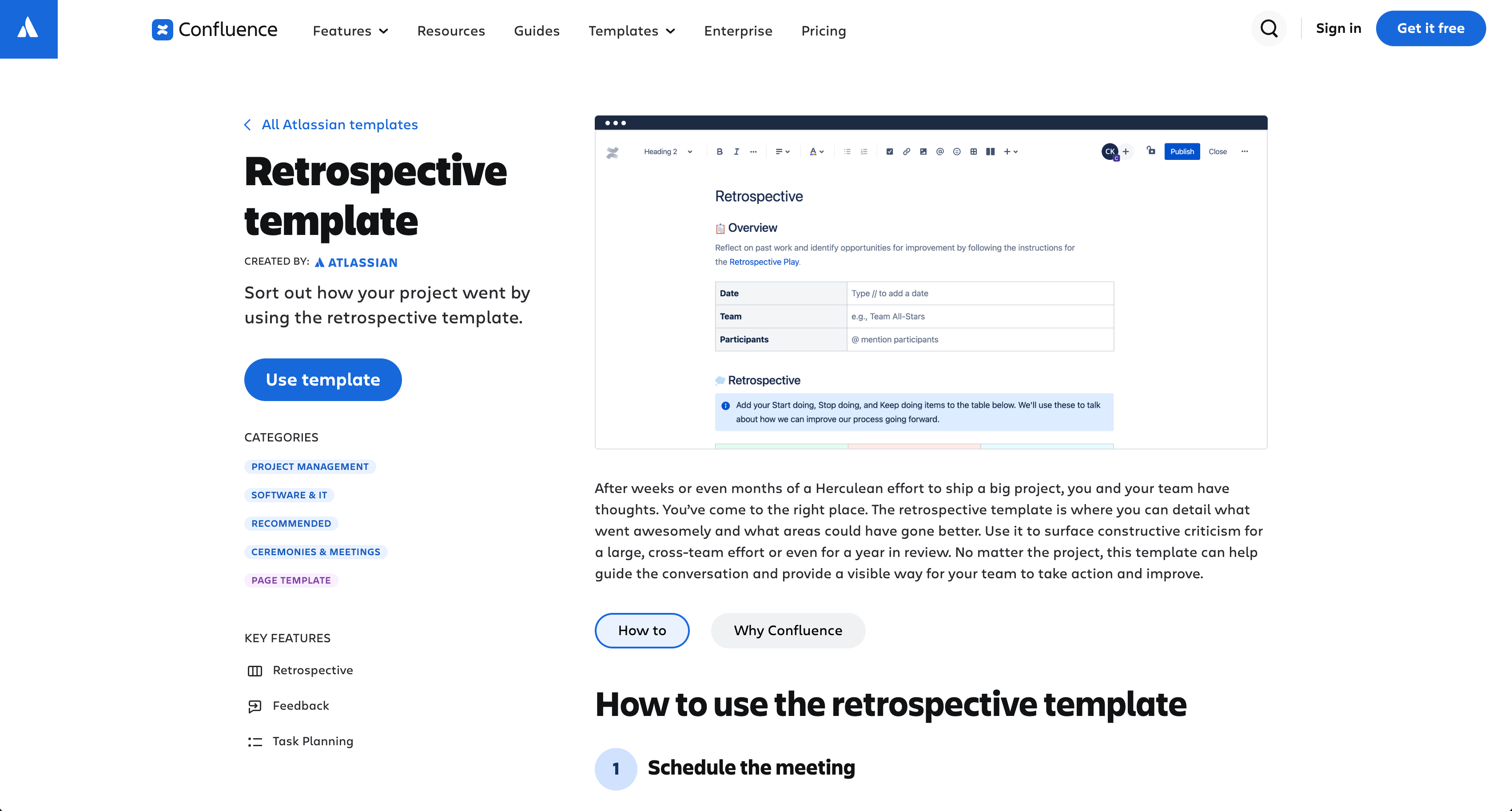
The Retrospective Template provides a structured format for examining what worked, what did not, and what should change.
Best for: Quarterly strategy reviews, major initiatives, and organizational learning.
Practical application: Review the most consequential strategic activities from the previous period. Distinguish operational problems from flawed strategic assumptions.
What to take away: A disciplined method for translating reflection into practical improvement.
Output: A prioritized improvement plan.
Access: Public Confluence template.
37. 4Ls Retrospective
Provider: Atlassian Team Playbook
Resource: 4Ls Retrospective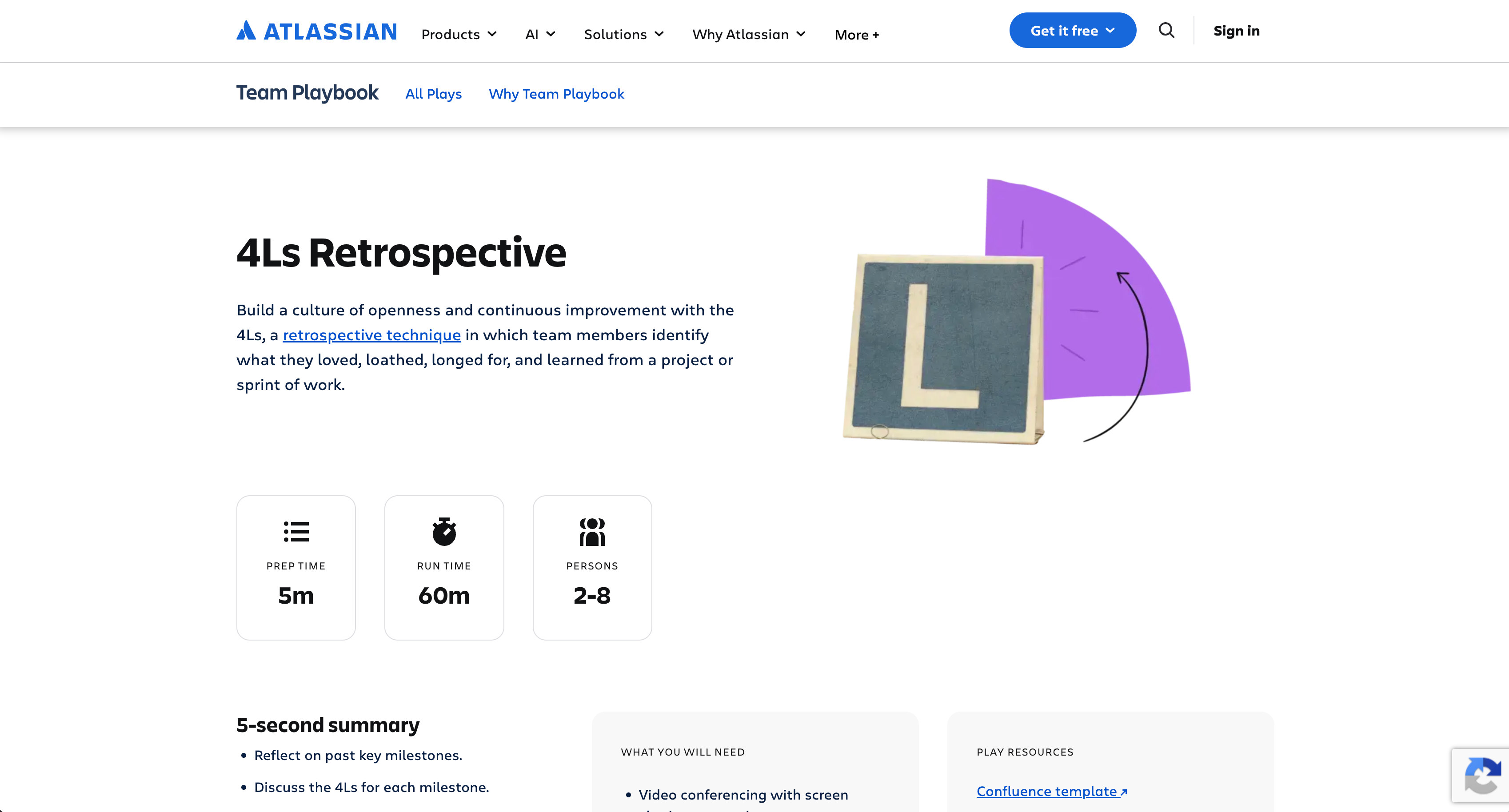
The 4Ls Retrospective structures reflection around four questions:
-
What did we love?
-
What did we loathe?
-
What did we long for?
-
What did we learn?
The framework encourages teams to examine both positive experiences and obstacles rather than focusing exclusively on failures.
Best for: Strategic project reviews, transformation teams, and cross-functional learning.
Practical application: Review the previous quarter through the four lenses. Identify what should be retained, eliminated, introduced, or investigated further.
What to take away: A balanced perspective on organizational experience and improvement opportunities.
Output: A structured retrospective with accountable improvement actions.
Access: Free guided exercise with Confluence, Trello, and whiteboard template options.
38. 5 Whys Analysis
Provider: Atlassian Team Playbook
Resource: 5 Whys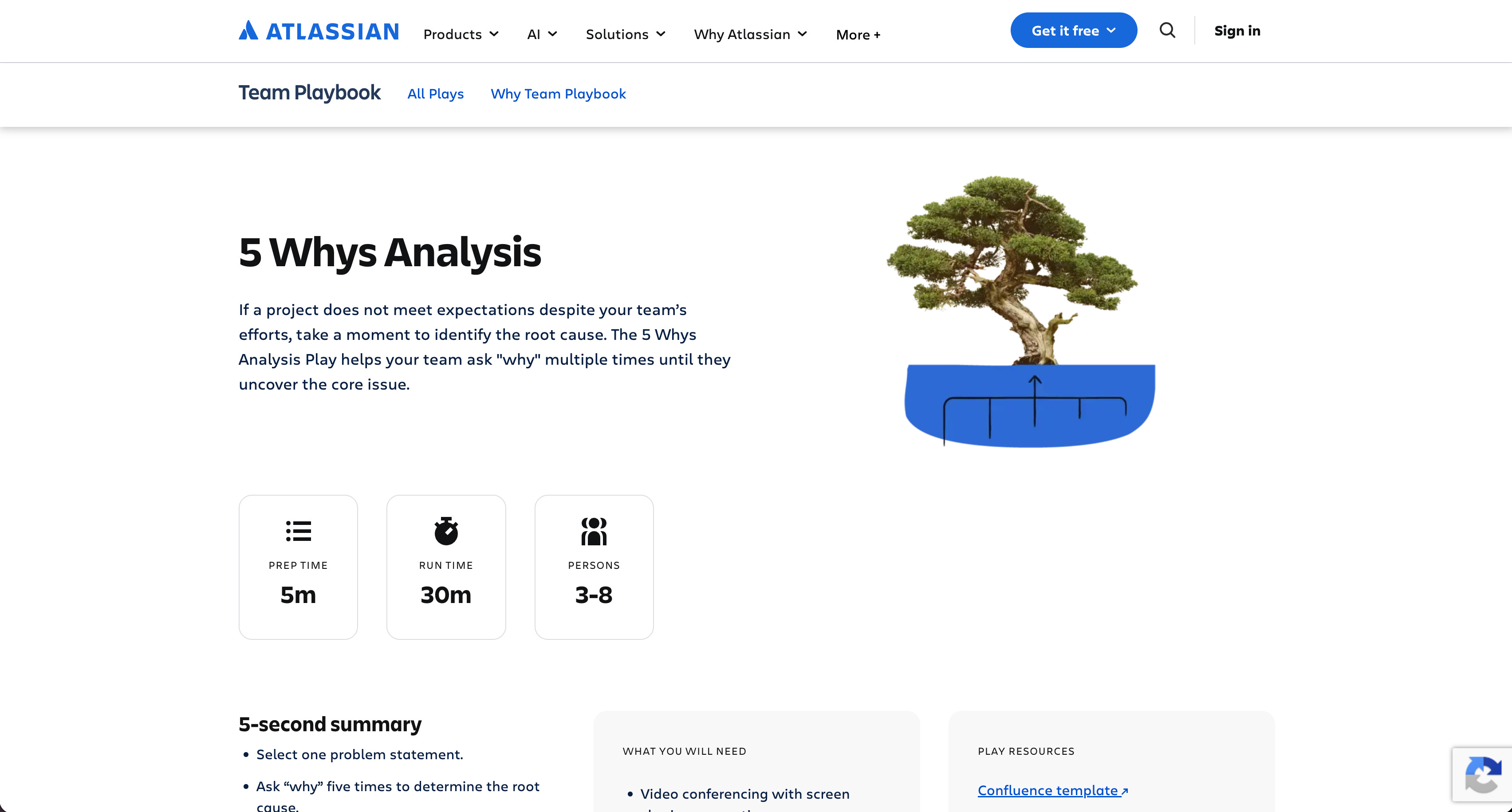
The 5 Whys method investigates the underlying causes of an observed problem by repeatedly asking why it occurred.
Although simple, it can reveal organizational or process conditions that superficial performance reporting overlooks.
Best for: Investigating recurring execution problems and operational failures.
Practical application: Select one significant deviation from the strategy. Investigate the underlying causes, test the resulting explanation against available evidence, and identify corrective actions.
What to take away: A structured way to distinguish symptoms from potentially deeper operational causes.
Output: A root-cause hypothesis and corrective-action plan.
Access: Free guided worksheet.
Important: The exercise is a diagnostic aid. Complex problems may have multiple causes and require additional evidence beyond five questions.
39. Experiment Library
Provider: Strategyzer
Resource: Experiment Library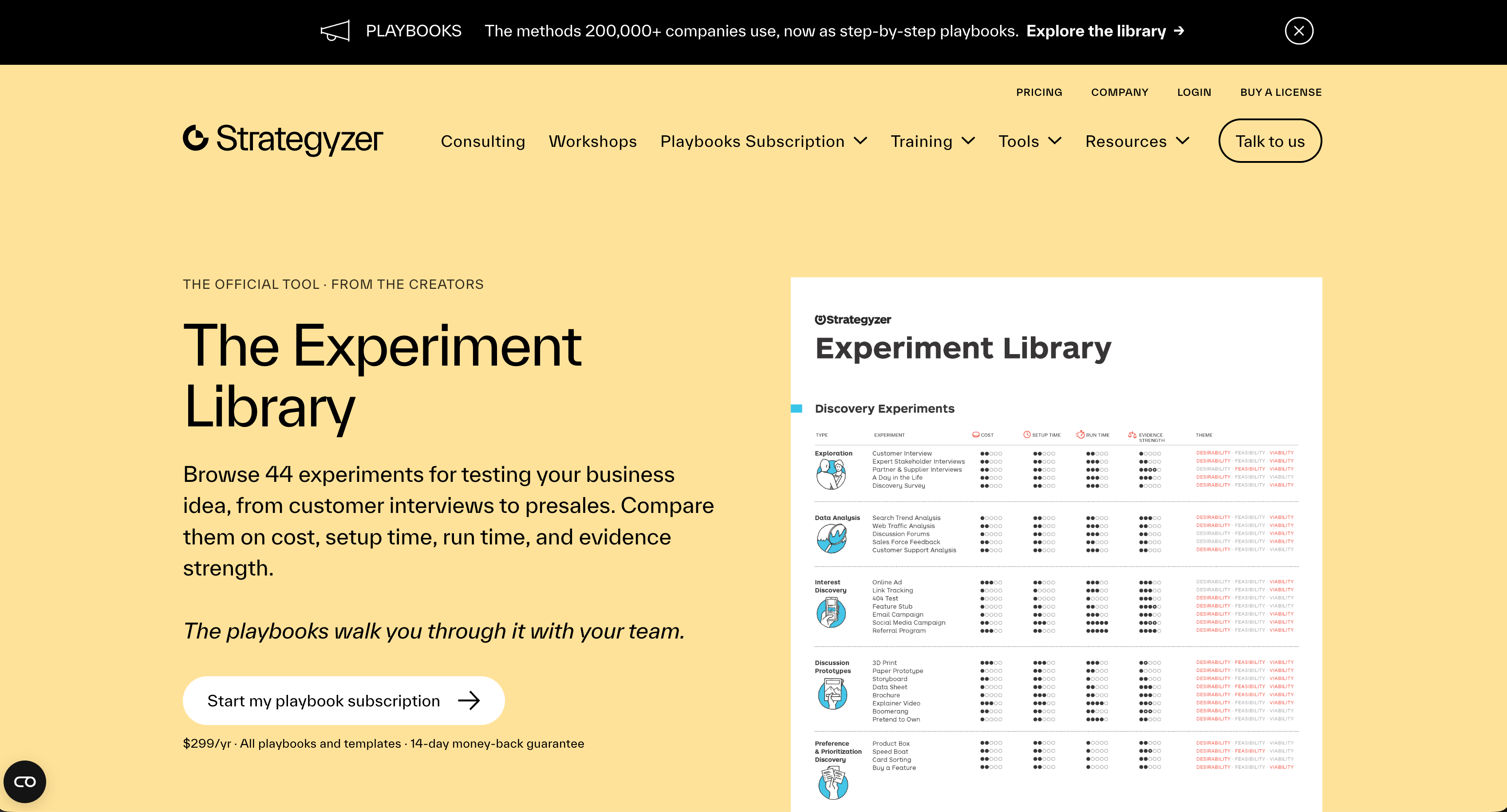
The Experiment Library introduces 44 approaches to testing business ideas, ranging from discovery activities to stronger validation methods.
It compares experiments according to factors such as cost, setup time, execution time, and strength of evidence.
This makes it particularly relevant when a strategic review reveals that an important assumption remains unresolved.
Best for: Strategic experimentation, business model innovation, and adaptive investment decisions.
Practical application: Select an assumption requiring further evidence. Compare alternative experiments and choose a method appropriate to the importance and uncertainty of the decision.
What to take away: A broader understanding of evidence-gathering methods beyond surveys and basic prototypes.
Output: A selected experiment approach and evidence-development plan.
Access: Free official experiment-library poster; guided implementation playbooks are paid separately.
40. Ecosystem Map
Provider: Strategyzer
Resource: Ecosystem Map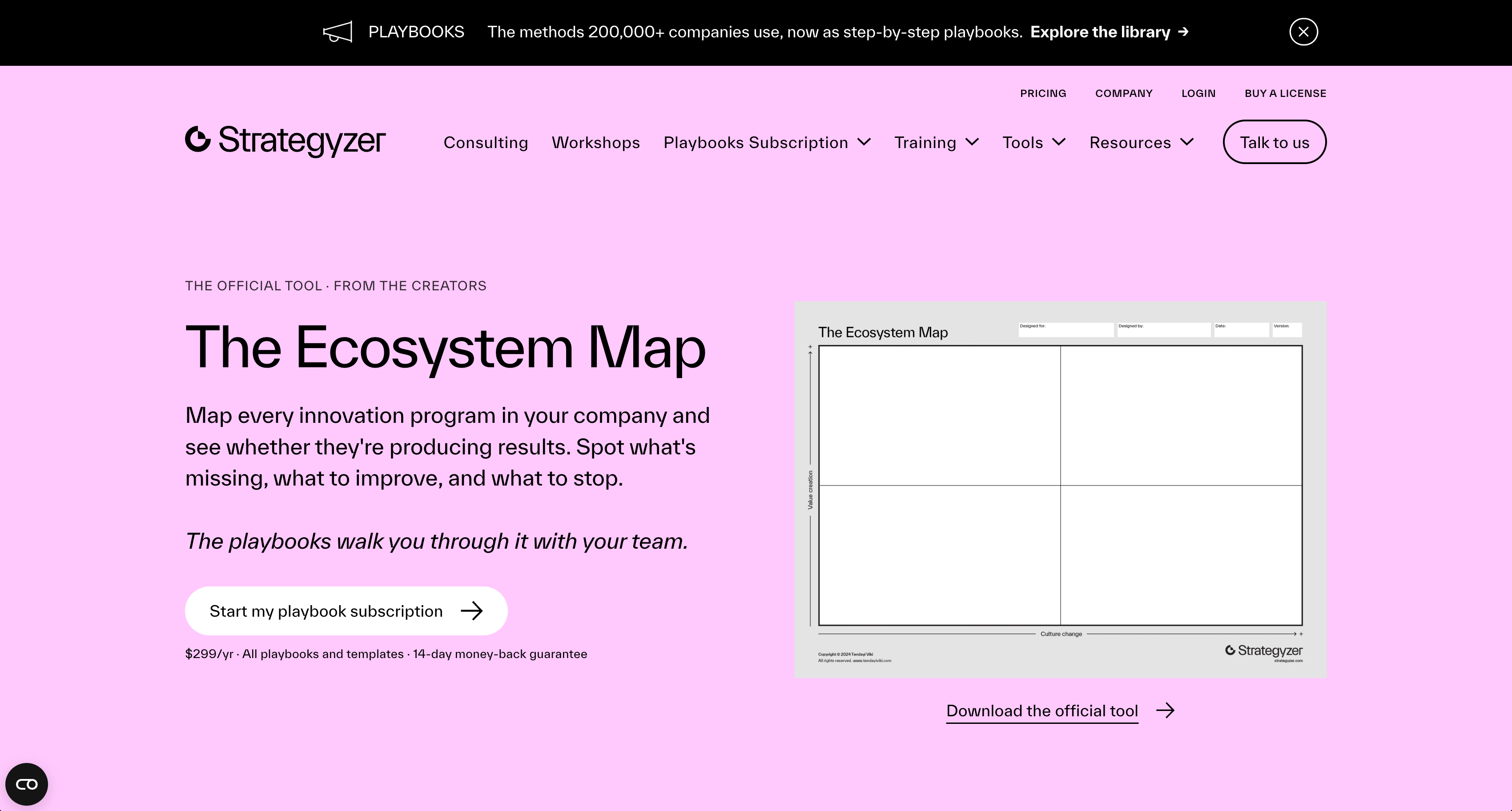
The Ecosystem Map helps organizations examine their innovation programs as an interconnected system.
It supports discussions about which programs are creating value, which are disconnected from strategic priorities, where gaps exist, and which initiatives should be improved or discontinued.
This is particularly valuable for organizations whose strategic learning remains fragmented across separate innovation units.
Best for: Corporate innovation portfolios, enterprise transformation, and strategy renewal.
Practical application: Map your organization’s innovation programs and evaluate their contribution to strategic objectives. Identify programs that reinforce each other, areas with missing capabilities, and initiatives that no longer justify investment.
What to take away: A system-level view of whether organizational innovation activity supports strategic direction.
Output: An innovation ecosystem map and portfolio improvement decisions.
Access: Free official printable PDF template; guided Strategyzer playbooks are paid separately.
Section 08 implementation checkpoint
A strategy review is complete only when new evidence has been translated into an explicit decision.
Expected deliverable: An updated set of assumptions, priorities, commitments, and learning records.
The Strategy Operating System: Six Original TSS Frameworks
The 40 resources address specific strategic challenges. The following original frameworks connect those activities into one operating method.
These are TSS synthesis frameworks, not official extensions of the external providers’ methodologies.
Framework 01 — The Strategy-to-Execution Architecture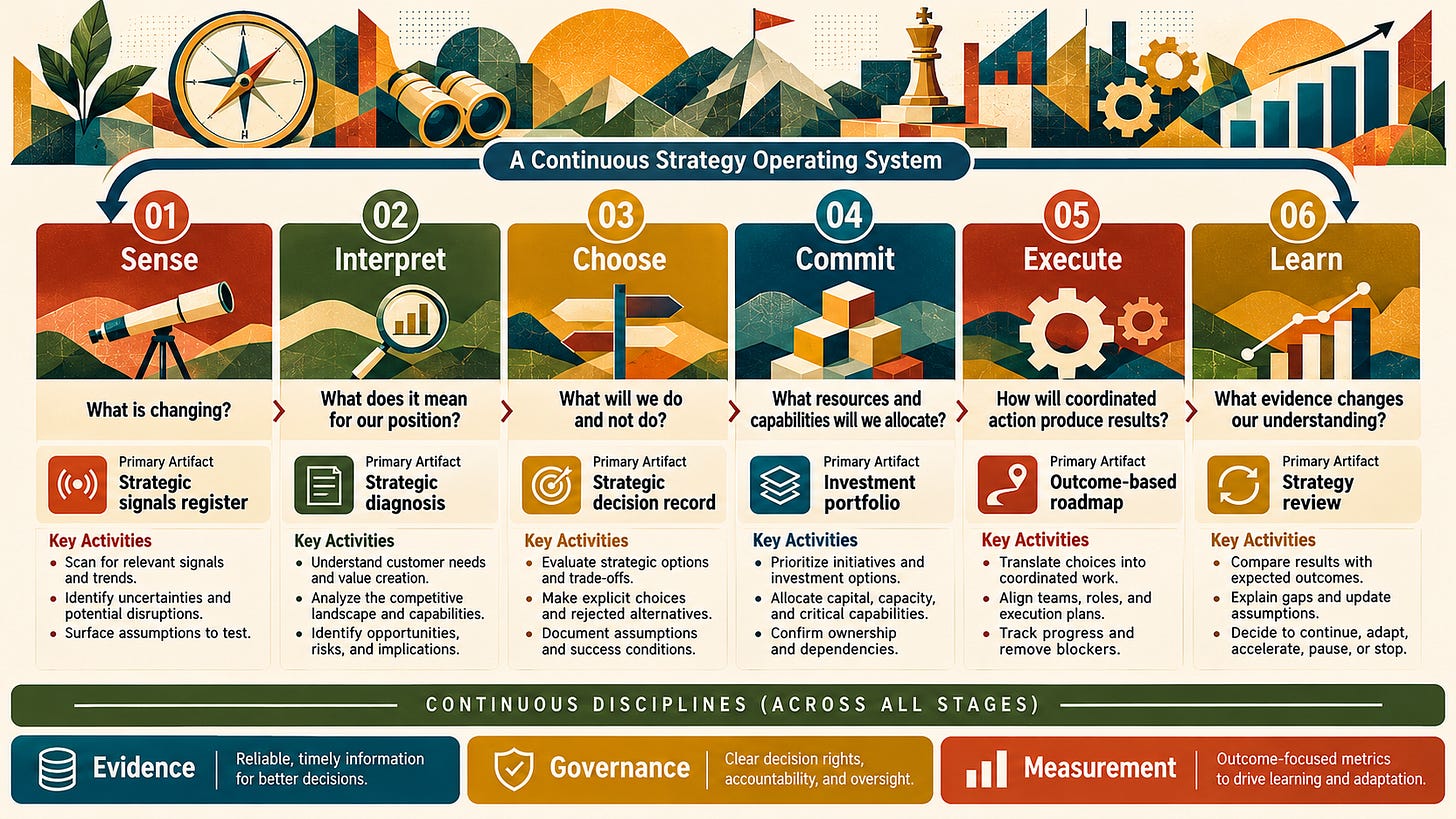
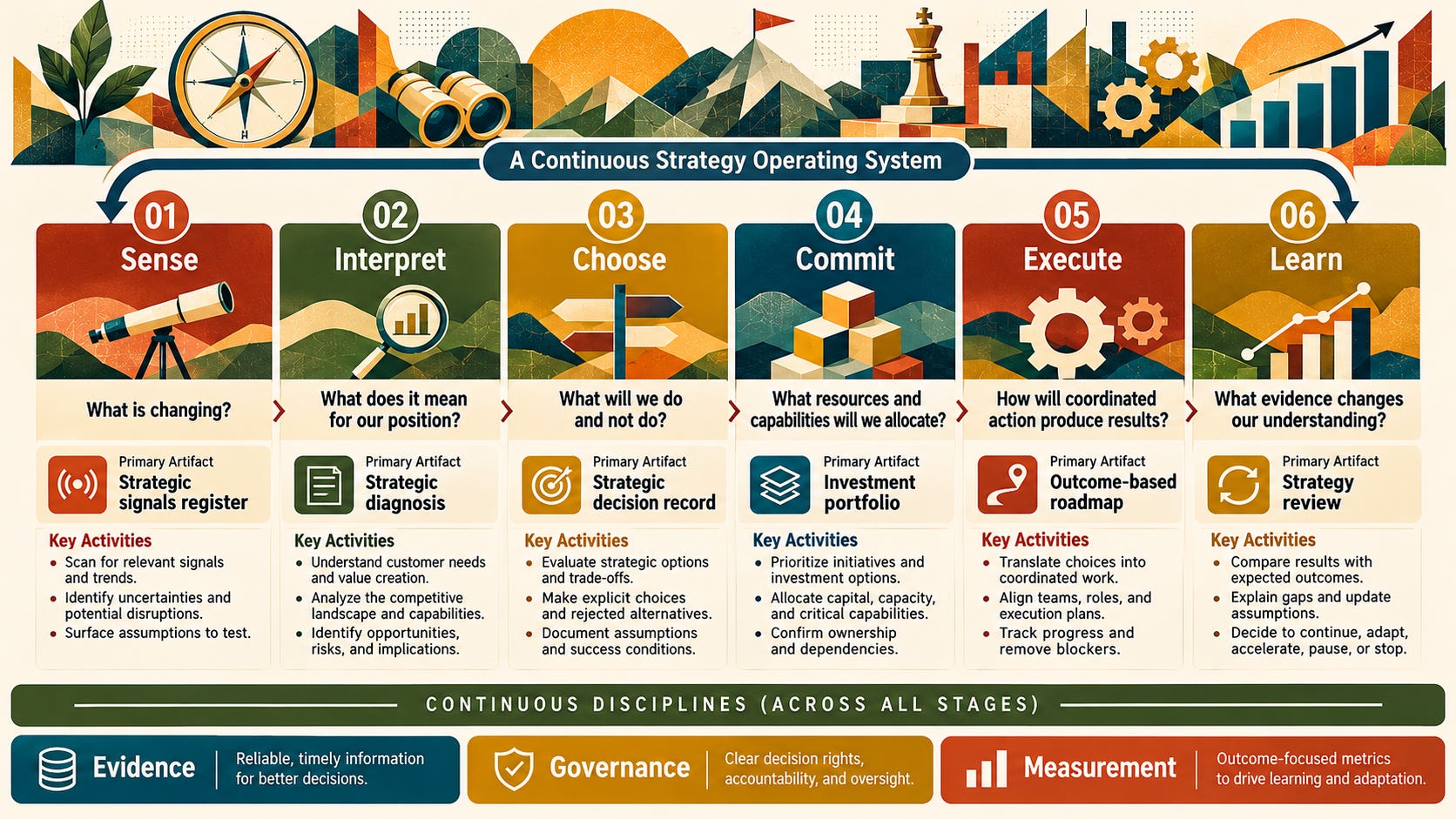
An effective strategy operating system performs six recurring functions.
The six activities form a continuous loop rather than a rigid process.
How to use it
Start with one important strategic initiative.
Map the documents and processes currently supporting each function. Identify which activities are poorly connected.
For example, the organization may have excellent competitive analysis but no documented strategic trade-offs. Or it may have a detailed project portfolio without evidence that those projects support a coherent strategic direction.
The framework helps identify these gaps.
Decision rule: Every consequential strategic initiative should be traceable from its underlying opportunity and strategic choice through to the resources committed, actions taken, and results observed.
Framework 02 — The Modern Strategy Template Selection Matrix
Choose templates based on the decision the organization needs to make.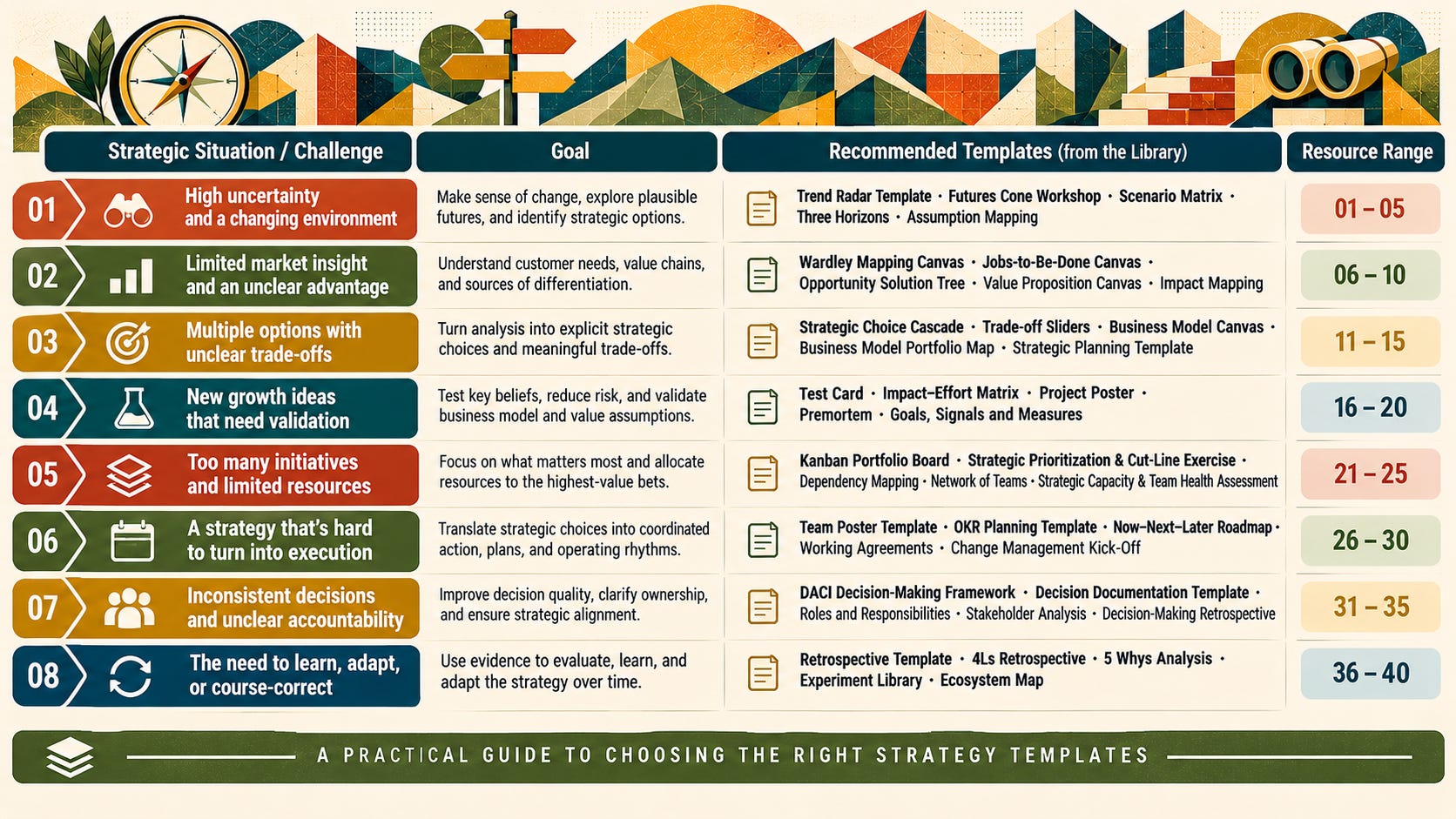
How to use it
Identify the strategic question that currently constrains progress.
Then select the smallest combination of templates capable of producing a useful decision or evidence.
Avoid introducing a framework simply because it is fashionable, familiar, or used by another organization.
Decision rule: Use the smallest set of templates necessary to make a consequential decision well.
Framework 03 — The Strategic Decision Record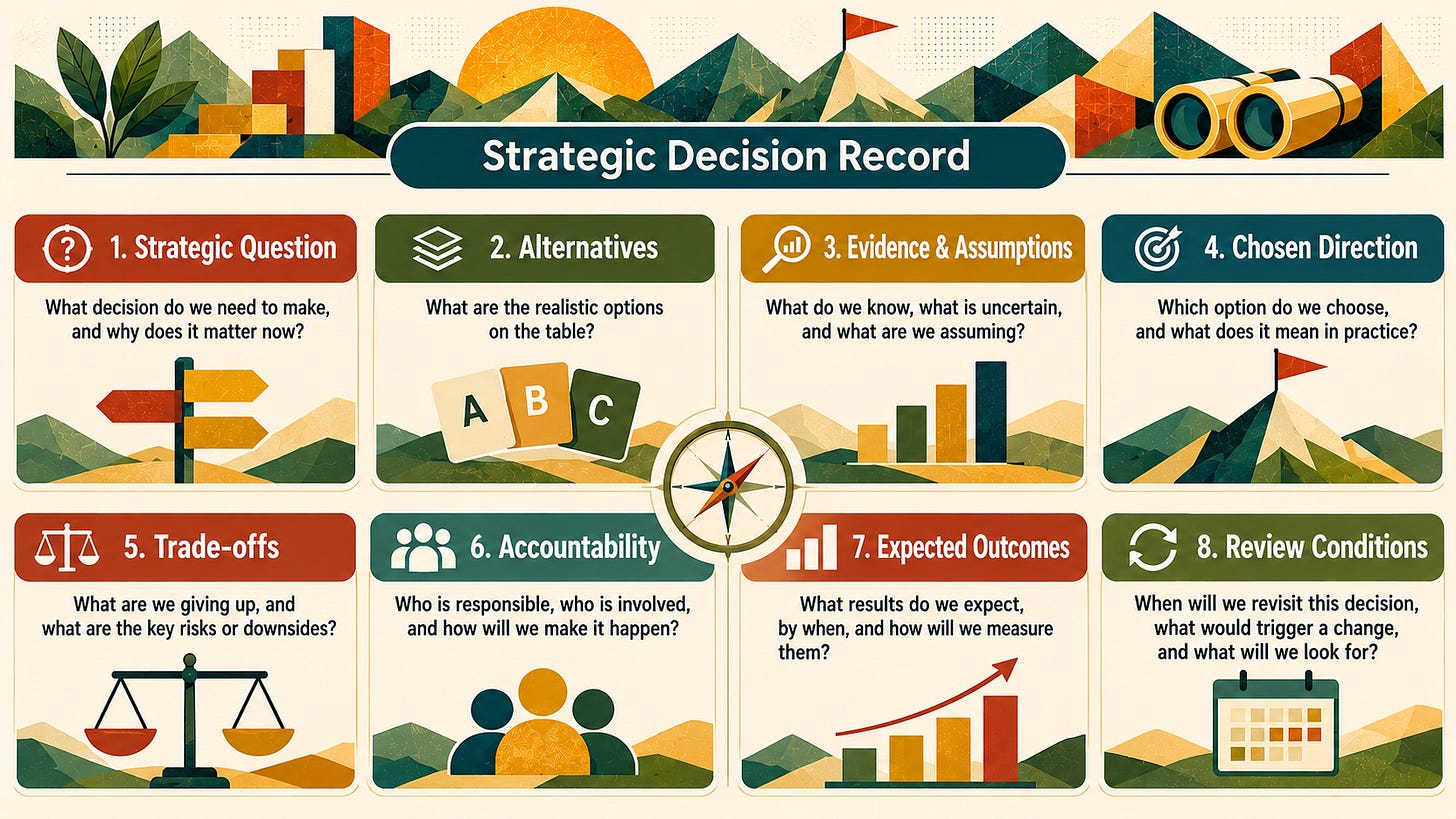
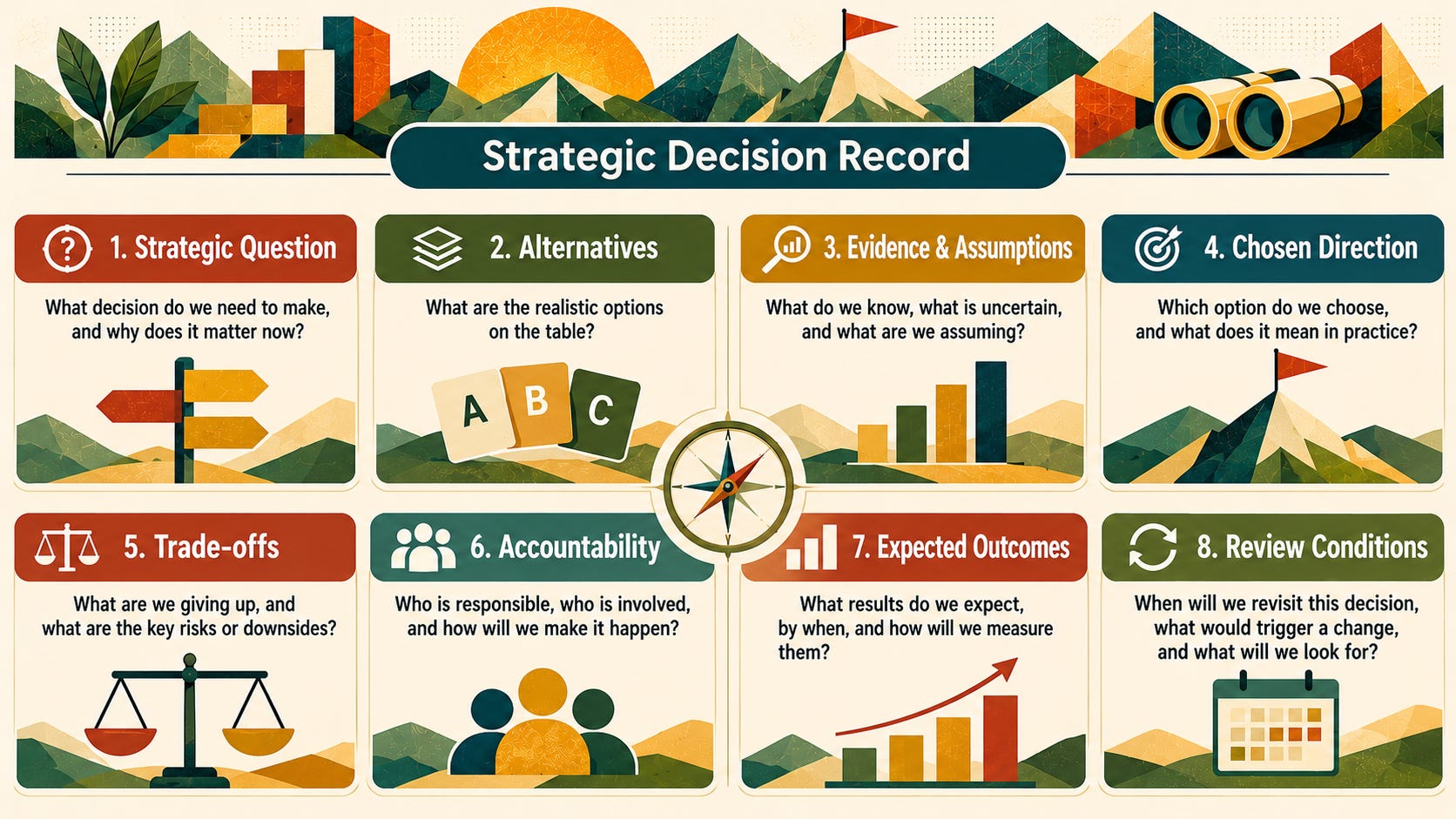
Every consequential strategic decision should preserve eight elements:
-
Strategic question: What problem or opportunity requires a decision?
-
Alternatives: Which feasible options were considered?
-
Evidence and assumptions: What is known, and what remains uncertain?
-
Chosen direction: What did the organization decide?
-
Trade-offs: Which alternatives were rejected, and why?
-
Accountability: Who owns the decision and its execution?
-
Expected outcomes: What should improve if the decision succeeds?
-
Review conditions: What evidence would justify reconsideration?
How to use it
Complete the record before implementation.
Store it where the people responsible for execution can find it. Revisit it when predefined evidence emerges, rather than reopening decisions simply because preferences have changed.
The purpose is not to freeze the strategy. It is to preserve the reasoning required to adapt it intelligently.
Framework 04 — The Strategy Execution Operating Cadence
Strategic direction must connect to recurring operational decisions.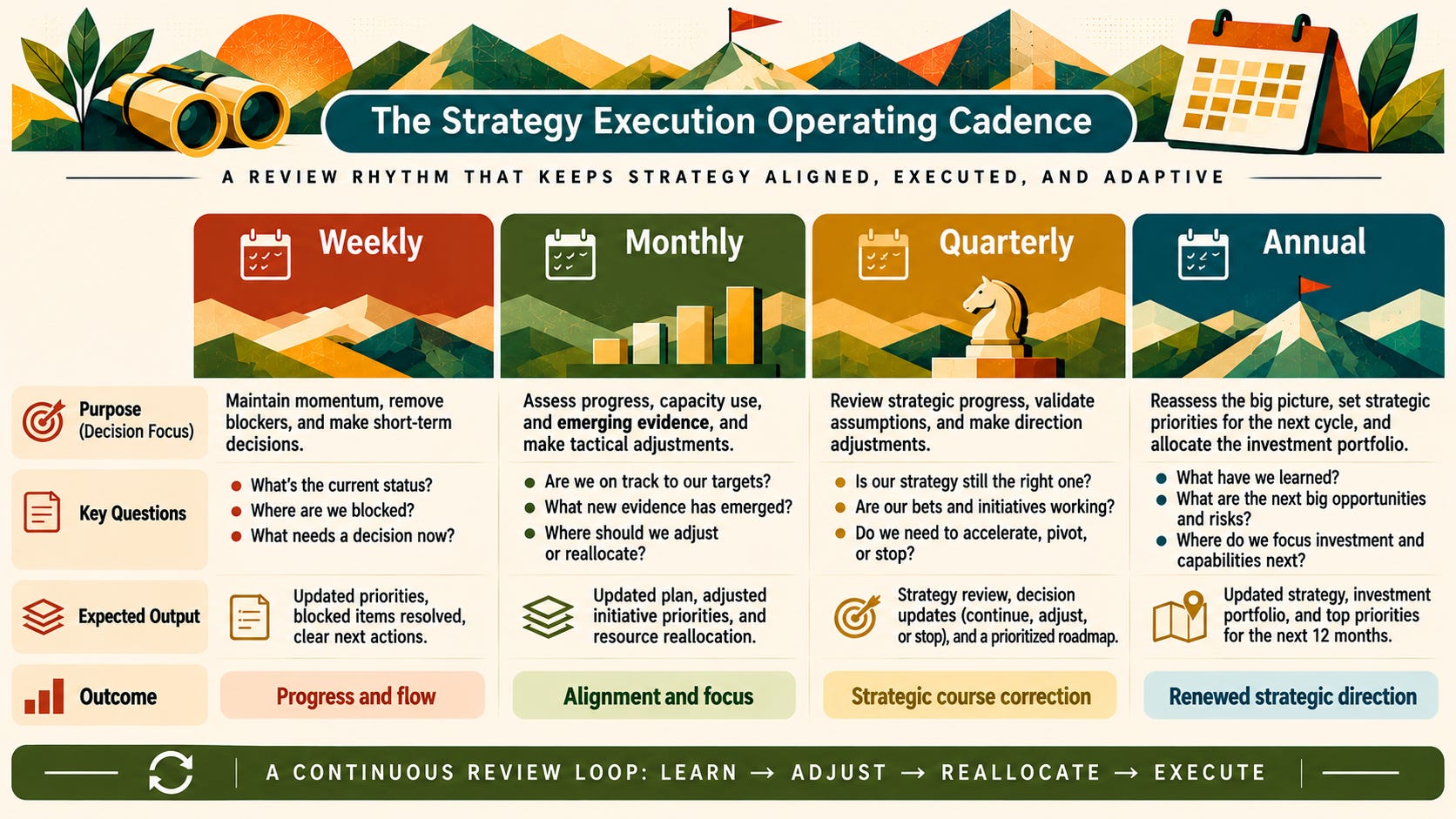
How to use it
Begin with the decisions that genuinely require periodic attention.
Weekly execution reviews should not recreate the annual strategy workshop. Likewise, quarterly reviews should examine strategic assumptions rather than becoming an extended project status meeting.
Decision rule: Every recurring review should have a defined decision purpose and produce a recorded outcome.
The cadence is an example, not a universal standard. Organizations should adapt it to their operating environment.
Framework 05 — The Strategic Alignment Audit
Assess each major initiative against five questions.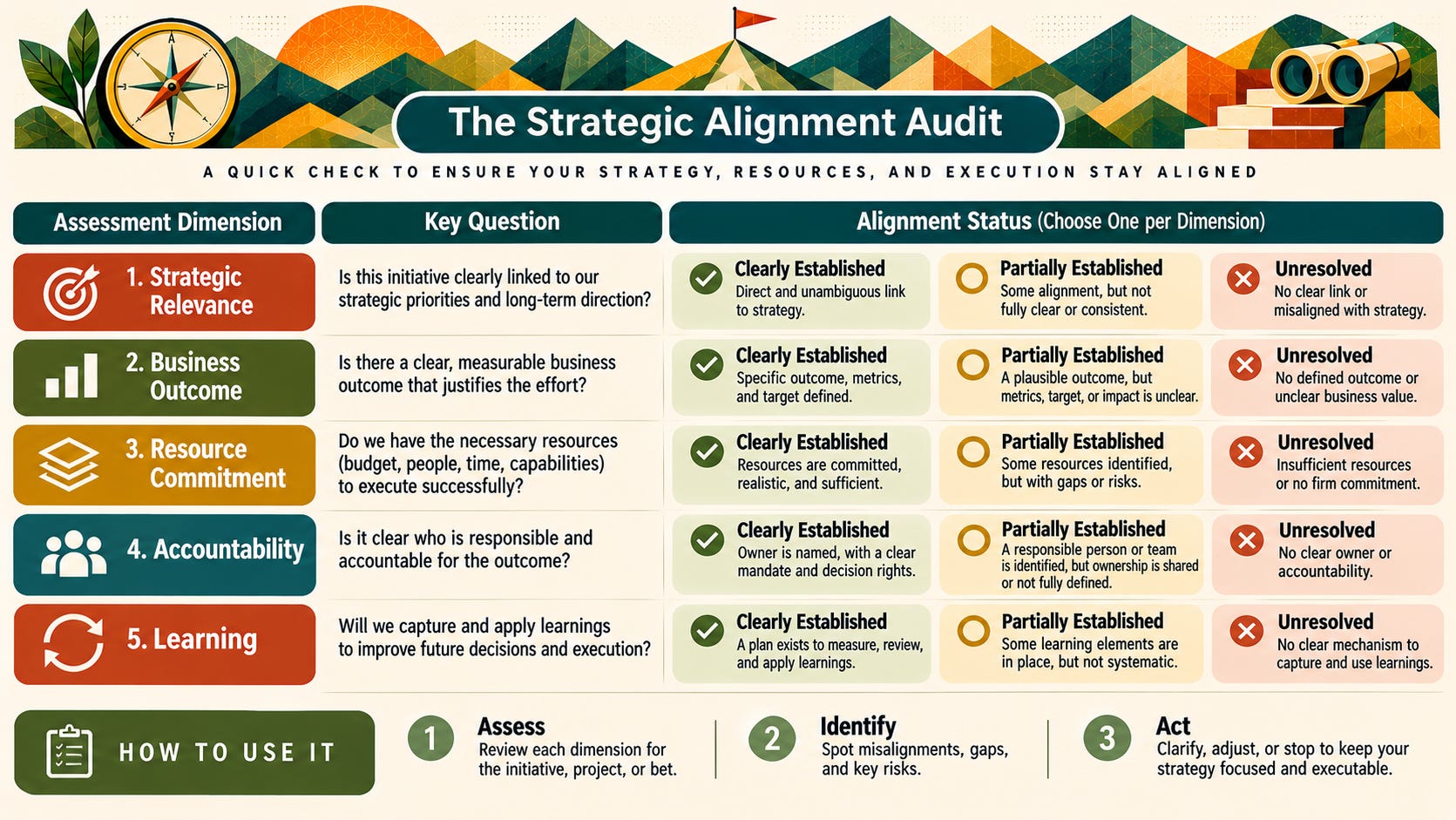
How to use it
For each initiative, record whether the requirement is:
-
Clearly established.
-
Partially established.
-
Unresolved.
An initiative with unresolved requirements is not automatically worthless, but the gaps must be addressed before new commitments are made.
Output: An initiative alignment and execution-gap register.
Framework 06 — The Strategic Learning Loop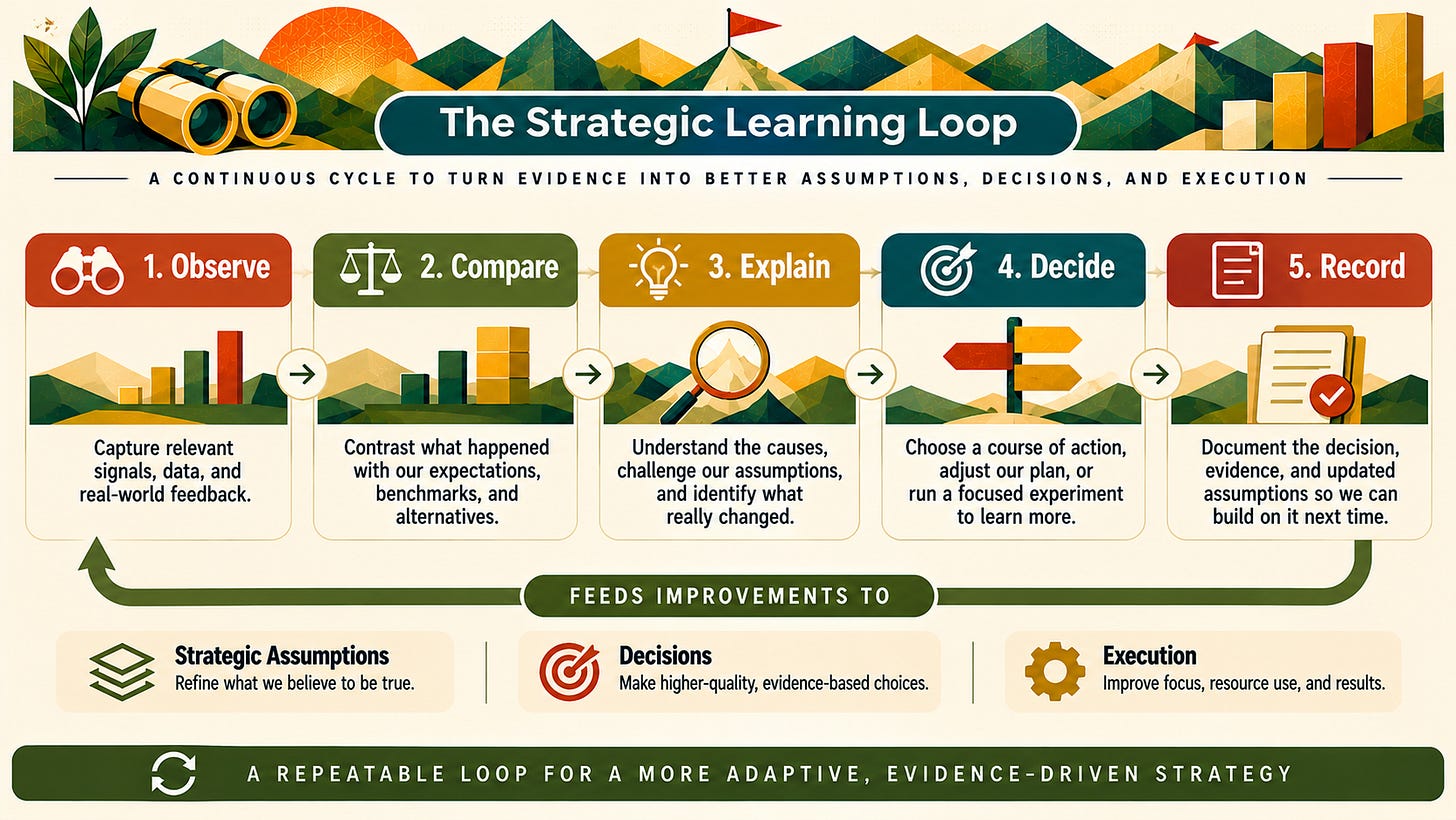
Use five steps to update strategic decisions.
Observe: Collect relevant operational, customer, competitive, and environmental evidence.
Compare: Evaluate it against original assumptions and expected outcomes.
Explain: Determine whether discrepancies reflect execution problems, changed circumstances, or an incorrect strategic hypothesis.
Decide: Continue, adapt, accelerate, pause, or stop the initiative.
Record: Update the relevant decision, portfolio, and execution documents.
How to use it
Apply the loop during recurring strategic reviews.
Distinguish observed facts from interpretations. Preserve disagreements where the evidence remains inconclusive.
Assign owners to improvement actions and record what evidence should be examined at the next review.
Output: A traceable history of strategic learning and adaptation.
Worked Example — A Professional Services Firm Repositioning for AI-Enabled Competition
Consider a hypothetical professional services firm with 120 employees.
Its traditional business relies on consulting projects delivered through specialist teams.
Customers increasingly expect faster delivery, clearer measurable outcomes, and greater use of AI-assisted capabilities.
The company faces several strategic questions.
Should it maintain its existing service model, introduce AI tools to improve internal efficiency, or redesign how services are delivered?
Should it invest in internal technology, purchase external platforms, or develop specialized expertise?
And how should it allocate scarce resources between current client commitments and future capability development?
The following example shows how connected strategy templates can support these decisions.
Step 1 — Sense change
Use the Trend Radar and Scenario Matrix to identify changes in customer expectations, technology capabilities, competitor offerings, and service economics.
The output is not a prediction that AI will eliminate conventional consulting.
It is a set of plausible developments requiring monitoring and strategic consideration.
Templates used: 01, 03, 05.
Step 2 — Diagnose the opportunity
Use Jobs-to-Be-Done research to understand which customer outcomes matter most.
Apply Wardley Mapping to examine which service activities may become standardized and where specialized expertise remains valuable.
The organization identifies a potential opportunity in combining domain expertise with AI-assisted analysis and implementation.
Templates used: 06, 07, 09.
Step 3 — Make strategic choices
Use the Strategic Choice Cascade to compare three approaches:
-
Preserve the current specialist consulting model.
-
Introduce AI tools primarily to improve internal productivity.
-
Develop an AI-enabled service offering around a defined client problem.
The leadership team chooses to investigate the third option while continuing to improve existing operations.
Templates used: 11, 12, 13.
Step 4 — Test the investment hypothesis
Use Assumption Mapping and Strategyzer’s Test Card to establish what must be true for the selected direction to succeed.
Illustrative assumptions include:
-
Customers value the proposed outcome enough to pay for it.
-
The firm can deliver the service at acceptable quality.
-
AI improves delivery economics or expands its capabilities.
-
Relevant risks can be managed within agreed boundaries.
Each assumption receives an appropriate evidence-gathering activity.
Templates used: 05, 16, 19, 39.
Step 5 — Allocate resources
Use a portfolio Kanban board and the Cut-Line Exercise to distinguish existing client obligations, internal capability investments, and exploratory opportunities.
The firm limits the resources committed to the experiment and records the evidence required for additional investment.
Templates used: 21, 22, 23.
Step 6 — Establish coordination
Create a Team Poster for the implementation team.
Use Working Agreements to define collaboration practices and DACI to establish who approves consequential decisions.
Templates used: 26, 29, 31.
Step 7 — Execute and learn
Use Goals, Signals and Measures to evaluate progress.
Maintain a decision record and conduct structured retrospectives.
If the initial experiment fails to support the investment hypothesis, the firm does not automatically expand it.
Instead, leadership examines the evidence and decides whether to revise, continue, or stop.
Templates used: 20, 32, 37, 38.
The lesson
The templates become valuable because they connect environmental evidence, customer understanding, strategic choices, investment decisions, execution, and organizational learning.
A collection of completed frameworks would not produce the same result if those connections were absent.
The 30-Day Strategy Implementation Sprint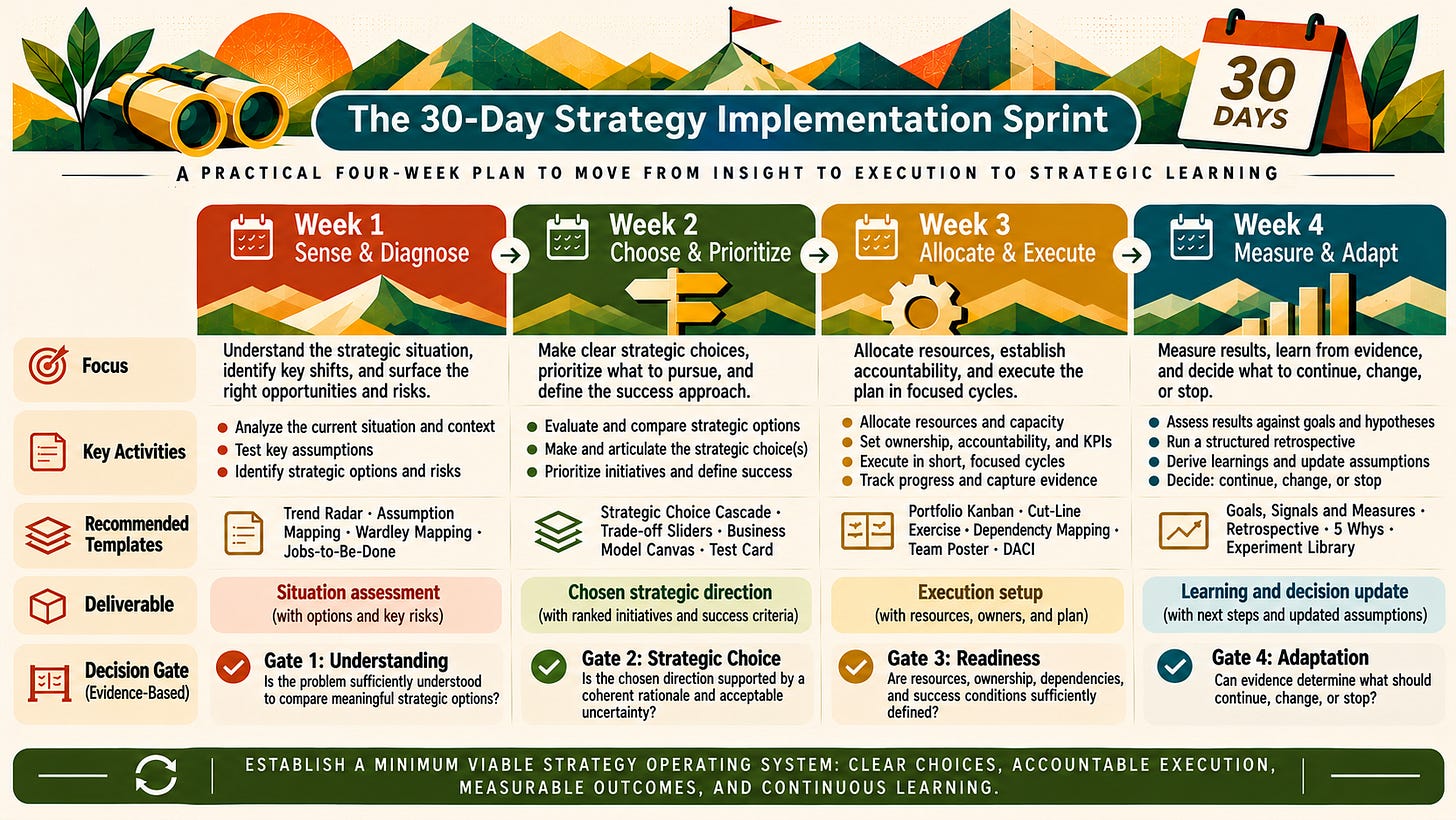
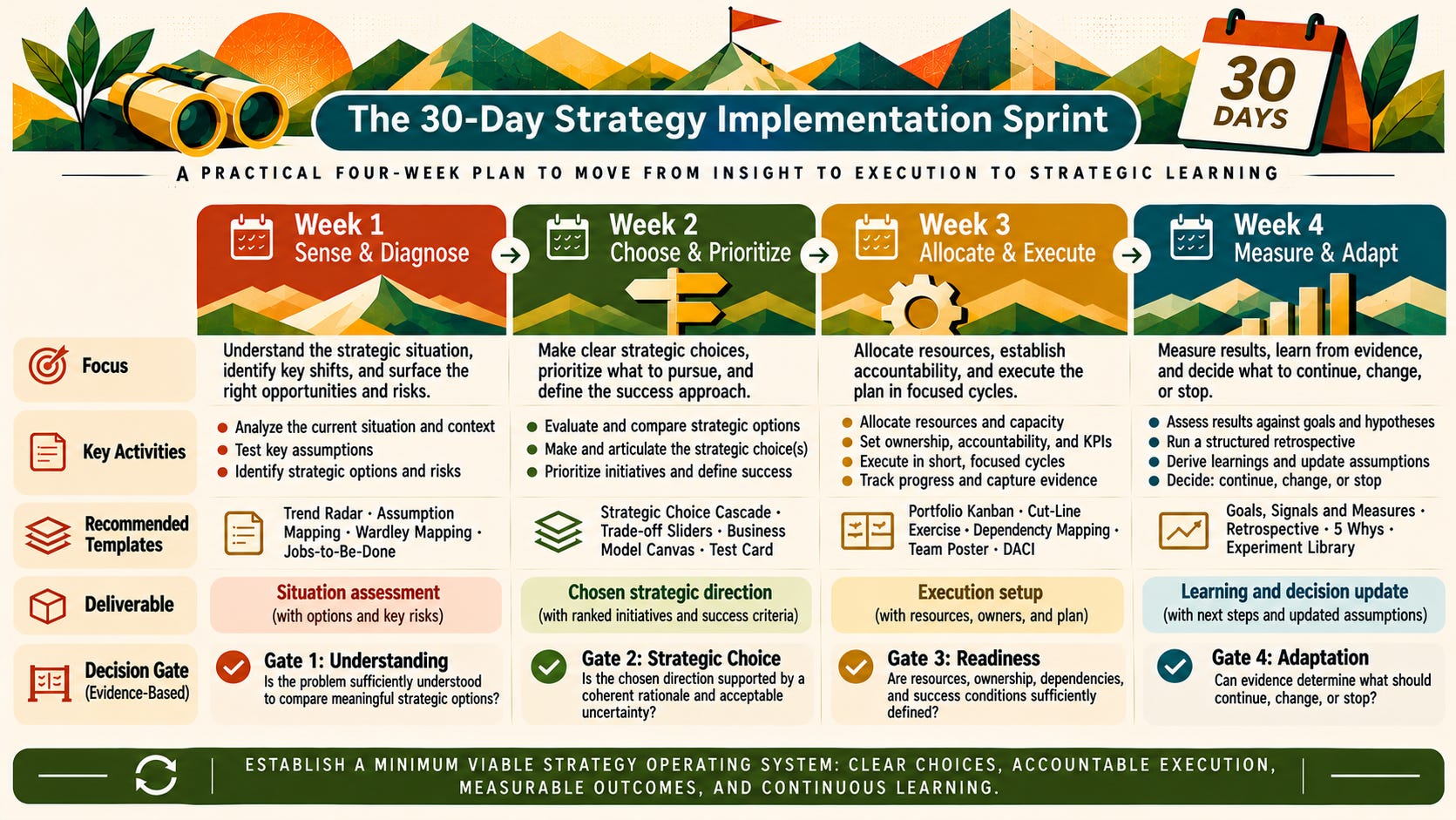
A modern strategy operating system does not have to begin as a large enterprise transformation.
It can begin with one strategic priority, a small number of connected documents, and a disciplined review cycle.
Week 01 — Sense and Diagnose
Objective: Establish a credible understanding of the strategic situation.
Activities:
-
Select one important strategic challenge.
-
Collect relevant market and customer evidence.
-
Identify critical uncertainties.
-
Map current value creation and important capabilities.
-
Document underlying assumptions.
Recommended templates: Trend Radar, Assumption Mapping, Wardley Mapping, Jobs-to-Be-Done.
Deliverables: Strategic diagnosis, signals register, assumption map.
Decision gate: Is the problem sufficiently understood to compare meaningful strategic options?
Week 02 — Choose and Prioritize
Objective: Translate analysis into explicit strategic commitments.
Activities:
-
Develop distinct strategic options.
-
Evaluate customer and competitive implications.
-
Document trade-offs.
-
Identify critical assumptions.
-
Select a testable strategic direction.
Recommended templates: Strategic Choice Cascade, Trade-off Sliders, Business Model Canvas, Test Card.
Deliverables: Strategic choice, decision record, experiment shortlist.
Decision gate: Is the chosen direction supported by a coherent rationale and an acceptable level of uncertainty?
Week 03 — Allocate and Execute
Objective: Establish the operating conditions for implementation.
Activities:
-
Review available resources.
-
Prioritize the initiative portfolio.
-
Assign decision and execution responsibilities.
-
Map dependencies.
-
Define outcomes and initial measures.
-
Establish working agreements.
Recommended templates: Portfolio Kanban, Cut-Line Exercise, Dependency Mapping, Team Poster, DACI.
Deliverables: Portfolio board, accountability structure, execution roadmap.
Decision gate: Are resources, ownership, dependencies, and success conditions sufficiently defined?
Week 04 — Measure and Adapt
Objective: Establish a functioning strategic learning process.
Activities:
-
Conduct the first execution review.
-
Examine available evidence.
-
Identify implementation barriers.
-
Evaluate critical assumptions.
-
Document decisions and changes.
-
Establish a recurring review cadence.
Recommended templates: Goals, Signals and Measures, Retrospective, 5 Whys, Experiment Library.
Deliverables: Initial strategy review, updated decision record, next-cycle commitments.
Decision gate: Can the team use evidence to determine what should continue, change, or stop?
What success looks like after 30 days
A useful 30-day outcome is not necessarily improved revenue, completed transformation, or successful market entry.
Those outcomes may take substantially longer.
The immediate objective is to establish a minimum viable strategy operating system:
A clearly defined strategic problem, explicit choices, prioritized commitments, accountable owners, measurable outcomes, and a functioning process for learning and adaptation.
Choosing the Right Strategy Template
Not every organization needs all 40 resources.
Start with the challenge most relevant to your current decision.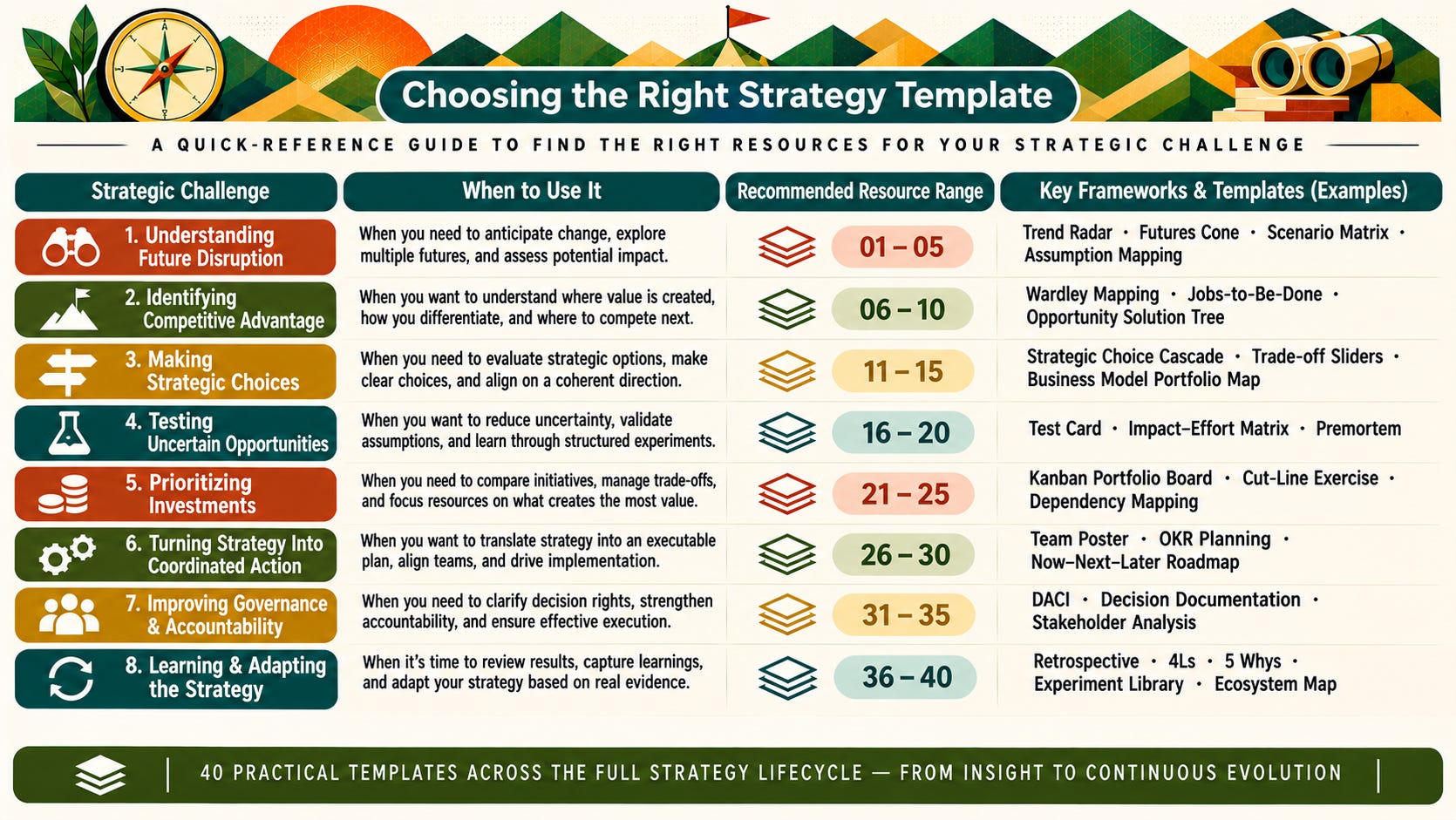
The recommended numbers refer to the entries in this library. They are starting points, not mandatory sequences.
A resource-selection principle: The relevant question is not whether a framework is fashionable, old, or new. It is whether it improves the quality of a decision that matters.
Final Perspective — Strategy Is a System of Choices and Learning
The most useful strategy template is not the one that produces the most impressive diagram.
It is the one that helps an organization see something important, make a difficult choice, or act with greater clarity.
Some templates improve understanding. Others expose uncertainty. Some make trade-offs explicit. Others establish ownership or help teams learn whether an investment is working.
Their collective value emerges when the outputs connect.
A customer insight should inform a strategic choice.
A strategic choice should determine resource allocation.
Resource allocation should produce an executable commitment.
Execution should generate evidence.
And evidence should influence the next strategic decision.
Without those connections, even sophisticated frameworks become isolated management exercises.
The future of strategic planning is not simply faster analysis or more frequent presentation updates.
It is the development of organizational systems that preserve reasoning, coordinate action, and adapt as reality changes.
Strategy becomes more effective when thinking, choosing, executing, and learning are treated as one continuous capability.