Knowledge leverage - codify expert judgment into prompts, rules, workflows, and agents so institutional learning scales without proportional headcount
By Alex Pawlowski
Published: 2026-09-19
URL: https://thestrategystack.substack.com/p/knowledge-leverage
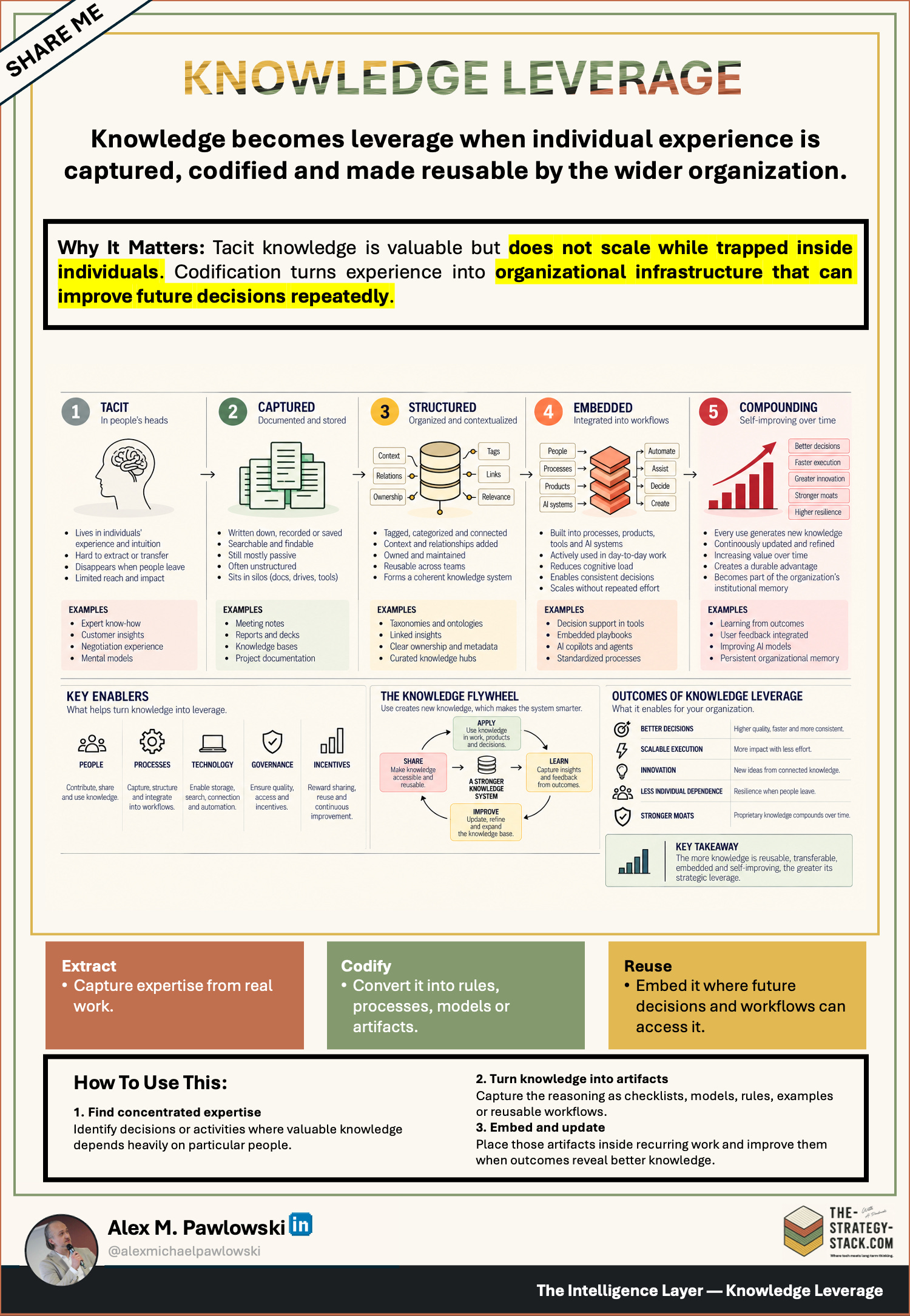
Your best operator closes deals your juniors cannot.
Your senior engineer debugs in minutes what takes the team hours. Your founder makes strategic calls that look like intuition. That knowledge lives in heads - and headcount does not scale linearly with expertise.
Knowledge leverage is the practice of extracting judgment from individuals and embedding it into systems - playbooks, decision rules, prompt libraries, evaluation rubrics, agent instructions, workflow templates - so the organization gets smarter without hiring clones of your best people.
This is not documentation theater. It is architecture for compounding capability - the bridge between human expertise and machine execution.
The Codification Ladder
Knowledge moves through increasing levels of system embeddability:
Tacit - lives in experience, pattern recognition, unwritten heuristics
Articulated - expressed in conversation, mentorship, case review
Documented - written in playbooks, SOPs, decision memos
Structured - encoded as rules, rubrics, thresholds, taxonomies
Executable - embedded in prompts, agents, automated workflows, product logic
Each rung increases reuse and decreases dependency on specific individuals. Most firms stall at documented - long PDFs nobody reads - and wonder why AI assistants feel generic.
The ladder’s top rung is where knowledge leverage pays off: executable knowledge that runs while experts sleep.
What to Codify First
Not everything deserves system embed. Prioritize knowledge that is:
-
Repeated - happens weekly, not once a year
-
Consequential - errors cost real money or trust
-
Teachable - experts can articulate criteria, even imperfectly
-
Correctable - outcomes reveal whether the codification worked
Start with high-frequency, medium-consequence decisions - support escalation, lead qualification, content approval, code review standards. These produce correction signal fast enough to improve the codified layer.
Avoid codifying pure intuition under true ambiguity - that stays human-only on the decision gradient. Codify the boundaries and heuristics around it instead.
The Reinvestment Loop
Knowledge leverage compounds when codification connects to feedback:
Expert acts → outcome observed → criteria refined → system updated → next actor (human or agent) performs closer to expert level → repeat
Without the loop, codification freezes outdated judgment. With the loop, the system learns forward - expertise becomes a rising floor, not a static manual.
Capture overrides explicitly. When a senior rejects an agent proposal, the rejection reason is more valuable than the original proposal.
Where Knowledge Leverage Fails
Knowledge leverage collapses when:
-
Playbooks are written once and never updated after market shifts
-
Codification captures steps but not judgment criteria - “how” without “when” or “why”
-
Experts refuse to articulate heuristics - knowledge hoarding disguised as irreplaceability
-
AI prompts are generic - no firm-specific decision logic embedded
-
Corrections happen outside the system - expertise leaks into Slack, not back into rules
-
Over-codification - rigid rules where adaptive judgment should remain human
The diagnostic: if your top performer left tomorrow, what decisions would immediately degrade - and is any of that judgment executable in systems today?
How to Use This Framework
1. Identify three high-frequency expert decisions
Where does senior judgment get applied repeatedly?
2. Extract decision criteria
Not steps - thresholds, red flags, tradeoffs, “it depends on what.”
3. Choose codification rung
Document first if ambiguous; structure or execute when criteria stabilize.
4. Embed in the intelligence stack
Route codified rules to decision logic and agent propose layers.
5. Instrument overrides
Track when humans disagree with codified judgment - and why.
6. Schedule refinement cycles
Monthly for fast domains; quarterly for stable ones.
Diagnostic questions:
-
What percentage of your team’s best judgment is executable vs trapped in heads?
-
Which codified rules haven’t been updated since the last product or market shift?
-
When an agent errs, does the fix update the system - or just the single instance?
👉 Unlock the Strategy Stack
…and access the Business Model Series, advanced Cheat Sheets, the Operator Vault, and various essays at the intersection of strategy and technology.
In this series →
https://thestrategystack.substack.com/p/the-intelligence-layer-collection
Read next →
https://thestrategystack.substack.com/p/intelligence-as-infrastructure
Go deeper →