Synthetic strategy - govern semi-autonomous systems that execute on strategic intent with explicit boundaries, correction paths, and human authority where it matters
By Alex Pawlowski
Published: 2026-09-19
URL: https://thestrategystack.substack.com/p/synthetic-strategy
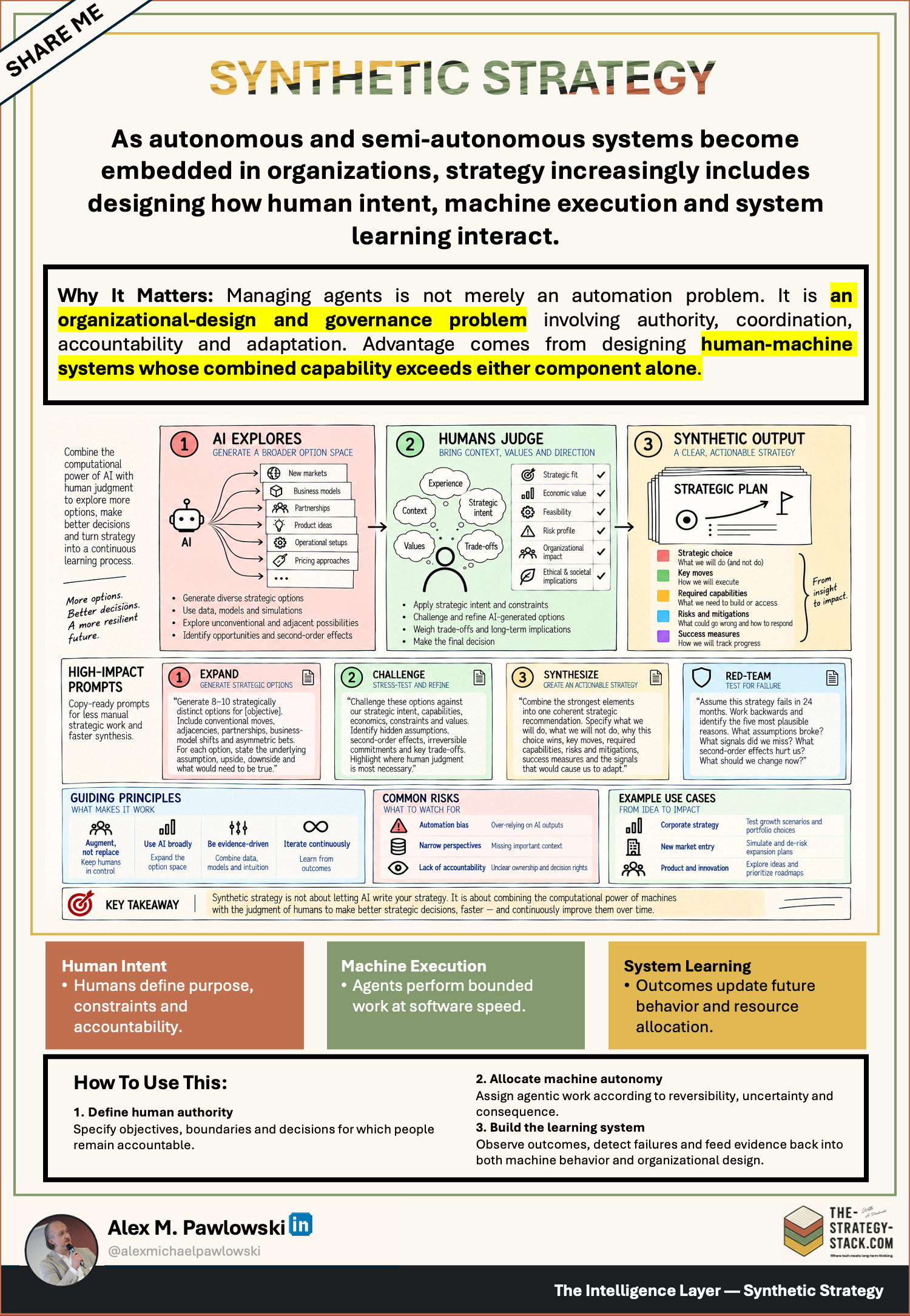
Strategy used to mean: decide, document, execute, review.
That rhythm breaks when systems act continuously - agents routing leads, products personalizing in real time, pricing engines adjusting, content pipelines publishing, monitoring systems escalating. The firm no longer waits for the quarterly offsite to behave strategically. It behaves strategically - or chaotically - every hour.
Synthetic strategy is the governance layer for this reality: how organizations set intent, define boundaries, route authority, and capture correction when semi-autonomous systems execute on their behalf.
Not strategy replaced by machines. Strategy expressed as architecture - so autonomous action stays aligned when nobody is in the room.
What “Synthetic” Means
Synthetic does not mean fake or simulated.
It means composed - strategy assembled from human intent plus machine execution, operating as one coordinated system. The strategist’s job shifts from writing plans to designing the constraints and objectives within which agents and adaptive systems act.
Three components:
Intent layer - what the firm optimizes for, refuses to do, and prioritizes under tradeoffs - expressed clearly enough to encode
Execution layer - agents, loops, routing engines, adaptive products - authorized to act within boundaries
Governance layer - approval gates, audit trails, drift detection, correction capture, escalation to human commit
When intent is vague, execution fills the vacuum with local optimization. When governance is absent, execution moves fast until incident. Synthetic strategy connects all three.
The Strategy Stack for Autonomous Action
Translate traditional strategy into machine-readable architecture:
Objectives → measurable targets with weights (growth vs margin vs trust vs speed)
Constraints → hard rules agents cannot violate (legal, brand, spend caps, customer segments)
Decision gradient → which action types auto-execute, verify, or require human commit
Exception taxonomy → how agents escalate ambiguity - with context, not just “error”
Correction protocol → how human overrides update intent, constraints, or execution logic
Review cadence → when humans audit system behavior vs individual decisions - drift detection, not ticket review
Strategy decks that cannot map to these elements are not yet synthetic - they are narratives awaiting manual translation.
Human Role in Synthetic Strategy
Humans don’t disappear. They concentrate on:
-
Intent definition - what success means, what tradeoffs are acceptable
-
Boundary design - where autonomous action stops
-
Drift correction - when system behavior diverges from intent over time
-
Novel judgment - situations outside encoded constraints
-
Accountability - who owns outcomes when agents act
Synthetic firms and synthetic strategy share DNA: agents operate, humans govern. The difference is elevation - synthetic strategy governs not just tasks but portfolio-level behavior of intelligent systems across products and operations.
Where Synthetic Strategy Fails
Synthetic strategy fails when:
-
Intent is slogan-level - “customer-centric” without weighted objectives agents can optimize
-
Autonomous systems multiply without shared governance - each team encodes different risk tolerance
-
Humans review transactions, not drift - nobody asks whether the system still matches intent
-
Correction is punitive, not architectural - blame operators instead of updating constraints
-
Strategy updates quarterly, execution updates continuously - intent goes stale while agents adapt locally
-
No commit authority map - incidents reveal nobody owned the decision
-
Synthetic strategy means “let AI decide strategy” - abdication, not architecture
The diagnostic: if all agents paused tonight, could you explain what strategic intent they were executing - in terms specific enough to re-encode tomorrow?
How to Use This Framework
1. Write intent as constraints and objectives
Replace platitudes with weighted targets and explicit refusals.
2. Inventory autonomous and semi-autonomous actors
Agents, adaptive products, automated routing - who acts without per-action human approval?
3. Map each to the decision gradient
Automate, assist, verify, human-only - per action type, not per tool.
4. Build drift detection
Weekly: does system behavior match intent metrics? Monthly: do constraints need revision?
5. Connect correction to architecture
Overrides update rules, prompts, thresholds - not just individual cases.
6. Align strategy cadence with execution speed
Intent review on a clock the organization can actually honor - or agents outrun governance.
Diagnostic questions:
-
Can your agents explain - via logs and rules - what they optimize for?
-
When did strategic intent last change - and did execution layers update the same week?
-
Who is accountable when an autonomous system produces a strategic mistake?
👉 Unlock the Strategy Stack
…and access the Business Model Series, advanced Cheat Sheets, the Operator Vault, and various essays at the intersection of strategy and technology.
In this series →
https://thestrategystack.substack.com/p/the-intelligence-layer-collection
Collection complete →
https://thestrategystack.substack.com/p/the-intelligence-layer-collection
Go deeper →