Intelligence compounding - build the flywheel where better decisions produce better data, better inference, and accelerating advantage over time
By Alex Pawlowski
Published: 2026-09-19
URL: https://thestrategystack.substack.com/p/intelligence-compounding
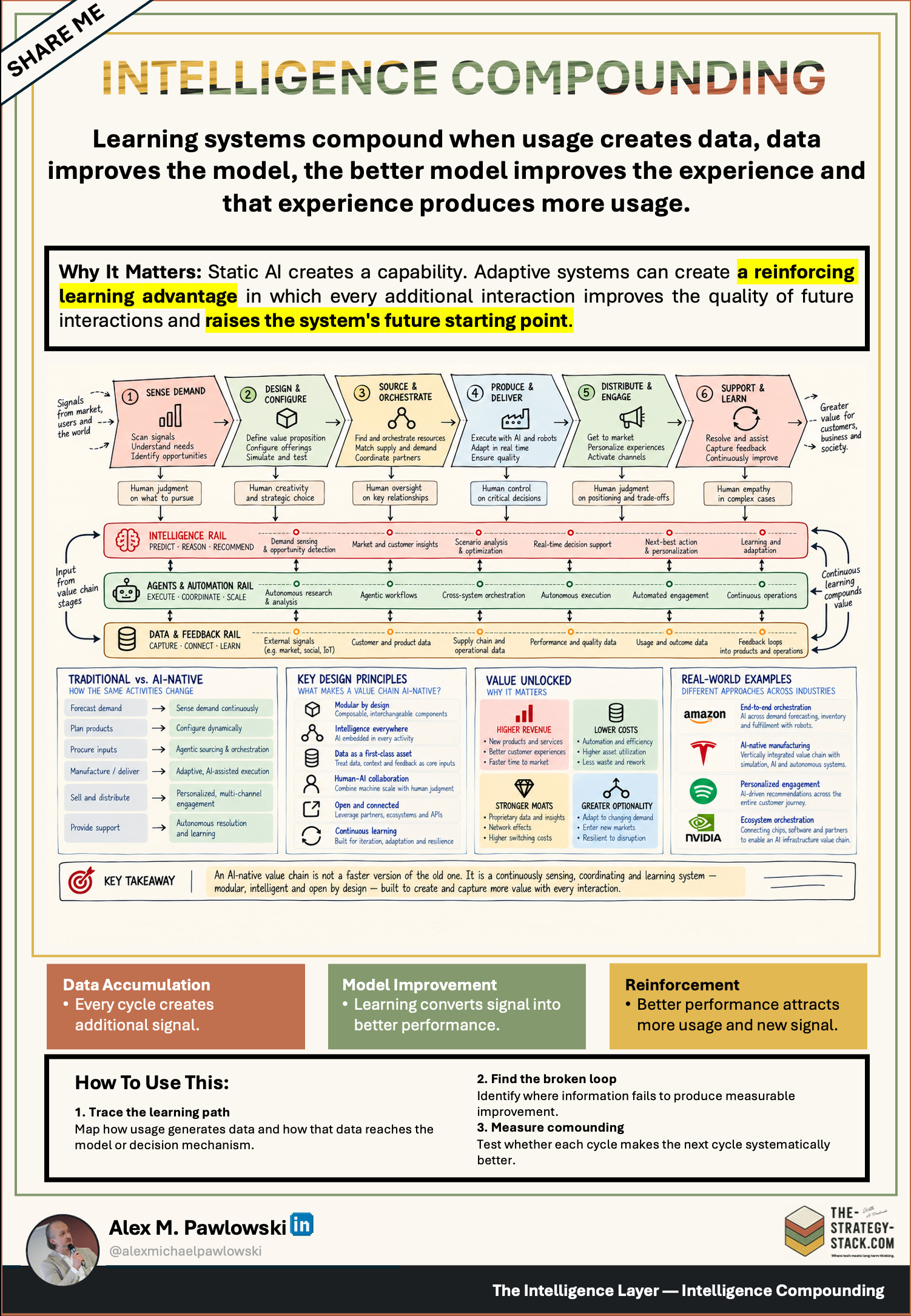
Linear growth is comfortable.
You ship features. Revenue rises proportionally. Headcount tracks output. Compounding intelligence breaks that curve - each cycle makes the next cycle cheaper, faster, and more accurate. Competitors on linear paths don’t fall behind gradually. They fall behind exponentially - and often can’t diagnose why.
Intelligence compounding is what happens when the full stack works: decisions produce outcomes, outcomes produce signal, signal improves inference and decision logic, and improved logic produces better decisions. The loop accelerates - cycle time shrinks, error rates fall, marginal cost of being right drops.
Features don’t compound. Loops do.
The Compounding Equation
Compounding requires three variables working together:
Cycle time - how fast the loop completes (interaction → outcome → update)
Signal quality - how much learning value each cycle produces (correction > consumption)
Reinvestment rate - how much of each cycle’s learning updates the system (vs sitting in reports)
Improve any one variable and returns rise. Improve all three and returns accelerate - the characteristic S-curve of compounding systems.
Firms with slow cycles (quarterly reviews), weak signal (clicks without correction), and low reinvestment (insights in slide decks) wonder why AI investment feels linear. It is - by design failure, not by law of technology.
Compounding vs Linear: The Diagnostic
Linear intelligence:
-
Same model serves all users indefinitely
-
Decisions don’t change based on last month’s outcomes
-
Human corrections vanish after the ticket closes
-
Analytics describe the past; operations don’t update
-
Competitors catch up when they buy the same API
Compounding intelligence:
-
Inference or rules update from outcome and correction signal
-
Decision thresholds drift toward better economics as evidence accumulates
-
Cycle time measured and actively reduced
-
Each user cohort benefits from prior cohorts’ signal (where appropriate)
-
Competitors need your loop, not your model vendor
The gap between linear and compounding widens with time - not with single-feature launches.
The Reinforcing Flywheel
Map the flywheel explicitly:
Better decisions → improved outcomes (retention, margin, accuracy, speed)
Better outcomes → richer signal (labeled success, fewer exceptions, higher trust)
Richer signal → improved inference and decision logic
Improved logic → better decisions (loop closes)
Optional accelerants: more users → more signal (network data effects); lower inference cost → faster cycles; knowledge leverage → expert judgment embedded faster.
Each accelerant is optional. The closed loop is mandatory.
Where Compounding Stalls
Intelligence compounding stalls when:
-
Open loops - outcomes never reach inference or decision layers
-
Slow cycles - learning happens annually while markets shift weekly
-
Low signal quality - volume without correction or outcome labels
-
Manual reinvestment - every update requires a project, not a pipeline
-
Local optimization - one team compounding while others stay linear
-
Overfitting to noise - fast cycles without governance produce drift, not advantage
-
Commodity inference - model improves but decision logic and capture don’t
The diagnostic: plot decision quality or unit economics over the last four cycles. Is the rate of improvement itself improving - or flat?
How to Use This Framework
1. Draw the flywheel for your core workflow
Name mechanisms at each stage - not aspirations.
2. Measure cycle time
Interaction to system update - in days, hours, or minutes. Set a reduction target.
3. Upgrade signal quality
Add correction capture, outcome labeling, exception taxonomy.
4. Automate reinvestment
Corrections trigger rule updates, retraining jobs, or threshold adjustments - not quarterly meetings.
5. Compare compounding rate to competitors
Same model API? Your advantage must live in loop speed and exclusive signal.
6. Guard against drift
Fast compounding without governance produces confident wrong systems. Audit loops that accelerate errors.
Diagnostic questions:
-
Is your intelligence getting measurably better per cycle - or just bigger?
-
What would 10x faster cycle time break - and what would it unlock?
-
If a competitor copied your model tomorrow, would your flywheel still defend you?
👉 Unlock the Strategy Stack
…and access the Business Model Series, advanced Cheat Sheets, the Operator Vault, and various essays at the intersection of strategy and technology.
In this series →
https://thestrategystack.substack.com/p/the-intelligence-layer-collection
Read next →
https://thestrategystack.substack.com/p/synthetic-strategy
Go deeper →