Intelligence as infrastructure - when AI becomes a structural layer every product, workflow, and decision route depends on, not a feature bolted on top
By Alex Pawlowski
Published: 2026-09-19
URL: https://thestrategystack.substack.com/p/intelligence-as-infrastructure
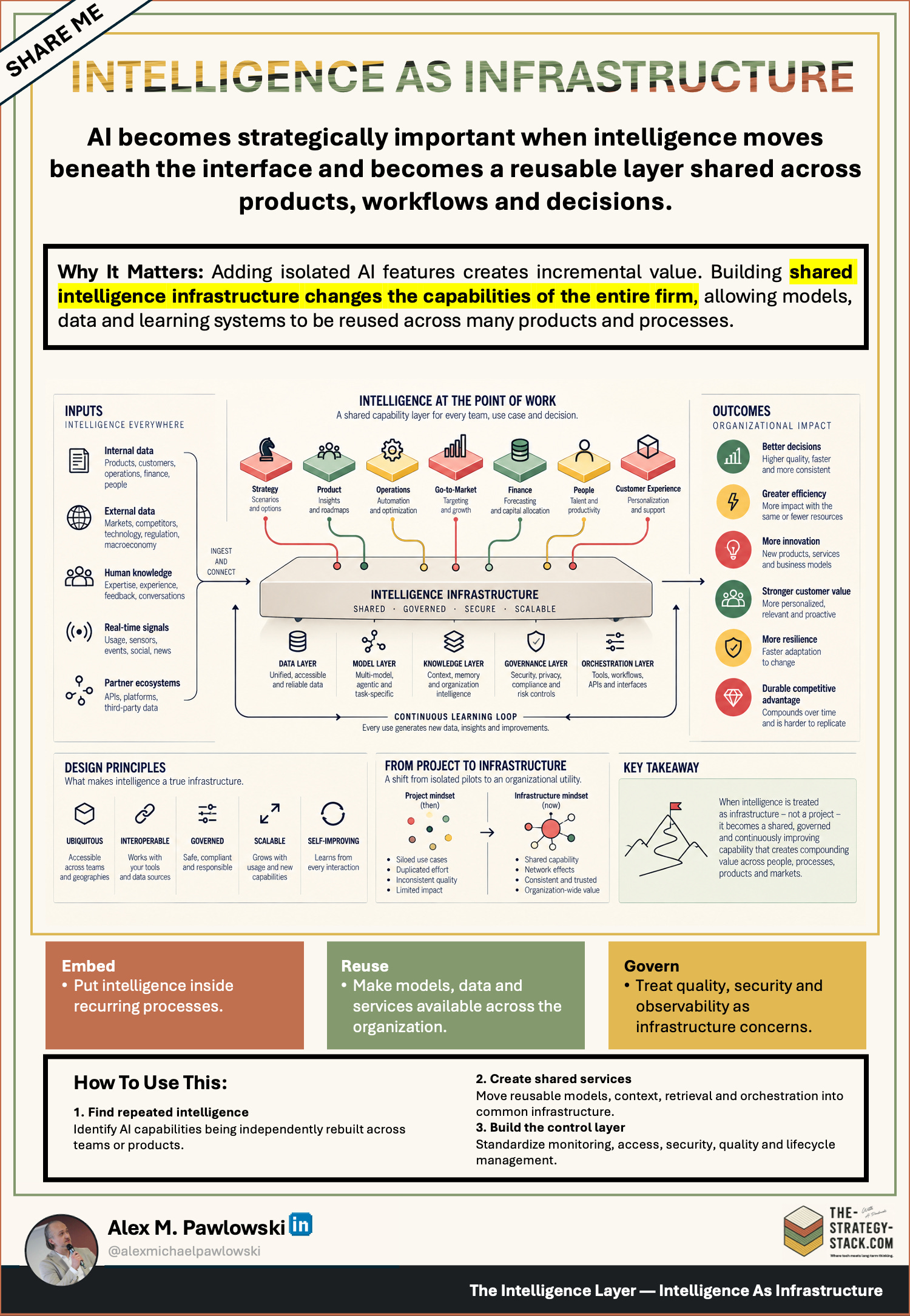
Data became infrastructure when firms stopped treating it as a reporting byproduct.
Distribution became infrastructure when every product assumed an owned audience channel. Intelligence is crossing the same threshold - and most organizations are still buying features when they need foundations.
Intelligence as infrastructure means inference, routing, decision logic, and feedback are shared services - not duplicated per product, team, or initiative. Every workflow reads from the same signal layer. Every agent inherits the same governance. Every correction improves the whole system.
Feature AI depreciates with the next model release. Infrastructure intelligence compounds with every interaction.
Feature vs Infrastructure
Feature intelligence:
-
Scoped to one product surface
-
Owned by a feature team
-
Ships on a roadmap cycle
-
Copied when competitors launch equivalents
-
No shared correction capture
-
Removed without breaking core operations
Infrastructure intelligence:
-
Horizontal layer beneath multiple products and ops
-
Owned by a platform or intelligence function
-
Continuous deployment with versioning and rollback
-
Embedded in decision paths competitors cannot see
-
Shared feedback improves all dependents
-
Removing it breaks routing, pricing, support, or content logic
The test: if you deleted the AI feature tomorrow, would the business function the same? If yes, you built a feature. If no - if decisions, economics, or delivery collapse - you built infrastructure.
The Infrastructure Stack
Infrastructure intelligence requires four shared capabilities:
Unified signal access - one instrumentation layer, consistent event schema, governed external data feeds
Shared inference services - models, embeddings, classifiers available to all dependents via API - not retrained per silo
Central decision registry - routing rules, thresholds, approval gates documented and versioned - not tribal spreadsheet logic
Correction bus - human overrides and outcome signals flow to a shared learning pipeline - not team-specific inboxes
These mirror how mature firms treat payments, identity, or messaging - boring horizontal layers that everything else assumes exist.
The Build Sequence
Infrastructure rarely arrives fully formed. Typical progression:
Phase 1 - Feature experiments - prove value in one workflow (acceptable starting point)
Phase 2 - Pattern extraction - identify shared signal, model, and governance needs across experiments
Phase 3 - Platform extraction - pull shared layers into services with SLAs, owners, and dependency maps
Phase 4 - Default assumption - new products must integrate intelligence infrastructure; exceptions require justification
Skipping Phase 2–3 produces feature sprawl - ten copilots, zero compounding. Premature Phase 4 produces platform theater - shared services nobody adopts because they weren’t pulled from real demand.
Where Infrastructure Thinking Fails
Intelligence infrastructure fails when:
-
Every team trains its own models on duplicated, inconsistent data
-
Decision logic lives in undocumented prompts scattered across tools
-
No owner for cross-product governance - each surface sets its own risk tolerance
-
Infrastructure built before any workflow proved intelligence changes outcomes
-
Platform team optimizes for model metrics, not dependent product economics
-
“Shared services” become a bottleneck because intake process kills velocity
The diagnostic: how many intelligence implementations exist in your org - and how many share correction signal?
How to Use This Framework
1. Inventory intelligence implementations
Count features, agents, models, copilots - and map dependencies.
2. Identify duplication
Same classification task in three products? Same routing logic rebuilt twice?
3. Define the horizontal layer
What signal, inference, decision, and feedback services should be shared?
4. Assign infrastructure ownership
Platform team, intelligence function, or federated model with central governance - pick one.
5. Set integration standards
New products declare intelligence dependencies at design - not after launch.
6. Measure infrastructure ROI
Dependent product velocity, correction reuse rate, incident reduction - not model accuracy alone.
Diagnostic questions:
-
Would a new product team rebuild intelligence from scratch - or plug into shared services?
-
Who owns decision logic when two products disagree on routing rules?
-
What breaks if your primary model vendor changes tomorrow - features or infrastructure?
👉 Unlock the Strategy Stack
…and access the Business Model Series, advanced Cheat Sheets, the Operator Vault, and various essays at the intersection of strategy and technology.
In this series →
https://thestrategystack.substack.com/p/the-intelligence-layer-collection
Read next →
https://thestrategystack.substack.com/p/ai-enhanced-product-loops
Go deeper →