Designing AI-native value chains - redesign where value is created, delivered, and captured with intelligence embedded in each link, not bolted onto legacy workflows
By Alex Pawlowski
Published: 2026-09-19
URL: https://thestrategystack.substack.com/p/designing-ai-native-value-chains
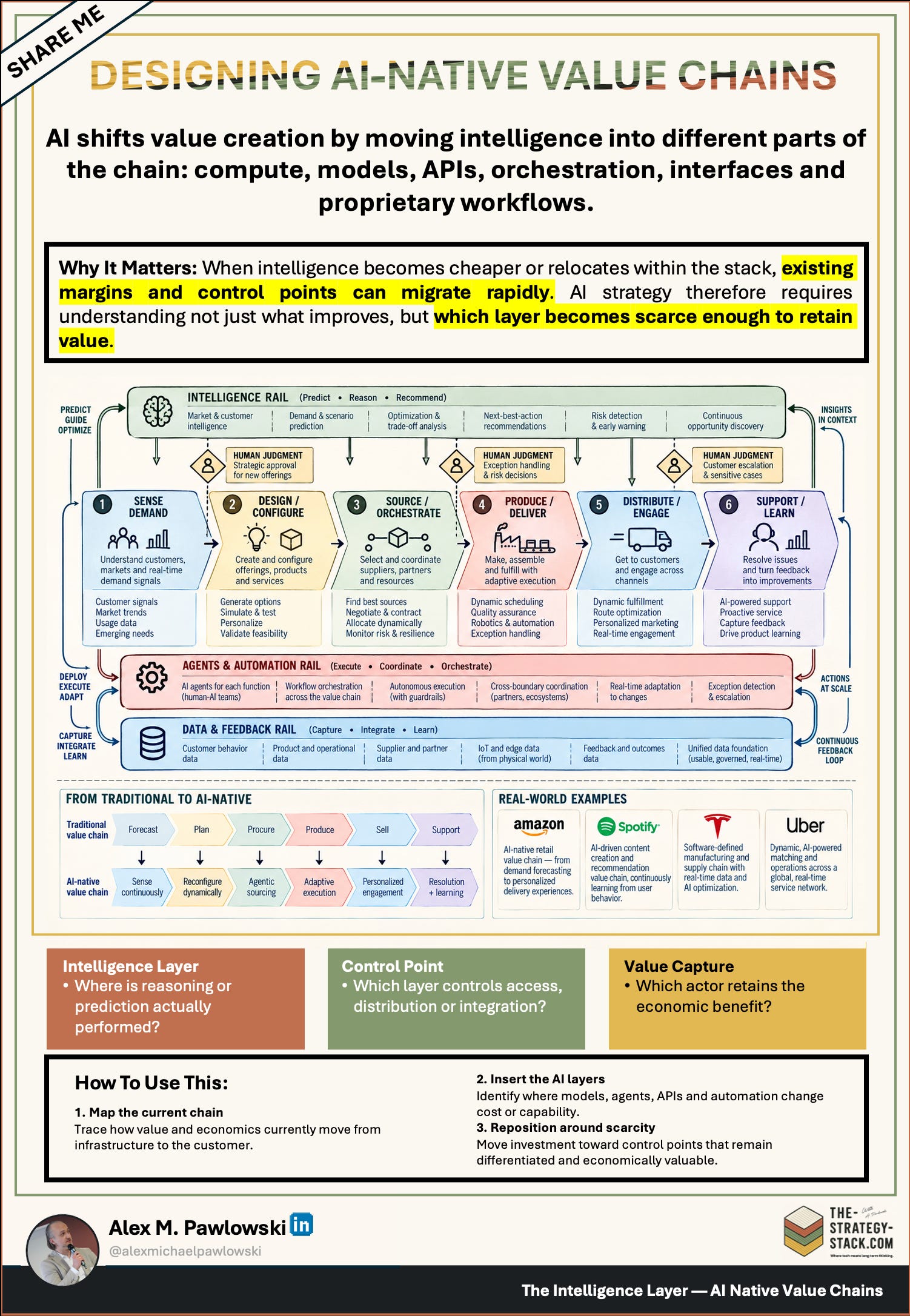
Most AI transformations start with the wrong question.
“Which tasks can we automate?” preserves the legacy value chain - and accelerates workflows designed for a pre-inference economy. The better question: where should intelligence sit in the chain - and which links disappear, merge, or become the new center of gravity?
AI-native value chains redesign creation, delivery, and capture assuming inference is cheap, agents coordinate work, and data loops are product requirements - not IT projects bolted on after the model ships.
Automating a broken chain makes you efficiently wrong. Redesigning the chain makes intelligence structural.
Map the Chain First
Every business runs a value chain - whether documented or not:
Inputs - raw materials, data, attention, capital, talent
Processing - transformation, analysis, assembly, curation, inference
Delivery - how value reaches the customer or user
Capture - pricing, retention, expansion, lock-in, network effects
Feedback - usage signal, correction, market response - routing back to inputs
Legacy chains assume human processing at most links. AI-native chains ask: which processing steps become inference? Which delivery steps become generative? Which capture steps become dynamic - personalized, usage-based, outcome-linked?
The Redesign Questions
For each link in the chain:
Can inference replace labor?
Not “assist” - replace as the primary transformation mechanism. Translation, classification, drafting, routing, monitoring, first-pass analysis.
Can delivery personalize at marginal cost near zero?
Static products become adaptive surfaces - content, pricing, onboarding, support paths tuned per user or segment.
Can capture link to outcomes?
Subscription for access gives way to value-aligned pricing where intelligence makes outcome measurement feasible.
Does feedback close inside the chain?
Usage improves processing without a quarterly rearchitecture - the chain learns.
Links that answer “no” to all four are candidates for legacy preservation - human-led, relationship-heavy, or regulatory-fixed. Everything else is redesign territory.
Native vs Augmented Chains
Augmented chain: Same suppliers, same handoffs, same SKU logic - with AI summaries, copilots, and faster email. Cost drops slightly. Structure unchanged. Competitors copy in one quarter.
Native chain: Customer submits intent → system interprets, generates, verifies, delivers → outcome captured → model updates → next customer gets better result with fewer humans in the path. Cost structure, margin logic, and defensibility change.
Cursor, Harvey, and AI-native research tools didn’t automate law firms or IDEs as-is. They replaced links in the chain where inference became the primary processor.
Where Value Chain Redesign Fails
AI-native value chain design fails when:
-
Automation targets cost cutting without repositioning capture - margin improves briefly, defensibility doesn’t
-
Intelligence sits between legacy links as a bridge - adding latency and handoffs
-
Delivery still assumes static product - inference runs in back office, user sees generic output
-
Capture model incompatible with personalization - flat pricing while costs scale with inference
-
Feedback improves internal dashboards but not delivery or capture
-
Redesign ignores trust and governance - autonomous delivery without verify gates on high-consequence outputs
-
Teams optimize links in isolation - processing improves, capture doesn’t move
The diagnostic: draw your value chain. Circle every link where a human transforms input today. For each circle: inference-primary, human-primary, or hybrid - and does your P&L reflect that answer?
How to Use This Framework
1. Document the current chain
Inputs → processing → delivery → capture → feedback. Name owners and cost drivers per link.
2. Score each link for inference substitution
Labor intensity, error cost, signal availability, reversibility.
3. Identify the new center of gravity
Which link becomes the product when intelligence is native - often processing or delivery, rarely inputs alone.
4. Redesign capture to match
If delivery personalizes, pricing and retention must capture that value - or economics break.
5. Prototype the native chain on one segment
One customer type, one workflow - prove the chain before migrating the whole business.
6. Kill bridge architecture
Remove interim human handoffs that exist only because the old chain assumed them.
Diagnostic questions:
-
Are you automating tasks - or redesigning links?
-
Which link, if inference-primary, would change your pricing power?
-
Where does feedback re-enter the chain - delivery, capture, or nowhere?
👉 Unlock the Strategy Stack
…and access the Business Model Series, advanced Cheat Sheets, the Operator Vault, and various essays at the intersection of strategy and technology.
In this series →
https://thestrategystack.substack.com/p/the-intelligence-layer-collection
Read next →
https://thestrategystack.substack.com/p/intelligence-compounding
Go deeper →