AI-enhanced product loops - embed intelligence in the usage cycle so every interaction captures signal and makes the next outcome better
By Alex Pawlowski
Published: 2026-09-19
URL: https://thestrategystack.substack.com/p/ai-enhanced-product-loops
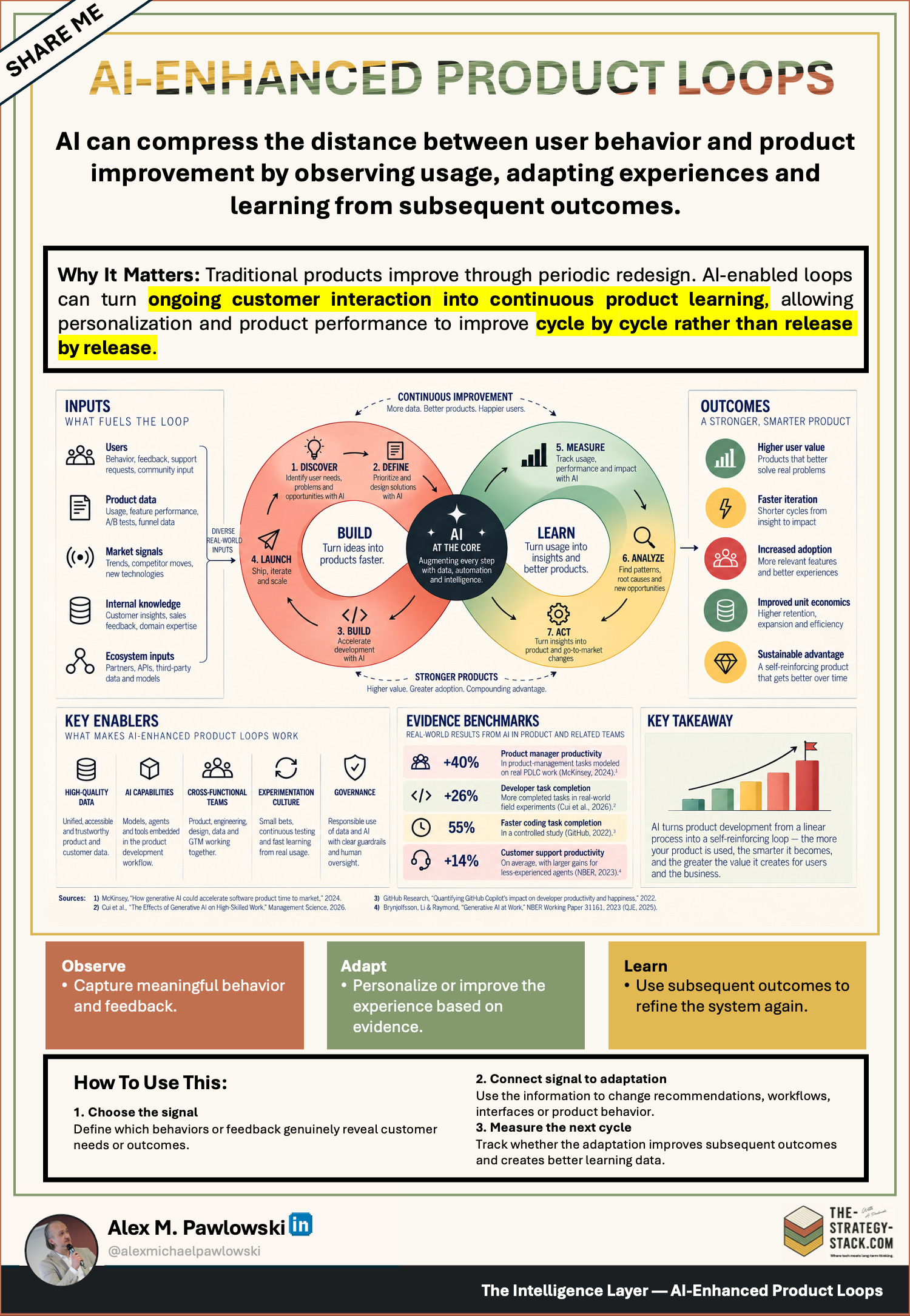
The best digital products don’t just serve users.
They learn from usage - and get better because they run. Spotify’s Discover Weekly improves with listening. Waze improves with driving. Duolingo improves with practice patterns.
AI-enhanced product loops design this dynamic deliberately: intelligence is not a sidebar feature - it is embedded in the core usage cycle, accelerating signal capture, inference, and outcome delivery with each pass.
Products without loops plateau. Products with loops compound.
The Loop Anatomy
Every AI-enhanced product loop follows the same structural pattern:
Interaction - user engages with the product in a way that generates signal
Capture - system records behavior, outcome, correction, or context - not just clicks
Inference - models or rules update beliefs about what this user (or users like them) need
Delivery - next interaction is better - faster, more relevant, more personalized, more accurate
Re-engagement - improved outcome increases retention, frequency, or expansion - feeding more interaction
AI accelerates each stage: richer capture from unstructured input, faster inference at scale, generative delivery, predictive re-engagement. But the loop structure must exist first - AI on a linear product still produces linear returns.
Loop Design Principles
Make interaction necessary for improvement
If the product works equally well without user signal, there is no loop - only a static tool. Design actions that require engagement to unlock value.
Capture correction, not just consumption
Passive telemetry is weak signal. Active correction - edits, rejections, ratings, overrides - is learning gold. Design UI that makes correction natural, not punitive.
Close the loop inside the session
Users should feel improvement within the same workflow - not in a release note three months later. Perceived loop speed drives retention.
Separate individual and collective loops
Some learning improves one user’s experience. Some improves the product for everyone. Both matter - but require different data governance and cold-start strategies.
Instrument loop health, not vanity metrics
Track: signal volume per user, inference update frequency, outcome delta cycle-over-cycle, correction rate, re-engagement lift.
Loop vs Feature
Feature logic: Add AI summary button → users sometimes click → no signal feeds back → competitors add same button
Loop logic: User edits AI draft → edit diff captured → model fine-tuned on correction patterns → next draft requires fewer edits → user completes task faster → usage frequency rises → more correction signal
Same technology. One is a widget. One is a compounding engine.
Where Product Loops Fail
AI-enhanced loops fail when:
-
AI sits adjacent to the core workflow - users bypass it
-
Capture is sparse or noisy - insufficient signal to improve inference
-
Improvement is invisible - users don’t perceive the product getting better
-
Cold start never solved - new users get generic experience, churn before loop engages
-
Privacy or trust blocks honest capture - users withhold signal
-
Loop optimizes engagement metrics that don’t map to user value - addictive, not useful
-
Corrections don’t reach the inference layer - product team manually fixes, system never learns
The diagnostic: for your core workflow, can you draw a closed circle from interaction back to improved interaction - with named mechanisms at each step?
How to Use This Framework
1. Map the core usage cycle
What does a successful user do repeatedly - and what signal does each step produce?
2. Identify the weakest loop stage
Is capture thin? Inference slow? Delivery unchanged? Re-engagement missing?
3. Design correction capture
Where can users naturally teach the system - edits, thumbs, rejections, reordering?
4. Set loop latency targets
How fast must improvement be perceptible - same session, same week, same month?
5. Plan cold-start strategy
Defaults, onboarding signal, collective loop bootstrap - before individual loops engage.
6. Connect to intelligence infrastructure
Shared inference services, correction bus, decision registry - loops shouldn’t be siloed per feature.
Diagnostic questions:
-
Does usage make your product measurably better - or just generate analytics?
-
What would competitors need to copy your loop - not just your model?
-
Where do user corrections die instead of reaching inference?
👉 Unlock the Strategy Stack
…and access the Business Model Series, advanced Cheat Sheets, the Operator Vault, and various essays at the intersection of strategy and technology.
In this series →
https://thestrategystack.substack.com/p/the-intelligence-layer-collection
Read next →
https://thestrategystack.substack.com/p/data-moat-canvas
Go deeper →