Pricing power framework - map differentiation, switching cost, reference points, and value metrics to know when the market will accept your price
By Alex Pawlowski
Published: 2026-09-18
URL: https://thestrategystack.substack.com/p/pricing-power-framework
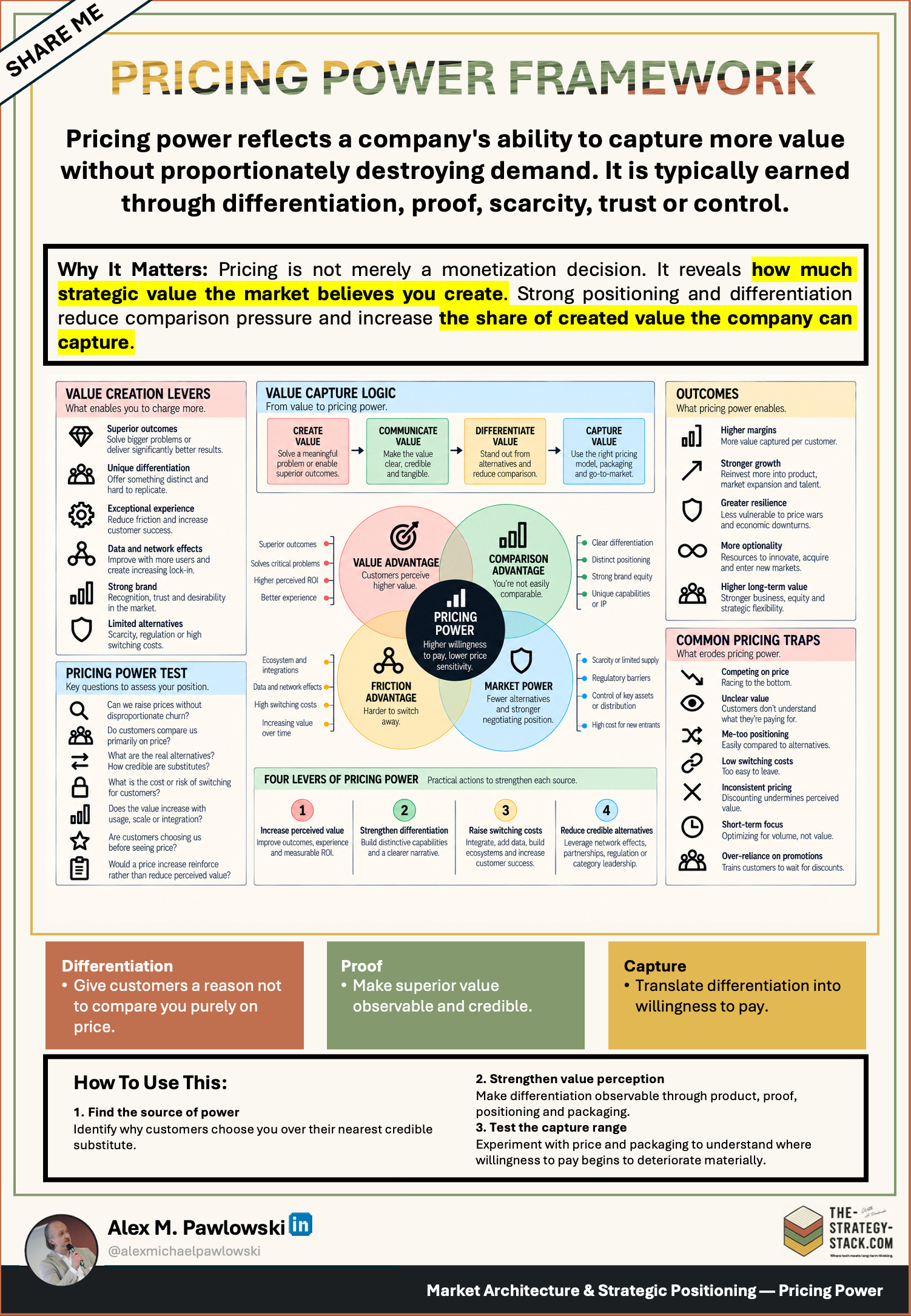
Two companies deliver similar outcomes. One raises prices annually with low churn. One fights discount requests every quarter.
The difference is rarely cost structure alone. It is pricing power - the market’s willingness to accept your price and your ability to set reference points competitors cannot easily undercut.
Pricing power sits at the intersection of market architecture and value capture. Positioning defines what you are compared to. Perception shapes what buyers believe you deliver. Brand flywheel lowers price sensitivity over time. The pricing power framework names four structural sources - and tests whether your architecture supports premium capture or commodity defense.
Four Sources of Pricing Power
1. Differentiated value
Buyers pay premium when the outcome is measurably superior on the axis they care about - speed, risk reduction, revenue lift, compliance certainty. Differentiation must survive procurement scrutiny, not just marketing copy.
Weak differentiation → price follows the category median.
2. Switching costs
Integration depth, workflow embedding, data accumulation, team habit, and contractual friction raise the cost of leaving. Switching costs are not an excuse for poor experience - but they extend pricing runway while you improve.
Commodity interfaces with easy export → price wars.
3. Reference point control
Who sets the comparison set? Category creators and narrative leaders anchor high. Followers inherit anchors set by incumbents or aggregators.
If buyers compare you to a free alternative or a spreadsheet, pricing power is already lost.
4. Value metric alignment
Price tied to value delivered - seats, usage, outcomes, revenue processed - scales capture as customer success grows. Misaligned metrics create resentment; aligned metrics create expansion.
Per-seat pricing on automation that replaces seats is a metric mismatch waiting to churn.
Pricing Power Spectrum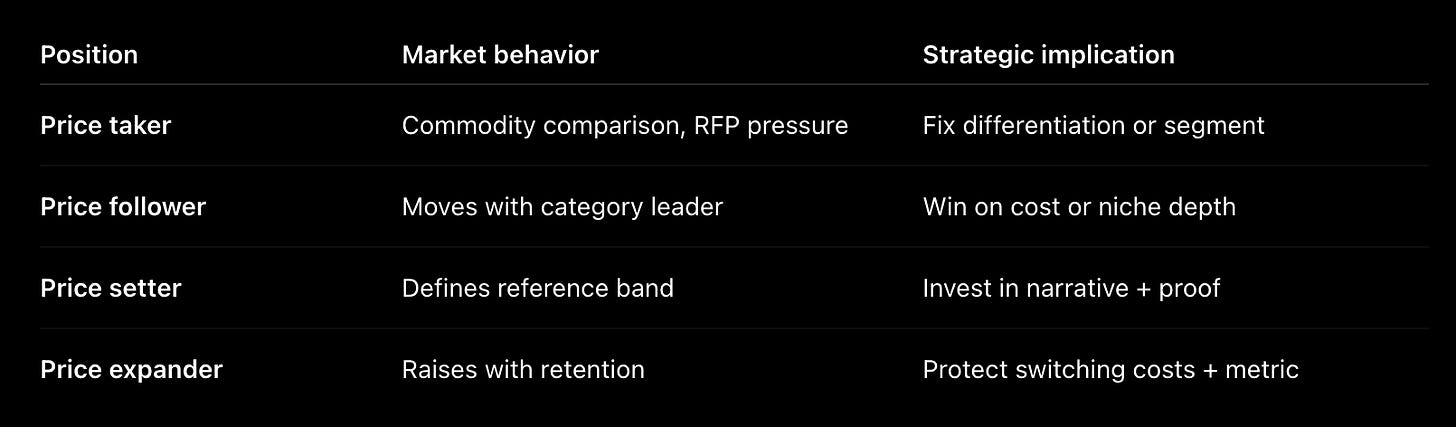
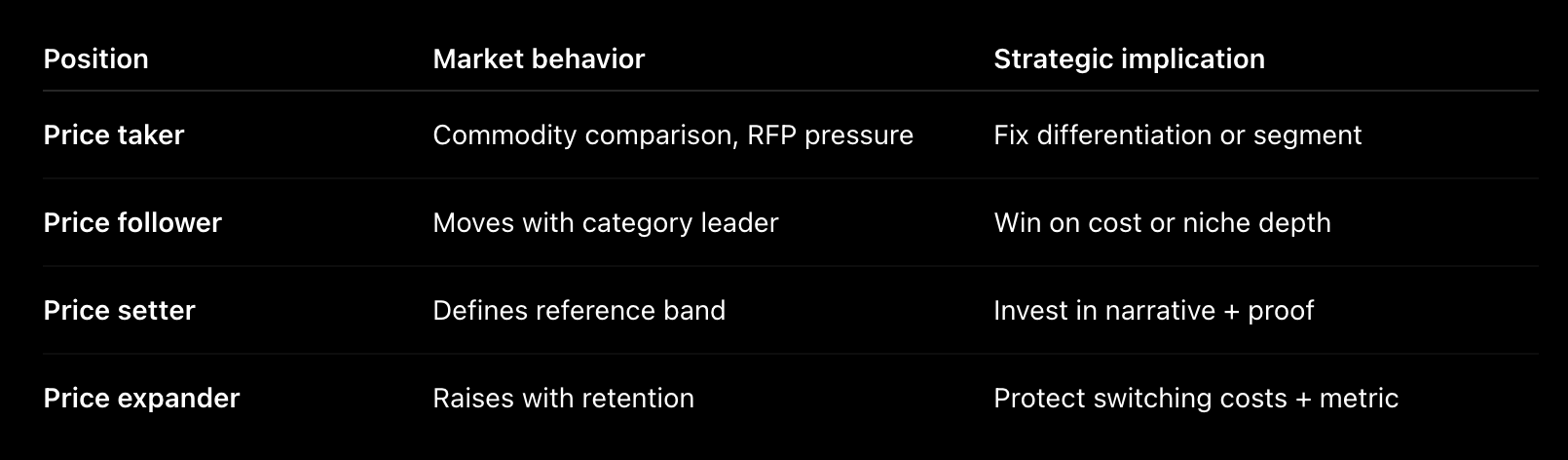
Most startups start as price takers. Market architecture work - positioning, category, brand, perception - exists partly to move right on the spectrum.
Raise Readiness Tests
Before raising price, run four tests:
Differentiation test - can sales document outcome delta vs. next best alternative?
Switching test - what breaks if the customer leaves - honestly?
Reference test - do buyers still compare you to premium peers after the increase?
Metric test - does the bill grow as customer value grows - fairly?
Fail two or more and a price increase produces churn disguised as revenue growth.
Connection to Value Architecture
Pricing power is the market-facing half of value capture. Value architecture (frame, meter, package) is the design half.
Together they answer:
-
What comparison set do we invite?
-
What unit scales with delivered value?
-
How do tiers segment willingness to pay?
-
What behavior does price incentivize post-sale?
Position without pricing alignment is theater. Premium perception with budget packaging destroys credibility.
Failure Patterns
Pricing power erodes when:
-
Discounting trains the market to wait for end-of-quarter deals
-
Feature parity with cheaper alternatives grows while price stays premium
-
Value metric punishes customer success
-
Brand promises enterprise; price signals starter tool
-
Aggregator or marketplace comparison exposes lower substitutes instantly
How to Use This Framework
1. Score the four sources
Rate each 1–5 with evidence - not hope.
2. Identify limiting source
Weakest link caps pricing power.
3. Align architecture stack
Positioning, narrative, perception, packaging - same price story.
4. Plan metric evolution
How should pricing scale as product matures?
5. Set raise gates
Threshold metrics before the next increase.
Diagnostic questions:
-
Are you a price setter - or a price taker with premium branding?
-
Which source would a competitor attack first?
-
Does your pricing architecture match your positioning matrix coordinate?
👉 Unlock the Strategy Stack
…and access the Business Model Series, advanced Cheat Sheets, the Operator Vault, and various essays at the intersection of strategy and technology.
In this series →
https://thestrategystack.substack.com/p/market-architecture-strategic-positioning
Read next →
https://thestrategystack.substack.com/p/market-architecture-strategic-positioning
Go deeper →