The positioning matrix - plot competitors and your offer on the axes buyers actually use before you claim differentiation the market cannot see
By Alex Pawlowski
Published: 2026-09-18
URL: https://thestrategystack.substack.com/p/positioning-matrix
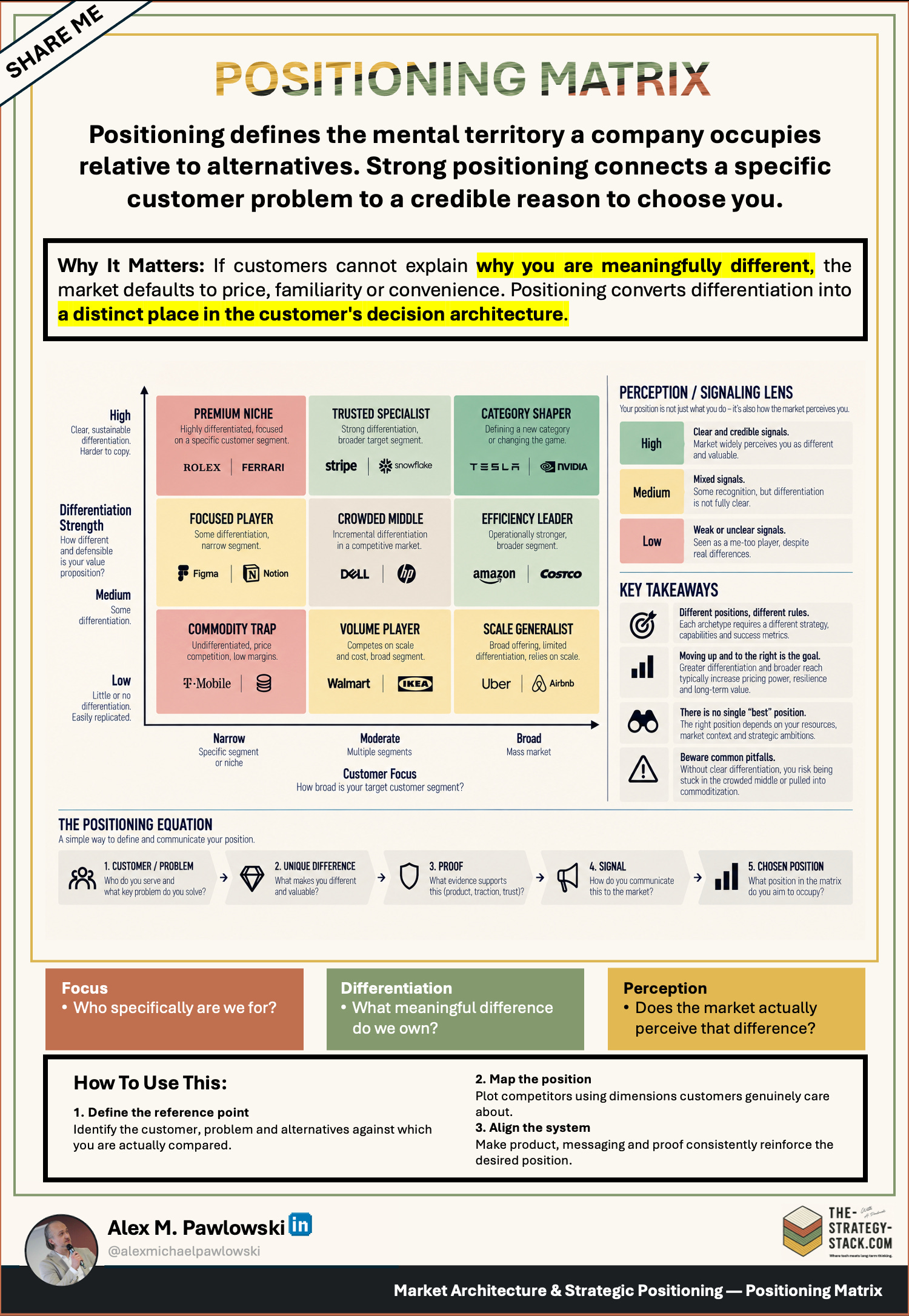
Most positioning exercises produce adjectives.
Faster. Smarter. AI-native. Human-centric.
Adjectives are not coordinates. A positioning matrix forces a different question: on the dimensions buyers actually trade on, where do you sit - and where is the market already crowded?
Without a map, strategy becomes narrative theater. Teams claim differentiation while occupying the same quadrant as five well-funded incumbents. The matrix makes collision visible before capital is committed.
The Two-Axis Rule
A useful positioning matrix uses two axes that buyers weigh simultaneously - not two attributes your product team prefers.
Strong axis pairs:
Outcome depth vs. time-to-value - enterprise transformation vs. immediate utility
Openness vs. control - extensible platform vs. managed simplicity
Price vs. performance - when budget and capability trade off predictably
Self-serve vs. high-touch - when delivery model shapes purchase decisions
Generalist vs. vertical depth - when industry context changes willingness to pay
Weak axes: “innovative,” “customer-centric,” “best-in-class.” If both competitors and you score high on an axis, it is not a differentiator — it is table stakes.
The test: would a buyer reject an option based on this axis alone? If not, pick a different dimension.
Reading the Map
Plot every credible alternative - incumbents, substitutes, DIY, status quo.
Cluster zones - where multiple players compete on the same tradeoffs. Margin compression and feature parity live here.
White space - coordinates with real buyer demand but weak supply. Not every empty quadrant is opportunity; some are empty because nobody wants to pay.
Your wedge - the coordinate you can defend with product, distribution, or economics - not merely messaging.
Trajectory arrows - where incumbents are moving. White space that incumbents are racing toward is not white space for long.
The matrix is a snapshot and a forecast. Position is dynamic; maps that freeze competition in last year’s framing mislead.
Where Matrices Fail
Positioning matrices collapse when:
-
Axes reflect internal org structure instead of buyer decision logic
-
The team plots aspiration, not current reality
-
Substitutes are omitted — spreadsheets, agencies, manual process
-
White space is confused with “no competitors” rather than “unproven willingness to pay”
-
Position is updated in slides but not in product, pricing, or distribution choices
The diagnostic: if your matrix quadrant and your pricing, packaging, and channel strategy could belong to different companies, the map is decoration.
Signals in Practice
Salesforce - plotted on enterprise depth vs. configurability, occupies the high-control quadrant incumbents defend. Challengers that attack on simplicity without matching governance needs cluster in a different coordinate - not “better CRM,” but a different axis pair.
Notion vs. Confluence - similar outcomes, different coordinates on flexibility vs. enterprise compliance. The matrix explains why both coexist: they serve overlapping but not identical buyer tradeoffs.
Vertical SaaS winners - depth on industry-specific axes (e.g., compliance depth vs. time-to-implement) beats horizontal feature parity. The wedge is visible only when the axis is industry workflow - not “features.”
Use cases as proof: if you cannot name two real companies on your map and explain their coordinates in one sentence each, the axes are still wrong.
Building Your Matrix
1. Interview the tradeoff
Ask buyers what they gave up to choose any option in the category. Tradeoffs reveal axes.
2. Draft three axis pairs
Force a choice. Pick the pair where your wedge is clearest and most defensible.
3. Plot honestly
Include incumbents, fast followers, and the “do nothing” alternative.
4. Name the cluster you are leaving
Explicit rejection of a crowded quadrant sharpens narrative and product focus.
5. Align the stack
Pricing, packaging, sales motion, and partnership strategy must match the coordinate - not fight it.
Diagnostic questions:
-
Can a stranger place you on the map without reading your homepage?
-
Which axis would a well-funded clone attack first?
-
If you moved one quadrant over, would economics improve - or would you lose the only advantage you have?
👉 Unlock the Strategy Stack
…and access the Business Model Series, advanced Cheat Sheets, the Operator Vault, and various essays at the intersection of strategy and technology.
In this series →
https://thestrategystack.substack.com/p/market-architecture-strategic-positioning
Read next →
https://thestrategystack.substack.com/p/category-creation-blueprint
Go deeper →