Perception architecture - align signal, proof, and experience so the market believes what your strategy requires - not what your adjectives claim
By Alex Pawlowski
Published: 2026-09-18
URL: https://thestrategystack.substack.com/p/perception-architecture
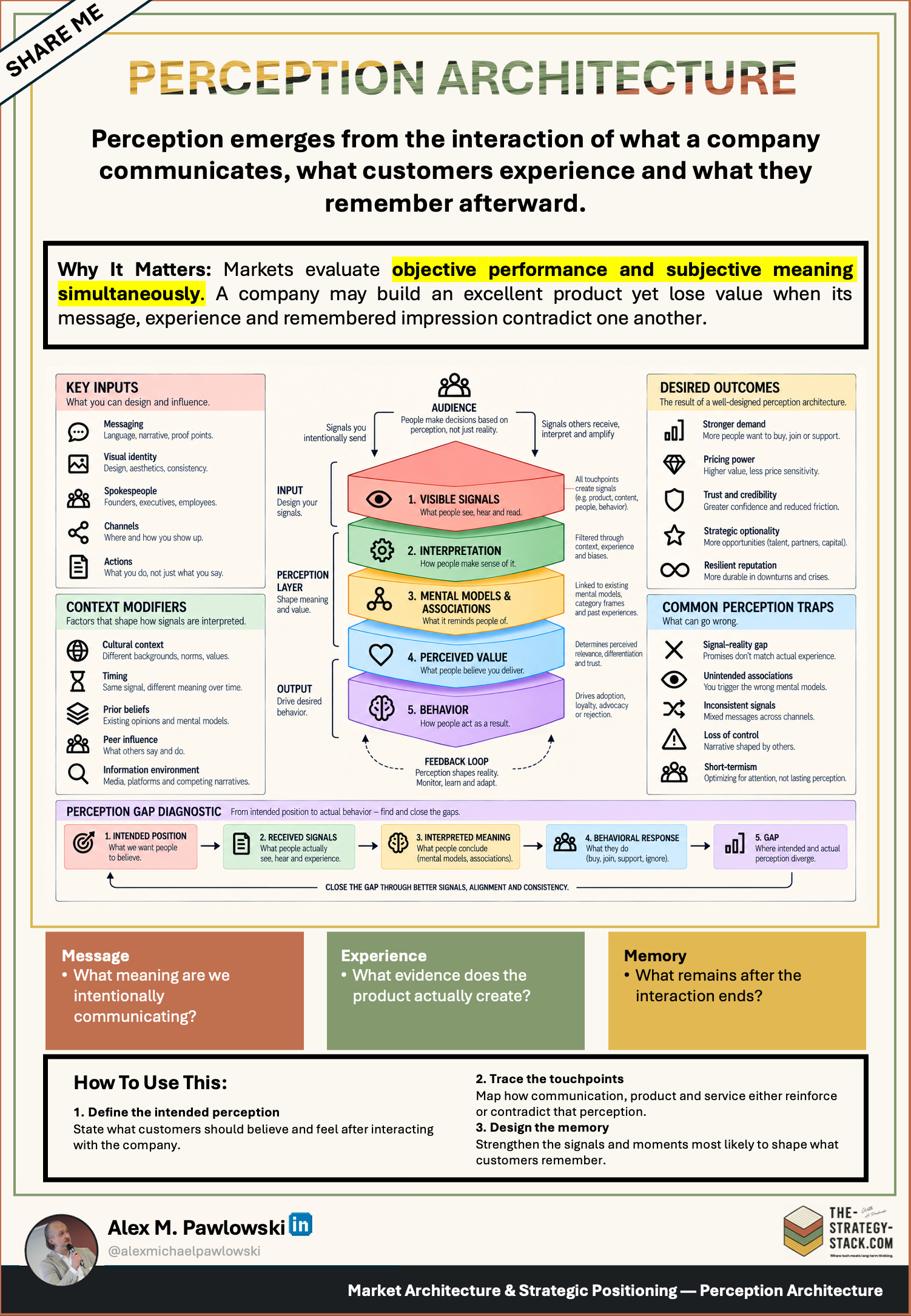
Buyers never access your full reality.
They access signals - website, pricing page, customer logos, founder posts, sales conversations, product UI, support responsiveness, competitor comparisons. From signals they infer beliefs about quality, category, risk, and fit.
Perception architecture is the deliberate design of those inference paths so market belief aligns with strategic intent. It is not manipulation - it is coherence. When perception matches capability, sales cycles shorten and pricing holds. When perception outruns capability, churn and reputation debt accumulate.
Strategic narrative tells the story. Perception architecture builds the evidence environment where the story becomes believable.
Three Layers
Signal surface - what is visible before purchase
Design, copy, pricing presentation, media presence, event footprint, analyst mentions. Signals set reference points - premium vs. budget, enterprise vs. prosumer, innovator vs. incumbent.
Signals are cheap to change. They are also cheap to falsify. Surface alone produces hollow brands.
Proof layer - what validates signals
Case studies with metrics, third-party reviews, certifications, customer quotes, usage data, partner endorsements, community scale. Proof converts claims into credible beliefs.
Weak proof layers force sales to overcome skepticism discount on every deal.
Experience core - what confirms or destroys belief after purchase
Onboarding, product outcomes, support, reliability, roadmap delivery. Experience is the hardest layer to fake and the strongest perception input over time.
Misaligned experience resets signal and proof investment - often publicly.
Perception Loops
Perception compounds or decays through loops:
Positive loop - signal attracts → proof validates → experience confirms → customers amplify signal
Negative loop - signal overclaims → proof thin → experience disappoints → market amplifies skepticism
Competitor loop - rival signal shapes your reference price and category frame
Aggregator loop - ranking, reviews, and interface presentation filter which signals reach buyers
Perception architecture must account for who mediates belief - direct visitors, aggregators, analysts, community influencers.
Design Principles
Coherence over creativity
Every signal should reinforce the same strategic coordinate - positioning matrix quadrant, depth wedge, narrative arc.
Proof before polish
Invest in customer outcomes visible to the market before redesigning the homepage.
Reference management
Anchors matter - who buyers compare you to is a strategic choice, not an accident.
Segment-specific perception
Enterprise and SMB infer different signals from the same page. Architecture may require segmented surfaces, not one generic story.
Latency awareness
Belief changes slower than product. Major pivots require perception transition plans - not overnight rebrand.
Failure Patterns
Perception architecture fails when:
-
Premium signal meets budget experience
-
Category creation language without proof layer support
-
Founder brand contradicts company brand
-
Review and aggregator environments tell a different story than marketing
-
Perception optimized for fundraising, not buyer evaluation
The test: ask a target buyer what they believe about you after ten minutes of research - without sales intervention. Belief should match strategy.
Signals in Practice
Enterprise SaaS pricing pages - annual-only, no public price, “Contact sales” signal premium and complexity. Misaligned when the product is self-serve PLG - buyers infer enterprise sales motion and bounce.
App store ratings - aggregator-mediated perception. A 3.8-star product with brilliant marketing loses to a 4.6-star mediocre competitor when discovery is feed- or store-driven.
Founder-led LinkedIn - signal surface at scale. When founder narrative contradicts company customer proof, buyers trust neither layer.
Perception architecture is segment-specific. One global surface rarely serves enterprise, mid-market, and prosumer inference paths equally well.
How to Use This Framework
1. Define target belief
What must buyers believe about category, urgency, and your role?
2. Audit signal surface
Does every visible element reinforce target belief?
3. Inventory proof gaps
Where claims lack third-party or customer validation?
4. Measure experience alignment
NPS, expansion, public complaints - belief after purchase.
5. Map perception mediators
Aggregators, analysts, communities shaping inference.
Diagnostic questions:
-
Would a skeptical buyer’s research confirm or contradict your positioning?
-
Which layer is weakest - signal, proof, or experience?
-
Are you engineering perception - or hoping authenticity is enough?
👉 Unlock the Strategy Stack
…and access the Business Model Series, advanced Cheat Sheets, the Operator Vault, and various essays at the intersection of strategy and technology.
In this series →
https://thestrategystack.substack.com/p/market-architecture-strategic-positioning
Read next →
https://thestrategystack.substack.com/p/pricing-power-framework
Go deeper →