Strategic depth vs breadth - when to dominate a narrow wedge and when to expand market coverage without diluting the advantage that got you here
By Alex Pawlowski
Published: 2026-09-18
URL: https://thestrategystack.substack.com/p/strategic-depth-vs-breadth
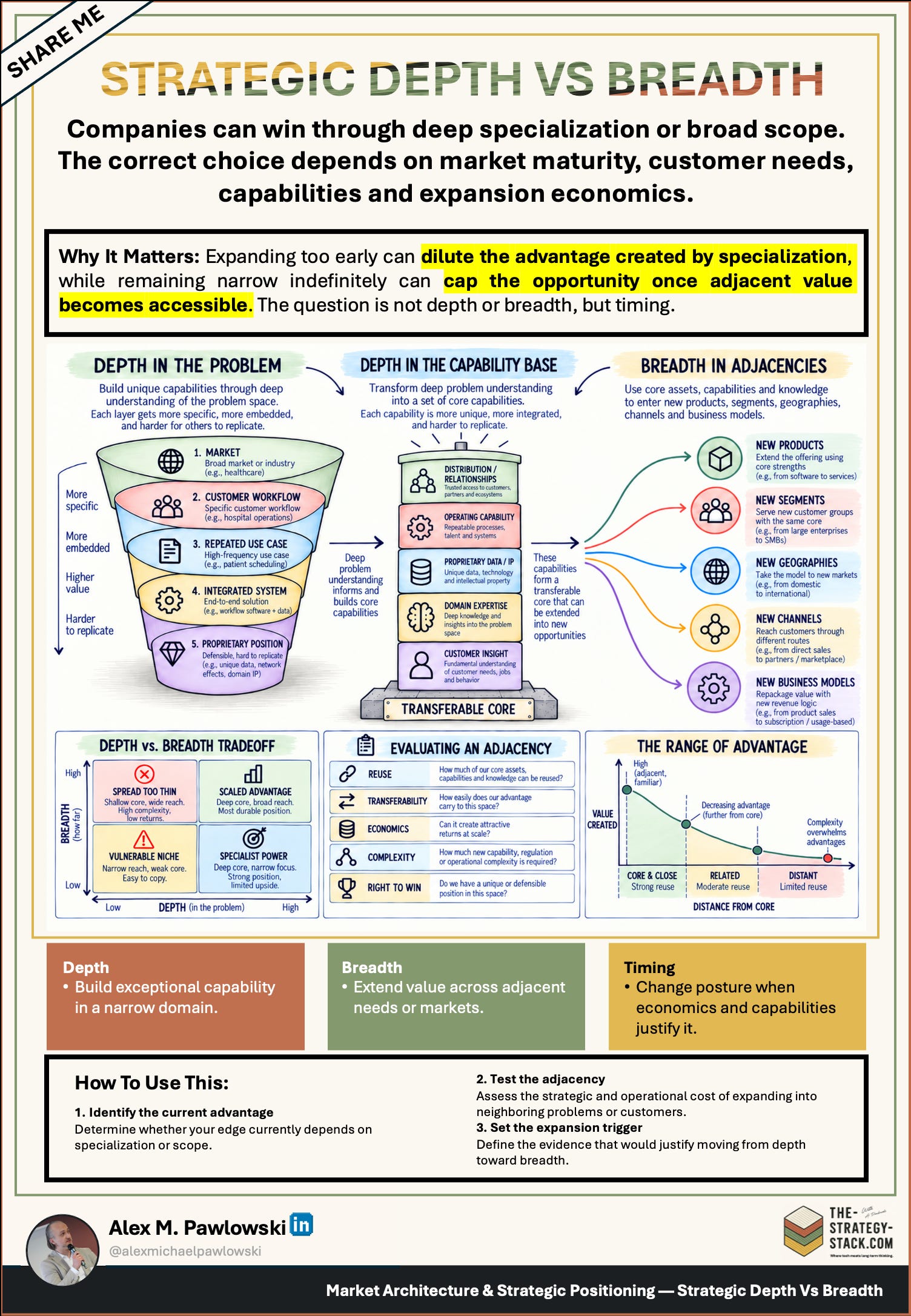
Growth pressure pushes breadth.
Investors ask about TAM expansion. Sales asks for adjacent SKUs. Product asks for the next vertical. Founders hear “we’re leaving money on the table.”
Sometimes they are. Often they are destroying the wedge that made winning possible.
Strategic depth means dominating a narrow market slice - segment, use case, geography, or workflow - with superior economics, expertise, and defensibility.
Strategic breadth means covering more of the market map - more segments, more products, more geographies - accepting complexity cost in exchange for reach and resilience.
Neither is universally correct. The error is choosing breadth while still needing depth to survive - or choosing depth when the wedge is already commoditized.
What Depth Buys
Depth compounds when:
-
Buyers pay for specialized outcomes generalists cannot match
-
Sales cycles shorten because you speak the buyer’s language fluently
-
Product feedback loops tighten - every customer teaches the same lesson
-
Word-of-mouth concentrates in a community that recognizes your name
-
Defensibility emerges from accumulated context - data, workflow, trust
Depth failures look like premature generalization: a vertical SaaS company that becomes horizontal before owning the vertical; a creator who broadens topics before audience trust compounds; a platform that adds sides before liquidity on the first exchange.
The depth question: can you be the obvious choice for a defined buyer - not a reasonable choice for many?
What Breadth Buys
Breadth pays when:
-
The core wedge faces commoditization or ceiling
-
Shared infrastructure makes marginal expansion cheap
-
Customer trust transfers across adjacent problems
-
Portfolio logic reduces single-market risk
-
Cross-sell economics exceed new-logo CAC in the core
Breadth failures look like unconnected diversification: new products that share a logo but not capability, audience, or data; geographic expansion without local demand proof; “platform” language hiding a bundle of weak SKUs.
The breadth question: does each expansion reuse something expensive you already built - or start from zero with extra coordination cost?
The Sequencing Rule
Most durable paths follow a sequence:
Depth first - win a wedge with clear economics and reference customers
Adjacent breadth - expand along the same buyer, workflow, or capability
Portfolio breadth - multiple wedges sharing infrastructure - only when depth is secured
Skipping depth produces companies that are wide and weak. Skipping breadth produces companies that win a niche and stall when the niche saturates.
The art is knowing when the wedge is won - not when the board deck says it is.
Depth vs Breadth Matrix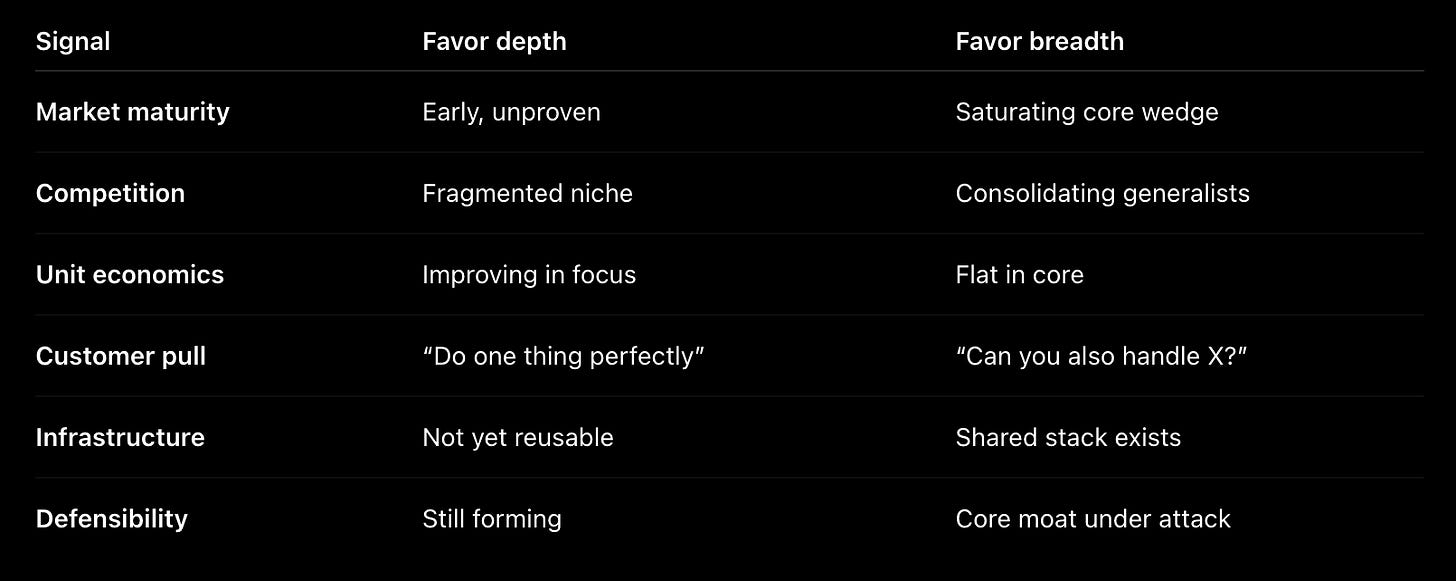
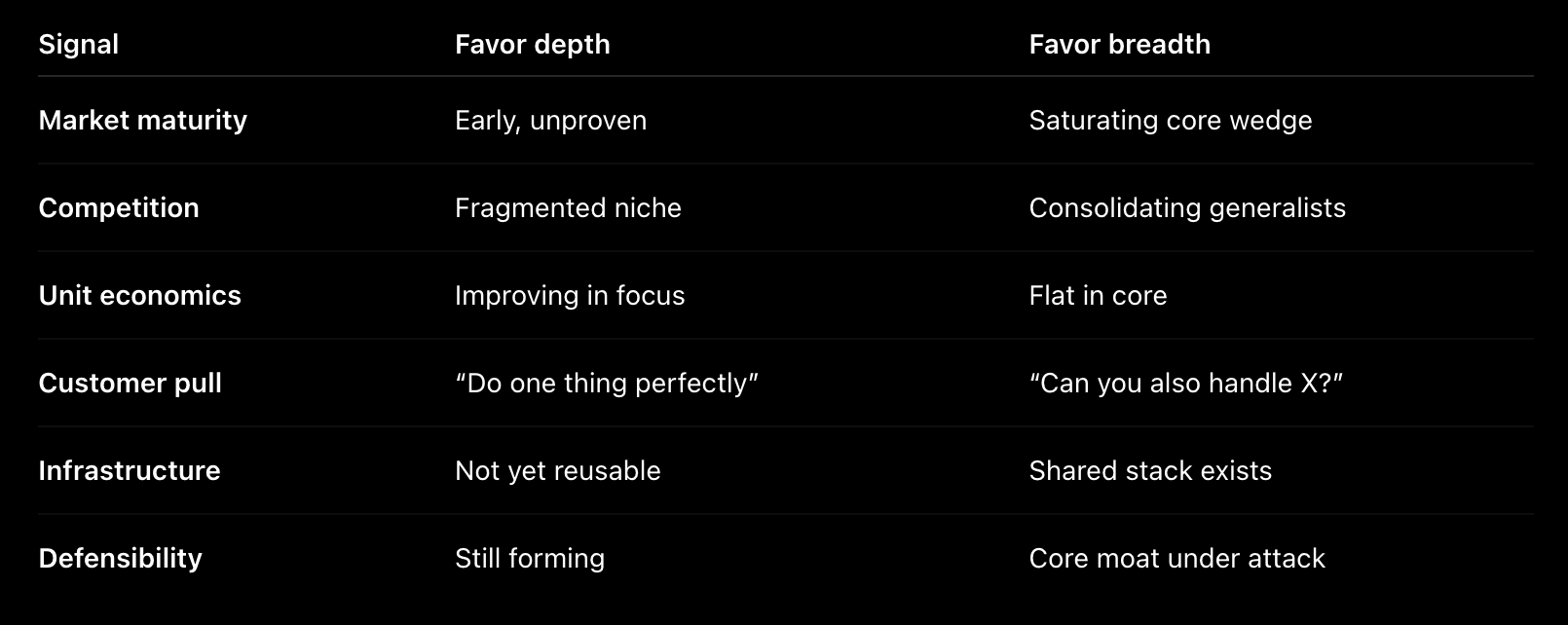
Use the matrix quarterly. Depth and breadth are phases, not identities.
How to Use This Framework
1. Name your current wedge
Segment, job, workflow, geography - one sentence.
2. Score wedge strength
Reference customers, retention, pricing power, inbound share - honest numbers.
3. Map adjacent moves
Which expansions reuse audience, data, or capability?
4. Quantify complexity tax
What breaks if you add a segment, product line, or region?
5. Set expansion gates
Breadth unlocks only when depth metrics hit defined thresholds.
Diagnostic questions:
-
Are you broad because the wedge is won - or because depth is hard?
-
Would your best customers recommend you for the adjacent offer today?
-
Does breadth increase defensibility - or merely revenue volatility?
👉 Unlock the Strategy Stack
…and access the Business Model Series, advanced Cheat Sheets, the Operator Vault, and various essays at the intersection of strategy and technology.
In this series →
https://thestrategystack.substack.com/p/market-architecture-strategic-positioning
Read next →
https://thestrategystack.substack.com/p/demand-aggregation-models
Go deeper →