The network effect map - direct, indirect, data, and social network effects, cold-start dynamics, and how to tell real defensibility from network effect theater
By Alex Pawlowski
Published: 2026-09-17
URL: https://thestrategystack.substack.com/p/network-effect-map
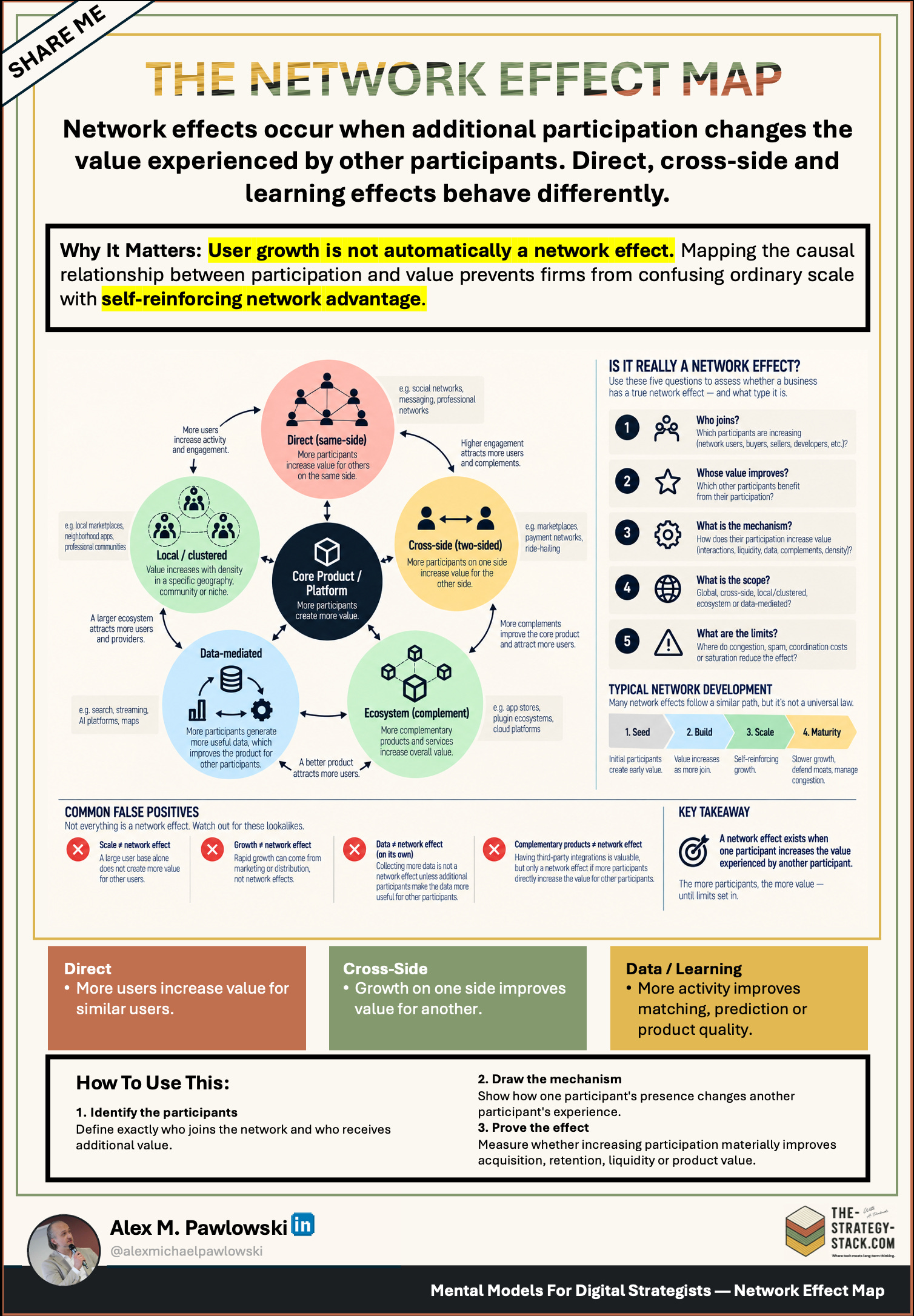
Every pitch deck claims network effects.
More users → more value → more users. The loop sounds inevitable. Most businesses labeled “networked” are aggregated, scaled, or data-rich - without the structural dynamic where each participant increases value for others.
Network effects are a specific mechanism: product or platform value to a user increases as the number of other users (or complementary participants) increases. Confusing growth with network effects leads to overpriced defensibility, wrong cold-start strategy, and platform investments that competitors bypass.
The Network Effect Map separates effect types - so you design for the mechanism you actually have, not the one you wish you had.
Four Effects on the Map
Direct network effects - same-side value increases with same-side participation
Telephone networks, messaging apps, social graphs where each additional user makes the network more useful to every other user. Classic, powerful, hardest to bootstrap - cold start is real.
Indirect (cross-side) network effects - value on one side increases with participation on the other side
Marketplaces, platforms, developer ecosystems. More sellers attract more buyers attract more sellers. Requires both sides to reach density; chicken-and-egg is structural.
Data network effects - product improves as usage generates data that improves the product for all users
Search ranking, recommendation engines, fraud models, routing optimization. Weaker than often claimed - competitors can replicate with sufficient data access or synthetic alternatives; strength depends on proprietary data loops and integration into decisions.
Social/network-of-attention effects - value from status, discovery, or identity within a visible network
Creator platforms, professional networks, gaming communities. Combines direct graph value with social proof and identity lock-in; vulnerable to migration when culture shifts or creators multi-home.
Each type demands different bootstrap strategy, governance, and competitive defense.
Cold Start: Where Maps Go Blank
Network effects do not exist at zero density.
Cold start problem - early users receive insufficient value because the network is empty; why join?
Common solutions (each with tradeoffs):
-
Single-player mode - value before network (Notion, personal utility tools)
-
Subsidize one side - pay supply or demand until density (marketplace classic)
-
Geographic or niche concentration - win one city or segment before expanding (Uber, Facebook campus)
-
Come for tool, stay for network - utility hook that aggregates participants (Dropbox sharing, Slack teams)
-
Fake supply / curated inventory - platform fills one side manually until organic (early marketplaces)
Claiming network effects without a credible cold-start path is strategy fiction.
Network Theater vs Real Defensibility
Network claims fail when:
-
Scale without cross-user value - large user base where additional users do not improve experience for incumbents
-
Multi-homing is easy - sellers and buyers use multiple platforms; no lock-in, no effect
-
Data does not compound uniquely - same data available to competitors; model parity achievable
-
Local not global effects - density in one category does not transfer; horizontal expansion resets cold start
-
Negative network effects ignored - congestion, spam, quality degradation as network grows; net value per user falls
The diagnostic: ask whether a marginal user makes the product meaningfully better for existing users. If no, you have scale - not network effects.
Signals in Practice
WhatsApp / iMessage - direct network effects strong; switching cost is social graph; cold start solved per geography and contact import.
Airbnb - cross-side effects with geographic density; cold start city-by-city; data effects in pricing and trust secondary to liquidity.
Waze - data network effects during use; each driver improves routing; effect weakens if maps commoditize - Google acquisition logic.
LinkedIn - direct (professional graph), social (identity, reputation), data (recruiting signals); multi-sided with strong cold-start history in professional segment concentration.
The pattern: defensible networks show increasing value per user as density grows - measurable in retention, pricing power, or bypass difficulty.
Network Diagnostics
1. Classify your effect type
Which box on the map - direct, indirect, data, social? Mixed is common; name the primary driver.
2. Draw the cold-start sequence
How do you reach minimum viable density? What is the time and capital cost? What happens if a competitor reaches density first in your wedge?
3. Test marginal user value
Instrument whether N+1 users improve outcomes for users 1…N - not just total metrics.
4. Assess multi-homing and bypass
Can participants use you and a competitor simultaneously? Can supply reach demand without you?
5. Plan for negative effects
What breaks at 10x scale - quality, trust, congestion? Governance is part of network architecture.
Diagnostic questions:
-
Which network effect type drives your defensibility - and could you articulate it without using the word “platform”?
-
What is your cold-start wedge - and how long until the effect is self-sustaining?
-
If a well-funded competitor copied your features tomorrow, would your network still defend you?
👉 Unlock the Strategy Stack
…and access the Business Model Series, advanced Cheat Sheets, the Operator Vault, and various essays at the intersection of strategy and technology.
In this series → Mental Models for Digital Strategists: The Complete Collection
Read next → The Law of Increasing Returns
Go deeper → Network Effects: Why Strong Ecosystems Win