The law of increasing returns - why scale changes economics in digital markets, how early advantage compounds, and when diminishing-returns thinking misleads strategy
By Alex Pawlowski
Published: 2026-09-17
URL: https://thestrategystack.substack.com/p/law-of-increasing-returns
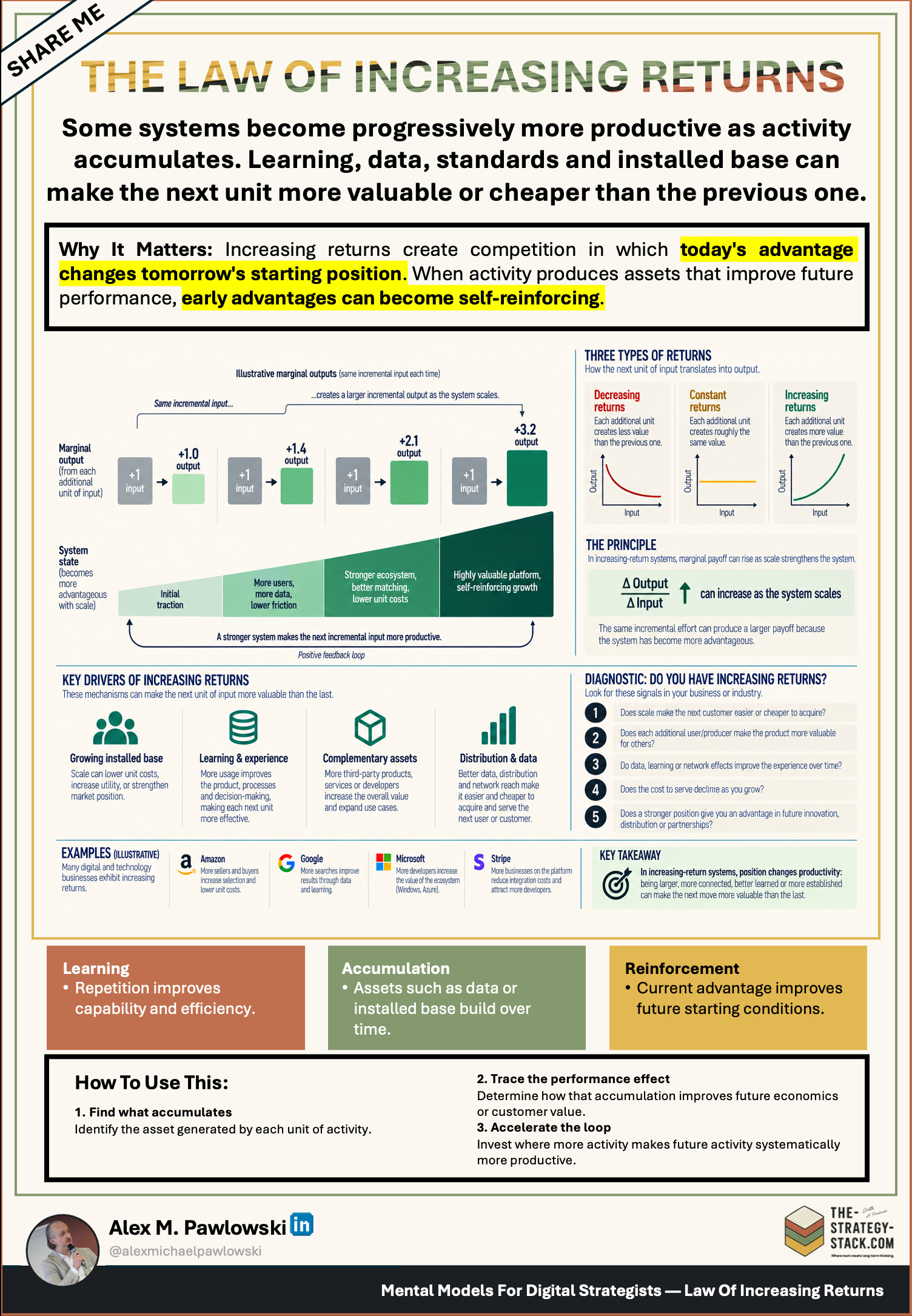
Industrial economics taught diminishing returns.
Farm more land, yield per acre falls. Hire more workers, marginal productivity drops. Optimize until marginal cost equals marginal revenue - then stop. Equilibrium thinking.
Software, platforms, and intelligence-heavy businesses often operate under increasing returns.
The more you produce, the cheaper or better the next unit becomes - not the worse. Early share leads to learning curve advantage leads to customer preference leads to more share. Gap widens; catch-up cost rises. Brian Arthur formalized what strategists observe in tech: positive feedback replaces equilibrium as the default mental model.
Confusing diminishing with increasing returns produces premature diversification, underinvestment in winners, and surrender of markets that were still contestable.
Returns Logic: Two Regimes
Diminishing returns regime
Physical goods, commodity extraction, many service businesses at scale. Competition drives prices toward cost. Advantage erodes. Strategy emphasizes efficiency and niche focus.
Increasing returns regime
High fixed cost, low marginal cost; network and learning effects; standards and compatibility pressure; data that improves with scale. Leadership is valuable because leadership compounds. Strategy emphasizes speed to scale, lock-in, and ecosystem orchestration.
Most digital firms operate in mixed regimes - increasing returns in core, diminishing in operations. Strategy error: manage the increasing-returns core with cost-cutting logic from the diminishing tail.
Mechanisms That Increase Returns
Learning curves - cost or quality improves with cumulative production; experience is an asset
Adoption feedback - more users attract complements, developers, content, integrations; ecosystem depth increases value
Standardization and compatibility - de facto standards create switching costs; late entrants must pay compatibility tax
Data and intelligence loops - scale generates signal that improves product; improved product accelerates adoption
Brand and trust at scale - enterprise buyers reduce perceived risk by choosing market leader; sales cycle advantage compounds
Each mechanism reinforces others - increasing returns is rarely single-source.
Where Increasing-Returns Thinking Misfires
-
Assuming returns increase everywhere - ops, support, and complexity often hit diminishing returns even when core product does not
-
Scale before product-market fit - increasing returns require a loop that works; scaling broken loops accelerates failure
-
Ignoring coordination costs - organization complexity can overwhelm product-level increasing returns
-
Regulatory or bypass shocks - returns can reverse when standards shift or interoperability is mandated
-
Linear extrapolation of early lead - lead must connect to compounding mechanism; first-mover without loop is not increasing returns
The diagnostic: can you name*what gets cheaper or better with each incremental unit of scale? If marginal unit is neutral or worse, you are not in increasing returns - yet.
Signals in Practice
Microsoft Office / Windows era - compatibility and developer ecosystem created increasing returns; marginal user increased value for all through file format and application standard.
AWS - scale in infrastructure drives cost efficiency and feature velocity; learning from diverse workloads; late entrants face dual disadvantage on price and capability breadth.
Tesla early manufacturing - learning curve logic in production; increasing returns if quality and cost improve with volume - contested when scale exposes complexity.
Traditional retail without digital loop - often diminishing returns at store saturation; no automatic compounding unless data, loyalty, or platform layer added.
AI model providers - inference cost and capability may improve with scale and data; increasing returns contested by open models and commoditization - mechanism must be proprietary loop, not generic scale.
The pattern: increasing-returns winners widen gap intentionally - reinvesting scale advantage into speed, ecosystem, and learning - not harvesting margin prematurely.
Returns Audit
1. Classify your core economics
Increasing or diminishing returns on the value unit? Map explicitly - do not assume “digital = increasing.”
2. Identify the compounding mechanism
What improves with scale - cost, quality, data, ecosystem, trust? If none, scale is size - not advantage.
3. Time investment to loop validation
Prove the loop at small scale before capital deployment for scale. Increasing returns amplify whatever you scale - including mistakes.
4. Monitor marginal unit economics
Track whether incremental customers/users improve or degrade unit economics - inflection points warn when regime shifts.
5. Defend the feedback path
Competitors attack loops - poach developers, open standards, subsidize switching. Increasing returns require active defense, not passive entitlement.
Diagnostic questions:
-
What specifically gets better or cheaper as you grow - and can competitors replicate that mechanism?
-
Are you managing an increasing-returns asset with diminishing-returns discipline - or the reverse?
-
Where would a small early lead compound - if you invested aggressively for twelve months?
👉 Unlock the Strategy Stack
…and access the Business Model Series, advanced Cheat Sheets, the Operator Vault, and various essays at the intersection of strategy and technology.
In this series →
https://thestrategystack.substack.com/p/mental-models-for-digital-strategists
Read next →
https://thestrategystack.substack.com/p/compounding-leverage-flywheel
Go deeper →