The compounding leverage flywheel - where leverage meets compounding in one integrated loop, and how to tell real flywheel motion from coordinated hustle
By Alex Pawlowski
Published: 2026-09-17
URL: https://thestrategystack.substack.com/p/compounding-leverage-flywheel
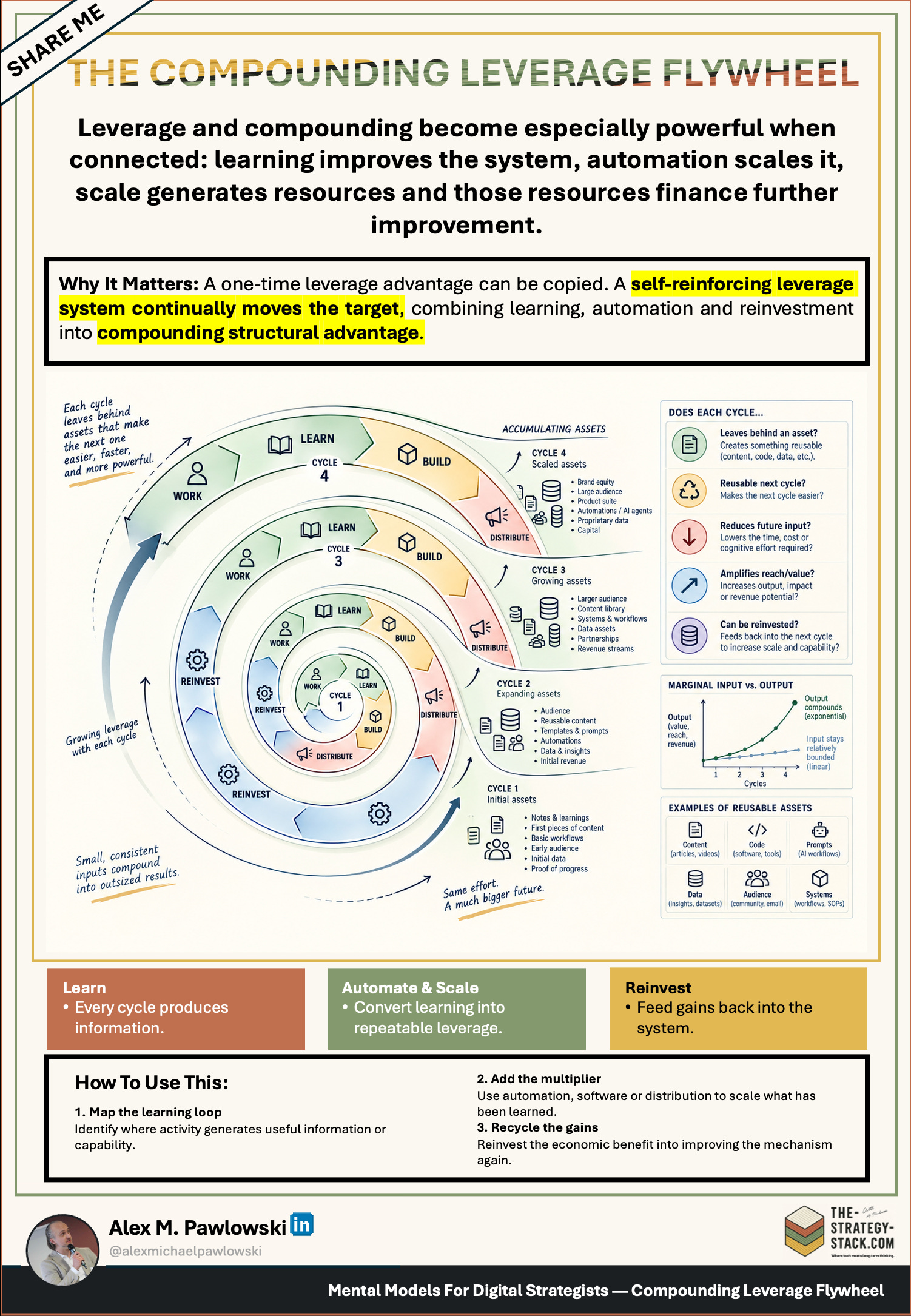
Leverage without compounding produces spikes.
Compounding without leverage produces slow arithmetic.
Durable digital advantage requires both - output disproportionate to input, with surplus reinvested into the system so the next cycle starts from a higher base. Amazon called it a flywheel. Strategists call it moat. Operators call it “the thing that actually works.”
The Compounding Leverage Flywheel is the capstone mental model in this collection: not a new mechanism, but the integration of levers and loops into architecture you can audit, defend, and accelerate.
If you cannot draw your flywheel in one diagram - with named levers, named stock, and closed feedback - you have initiatives, not advantage.
The Integrated Loop
A real flywheel has four connected elements:
1. Leverage source - which lever produces disproportionate output?
Code serving users. Media reaching audience. Capital funding assets. Intelligence improving decisions. Usually one primary lever with secondary reinforcement.
2. Value delivery - what outcome proves the lever works?
Customers pay. Users retain. Participants transact. Signal exceeds cost. Without validated delivery, “leverage” is theory.
3. Surplus capture - what stock accumulates?
Revenue, data, audience, capability, reputation, network density. Surplus must be capturable - not entirely extracted by partners or platforms.
4. Reinvestment path - how does surplus strengthen the lever?
R&D, content, infrastructure, model training, supply subsidies, brand - explicit allocation back into the mechanism that produced surplus. The loop closes here - or compounding never begins.
Flywheel motion: Lever → Deliver → Capture → Reinvest → Stronger Lever → …
Each rotation should require less marginal input per unit of output - or produce more output per unit of input - or both.
Flywheel vs Motion Theater
Flywheels fail when:
-
No named lever - activity everywhere, multiplication nowhere
-
Surplus leaks - platform takes audience; partners take margin; churn drains base
-
Reinvestment unfocused - surplus funds overhead, not loop; general growth vs loop-specific strengthening
-
Open feedback - data not integrated; learning not captured; each cycle starts cold
-
Negative effects at scale - congestion, quality decay, support collapse; net rotation slows
-
Flywheel language without metrics - narrative of compounding without retention, margin, or marginal cost improvement
The diagnostic from earlier models applied here: Would stopping new acquisition cause the system to continue accelerating? If yes, flywheel. If no, treadmill.
Architecture Patterns
Product-led flywheel - code leverage → user value → data → better product → more users
Classic SaaS with learning loops; requires retention and expansion revenue to close capture.
Audience-led flywheel - media leverage → trust → owned audience → monetization → more media capacity
Newsletter, creator, and education businesses; requires owned distribution, not rented reach.
Platform flywheel - cross-side effects → liquidity → participant surplus → more participation
Marketplaces and ecosystems; requires governance that preserves trust at scale.
Intelligence flywheel - inference at scale → outcome data → model improvement → better decisions → more usage
AI-native businesses; requires proprietary feedback and decision integration — not generic model access.
Most firms need one primary flywheel - not five competing loops that dilute reinvestment.
Signals in Practice
Amazon (canonical) - selection, experience, traffic, sellers, selection - explicit flywheel in investor materials; reinvestment into price, speed, and infrastructure; leverage in logistics and data compounds over decades.
Shopify - merchant success → platform revenue → developer ecosystem and product → more merchant success; cross-side with code and capital leverage in payments and infrastructure.
Figma - product leverage, community and file network effects, reinvestment in collaboration and platform; acquisition logic reflected flywheel value in design workflow density.
Services firm with “flywheel” branding - linear delivery, no capture stock, reinvestment in hiring; motion without rotation; leverage model caps flywheel potential.
The pattern: flywheel businesses report loop metrics - retention, NRR, marginal cost trends, network density - not only gross growth.
Spinning Up Your Flywheel
1. Draw the loop in one page
Four boxes: lever, delivery, capture, reinvest. Arrows closed. If open, name what would close it.
2. Assign reinvestment ownership
Who decides loop reinvestment vs general budget? Flywheels die in annual planning when surplus is spread across priorities.
3. Measure rotation speed
How fast does one cycle complete - and is each cycle faster or slower than the last? Time-to-rotation matters.
4. Protect the stock
Churn, platform risk, and data portability attacks drain capture. Defense is flywheel maintenance.
5. Align mental models
Leverage audit (post 1), compounding test (post 2), network map (post 8), increasing returns check (post 9) - all inputs to flywheel design. This model is the synthesis.
Diagnostic questions:
-
Can every leader on your team draw the same flywheel - with the same lever and same reinvestment path?
-
What metric proves the wheel spins faster this year than last - not just that revenue grew?
-
If you had to kill one initiative to protect flywheel reinvestment, which would it be?
👉 Unlock the Strategy Stack
…and access the Business Model Series, advanced Cheat Sheets, the Operator Vault, and various essays at the intersection of strategy and technology.
In this series →
https://thestrategystack.substack.com/p/mental-models-for-digital-strategists
Read next →
https://thestrategystack.substack.com/p/mental-models-for-digital-strategists
Go deeper →