Second-order effects — why the obvious next outcome is rarely the last outcome, and how to trace consequences before they compound against you
By Alex Pawlowski
Published: 2026-09-17
URL: https://thestrategystack.substack.com/p/second-order-effects
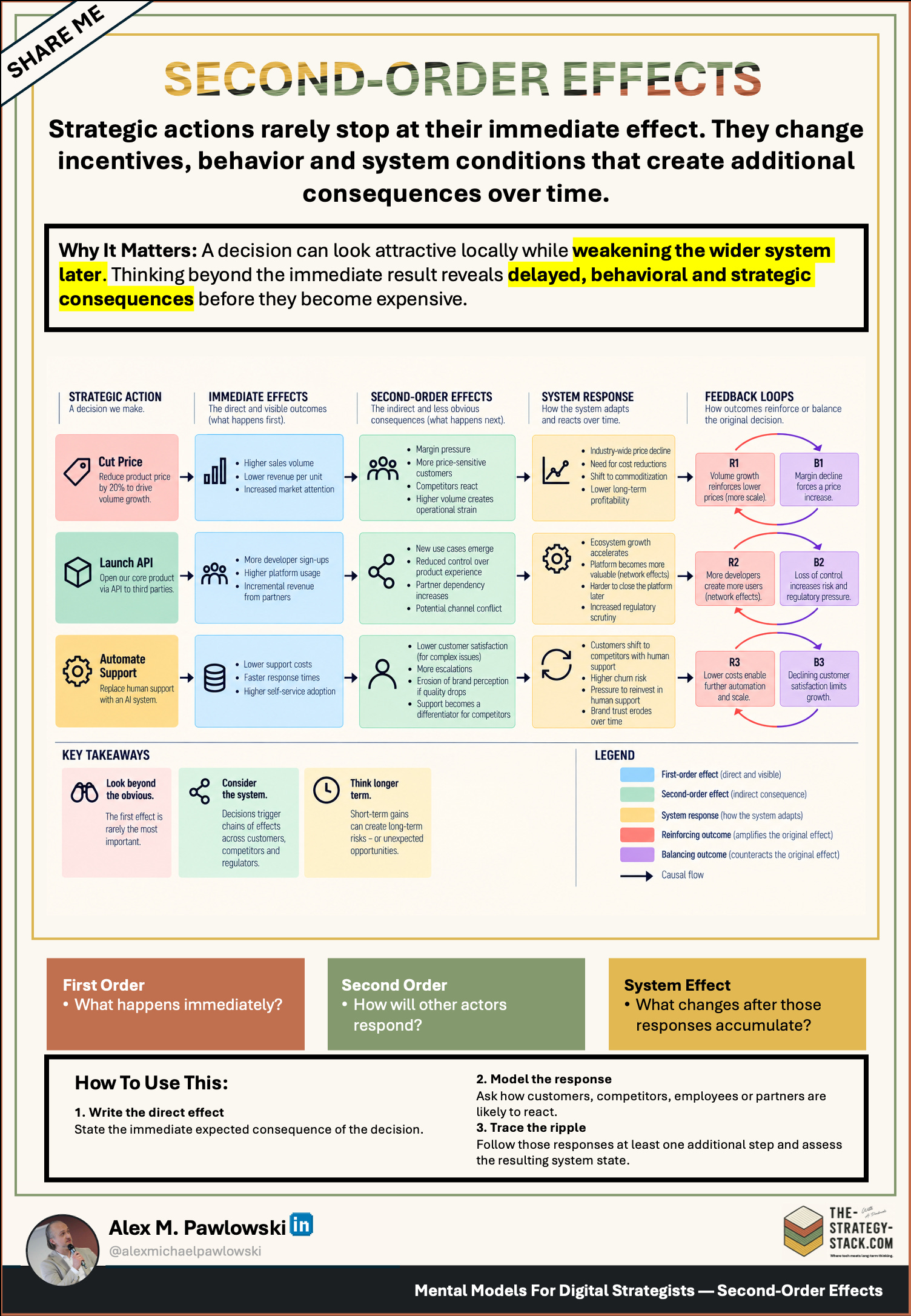
The promotion worked.
Conversion rate jumped. The team celebrated. Six months later, support costs doubled, brand sentiment dropped, and the highest-value customers churned to a competitor that never ran the promotion.
First-order thinking saw the immediate effect: more signups.
Second-order thinking would have asked: who converts, what do they expect, what does support load look like, how does discounting anchor willingness-to-pay, what signal do we send to the market?
Most strategic mistakes are not wrong at step one.
They are wrong at step two or three - when consequences of consequences arrive on a delay long enough that causation gets debated in hindsight.
First Order vs Second Order
First-order effect - the direct, often intended result of an action
Cut price → more sales. Launch feature → more usage. Hire sales → more pipeline. Add AI chat → faster responses.
Second-order effect - the consequence of the first consequence
More sales → margin compression and support load. More usage → infrastructure cost and complexity debt. More pipeline → lower close quality and longer cycles. Faster responses → customers expect instant resolution on harder problems agents cannot solve.
Third-order and beyond - competitors respond, market expectations shift, culture adapts, regulation reacts
Discounting trains market to wait for sales. AI support trains customers to abandon self-serve. Aggressive growth hiring trains investors to expect unsustainable velocity.
Digital systems amplify second-order effects because feedback loops are fast and competitors copy visible first-order wins without copying hidden second-order costs.
The Cascade Pattern
Second-order failures share structure:
1. Local optimization - a metric improves in one function without global view
2. Delayed feedback - second-order costs arrive weeks or quarters later, disconnected from the decision in attribution
3. Compensation behavior - other parts of the system adjust to absorb first-order change, storing stress
4. Sudden correction - accumulated second-order effects trigger crisis; team treats crisis as new problem, not consequence
Examples across digital strategy:
-
Growth hacking - first order: user growth; second order: low-quality users, fraud, degraded community, ad platform penalties
-
Platform dependency - first order: cheap acquisition; second order: algorithm change, margin to intermediary, no owned audience
-
Feature accumulation - first order: checkbox parity; second order: product complexity, slower iteration, confused positioning
-
Automation without governance - first order: cost reduction; second order: edge case failures, customer trust erosion, compliance exposure
-
Aggressive monetization - first order: revenue lift; second order: churn, negative word-of-mouth, sales cycle friction
Why Teams Miss Second Order
-
Metrics scoped to functions - marketing owns CAC, product owns activation, nobody owns twelve-month LTV quality
-
Short incentive horizons - quarterly bonuses reward first-order wins; second-order costs land on successor’s P&L
-
Linear narrative - decks show A → B; reality is A → B → C → D with delays between nodes
-
Success bias - wins get studied for replication; near-misses where second order almost broke the firm get forgotten
-
Complexity avoidance - second-order analysis feels speculative; first-order data feels concrete
The diagnostic: for your last three “wins,” can you trace two steps past the celebrated metric? If not, you may be accumulating second-order debt.
Signals in Practice
Uber / ride pricing dynamics - surge pricing first order: balance supply and demand; second order: driver and rider expectation anchoring, competitor response, regulatory scrutiny in some markets.
Social platform engagement optimization - first order: time on platform; second order: content quality degradation, advertiser brand safety concerns, creator burnout, regulatory intervention.
SaaS unlimited plans - first order: simplified sales; second order: power users subsidized by light users until economics break; support and infrastructure costs concentrate at tail.
Open-source to commercial pivot - first order: monetization; second order: community trust fracture, fork risk, contributor exodus.
The pattern: first-order wins are visible and attributable; second-order costs are diffuse and debatable - until they are existential.
Second-Order Audit
1. Extend the causal chain
For any major decision, map: action → first effect → second effect → third effect. Force at least three hops before approval.
2. Assign a second-order owner
Someone accountable for downstream consequences - not just launch metrics. Often product ops, finance, or strategy - not only the sponsoring function.
3. Use time-delayed review
Schedule 90-day and 180-day reviews of major initiatives specifically for second-order assessment - not just “did we hit KPI?”
4. Stress-test incentives
Ask what behavior your metrics reward at step two when rational actors optimize. Goodhart’s law is second-order thinking applied to measurement.
5. Study near-misses
Examine initiatives that hit first-order targets but nearly broke something downstream. Pattern library beats one-off pre-mortems.
Diagnostic questions:
-
What second-order effect is your current strategy most likely producing - that nobody is measuring yet?
-
Which metric improvement would you refuse if you had to own all consequences through step three?
-
Where does your organization reward first-order wins while socializing second-order costs?
👉 Unlock the Strategy Stack
…and access the Business Model Series, advanced Cheat Sheets, the Operator Vault, and various essays at the intersection of strategy and technology.
In this series →
https://thestrategystack.substack.com/p/mental-models-for-digital-strategists
Read next →
https://thestrategystack.substack.com/p/asymmetric-bets
Go deeper →