Power laws in digital systems - why a few winners capture most value, how averages mislead, and what it means for platform and distribution strategy
By Alex Pawlowski
Published: 2026-09-17
URL: https://thestrategystack.substack.com/p/power-laws-digital-systems
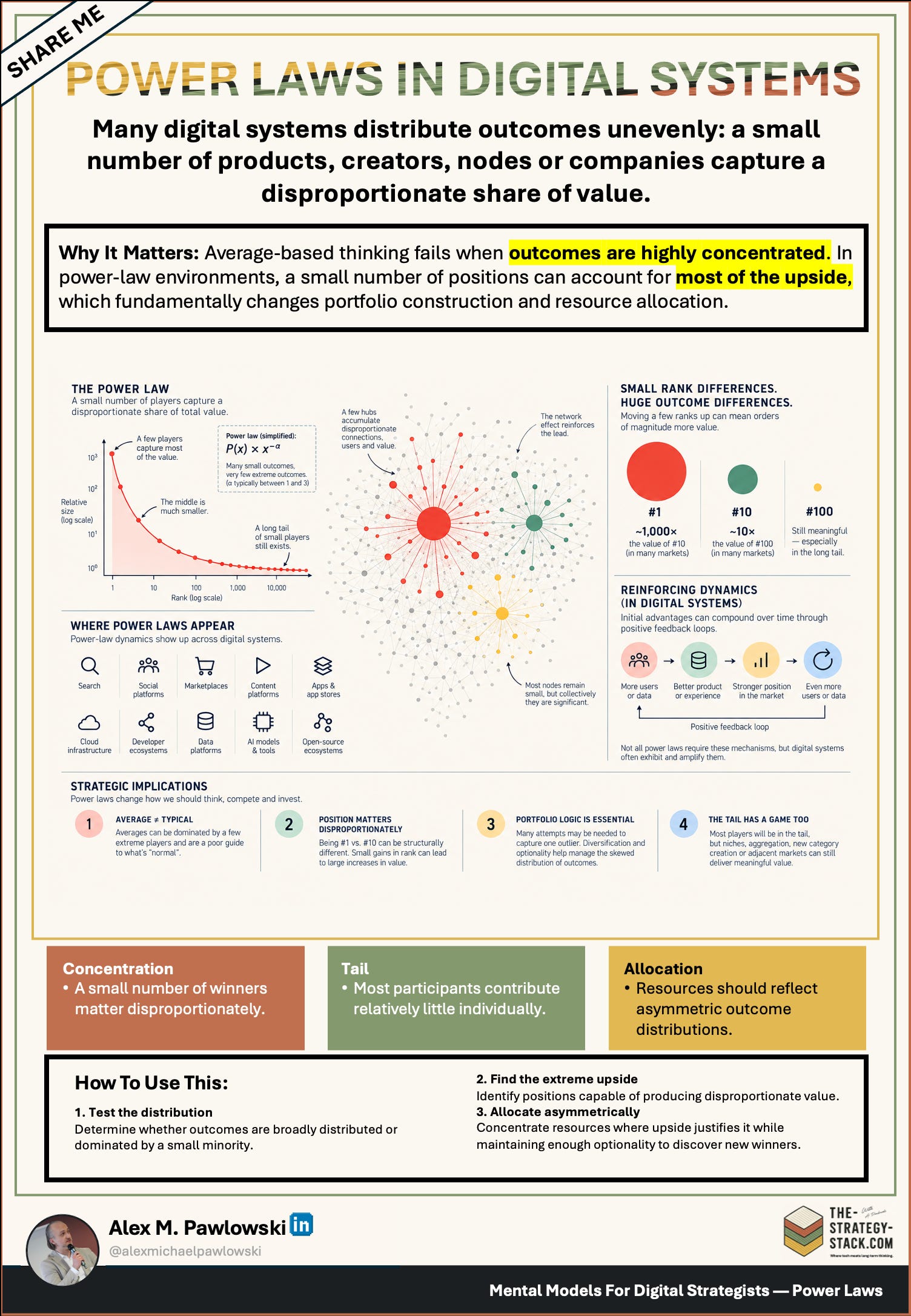
Business school still trains on bell curves.
Revenue averages. Market share medians. Typical customer behavior. In many physical markets, normal distributions approximate reality well enough.
Digital systems behave differently.
Power laws describe relationships where a small number of entities capture a disproportionate share of outcomes - users, revenue, attention, connections, compute, search results. The top 1% is not slightly ahead of the median. It is orders of magnitude ahead. Strategy built on mean assumptions systematically misallocates resources.
If you are optimizing for the average user, average channel, or average competitor, you are likely fighting the wrong war.
Where Power Laws Appear
Markets and platforms - top apps, top sellers, top creators dominate gross merchandise value; the long tail exists but the head funds the ecosystem
Attention economies - few accounts capture most engagement; distribution is concentrated even when production is democratized
Networks - preferential attachment: nodes with more connections attract more connections; hub formation is structural, not accidental
Venture and innovation - few investments return most fund performance; portfolio logic assumes power law, not diversification to mean
Search and discovery - top results capture most clicks; ranking position is power law in disguise
Internal organizations - small number of people, projects, or customers often drive most value; headcount planning that ignores this misprices leverage
The unifying mechanism: positive feedback - success breeds visibility, visibility breeds adoption, adoption breeds more success. Linear inputs produce nonlinear outputs when feedback loops favor incumbents.
Misreading Mean vs Tail
Power law environments produce predictable strategic errors:
-
Averaging customer value - optimizing for median ARPU while whales or power users fund the model
-
Democratic resource allocation - equal budget across segments when tail segments have asymmetric return
-
Competing in the crowded middle - markets where the head is taken and the middle is commoditized
-
Underestimating winner persistence - assuming mean reversion when feedback loops entrench leaders
-
Portfolio of median bets - many small initiatives with moderate expected value instead of few with convex upside
-
Feature parity strategy - copying leaders without acknowledging cumulative advantage in data, distribution, or habit
The diagnostic: if your strategy would work equally well in a normal distribution world and a power law world, it probably ignores the power law.
Signals in Practice
Google Search - query volume and advertiser spend concentrate on head terms; long tail exists at scale but economics favor those who win head positions or aggregate tail efficiently.
Spotify / streaming - top artists capture disproportionate streams; platform succeeds by catalog breadth but economics and discovery favor concentration; power law at artist level, aggregation at platform level.
App stores - top charts drive most downloads; ranking systems create power law in visibility; developers fight for tail position inside a power-law discovery layer.
Enterprise SaaS - land-and-expand often reveals power law within accounts: few customers become disproportionate revenue through expansion; success teams should recognize tail value early.
Venture portfolios - funds designed for power law returns accept many zeros to capture outliers; corporate innovation programs that punish failure kill power law optionality.
The pattern: winners in power law systems compound advantage at the top - not because they are infinitely better, but because feedback loops amplify early leads.
Designing for Tails
1. Identify the power law dimension
Which variable in your market is power-law distributed - attention, revenue, connections, usage? Strategy differs by dimension.
2. Choose head vs tail vs aggregator position
Win the head (hard, winner-take-most). Serve the tail profitably (aggregation, niche depth). Enable others to fight for head while you orchestrate (platform). Do not default to middle.
3. Price convexity
In power law environments, upside optionality matters more than mean expected value. Small bets with large tail payoff beat many moderate bets.
4. Measure percentiles, not just averages
Track P90, P99, top-decile cohort behavior - not only mean and median. Decisions change when you see tail economics.
5. Build feedback awareness
Ask what mechanism makes winners win more. Can you enter that loop early - or are you structurally excluded?
Diagnostic questions:
-
What percentage of your revenue or engagement comes from the top decile - and does strategy reflect that concentration?
-
Are you competing where power laws favor incumbents - or where feedback loops are still open?
-
Would your plan still make sense if outcomes were normally distributed? If yes, you may be ignoring the curve.
👉 Unlock the Strategy Stack
…and access the Business Model Series, advanced Cheat Sheets, the Operator Vault, and various essays at the intersection of strategy and technology.
In this series →
https://thestrategystack.substack.com/p/mental-models-for-digital-strategists
Read next →
https://thestrategystack.substack.com/p/inversion-thinking
Go deeper →