Optionality - playing infinite games: when to commit, when to preserve paths, and how to avoid foreclosing upside before information arrives
By Alex Pawlowski
Published: 2026-09-17
URL: https://thestrategystack.substack.com/p/optionality-infinite-games
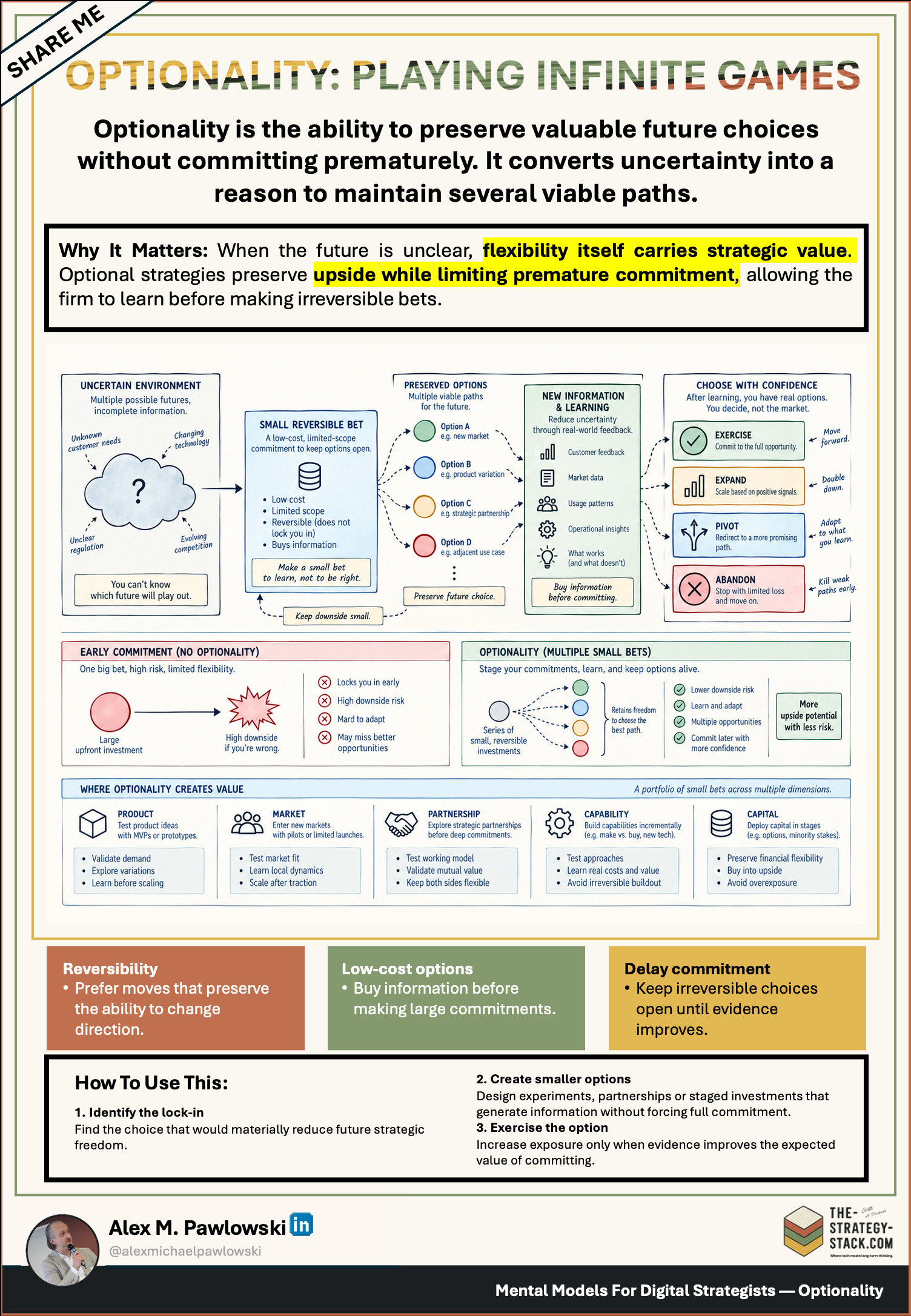
Strategy culture rewards conviction.
Pick a lane. Burn the boats. Commit fully. The narrative sounds decisive - and it is often strategically wrong.
Optionality is the discipline of preserving valuable paths when the future is uncertain, information is asymmetric, and reversibility is expensive. It is not indecision. It is sequencing bets so that early moves keep later moves available - instead of foreclosing them to appear bold.
James Carse distinguished finite games - played to win, with defined endings - from infinite games - played to keep playing. Digital businesses operate in infinite games: platforms shift, models mutate, capabilities emerge. The goal is not to “win” a quarter. It is to remain a player with attractive options when the landscape changes.
#Real Options vs Theater
Real optionality has structure:
-
Low cost to maintain - the option does not consume resources disproportionate to its value
-
Asymmetric upside - if the path opens, payoff is large relative to cost of preservation
-
Defined trigger - you know what signal converts option to commitment
-
Bounded downside - preserving the path does not bankrupt the core business
Fake optionality is common:
* We’re keeping our options open while funding nothing that creates future paths
* Parallel bets without governance - optionality theater that diffuses focus
* Delay disguised as flexibility - waiting because deciding feels risky
* Reversible decisions treated as irreversible - burning calendar on low-stakes calls
The test: can you name what option you hold, what it costs to hold, and what signal exercises it? If not, you have ambiguity - not optionality.
When to Commit vs When to Preserve
Commit when:
-
Information is cheap to obtain and you already have enough
-
Delay has higher cost than wrong reversible action
-
The decision is genuinely irreversible and impact is high - run the full process
-
Compounding requires sustained investment in one loop - splitting kills the rate
Preserve optionality when:
-
Volatility is high and forecasts have poor track records
-
Multiple viable paths exist with similar expected value but different upside shapes
-
Early commitment forecloses learning that would arrive cheaply in six months
-
The core business cannot absorb a wrong irreversible bet
Strategy is often timing the transition from option to commitment - not maximizing conviction at the start.
Path Dependencies Worth Naming
Some commitments foreclose silently:
-
Architecture lock-in - tech choices that prevent pivoting to adjacent models
-
Brand positioning - audience expectations that resist expansion
-
Capital structure - funding terms that force premature scale or exit
-
Partnership exclusivity - distribution deals that block direct relationships
-
Geographic or regulatory commitments - compliance costs that anchor you in one market
-
Talent and culture - hiring profiles that cannot execute a different strategy
Each foreclosed path has a price - not always visible until you need the path and find it gone.
Signals in Practice
Amazon Web Services - optionality preserved for years while retail scaled; infrastructure capability became an independent path when the trigger (external demand for cloud) arrived. Retail commitment did not foreclose AWS.
Apple’s chip transition - years of incremental option preservation (in-house design alongside Intel) before irreversible commitment when capability and economics aligned.
Startups that raise too early at high valuation - optionality foreclosed by growth expectations; cannot pivot to smaller viable model without down round or failure narrative.
Conglomerates with portfolio logic - explicit optionality across bets; capital reallocates when signals shift - antifragile at portfolio level even when individual bets fail.
The pattern: optionality-rich organizations survive wrong bets because not every asset was bet. Optionality-poor organizations treat each decision as the last.
Preserving Flexibility Without Drift
1. Map foreclosed paths
List what your last three major decisions made impossible. Surprises here reveal silent lock-in.
2. Price option maintenance
What does each preserved path cost per quarter? Cut options that no longer have asymmetric upside.
3. Define exercise triggers
For each real option: what observable signal converts exploration to commitment? Publish internally.
4. Separate reversible from irreversible
Run fast on the former; run process on the latter. Confusion between the two destroys both speed and safety.
5. Play infinite games explicitly
Ask: does this decision keep us in the game with attractive future paths - or does it optimize for winning a finite round?
Diagnostic questions:
-
What strategic path did you foreclose in the last year - intentionally or accidentally?
-
Which options are you holding - and what would it cost to exercise each one?
-
Are you preserving flexibility - or avoiding decisions that learning would resolve?
👉 Unlock the Strategy Stack
…and access the Business Model Series, advanced Cheat Sheets, the Operator Vault, and various essays at the intersection of strategy and technology.
In this series →
https://thestrategystack.substack.com/p/mental-models-for-digital-strategists
Read next →
https://thestrategystack.substack.com/p/power-laws-digital-systems
Go deeper →