Leverage as the core concept of business: why output must exceed input, which levers multiply return, and how to stop confusing effort with advantage
By Alex Pawlowski
Published: 2026-09-17
URL: https://thestrategystack.substack.com/p/leverage-core-concept
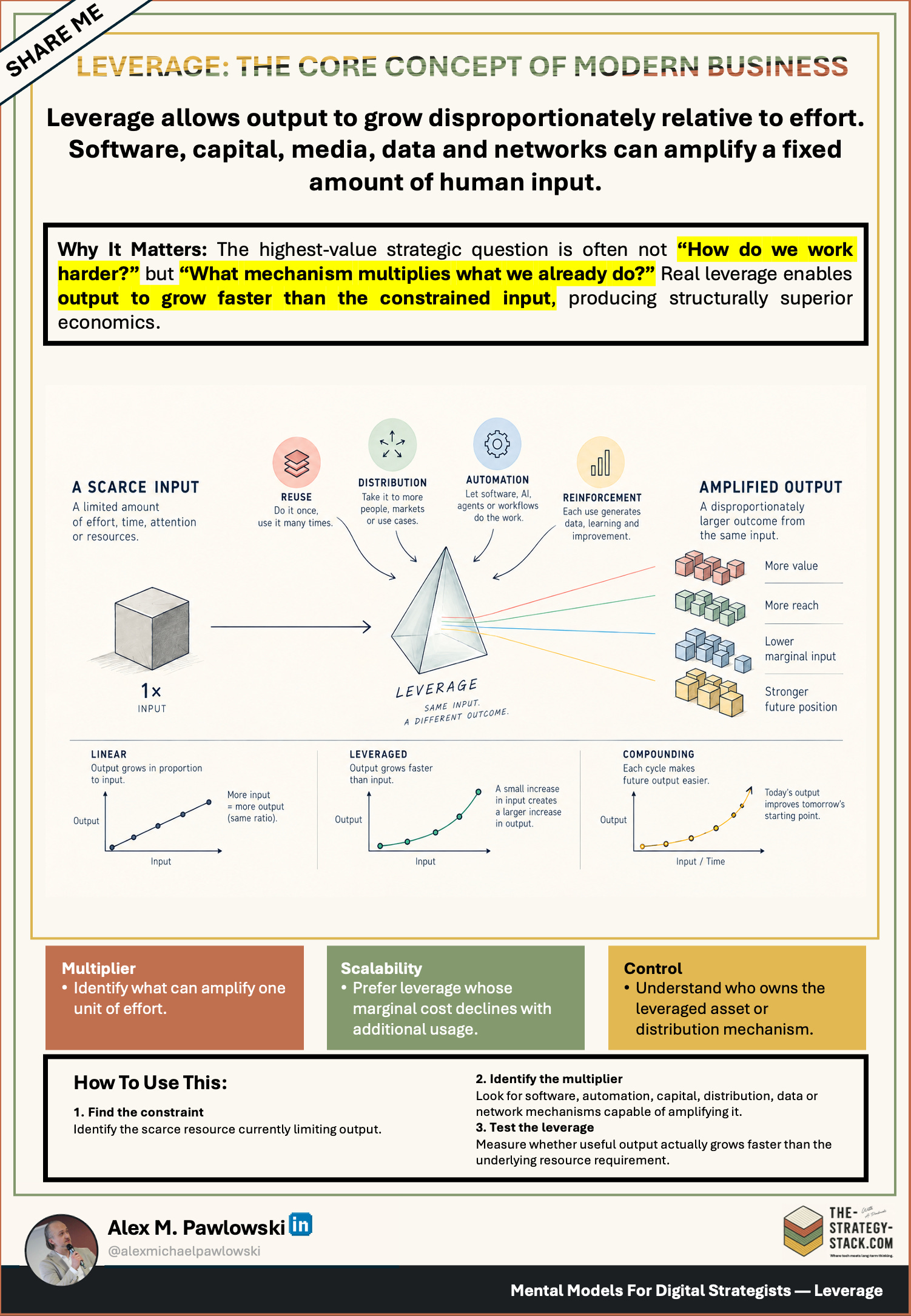
Most strategy conversations still measure input - headcount, hours, budget, intensity.
That is not leverage.
Leverage is the ratio between what you put in and what comes out. A leveraged business produces outcomes that scale faster than the resources required to produce them. An unleveraged business - no matter how talented - trades time for output in roughly linear proportion.
Digital strategy fails when teams optimize the wrong side of the equation: more people on linear work, more content without distribution leverage, more capital on assets that do not compound, more AI features without intelligence leverage in the model itself.
The first mental model every digital strategist needs is not a framework. It is a reflex: before any investment, ask which lever you are pulling - and whether it multiplies.
The Four Levers (And the Fifth)
Code leverage - build once, run infinitely
Software, automation, APIs, and agent workflows. Marginal cost of the next transaction approaches zero. Code leverage is why a small team can serve millions - and why technical architecture is strategic, not operational.
Media leverage - create once, distribute repeatedly
Content, courses, templates, brand assets, audience infrastructure. Media decouples production from distribution when you own the channel. Without owned distribution, media leverage leaks to platforms that capture the audience.
Capital leverage - deploy money to accelerate compounding assets
Funding growth, acquiring distribution, buying capability, underwriting inventory. Capital multiplies when it funds assets with increasing returns — not when it subsidizes broken unit economics indefinitely.
Labor leverage - coordinate human output through systems
Teams, agencies, contractors, partnerships. Labor is the least scalable lever in isolation - but essential when paired with code, media, or capital that multiplies what each person produces.
Intelligence leverage - the emerging fifth lever
Models, decision systems, personalization engines, agent orchestration. Intelligence leverage compounds when learning loops close - when each interaction improves the next outcome. Bolt-on AI features without loop closure is labor with better autocomplete.
The strategic question is never how hard are we working? It is which lever are we pulling - and does it reinforce the others?
Where Leverage Leaks
Leverage collapses predictably when:
-
Linear work scales linearly - hiring solves capacity but not multiplication; headcount grows with revenue instead of ahead of it
-
Code without distribution - product built, nobody finds it; engineering leverage without media or network leverage
-
Media without ownership - audience built on rented platforms; every algorithm change resets the asset
-
Capital without returns logic - growth spend that buys users who churn; subsidies mistaken for strategy
-
Labor without systems - heroic individuals replace architecture; knowledge lives in people, not workflows
-
Intelligence without feedback - models deployed without capture of outcomes; inference cost without compounding advantage
The diagnostic: if doubling team size would roughly double output, you are not leveraged - you are staffed.
Signals in Practice
Basecamp / 37signals - extreme code leverage with minimal headcount; product philosophy explicitly rejects linear scaling of people relative to revenue.
MrBeast - media leverage through repeatable content systems, then capital leverage to reinvest in production infrastructure; audience ownership converts views into multiple business lines.
Stripe - code leverage at the API layer; intelligence leverage in fraud and routing that improves with transaction volume; capital leverage optional because product leverage is sufficient.
The pattern: leveraged businesses decouple revenue growth from proportional resource growth. Unleveraged businesses hit a ceiling where every incremental dollar requires incremental cost.
Pulling the Right Lever
1. Audit current leverage mix
Where does revenue actually come from? Map each revenue stream to its primary lever. Most firms discover they are 80% labor-leveraged with code and media as support functions - not strategic assets.
2. Test marginal economics
What happens to cost when volume doubles? If unit cost stays flat or falls, you have leverage. If unit cost rises, you have congestion - not scale.
3. Stack levers deliberately
Code + media (product-led content). Code + intelligence (learning systems). Media + capital (audience acquisition at positive ROI). Levers that reinforce multiply; levers that compete cannibalize.
4. Eliminate anti-leverage work
Identify tasks that scale linearly with growth and ask: can code, media, or intelligence absorb this? Founder time on reversible low-impact decisions is anti-leverage.
5. Measure leverage, not activity
Replace vanity metrics with leverage diagnostics: revenue per employee, cost per transaction trend, audience growth vs content production ratio, model accuracy improvement per thousand inferences.
Diagnostic questions:
-
Which lever produces 80% of your strategic advantage - and which lever absorbs 80% of your resources?
-
If you stopped hiring for twelve months, would revenue stall or continue compounding?
-
Where is intelligence deployed - and does each deployment close a learning loop?
👉 Unlock the Strategy Stack
…and access the Business Model Series, advanced Cheat Sheets, the Operator Vault, and various essays at the intersection of strategy and technology.
In this series →
https://thestrategystack.substack.com/p/mental-models-for-digital-strategists
Read next →
https://thestrategystack.substack.com/p/compounding-momentum
Go deeper →