Inversion - thinking backward to find the truth: why asking how to fail produces clearer strategy than asking how to succeed
By Alex Pawlowski
Published: 2026-09-17
URL: https://thestrategystack.substack.com/p/inversion-thinking
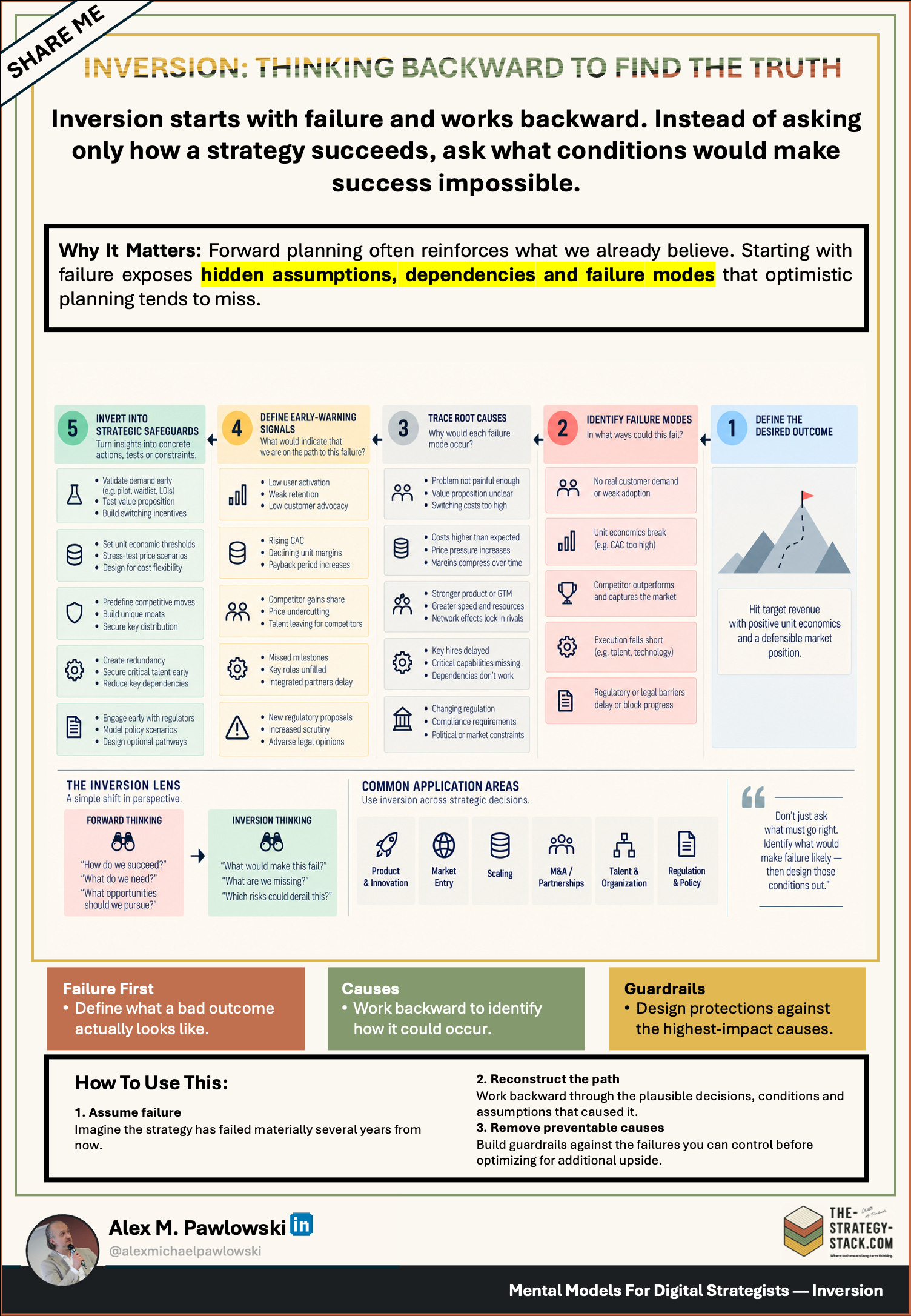
Strategy workshops start with ambition.
What do we want? Where could we be in three years? What would success look like? Forward planning has its place - but it is vulnerable to narrative bias, optimism, and incentive distortion. The deck that wins approval is rarely the plan that survives contact with reality.
Inversion flips the question.
Instead of “How do we win?” ask ”How do we guarantee failure?” - then remove those paths. Charlie Munger built a career on this: invert, always invert. Not because success is unknowable, but because failure modes are often clearer, more enumerable, and less flattering than success paths.
Digital strategists operating in complex systems - platforms, AI integration, portfolio bets - need inversion as a standard lens, not a crisis tool.
The Munger Lens
Inversion works because:
Failure is overdetermined - many paths lead to ruin; success often requires several conditions to align
Incentives hide risk - forward plans authored by advocates understate downside; inverted analysis surfaces what nobody wants to present
Avoiding stupidity beats seeking brilliance - many strategic gains come from not doing obviously wrong things
Complexity favors negation - easier to identify what will not work than to prove what will
The practice: before committing resources, run a pre-mortem as default - assume the initiative failed in eighteen months; list why; address root causes before launch.
Failure First: Common Strategic Inversions
Invert typical digital strategy questions:
| Forward question | Inverted question |
|---|---|
| How do we grow faster? | What would make growth unsustainable? |
| How do we win this market? | What would guarantee we lose despite effort? |
| How do we integrate AI? | How would AI deployment destroy trust or margin? |
| How do we build a platform? | What would make us an irrelevant intermediary? |
| How do we scale the team? | What hiring pattern would make us slow and expensive? |
| How do we raise capital? | What funding terms would foreclose our best paths? |
Each inverted answer produces avoidance rules - often more actionable than aspirational goals.
Where Forward-Only Planning Breaks
Inversion reveals blind spots when:
-
Success metrics are defined but failure signatures are not - teams celebrate progress toward goals while early warning signals go unmonitored
-
Assumptions are implicit - inverted analysis forces assumption surfacing because failure requires naming what must not break
-
Consensus suppresses dissent - pre-mortems give permission to articulate risks without being labeled negative
-
Complexity exceeds modeling capacity - forward models multiply assumptions; inverted lists focus on kill conditions
-
Hero narratives dominate - founder charisma substitutes for structural avoidance of known failure modes
The diagnostic: if your planning process cannot produce a credible ”how we fail” document, it is not rigorous - it is advocacy.
Signals in Practice
Buffett’s investment discipline - emphasis on avoiding permanent capital loss before seeking upside; inversion at portfolio level: what would make this investment irredeemable?
Amazon’s “working backwards” - press release before product; invert from desired customer outcome to required capabilities; failure defined as launching something customers would ignore
Security and reliability engineering - threat modeling inverts from attacker success conditions; fix paths that guarantee breach rather than hoping for perfect defense
Restaurants that fail predictably - wrong location, wrong unit economics, wrong labor model; inversion checklist would flag most before lease signing; survivors often avoided obvious failure modes rather than executing brilliant forward plans
The pattern: durable outcomes often reflect subtraction - fewer failure paths remaining - not maximal forward optimization.
Working Backward in Practice
1. Pre-mortem every major bet
Assume failure in 12–18 months. Each stakeholder writes reasons independently. Cluster themes. Address top three before proceeding.
2. Maintain a “guaranteed failure” list
Organizational habits that historically destroy value: over-hiring ahead of product-market fit, platform dependency without owned audience, pricing below cost to win logos, etc. Review quarterly.
3. Invert KPIs
For each success metric, define the anti-metric - the signal that you are on the failure path. Monitor both.
4. Ask “what must be true?”
Forward plans hide assumptions. Invert: what if the opposite of our key assumption were true? Does the plan survive?
5. Use inversion in competitive analysis
Instead of “how do we beat them?” ask “what would they do if they wanted to eliminate us?” - then defend those attack paths.
Diagnostic questions:
-
If this initiative failed, what would the post-mortem say - and have you addressed those causes in advance?
-
What three things would guarantee failure in your market - and are you accidentally doing any of them?
-
Does your team feel safe articulating failure paths - or only success narratives?
👉 Unlock the Strategy Stack
…and access the Business Model Series, advanced Cheat Sheets, the Operator Vault, and various essays at the intersection of strategy and technology.
In this series →
https://thestrategystack.substack.com/p/mental-models-for-digital-strategists
Read next →
https://thestrategystack.substack.com/p/second-order-effects
Go deeper →