Compounding - the mathematics of momentum: why linear effort produces linear results, how small advantages multiply, and what kills the curve before it bends
By Alex Pawlowski
Published: 2026-09-17
URL: https://thestrategystack.substack.com/p/compounding-momentum
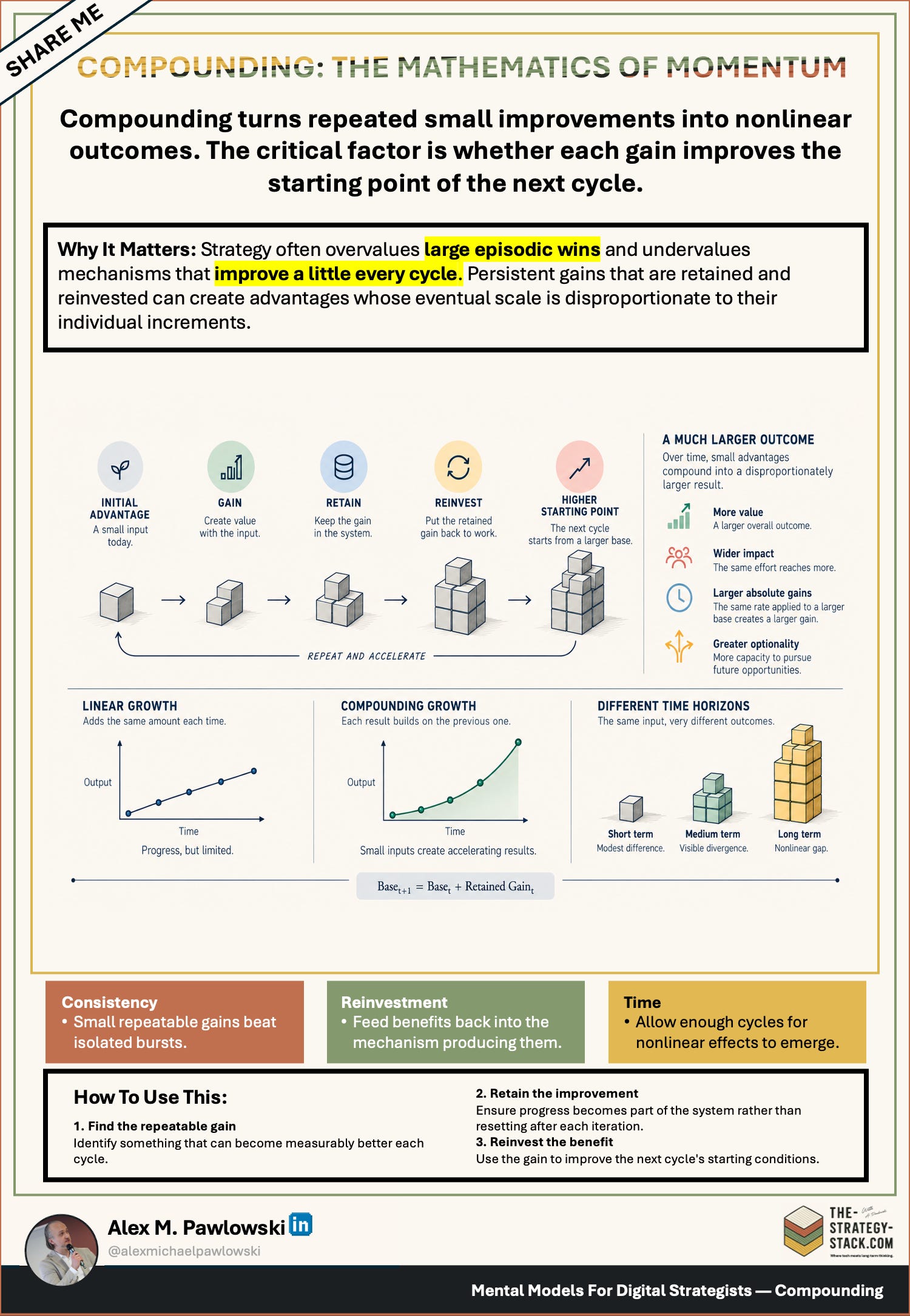
Strategy decks love hockey sticks.
What they rarely show is what feeds the curve - the mechanism that turns today’s output into tomorrow’s input. Without reinvestment, growth is arithmetic: add 10% this year, add 10% next year, hope the line looks impressive on a slide.
Compounding is different. Each cycle leaves the system stronger than the last - audience that attracts audience, data that improves product, product that retains users who generate more data. The math is exponential because the base grows between periods.
Digital strategists who miss compounding optimize quarters. Those who design for it optimize loops.
The Reinvestment Principle
Compounding requires three conditions:
1. A surplus that can reinvest
Something must accumulate: users, data, capital, reputation, capability, content library, network density. No stock, no compound.
2. A feedback path from output to input
The surplus must flow back into the system that produced it - not leak to partners, churn out, or sit idle in dashboards. Open loops produce spikes. Closed loops produce curves.
3. Time at positive rate
Compounding is patient. Early periods look flat - the curve bends only after enough cycles at a consistent reinvestment rate. Teams that abandon loops before the bend never see exponential behavior.
The formula is simple: Value(t+1) = Value(t) × (1 + r) where r is the reinvestment rate and t is time. Strategy is the design of r — and the protection of the loop that sustains it.
Linear Traps That Look Like Growth
Compounding fails when growth is additive but not multiplicative:
-
Paid acquisition without retention - new users replace churned users; the base never grows; CAC compounds against you
-
One-off wins - viral moments, PR spikes, launch surges that do not convert to repeatable systems
-
Feature shipping without learning capture - velocity without feedback; each release starts from zero insight
-
Revenue without margin reinvestment - top-line growth that funds overhead instead of assets that compound
-
Content without audience ownership - impressions on rented platforms; no stock accumulates under your control
-
Data without decision integration - analytics that inform slides but not product, pricing, or matching logic
The diagnostic: ask whether this quarter’s success automatically improves next quarter’s starting position. If not, you have activity - not compounding.
Signals in Practice
Amazon - flywheel logic explicit in investor communications: selection drives traffic, traffic drives sellers, sellers drive selection. Each cycle reinvests into infrastructure that lowers cost and improves experience - compounding across decades.
Netflix - content investment funded by subscriber base; subscriber base funded by content quality and recommendation data; data improves matching which improves retention which funds more content. Broken loops (content cost without retention) show up immediately in the curve.
Early-stage SaaS with negative churn - expansion revenue from existing accounts exceeds churn; net revenue retention above 100% means the base compounds even without new logos. The opposite - high churn - is anti-compounding regardless of new sales velocity.
Creator who posts without list building - views compound on the platform’s graph, not the creator’s asset. Algorithm change resets the curve to zero.
The pattern: compounding businesses can point to the loop - what stock accumulates, what reinvests, what rate they sustain. Non-compounding businesses point to effort metrics.
Designing for Momentum
1. Name your stock
What accumulates in your business? Users, data, content, reputation, capital, capability? If you cannot name it, you cannot compound it.
2. Trace the reinvestment path
Follow one unit of surplus. Where does it go? Does it improve the next cycle - or exit the system?
3. Measure net retention, not gross adds
Gross new customers hide churn. Net revenue retention, cohort retention, and repeat engagement reveal whether the base compounds.
4. Protect the rate
Compounding is fragile at small r. One broken quarter of reinvestment - layoffs that kill product quality, policy changes that spike churn - flattens the curve for years.
5. Patience as strategy
Choose loops that compound over horizons your competitors abandon. The bend rewards those who sustain r when results look linear.
Diagnostic questions:
-
What stock did your business accumulate in the last twelve months - and did it reinvest automatically?
-
If you stopped all acquisition spend tomorrow, would revenue grow, flatline, or decay?
-
Which strategic choice last year improved this year’s starting position - not just this year’s outcome?
👉 Unlock the Strategy Stack
…and access the Business Model Series, advanced Cheat Sheets, the Operator Vault, and various essays at the intersection of strategy and technology.
In this series →
https://thestrategystack.substack.com/p/mental-models-for-digital-strategists
Read next →
https://thestrategystack.substack.com/p/optionality-infinite-games
Go deeper →