Asymmetric bets - high upside, low downside: how to structure strategic decisions so being wrong is survivable and being right is transformative
By Alex Pawlowski
Published: 2026-09-17
URL: https://thestrategystack.substack.com/p/asymmetric-bets
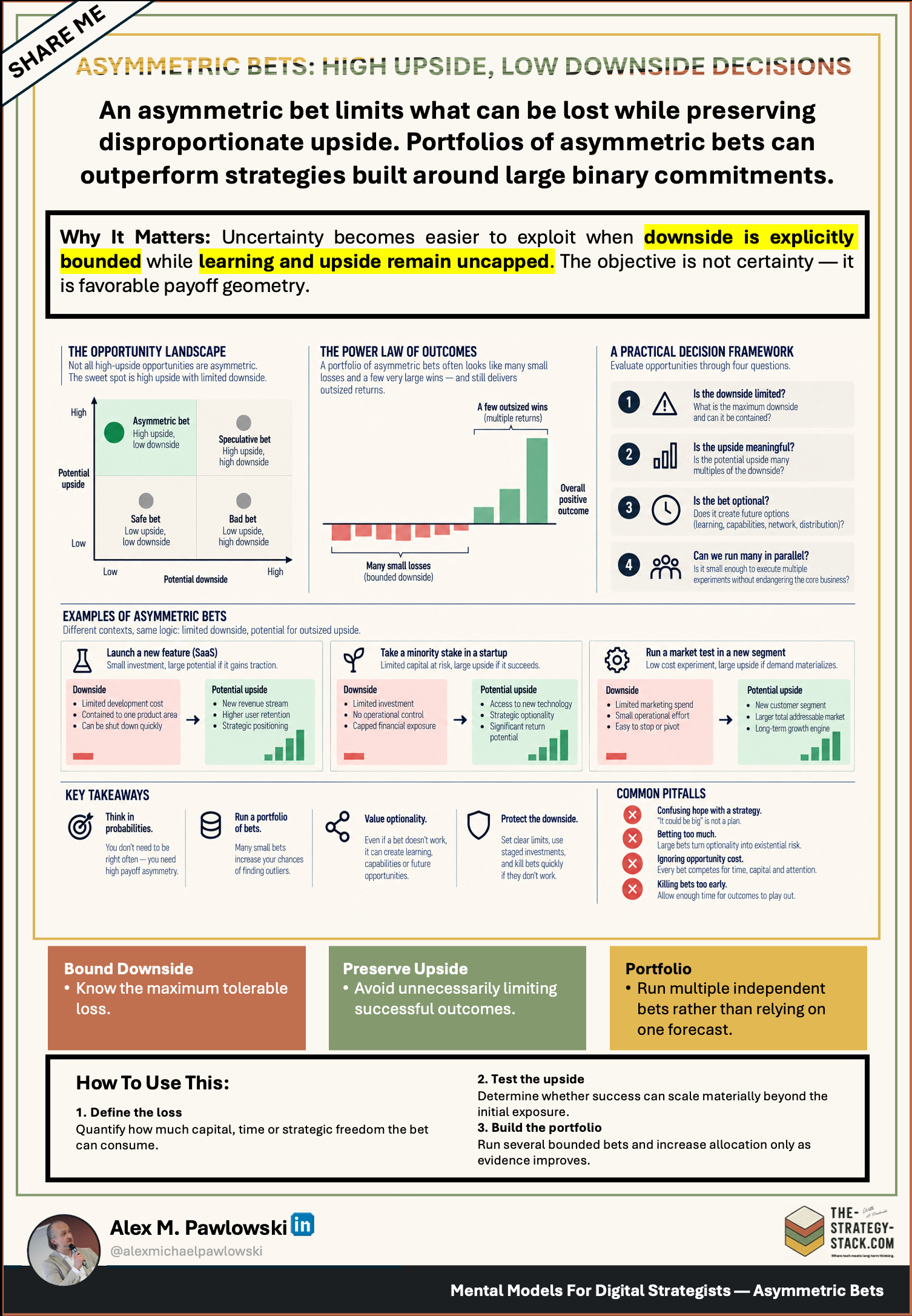
Strategy culture conflates bold with symmetric risk.
Bet the company. All-in on the vision. Burn the boats. Narratives that sound courageous often describe exposed downside - if the thesis is wrong, recovery is impossible. That is not bravery. It is poor bet structure.
Asymmetric bets invert the geometry.
Downside is bounded - you can be wrong and remain in the game. Upside is convex - if the thesis is right, payoff grows nonlinearly. Venture capital, R&D portfolios, and strategic optionality all assume asymmetry. Most corporate strategy accidentally builds symmetric exposure: moderate upside, catastrophic downside if wrong.
Digital strategists need asymmetry as a design constraint - not a personality trait.
Upside Geometry
Symmetric bet - gain and loss scale similarly; coin flip with real assets
Launch one product into one market with full organizational commitment; success and failure both determine survival.
Asymmetric bet - loss capped relative to gain potential
Pilot in one segment with reversible investment; success scales across segments; failure costs a quarter of runway, not the firm.
Asymmetry sources in digital strategy:
-
Reversibility - experiments before irreversible commitments
-
Stage-gated investment - capital releases on signal, not upfront
-
Portfolio structure - many small bets, few large commitments only after proof
-
Platform optionality - infrastructure that enables multiple paths if any one thesis fails
-
Learning value - even failed bets produce capability or data that improves next bet
The question is not “how much can we win?” It is ”how much can we lose if we are wrong - and how large is the payoff if we are right?”
Downside Caps Worth Building
Asymmetry requires explicit loss limits:
-
Time-boxed exploration - six-week sprint, not multi-year roadmap without validation
-
Capital ceilings - fixed budget per bet; no automatic escalation without new approval
-
Reversible architecture - modular systems that can unwind without rewriting the stack
-
Narrative discipline - avoid public commitments that make pivot psychologically or reputationally impossible
-
Dependency limits - no single customer, platform, or partner above survivable concentration threshold
Without caps, “experiment” becomes slow-motion commitment - asymmetric in rhetoric, symmetric in exposure.
Where Bet Structure Collapses
Asymmetric portfolios fail when:
-
Every bet is “strategic” - nothing is small enough to fail cleanly; organizational ego attaches to all initiatives
-
Escalation bias - sunk cost drives continued investment past cap; asymmetry erodes into symmetry
-
Hidden correlation - multiple “independent” bets share same platform risk, customer segment, or macro exposure
-
Upside truncation - structures that cap downside also cap upside through over-governance - false asymmetry
-
Success defined as not failing - bets that avoid loss but never produce convex win; portfolio of safe mediocrity
The diagnostic: if being wrong on your current initiative would end the game, you are not running an asymmetric bet - you are running a survival gamble.
Signals in Practice
Venture capital portfolio - many investments go to zero; a few return fund; explicit asymmetry in model; LPs accept loss rate for tail exposure.
Amazon’s bet portfolio - AWS, Kindle, Marketplace - multiple asymmetric experiments; failures (Fire Phone) survivable because core generated option funding; winners transformed the firm.
Google X / moonshots (ideal form) - capped investment, stage gates, kill criteria; asymmetry depends on discipline to actually kill - often the failure mode.
Corporate “innovation lab” without caps - symmetric exposure: budget consumed, political capital spent, no convex wins; looks like R&D, behaves like slow burn.
Founder second product - asymmetric when validated on subset before full pivot; symmetric when abandoning working business for unproven thesis without staged proof.
The pattern: asymmetric organizations survive enough wrong bets to be present when convexity arrives.
Portfolio Asymmetry in Practice
1. Size bets to survivable loss
Define maximum acceptable loss per bet as fraction of runway, reputation, or core business stability - before defining expected return.
2. Separate exploration from exploitation
Different governance, metrics, and kill criteria for asymmetric experiments vs core operations. Do not measure pilots with production KPIs.
3. Require explicit kill triggers
Pre-commit conditions that end the bet - not “we’ll revisit.” Asymmetry needs automatic downside caps, not committee courage.
4. Map correlation across bets
Stress test: what single event kills multiple bets simultaneously? Platform ban, funding winter, key person loss?
5. Reserve convex slots
Portfolio capacity for bets with nonlinear upside - not every initiative deserves equal weight; power law returns require asymmetric allocation.
Diagnostic questions:
-
If your top strategic bet failed completely, would you still be in the game with attractive options?
-
Which current initiatives have capped downside - and which are secretly all-in?
-
Are you building a portfolio of asymmetric bets - or a single symmetric gamble dressed as a roadmap?
👉 Unlock the Strategy Stack
…and access the Business Model Series, advanced Cheat Sheets, the Operator Vault, and various essays at the intersection of strategy and technology.
In this series →
https://thestrategystack.substack.com/p/mental-models-for-digital-strategists
Read next →
https://thestrategystack.substack.com/p/network-effect-map
Go deeper →