How to classify decisions by reversibility and impact, assign rights, and stop treating every call like it needs a board meeting
By Alex Pawlowski
Published: 2026-09-16
URL: https://thestrategystack.substack.com/p/decision-operating-system
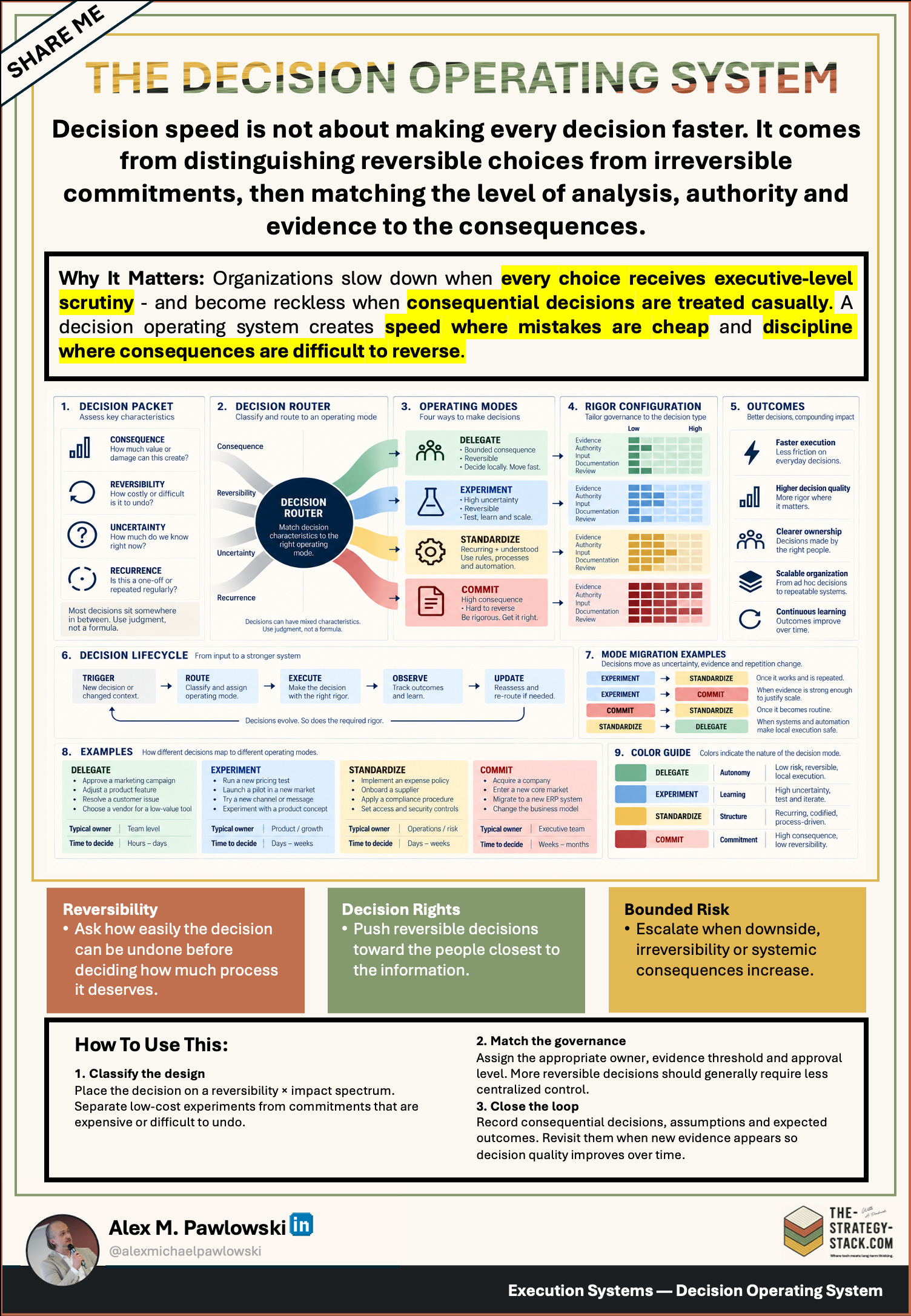
Most execution bottlenecks are not capacity problems.
They are decision routing problems - every call treated with the same weight, the same stakeholders, and the same approval chain. Reversible experiments wait for irreversible scrutiny. Low-stakes choices clog the calendar. High-stakes bets get made in Slack threads because the formal process only handles the trivial.
A decision operating system fixes the classification layer first. Before you optimize how teams decide, you define what kind of decision each call is - and who has authority to make it at what speed.
The Two Axes That Matter
Reversibility - can you undo it?
Reversible decisions: pricing tests, copy changes, feature flags, channel experiments, hiring trials, vendor pilots. Wrong calls cost learning, not survival. Speed beats consensus.
Irreversible decisions: equity structure, core architecture commitments, market exits, regulatory positions, key executive hires, brand pivots. Wrong calls compound. Deliberation beats velocity.
Impact - what breaks if you’re wrong?
Low impact: internal tooling, non-customer-facing workflows, reversible experiments with bounded blast radius.
High impact: customer trust, unit economics, legal exposure, strategic positioning, capital allocation.
The operating system lives in the intersection:
-
Reversible + low impact → decide fast, delegate fully, document lightly
-
Reversible + high impact → decide fast, but instrument outcomes and set review triggers
-
Irreversible + low impact → deliberate, but don’t over-staff the room
-
Irreversible + high impact → full process: explicit assumptions, dissent capture, defined owner, commit record
Most organizations invert this - slow on experiments, fast on bets that deserve scrutiny.
Where Decision Systems Collapse
Decision operating systems fail predictably when:
-
No classification - every request becomes a meeting because nobody knows if it’s reversible
-
Founder as universal approver - the only decision right that exists is “ask the CEO”
-
Consensus as default - reversible calls wait for alignment that learning would resolve faster
-
Irreversible calls in async - major bets made without explicit assumption records or dissent
-
Decision rights on org charts, not workflows - titles imply authority the system never defined
-
No commit record - decisions get re-litigated because nobody wrote down what was decided and why
The diagnostic: count how many decisions last week required the same person. If one name appears on everything, you have a routing problem - not a talent problem.
Building Your Decision OS
1. Inventory recurring decision types
List the 15–20 decisions your team makes repeatedly: pricing, hiring, feature priority, spend approval, partnership terms, content publish, escalation paths.
2. Classify each on both axes
For each type: reversible or not? Low or high impact? Be honest - most teams over-classify impact because ambiguity feels safer than speed.
3. Assign decision rights
Who decides? Who must be consulted? Who gets informed after? One owner per decision type - not a committee with veto power disguised as collaboration.
4. Define speed tiers
Tier 1: same-day for reversible/low.
Tier 2: one review cycle for reversible/high.
Tier 3: structured process for irreversible/high. Publish the tiers so nobody guesses.
5. Require commit records for Tier 3 only
Assumption, decision, owner, review date. Lightweight for Tier 1–2; non-negotiable for bets you cannot unwind.
Diagnostic questions:
-
Can your team classify any incoming decision in under 60 seconds?
-
Which reversible decisions still wait for you — and what would break if you delegated them this week?
-
When did you last make an irreversible call without writing down the assumption you were betting on?
👉 Unlock the Strategy Stack
…and access the Business Model Series, advanced Cheat Sheets, the Operator Vault, and various essays at the intersection of strategy and technology.
In this series →
https://thestrategystack.substack.com/p/execution-systems-collection
Read next →
https://thestrategystack.substack.com/p/execution-loops
Go deeper →